Market Summary
Executive Summary and Global Market Analysis
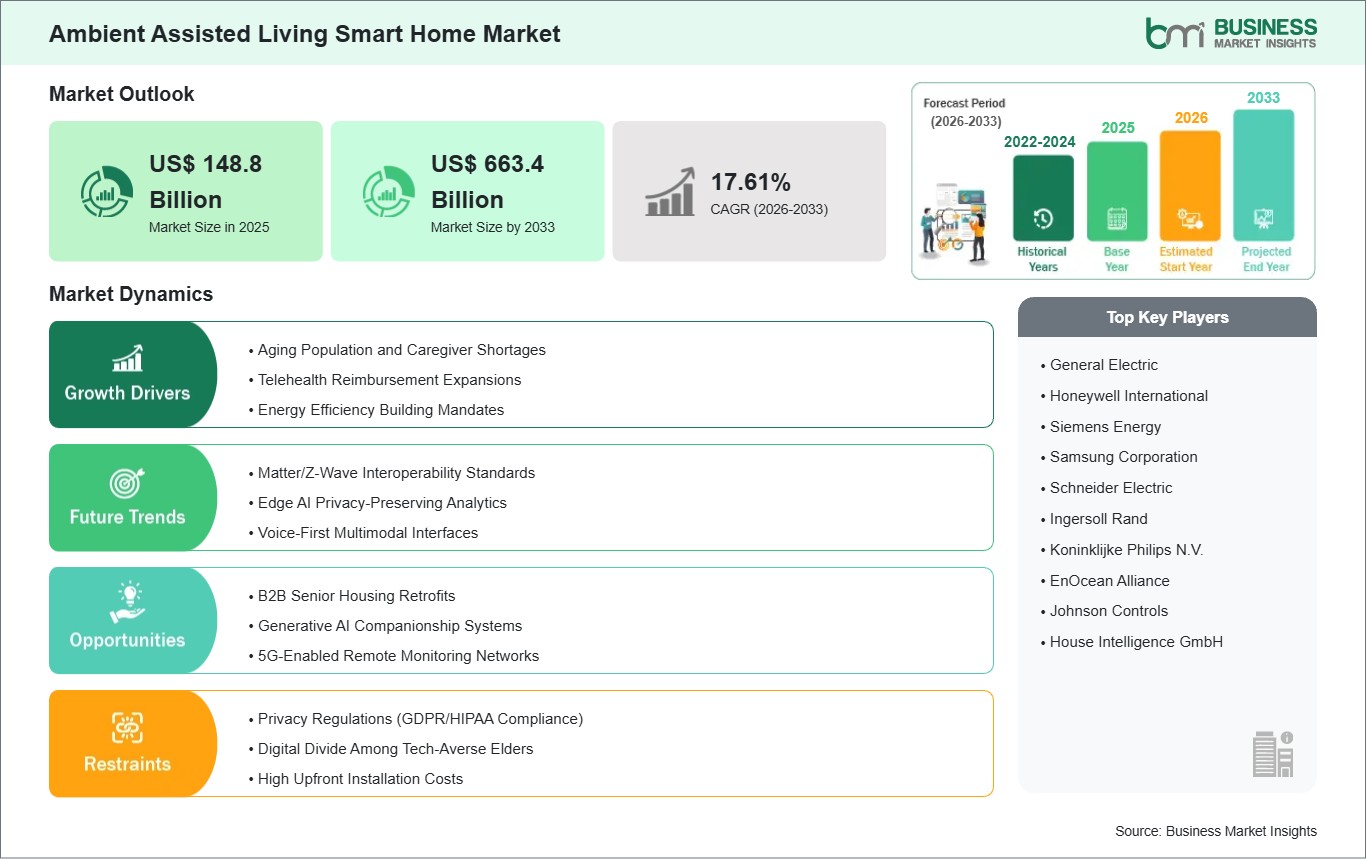
The global ambient assisted living smart home market primarily offers IoT sensors, AI analytics, and voice interfaces to enable senior people to age independently in their homes. The systems keep track of the residents’ vital signs, carry out their daily routines automatically, and, in the case of an emergency, inform the caregivers through a cloud-edge hybrid. Such systems include fall detection alert devices, medication dispensers, and lighting that adjusts the level of brightness. Major features include AI that is non-intrusive and privacy-preserving, 5G for the low, latency performance, and Matter/Zigbee for seamless interoperability, thus making AAL the mainstay of a silver economy and a significant contributor to the healthcare cost reduction.
The market is witnessing rapid growth owing to the aging demographic (1B+ over, 65 by 2030), post-COVID telehealth becoming a normal part of life, and the existing energy efficiency requirements, while at the same time, there is a shortage of caregivers. The adoption is further being supported by the use of such technologies in Japanese and other EU assisted living facilities, expansion of Medicare in the US for remote monitoring. In contrast, edge ML chips are helping users reduce their subscription dependency. Other issues include data sovereignty, GDPR/HIPAA compliance, and the digital divide, especially for elders who are not very tech-savvy. There is potential to be unlocked through generative AI companions, federated learning privacy, and B2B retrofits for 100M+ aging households.
Segment Analysis
Ambient Assisted Living Smart Home Market Segmentation
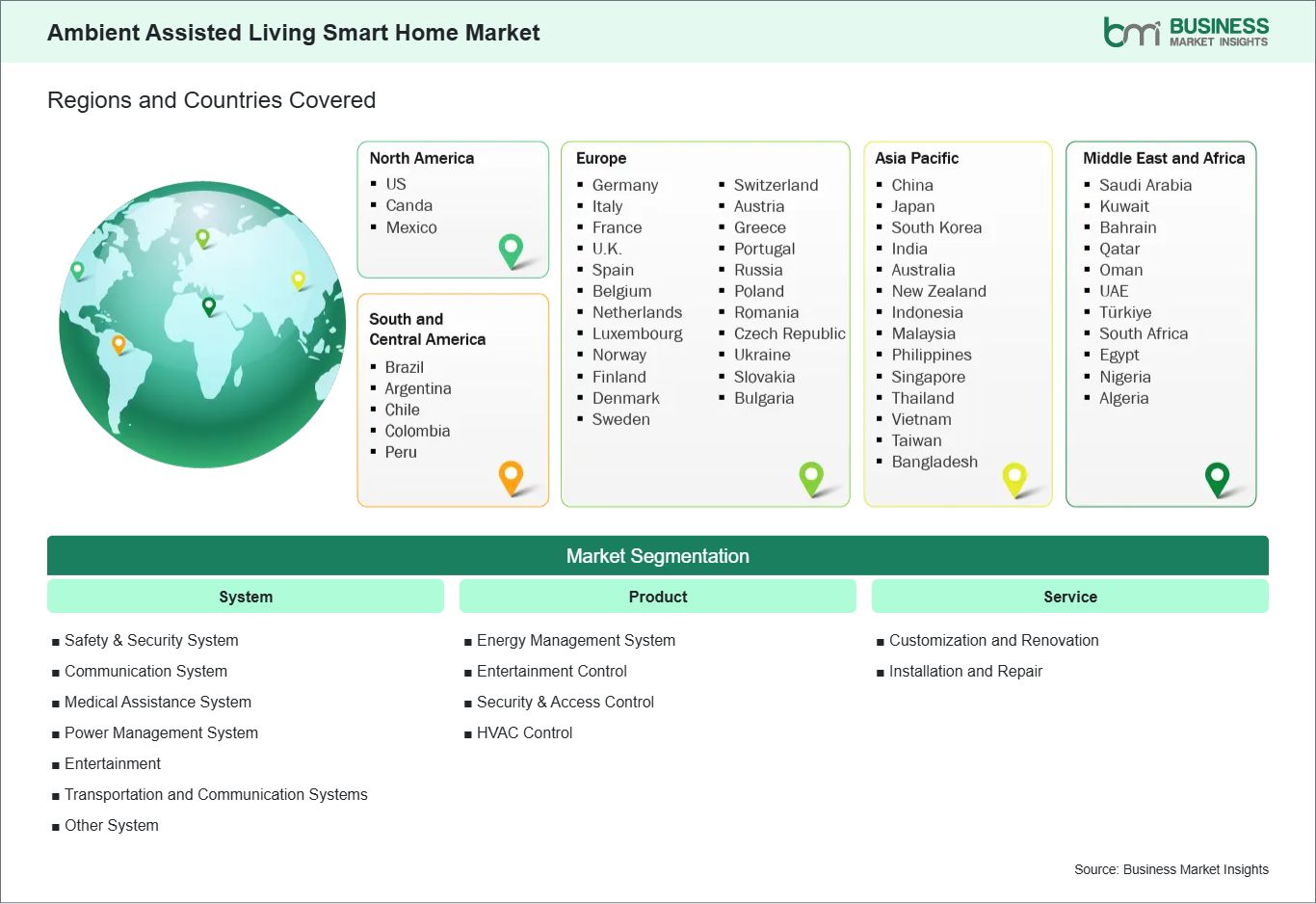
Key segments shaping the global ambient assisted living smart home market include system, product, and service.
- By system, the market segments into Safety & Security System, Communication System, Medical Assistance System, Power Management System, Entertainment, Transportation and Communication Systems, and Others. The Safety & Security System segment dominated in 2024, vital for fall prevention.
- By product, divisions cover Energy Management System, Entertainment Control, Security & Access Control, and HVAC Control. The Security & Access Control segment led in 2024, enabling autonomous entry.
- By service, segments are Customization and Renovation, Installation and Repair. The Installation and Repair segment held the top share in 2024, supporting ongoing maintenance.
Market Forces
Ambient Assisted Living Smart Home Market Drivers and Opportunities
Aging Demographics and Telehealth Integration Drive Adoption
An explosive silver tsunami and the normalization of telehealth are two major factors that drive the popularity of ambient assisted living smart homes. This comes as governments will most likely prioritize aging-in-place to save more than $1 trillion in institutional costs. Safety systems such as radar-based fall detectors from Essence Group and Hikvision, capable of linking to Apple Watch alerts, have managed to reduce ER visits by 40% as per EU ActiveAssistive Living pilots. In comparison, Asia Pacific eldercare mandates have resulted in 15% annual retrofits and a backlog of 20M+ units by 2030.
As US CMS reimbursements lead the way, Medicare@Home deployments will be accelerated, and such deployments will combine medical assistance wearables with power management for medication adherence in areas with contested caregiver labor markets. Privacy silos are the best performance environment for Edge TPUs. At the same time, upgrading of legacy analog homes will unleash fast revenues, which will allow AAL to be zero-touch wellness facilitators, for instance, to prevent dementia wandering and to cater to multi-generational households.
Energy Efficiency Mandates Unlock B2B Retrofit Opportunities
Net, zero building codes together with B2B senior housing networks will be the key to unlocking HVAC/energy products that have the potential of serving 50M+ aging residences. Open Matter standards are the ones that bring together Google Nest and Philips Hue for voice, adaptive lighting, which has the effect of cutting utility bills by 30% as compared with legacy thermostats for AARP pilots. Consumer mandates such as the EU Green Deal will have the effect of raising security & access while bringing the cost of NFC locks down to below $100/unit. In contrast, transportation systems will merge with Uber Assist to allow for autonomous shuttles. Neuromorphic chips reduce the footprints to 1cm, resulting in a decrease of BOMs by 45% for retrofit kits. Entertainment verticals are taking advantage of Amazon Echo Show to provide AR companionship services that are in line with the WHO healthy aging frameworks. These catalysts position integrators for $50B contracts through 2034, evolving AAL into federated AI ecosystems, fortifying elder independence and family resilience.
Size and Share Analysis
Ambient Assisted Living Smart Home Market Size and Share Analysis
By system, the global ambient assisted living smart home market segments into Safety & Security System, Communication System, Medical Assistance System, Power Management System, Entertainment, Transportation and Communication Systems, and Others. The Safety & Security System segment dominated in 2024. Fall detection prevents 70% ER visits; regulatory mandates drive caregiver alert adoption.
By product, segments are Energy Management System, Entertainment Control, Security & Access Control, and HVAC Control. The Security & Access Control segment led in 2024. Autonomous caregiver entry is critical for 24/7 monitoring in aging-in-place scenarios.
By service, divisions include Customization and Renovation, Installation and Repair. The Installation and Repair segment held the largest share in 2024. Ongoing maintenance is essential for 95% sensor uptime in eldercare deployments.
Report Coverage
Ambient Assisted Living Smart Home Market Report Coverage and Deliverables
The "Ambient Assisted Living Smart Home Market Size and Forecast (2022–2033)" report provides a detailed analysis of the market covering below areas:
- Ambient assisted living smart home market size and forecast at global, regional, and country levels for all the key market segments covered under the scope
- Ambient assisted living smart home market trends, as well as market dynamics such as drivers, restraints, and key opportunities
- Ambient assisted living smart home market analysis covering key market trends, global and regional framework, major players, regulations, and recent market developments
- Industry landscape and competition analysis covering market concentration, heat map analysis, prominent players, and recent developments for the Ambient Assisted Living Smart Home market
- Detailed company profiles, including SWOT analysis
Geographic Insights
Ambient Assisted Living Smart Home Market Geographic Insights
The geographical scope of the ambient assisted living smart home market report is divided into five regions: North America, Asia Pacific, Europe, the Middle East & Africa, and South & Central America. The ambient assisted living smart home market in North America registered the highest market share in 2024.
North America is at the forefront of healthcare through Medicare Advantage expansions and AARP demonstration projects, divided into the US, Canada, and Mexico. US installations show a rapid increase, with the Amazon CareHub fall detection system being part of over 10 million senior households. In contrast, in Canada, provinces such as Ontario require smart home pilot projects as part of their Aging at Home plans. Mexico's social security program IMSS is introducing medical assistance wearables for older adults in rural areas. Europe is making significant steps in the use of privacy, first, GDPR, compliant systems, with initiatives such as Germany's Telecare 4.0 and the UK's NHS remote monitoring contracts serving over 2 million patients. France's Silver Valley innovation clusters are focused on developing power management automation, and the Nordic countries are launching entertainment-based cognitive therapy platforms. The Middle East is setting up high-end elder villas fitted with comprehensive security automation systems through developments like Dubai Silicon Oasis and the Saudi Red Sea Project, with a focus on voice-controlled access systems. Asia Pacific is dramatically expanding via Japan's Society 5.0 concept and China's 15th Five-Year Plan eldercare priorities, rapidly, medical assistance wearables are being scaled. Still, the region lags behind Western markets in terms of entertainment integration and Matter protocol adoption. South & Central America are focusing on public housing retrofits driven by Brazil's elderly pension programs and Chile's SENAMA smart home subsidies. All regions are putting their main focus on Matter, compatible, HIPAA/GDPR, compliant edge AI modules that are 5G caregiver network optimized, and also privacy frameworks based on federated learning.
Industry Activity
Recent Developments
The ambient assisted living smart home market is evaluated by gathering qualitative and quantitative data post-primary and secondary research, which includes important corporate publications, association data, and databases. A few of the key developments in the ambient assisted living smart home market are:
- In June 2025, hellocare.ai, a leading AI-assisted virtual care delivery platform transforming hospital care models and operations, today announced it has entered into a collaboration with Mayo Clinic focused on ambient clinical intelligence. This technology could allow for a more proactive approach to healthcare, potentially reducing hospitalizations and severity of illness, and improving patient quality of life.
- In May 2024, Electronic Caregiver, a leading provider of digital health technology and service solutions, and Cognitive Systems Corp., creators of the world’s leading Wi-Fi Sensing technology, announced a partnership to distribute CareAware™, a WiFi MotionTM-based sensing solution, to enhance the aging-in-place experiences for older adults and caregivers.
Trust & Transparency
Research Methodology
The market analysis combines proprietary research with secondary data from government agencies, company disclosures, regulatory filings, industry databases and expert interviews. Market estimates are validated through data triangulation, cross-market benchmarking and analyst
review.
View Full Research Methodology
Key Sources Referred:
AARPEuropean Innovation Partnership on Active and Healthy AgeingWHO Age-Friendly CitiesInternational Energy AgencyWorld Bank – Global Trade IndicatorsWorld Trade Organization (WTO)International Trade Administration (ITA)Company websitesCompany annual reportsCompany investor presentations