
Actuators Market Outlook: Size, Share, Trends, Growth Analysis, Competitive Landscape & Forecast, 2026-2033

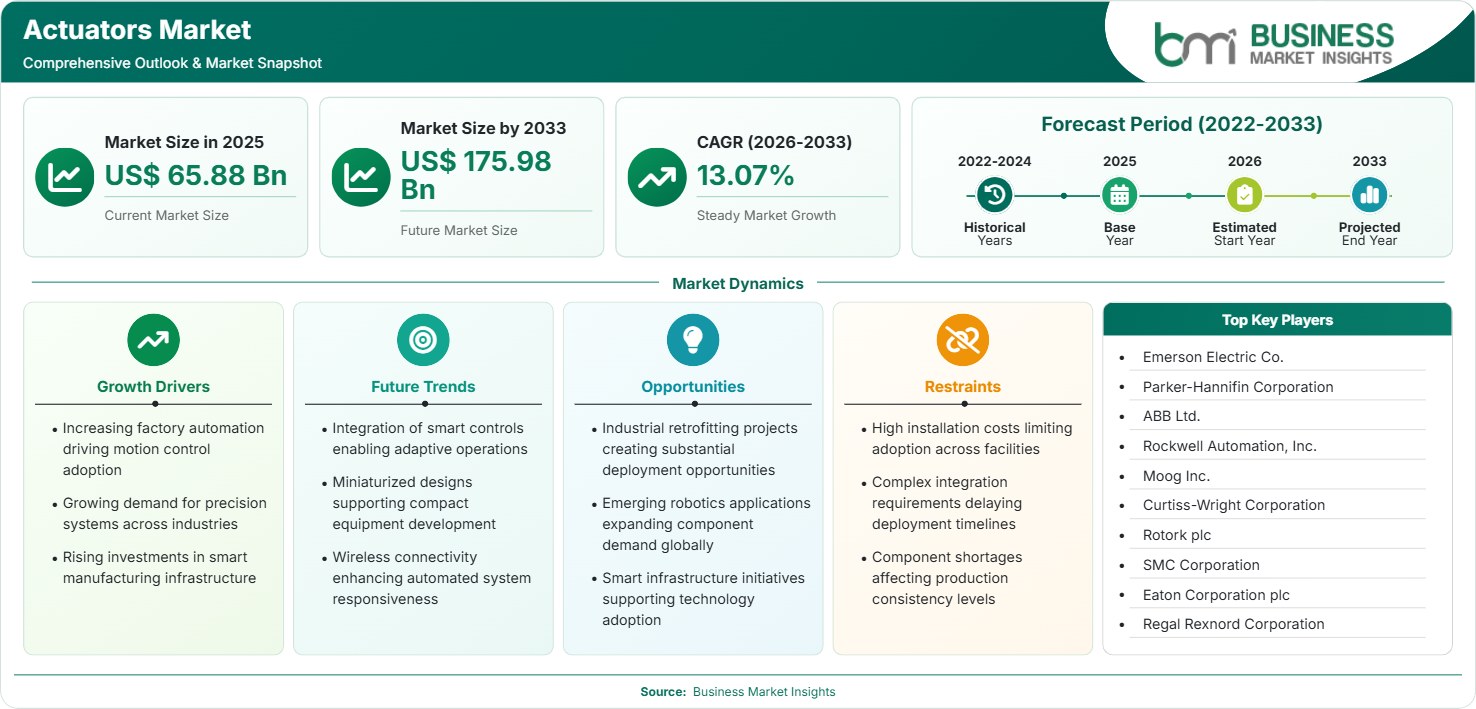
The Actuators Market size was valued at US$ 65.88 Billion in 2025 and is projected to reach US$ 175.98 Billion by 2033, growing at a CAGR of 13.07% during 2026–2033, driven by industrial automation, vehicle electrification, smart manufacturing, aerospace modernization, and demand for energy-efficient motion control.

Report Coverage
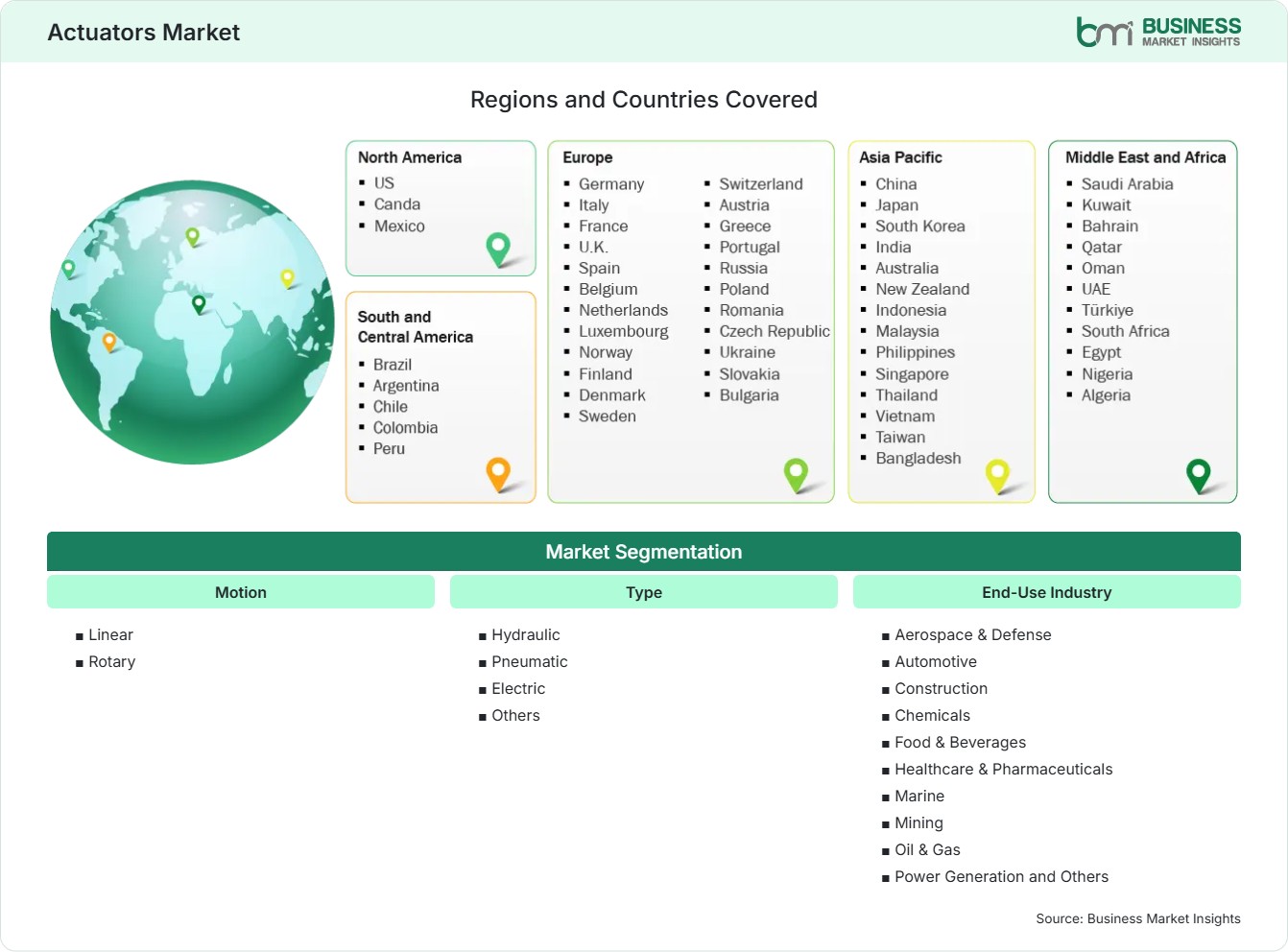
  • Motion: Linear, Rotary
  • Type: Hydraulic, Pneumatic, Electric, Others
  • End-Use Industry: Aerospace & Defense, Automotive, Construction, Chemicals, Food & Beverages, Healthcare & Pharmaceuticals, Marine, Mining, Oil & Gas, Power Generation and Others
US$ 65.88 Bn Market size in 2025
US$ 175.98 Bn Market Size by 2033
13.07% CAGR, 2026 - 2033
2026-2033 Forecast Period

AI Overview

Actuators Market Summary

  • North America Region: holds 30%–34% Actuators Market share in 2025, growing at 11.5%–12.5% CAGR, influenced by factory automation, aerospace programs, defense modernization, electrification, process control upgrades, and demand for intelligent motion systems.
  • Fastest Growing Region: Asia Pacific holds a 29%–33% share in 2025, growing at 14.0%–15.5% CAGR, supported by robotics, electronics manufacturing, electric vehicles, infrastructure investment, industrial automation, and expanding production capacity.
  • Leading Segment: Linear motion holds 43%–47% share in 2025, growing at 12.0%–13.0% CAGR, supported by robotics, material handling, automated assembly, machine tools, medical equipment, and precise positioning requirements.
  • High Growth Segment: Electric actuators hold a 29%–33% Actuators Market share in 2025, growing at 15.0%–17.0% CAGR, driven by electrification, digital controls, lower maintenance, precision positioning, cleaner operation, and Industry 4.0 integration.
  • Key Market Opportunity: Intelligent actuators combining embedded sensing, connectivity, diagnostics, and software create premium revenue opportunities across smart factories, autonomous equipment, electric mobility, energy infrastructure, and aerospace platforms.
  • Major Market Players: Emerson Electric Co., Parker-Hannifin Corporation, ABB Ltd., Rockwell Automation, Inc., Moog Inc., Curtiss-Wright Corporation, Rotork plc, SMC Corporation, Eaton Corporation plc, and Regal Rexnord Corporation.
Strategic Insights

Actuators Market: Strategic Insights

Actuators Market Strategic Framework
FREE PDF
Request your free sample
Request free sample
Stakeholder View

Key Takeaways

  • The value chain is moving toward integrated solutions in which actuator manufacturers increasingly combine mechanical transmission, motors, electronics, sensors, firmware, diagnostics, and service capabilities. This raises switching costs and favors suppliers with broad engineering portfolios.
  • Electric actuation provides the strongest expansion opportunity because it aligns with factory digitization, vehicle electrification, robotics, medical automation, and clean industrial equipment. Suppliers capable of replacing fluid-power systems with high-force electromechanical alternatives can address premium applications.
  • Roller-screw mechanisms, electrohydrostatic systems, integrated servo motors, smart position feedback, condition monitoring, and predictive diagnostics are reshaping product development. Manufacturers are prioritizing higher power density, smaller footprints, longer operating life, and easier digital commissioning.
  • Asia Pacific provides the strongest investment case because robotics deployment, electronics production, automotive manufacturing, and industrial capacity expansion are concentrated in China, Japan, South Korea, and India. IFR data confirms Asia's dominant position in industrial robot deployment.
  • Consolidation is increasingly focused on adding complementary automation, valve-control, electrification, and intelligent motion capabilities. ABB's 2026 agreement to acquire Rotork illustrates the strategic value of combining electrification and automation portfolios with mission-critical flow-control technologies.
  • Buyers increasingly evaluate total lifecycle economics rather than initial actuator price. Energy consumption, maintenance intervals, diagnostics, integration effort, cybersecurity readiness, spare-parts availability, and compliance increasingly influence purchasing decisions.
Geographic Outlook

Actuators Market Regional Highlights

North America Actuators Market

North America accounts for 30%-34% of the global actuator market share in 2025 and is expected to grow at a 11.5%-12.5% CAGR through 2033. North America gains on account of modernization in aerospace, defense expenditure, manufacturing processes, power infrastructure development, and upgrade of existing industrial equipment. United States is the major country market within the region due to a strong presence of aerospace, automotive, power, and industrial automation sectors.

  • US industrial automation investment supports demand for precision linear and rotary systems across machine tools, packaging, robotics, and material handling, while aerospace programs sustain high-value actuator requirements.
  • Canada provides opportunities in mining, energy, aerospace, and industrial equipment, where rugged hydraulic and electrohydraulic architectures remain relevant for high-load and harsh-environment applications.
  • Mexico benefits from automotive manufacturing expansion and nearshoring, creating demand for pneumatic, electric, and servo-based systems used in assembly, welding, material handling, and vehicle production.
  • North American buyers increasingly require condition monitoring, remote diagnostics, functional safety, and interoperability with industrial control platforms, supporting premium pricing for connected actuator architectures.

US Actuators Market

The US accounts for about 77%–82% of overall demand in North America in 2025, and its demand is expected to grow at a 11.5%–12.5% CAGR through 2033. The diversified applications of actuators are because of the country’s manufacturing sector, aerospace, defense procurement, data centers, energy infrastructure, and investments in industrial automation. Future manufacturing investments are increasingly focused on servo applications and feedback systems. The use of actuators in aerospace and defense needs reliable actuators that can function effectively in difficult environments.

  • Aerospace and defense remain high-value applications because electromechanical, hydraulic, and electrohydraulic actuators support flight controls, weapon systems, launch vehicles, landing systems, and precision positioning.
  • Automotive production increasingly uses electric motion systems as factories automate battery, powertrain, inspection, welding, and material-handling processes, supporting demand for high-cycle and digitally controlled products.
  • Oil, gas, power, and chemical facilities continue replacing manual equipment with automated valve-control systems, creating demand for robust rotary actuators, intelligent positioners, and remote diagnostics.

Europe Actuators Market

Europe accounts for around 24% to 27% of global demand in 2025 and is expected to see a 12.0% to 13.0% CAGR in the Actuators Market until 2033. Germany leads demand in the region across sectors such as automotive, machinery, robotics, and process industries, while France and Italy contribute significantly through their aerospace and industrial automation industries. The United Kingdom is still significant in energy, aerospace, and advanced manufacturing.

  • Germany remains the regional leader, supported by advanced machinery, automotive automation, robotics, and factory modernization. Its actuator demand increasingly favors precise electric and servo-driven architectures.
  • France benefits from aerospace and defense manufacturing, where high-reliability electromechanical and hydraulic actuation supports aircraft systems, missile platforms, and industrial test equipment.
  • Italy's machinery, packaging, food processing, and automation industries generate recurring demand for compact pneumatic and electric actuators requiring high cycle rates.
  • The UK provides opportunities in offshore energy, process automation, aerospace, and water infrastructure, with intelligent valve-control systems supporting modernization programs.

Asia Pacific Actuators Market

The Asia-Pacific region will account for 29%-33% of worldwide demand in 2025, registering a compound annual growth rate of 14.0%-15.5% until 2033. The Chinese economy is the leading consumer in the Asia-Pacific region, followed by Japan and South Korea, with India emerging as a high growth market. According to IFR data for 2024, 74% of all global robot installations were in Asia.

  • China remains the largest regional demand center because of its automotive, electronics, semiconductor, machinery, and industrial robotics ecosystems. Domestic automation capacity is increasing actuator requirements.
  • Japan combines mature robotics expertise with sophisticated automotive and electronics production, supporting high demand for precision electric, servo, and compact motion-control solutions.
  • South Korea benefits from semiconductor, electronics, automotive, and battery manufacturing, where high repeatability and clean operation favor electrically driven positioning systems.
  • India is emerging as a high-growth market through manufacturing localization, automotive investment, infrastructure development, pharmaceuticals, food processing, and expanding industrial automation adoption.
  • Southeast Asian economies are attracting electronics and automotive manufacturing investments, creating additional demand for pneumatic and electric actuators across newly automated production facilities.

Rest of World Actuators Market

Rest of World contributes to around 11%-15% of worldwide demand in 2025 and is expected to record a 13.5%-15.0% CAGR in the Actuators Market during 2033. South & Central America benefit from their mining operations, food processing, automotive manufacturing, and energy investments. Brazil continues to lead in the region, and Saudi Arabia and the UAE drive growth in the Middle Eastern market through their industrial diversification, energy investments, and infrastructure development.

In recent times, Middle Eastern demand has become more dependent on automation in oil & gas plants, water facilities, renewable energy developments, and petrochemical processing. In Latin America, the use of actuators is largely limited to the mining, food & beverage, automotive, and industrial processing industries.

  • Brazil combines mining, agricultural processing, energy, automotive, and manufacturing applications, creating demand for hydraulic, pneumatic, and electric actuator configurations.
  • Saudi Arabia is expanding industrial automation alongside energy diversification, supporting intelligent valve actuation across petrochemical, water, power, and infrastructure projects.
  • The United Arab Emirates provides opportunities in energy, marine, logistics, water treatment, and smart infrastructure, with increasing demand for connected automation systems.
  • South American mining operations favor rugged high-force systems capable of handling dust, vibration, temperature variation, and continuous duty cycles.
Global Market Geography
FREE PDF
Request your free sample
Request free sample
Segment Analysis

Actuators Market Segmentation

Motion

Motion is considered one of the key segmentation parameters, with linear systems expected to account for 43%-47% of market share by 2025, with a CAGR of 12.0%-13.0% from 2025 to 2033. Linear actuators benefit from the automation of systems, robotics, material handling, machining, and precise positioning, whereas rotary systems play an important role in valves, steering, industrial machines, and processing equipment. Actuators Market share increasingly reflects the expansion of automated motion architectures across manufacturing and infrastructure.

  • Linear: Linear actuators provide controlled straight-line movement for robotics, machine tools, packaging, medical equipment, material handling, and automated assembly, with demand supported by precision and repeatability requirements.
  • Rotary: Rotary actuators support valve control, robotic joints, industrial machinery, aerospace mechanisms, and vehicle systems, benefiting from automation upgrades requiring accurate angular positioning and reliable torque delivery.

Type

Type segmentation becomes increasingly dependent on electrification and digitization processes. The share of electric actuators is forecast to be around 29%-33% in 2025 and to expand at a CAGR of 15.0%-17.0% through 2033. However, hydraulic and pneumatic types still have their strengths when force density, speed, robustness, or infrastructure considerations outweigh the need for higher efficiency.

  • Hydraulic: Hydraulic actuators deliver high force and torque for construction, mining, aerospace, oil and gas, marine, and heavy industrial equipment where compact high-power output is essential.
  • Pneumatic: Pneumatic actuators remain important for fast repetitive movements in packaging, food processing, assembly, and material handling because compressed-air infrastructure is widely established.
  • Electric: Electric actuators offer precise positioning, digital control, lower maintenance, and cleaner operation, accelerating adoption in robotics, automated production, electric mobility, and smart industrial equipment.
  • Others: Mechanical and hybrid configurations continue serving specialized applications where simplicity, redundancy, environmental tolerance, or compatibility with existing machinery outweigh the advantages of newer architectures.

End-Use Industry

The end-use industry as a whole determines the actuator specifications for force, speed, environment, reliability, and certifications. In terms of demand, the automotive and aerospace industries continue to dominate, while there is diversification in construction, chemicals, health care, food processing, marine, mining, oil & gas, and power generation. The scope of the actuators market is growing due to automation.

  • Aerospace & Defense: High-reliability actuation supports flight controls, landing systems, weapon platforms, launch vehicles, spacecraft, and precision mechanisms requiring stringent qualification and lifecycle performance.
  • Automotive: Automated assembly, vehicle controls, electrification, thermal management, braking, seating, and production equipment support broad actuator demand as vehicle architectures become increasingly electronically controlled.
  • Construction: Excavators, cranes, concrete equipment, access platforms, and automated building machinery require high-force hydraulic and increasingly electrohydraulic solutions for demanding operating conditions.
  • Chemicals: Process plants require reliable valve actuation for flow regulation, isolation, pressure management, and hazardous-area operations where diagnostics and functional reliability are critical.
  • Food & Beverages: Hygienic designs support filling, packaging, conveying, sorting, and processing equipment, with electric and pneumatic technologies favored for repeatability and washdown compatibility.
  • Healthcare & Pharmaceuticals: Actuation enables medical beds, laboratory automation, imaging systems, drug-production equipment, and packaging machinery where precision, cleanliness, and controlled movement are required.
  • Marine: Ship steering, propulsion support, valve control, deck equipment, and offshore systems demand corrosion resistance, high reliability, and operation under vibration and harsh environmental conditions.
  • Mining: Mining equipment requires high-force systems for excavation, crushing, material handling, conveyors, and processing, favoring rugged hydraulic and electrohydraulic technologies.
  • Oil & Gas: Actuators control valves and flow systems across upstream, midstream, and downstream facilities, with increasing demand for intelligent diagnostics and electric alternatives.
  • Power Generation: Turbine bypass, steam, cooling, fuel, and process-control systems use precision actuation to regulate flows and support reliable plant operation.
Market Forces

Actuators Market Dynamics

Key Market Drivers

Industrial automation is increasing precision motion requirements

The growth of automation technology is increasing the number of robotic cells, automated assembly machines, machining centers, packaging equipment, and material-handling systems that use repeated, controllable movements. In the 2024 IFR report, there were 542,076 industrial robots in operation, with Asia accounting for 74% of installations. The market growth, therefore, depends more on the automation budget than on replacement cycles alone. A servo actuator system consists of the drive, motor, positioning feedback, and the mechanical transmission system. It is also easier to commission and monitor the conditions of an integrated actuator. The market for actuators is therefore becoming inclined towards devices that can interface with PLCs, motion controllers, industrial networks, and supervisory systems. Suppliers with application engineering expertise can add more value by offering motion-systems solutions.

Vehicle electrification is expanding electronically controlled motion

Electrification of the automotive industry is causing significant changes in actuator requirements across fields such as propulsion, thermal management, braking, steering, seating, charging, and manufacturing. Global sales of electric vehicles exceeded 20 million in 2025, representing 25% of global car sales, according to the IEA. The electrified architectures involve more electric control functionality and, in some instances, fewer mechanical connections. This results in growing demand for compact electric actuators suitable for positioning applications and silent operation. In addition, automotive factories require automated motion systems for handling batteries, module assembly, inspection, welding, and end-of-line testing. The result is demand for actuators from both the vehicle and factory sides. The Actuators Market growth thus benefits from the dual trends of electrification of vehicles and of manufacturing processes.

Smart actuation is raising product value beyond mechanical movement

Connectable actuators are now being developed as data-producing units rather than simple mechanical units. The embedded sensors that provide position, torque, pressure, and temperature readings, along with networking and diagnostic software, help operators detect abnormal system performance before it breaks down. For instance, the Rotork 2025 RTP-4000 intelligent valve positioner introduced contactless position feedback and pressure-sensor diagnostic features for both linear and rotary valve applications. These help reduce troubleshooting time and support predictive maintenance programs. Manufacturers will be able to optimize cycle profiles, monitor wear, and perform maintenance based on actual conditions rather than predetermined periods by using data from operating systems. Consequently, the actuators market trends is moving towards modularity, in which electronics and software are engineered alongside the mechanical system.

Key Market Opportunities

Electric replacement of fluid-power systems

Substitution of selected hydraulic and pneumatic systems with electromechanical equivalents presents a significant opportunity for suppliers as customers focus on energy savings, cleanliness, accuracy, and maintenance. Electromechanical actuators powered by electrical power can generate high force without hydraulic pumps, tanks, lines, or liquids. One example of such products is presented in the Curtiss-Wright Exlar product range, which includes actuators designed as substitutes for hydraulic and pneumatic actuators. The best fit for this type of product is plants with repeating cycles and digital positioning requirements. Some of the good applications for this technology are aerospace, packaging, food processing, machine tools, and automated material handling applications. For successful adoption of the solution, suppliers should offer engineering solutions, mechanical integration, controls integration, and retrofits rather than individual products.

Intelligent valve automation for energy infrastructure

Oil and gas, water, chemicals, power generation, and emerging hydrogen infrastructure require increasingly automated flow control. Intelligent actuators can provide remote positioning, diagnostic information, asset health data, and reduced maintenance requirements, making them attractive for unmanned or difficult-to-access facilities. Rotork supplied more than 200 actuators for the fully electrified N05-A offshore gas platform in the Netherlands, combining intelligent electric and electrohydraulic technologies with an automated operating architecture. Actuators Market Forecasts can therefore benefit from capital spending on electrified process facilities and remote operations. Vendors that combine actuator hardware with positioners, communications, analytics, and lifecycle services can address a larger portion of project budgets while strengthening recurring service revenue.

Localized manufacturing and application engineering in emerging markets

Manufacturing localization offers actuator suppliers the opportunity to establish regional capabilities in turning, engineering, testing, and service. The reason India is a special choice for the study is that investment in automation technologies spans sectors such as automotive, pharmaceuticals, food processing, electronics, renewable energy, railways, and infrastructure. For instance, ABB Company decided to invest around $75 million in India in 2026. Other localization projects in South-east Asia and the Middle East may decrease delivery times and improve customer service. Suppliers that localize their large-scale product lines, but leave centralized engineering for more sophisticated applications, will become more competitive.

Market Restraints and Challenges

High engineering and lifecycle requirements constrain standardization

Factor: The actuators are used under a wide variety of loads, speeds, temperatures, pressures, contamination levels, duty cycles, and safety environments, hence needing specific design and validation. Impact: Custom design will increase the costs of design, inventory management, testing, and time-to-market, especially in sectors such as aerospace, defense, medical, offshore, and hazardous industrial markets. Electric conversion may sometimes necessitate not only changes to components but also a redesign of the mechanism. Customers might need new installation mechanisms, controls, power supplies, safety features, and software interfaces prior to making any technological change. These considerations might delay even if a superior alternative is available that reduces energy usage. Thus, what manufacturers must have are standardized motor, sensor, communication, and control systems that maintain application flexibility.

Supply-chain exposure affects precision components and electronics

Factor: Actuators rely on motors, bearings, gears, magnets, sensors, semiconductors, seals, power electronics, special materials, and precision-machined parts, which are sourced through global supply chains. Impact: Any issues with availability or pricing may increase manufacturing costs, prolong lead times, and restrict the delivery of complex actuator assemblies. There are certain qualification considerations in aerospace and defense projects that make component substitution difficult. With the growing trend toward smart electric actuators, manufacturers are becoming more vulnerable to shortages of electronics and rare materials. Moog and Niron Magnetics have made an announcement about their cooperation in developing rare earth-free actuator technology until 2025.

Company Analysis

Competitive Landscape

The competitive environment combines diversified automation groups, motion-control specialists, fluid-power suppliers, aerospace actuation companies, and valve-control manufacturers. Actuators Market analysis indicates that competitive differentiation increasingly depends on integrated engineering, digital diagnostics, application support, reliability, and global service coverage rather than actuator hardware alone.

Company Name

Overview

Products and Services relevant to this market

Emerson Electric Co.

Global automation and process-control provider with extensive valve, instrumentation, and industrial automation capabilities.

Fisher control valves, valve actuators, process automation, digital control, instrumentation, diagnostics, and lifecycle services.

Parker-Hannifin Corporation

Diversified motion and control technology supplier serving industrial, aerospace, mobile, and process applications.

Hydraulic and pneumatic cylinders, electromechanical actuators, motion-control systems, aerospace actuation, and fluid-power solutions.

ABB Ltd.

Global electrification and automation company with extensive industrial motion and control capabilities.

Electric motion systems, drives, automation, industrial control technologies, and intelligent process-control solutions.

Rockwell Automation, Inc.

Industrial automation specialist focused on connected manufacturing, motion control, and digital transformation.

Servo motors, drives, motion controllers, integrated automation, industrial networks, and intelligent manufacturing solutions.

Moog Inc.

Precision motion and fluid-control specialist serving aerospace, defense, industrial, marine, and space applications.

Electromechanical, electrohydrostatic, hydraulic actuation, precision motion controls, aerospace systems, and integrated actuation technologies.

Curtiss-Wright Corporation

Engineering company supplying high-performance actuation and control technologies to demanding end markets.

Exlar linear and rotary actuators, intelligent actuation, aerospace systems, defense actuation, and industrial motion solutions.

Rotork plc

Specialist in intelligent flow-control and electric actuator technologies for critical process applications.

Electric actuators, electrohydraulic systems, valve positioners, control systems, diagnostics, and industrial flow-control services.

SMC Corporation

Major pneumatic automation supplier with extensive global manufacturing and distribution capabilities.

Pneumatic actuators, cylinders, valves, air preparation equipment, electric actuators, sensors, and automation components.

Eaton Corporation plc

Diversified power management company with strong hydraulic, aerospace, industrial, and energy capabilities.

Hydraulic actuators, aerospace actuation, fluid conveyance, motion-control technologies, and industrial power-management solutions.

Regal Rexnord Corporation

Motion-control manufacturer serving industrial automation, energy, aerospace, and commercial applications.

Motors, gearboxes, motion-control products, electromechanical systems, and integrated power transmission technologies.

Trust & Transparency

Research Methodology

The market analysis combines proprietary research with secondary data from government agencies, company disclosures, regulatory filings, industry databases and expert interviews. Market estimates are validated through data triangulation, cross-market benchmarking and analyst review.

View Full Research Methodology

Questions Answered

Frequently Asked Questions

What does a report help businesses evaluate?

An Actuators Market Report can help with supplier benchmarking, regional market expansion, product portfolio decisions, application priorities, technology choice, competitive positioning, and investment evaluation based on motion and application types.

What should buyers evaluate when selecting an actuator supplier?

Key criteria include application engineering capability, force and speed performance, operating life, certification, control compatibility, diagnostics, service coverage, spare-parts availability, lead times, and total lifecycle cost.

How is Asia Pacific influencing actuator manufacturing?

Asia Pacific features big-time robotics implementation, vehicle manufacturing, electronic manufacturing, semiconductor investments, and growing industrial capabilities. Consequently, countries such as China, Japan, South Korea, India, and Southeast Asia have a great bearing on both the actuator market and their components.

Which applications offer the strongest opportunity for electric actuation?

Robotics, automated assembly, packaging, machining equipment, medical instrumentation, car manufacturing, aerospace engineering, and specific hydraulic substitution uses provide excellent opportunities since they all need precision positioning and digital control.

What factors are changing actuator technology selection across industrial applications?

Increasingly, buyers look at factors such as accuracy, energy efficiency, diagnostic capabilities, maintenance considerations, total cost of ownership, security, environmental adaptability, and integration into automation systems. This is moving buyers away from mechanics to system performance.

Access the Full Actuators Market Report

Get segment-level forecasts, regional estimates, competitive benchmarking, company profiles and downloadable Excel datasets.

Access the full Actuators Market Report
350 pages PDF & Excel | 2026-09-18
Similar Research

Related Market Reports