
Accelerometer Market Outlook: Size, Share, Trends, Growth Analysis, Competitive Landscape & Forecast, 2022-2033

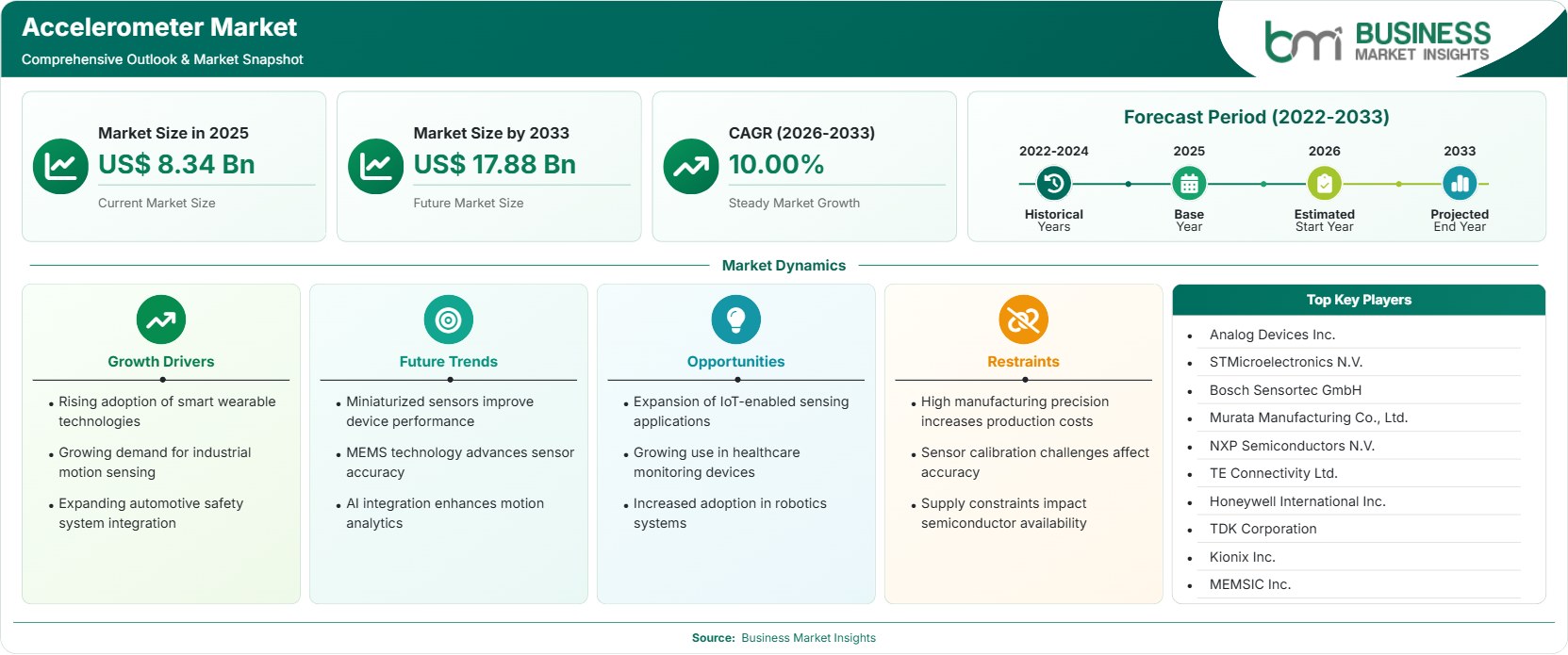
The Accelerometer Market size was valued at US$ 8.34 billion in 2025 and is projected to reach US$ 17.88 billion by 2033, growing at a CAGR of 10.00% during 2026–2033. Rising adoption of smart wearable technologies, growing demand for industrial motion sensing, expanding automotive safety system integration, increasing IoT applications, and advancements in MEMS-based sensing technologies are creating new growth opportunities across automotive, aerospace, consumer electronics, and industrial applications.

Report Coverage
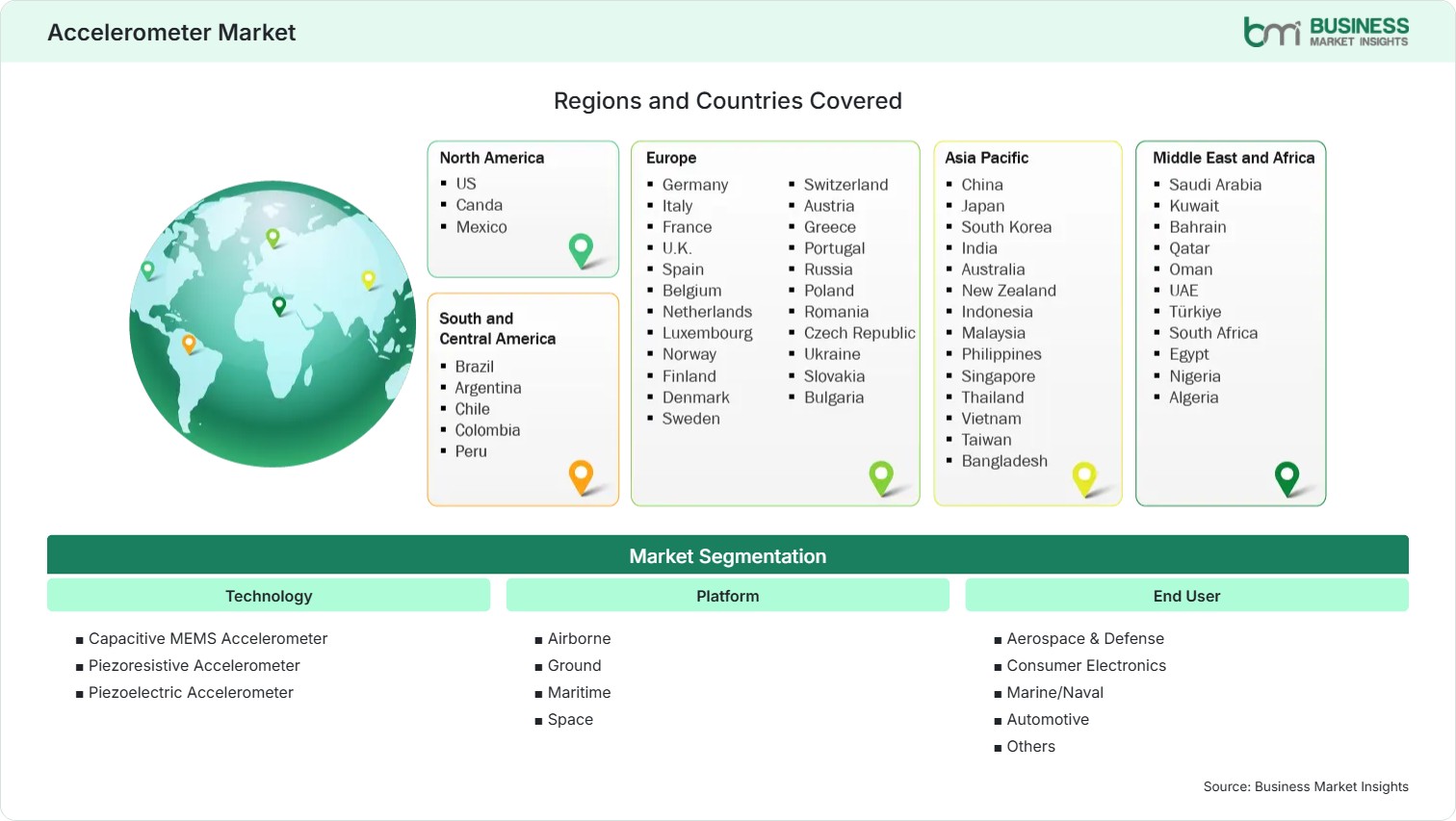
  • Technology: Capacitive MEMS Accelerometer, Piezoresistive Accelerometer, Piezoelectric Accelerometer
  • Platform: Airborne, Ground, Maritime, Space
  • End User: Aerospace & Defense, Consumer Electronics, Marine/Naval, Automotive, Others
US$ 8.34 Bn Market size in 2025
US$ 17.88 Bn Market Size by 2033
10.00% CAGR, 2026 - 2033
2026-2033 Forecast Period

01 AI Overview

Accelerometer Market Summary

  • North America Region: North America holds 32%–35% accelerometer market share in 2025 and is expected to grow at a CAGR of 9.4%–9.8% during 2026–2033. Strong aerospace and defense investments, advanced automotive technology adoption, industrial automation expansion, and increasing demand for precision sensing solutions continue supporting regional development. The United States remains the major contributor due to extensive semiconductor innovation, defense modernization, and automotive safety technology adoption, with an estimated CAGR of 9.5%–9.9% during 2026–2033.
  • Fastest Growing Region: Asia Pacific accounts for 38%–41% accelerometer market share in 2025 and is projected to register a CAGR of 11.2%–11.7% during 2026–2033. Expanding consumer electronics manufacturing, rising automotive production, increasing IoT deployments, and growing semiconductor investments continue accelerating regional market expansion.
  • Leading Segment: Capacitive MEMS Accelerometer represents 55%–58% accelerometer market share in 2025 and is expected to grow at a CAGR of 10.4%–10.8% during 2026–2033. Compact design, low power consumption, high reliability, and broad adoption across smartphones, vehicles, wearables, and industrial devices continue supporting segment leadership.
  • High Growth Segment: Automotive end user accounts for 26%–29% market share in 2025 and is forecast to expand at a CAGR of 11.0%–11.5% during 2026–2033. Increasing adoption of advanced driver assistance systems, vehicle safety technologies, electrification, and autonomous driving platforms continues creating strong demand for acceleration sensing solutions.
  • Key Market Opportunity: Growing integration of accelerometers into IoT ecosystems, healthcare monitoring devices, robotics platforms, and smart infrastructure applications is creating significant opportunities for sensor manufacturers to develop highly accurate, energy-efficient, and connected sensing solutions.
  • Major Market Players: Analog Devices Inc., STMicroelectronics N.V., Bosch Sensortec GmbH, Murata Manufacturing Co., Ltd., NXP Semiconductors N.V., TE Connectivity Ltd., Honeywell International Inc., TDK Corporation, Kionix Inc., and MEMSIC Inc.
02 Strategic Insights

Accelerometer Market: Strategic Insights

accelerometer-market-market-strategic-framework
FREE PDF
Request your free sample
Request free sample
03 Stakeholder View

Key Takeaways

  • The value chain is becoming increasingly interconnected as semiconductor manufacturers, MEMS technology developers, automotive suppliers, electronics producers, and industrial automation companies collaborate to improve sensor performance and accelerate commercialization.
  • Automotive applications represent a major growth opportunity as increasing adoption of advanced driver assistance systems, electric vehicles, autonomous technologies, and vehicle stability systems drives demand for accurate motion sensing components.
  • Innovation is shifting toward compact MEMS-based accelerometers featuring lower power requirements, improved sensitivity, multi-axis measurement capabilities, enhanced durability, and integration with artificial intelligence-enabled monitoring systems.
  • Asia Pacific presents strong investment potential due to expanding electronics manufacturing, semiconductor ecosystem development, automotive production growth, and increasing deployment of IoT-enabled technologies across emerging economies.
  • Strategic partnerships, technology collaborations, and acquisitions among sensor manufacturers and semiconductor companies are supporting portfolio expansion, improving manufacturing capabilities, and accelerating development of advanced sensing platforms.
  • Healthcare and robotics applications are emerging as important demand areas as wearable monitoring devices, rehabilitation equipment, autonomous machines, and intelligent automation systems increasingly require precise motion measurement capabilities.
04 Geographic Outlook

Accelerometer Market Regional Highlights

North America Accelerometer Market

North America accounted for 32%–35% of the Accelerometer Market Share in 2025 and is projected to expand at a CAGR of 9.4%–9.8% during 2026–2033. The region benefits from advanced semiconductor capabilities, strong aerospace and defense spending, rapid automotive technology adoption, and widespread industrial automation. Continuous investment in connected devices, autonomous systems, and smart manufacturing solutions is supporting demand for high-performance acceleration sensors across multiple applications.

  • The U.S. continues driving regional demand through strong aerospace programs, defense modernization initiatives, automotive innovation, and advanced electronics manufacturing capabilities supporting sensor adoption.
  • Increasing integration of accelerometers into electric vehicles and advanced driver assistance systems is encouraging automotive manufacturers to adopt reliable motion sensing solutions for safety applications.
  • Industrial automation growth is accelerating demand for precision sensing technologies used in equipment monitoring, predictive maintenance, robotics, and manufacturing optimization processes.
  • Leading semiconductor companies are investing in MEMS technology development to improve sensor sensitivity, energy efficiency, and miniaturization for next-generation electronic applications.
  • The expansion of healthcare technology adoption is increasing demand for wearable monitoring devices that incorporate compact, accurate motion-sensing components.

US Accelerometer Market

The United States represented 28%–31% of global revenue in 2025 and is forecast to register a CAGR of 9.5%–9.9% through 2026–2033. Strong semiconductor innovation, advanced defense applications, automotive technology development, and increasing industrial automation continue to maintain the country's position as a major market. Growing investments in connected systems and smart devices further support adoption across diverse industries.

  • Aerospace and defense organizations continue integrating advanced acceleration sensors into navigation systems, aircraft platforms, and military equipment requiring high reliability.
  • Consumer electronics manufacturers increasingly adopt MEMS accelerometers for smartphones, wearables, gaming devices, and smart home technologies requiring compact sensing solutions.
  • Automotive companies are expanding the use of accelerometers in safety systems, vehicle dynamics control, and autonomous driving technologies.
  • Research institutions and technology companies continue developing advanced sensor architectures to improve accuracy, response time, and operational efficiency.

Europe Accelerometer Market

Europe held 24%–27% market share in 2025 and is expected to grow at a CAGR of 9.2%–9.7% during 2026–2033. The region benefits from strong automotive manufacturing, industrial automation adoption, aerospace expertise, and increasing investment in smart mobility solutions. Germany leads regional demand with a CAGR of 9.4%–9.8%, while France represents a high-growth country with a CAGR of 9.8%–10.2% due to expanding aerospace and industrial technology applications.

  • Germany maintains regional leadership through advanced automotive manufacturing, industrial automation capabilities, and strong adoption of precision sensing technologies.
  • France continues expanding demand through aerospace innovation, defense technology programs, and increasing deployment of advanced electronic systems.
  • European automotive manufacturers are integrating accelerometers into electric vehicles, autonomous platforms, and advanced safety systems to improve vehicle performance.
  • Increasing focus on Industry 4.0 initiatives is encouraging adoption of motion sensors for equipment monitoring, automation, and predictive maintenance applications.
  • Sustainability initiatives are supporting demand for efficient sensing solutions that improve energy management and operational performance across industrial facilities.

Asia Pacific Accelerometer Market

Asia Pacific accounted for 38%–41% of the market in 2025 and is projected to achieve the highest CAGR of 11.2%–11.7% during 2026–2033. Expanding electronics production, semiconductor manufacturing growth, increasing automotive output, and rising IoT adoption are strengthening regional demand. China leads the market with a CAGR of 11.3%–11.7%, while India is expected to experience the fastest expansion at 11.8%–12.2%.

  • China continues strengthening its semiconductor ecosystem through investments in MEMS manufacturing, consumer electronics production, and automotive technology development.
  • India is experiencing rising demand due to expanding electronics manufacturing, smart device adoption, and increasing investments in industrial automation infrastructure.
  • Japan and South Korea remain important technology hubs supporting innovation in sensor miniaturization, semiconductor design, and advanced electronics applications.
  • Growing electric vehicle production across Asia Pacific is increasing integration of accelerometers into safety, navigation, and vehicle control systems.
  • Expanding IoT deployments across industrial and commercial environments are creating new opportunities for connected sensing solutions.

Rest of World Accelerometer Market

The Rest of World region accounted for a 7%–10% share in 2025 and is expected to expand at a CAGR of 9.8%–10.3% during 2026–2033. South & Central America are witnessing increasing adoption of industrial automation, automotive electronics, and connected devices.

The Middle East & Africa are expanding through smart infrastructure investments, aerospace modernization, and industrial digitization initiatives. Brazil leads South & Central America with a CAGR of 10.0%–10.4%, while the UAE represents a high-growth market in the Middle East with a CAGR of 10.5%–10.9%.

  • Brazil continues adopting advanced sensing technologies across automotive manufacturing, industrial equipment, and consumer electronics applications.
  • The UAE is increasing its investments in smart cities, aerospace systems, and automated infrastructure, which require advanced motion monitoring solutions.
  • Industrial modernization programs across emerging economies are encouraging the adoption of sensors for operational monitoring and equipment optimization.
  • Growing investments in aerospace and defense are creating opportunities for high-performance accelerometers in navigation and control systems.
  • The increasing availability of connected technologies is supporting the broader deployment of motion-sensing solutions across commercial applications.
global-market-geography
FREE PDF
Request your free sample
Request free sample
05 Segment Analysis

Accelerometer Market Segmentation

Technology

The Technology segment represented 61%–64% of the market in 2025 and is projected to grow at a CAGR of 10.2%–10.6% during 2026–2033. Increasing demand for compact, energy-efficient, and highly accurate sensing technologies is driving adoption across consumer electronics, automotive, industrial, and aerospace applications. The Accelerometer Market Forecasts indicate continued expansion as MEMS innovations improve performance, reliability, and integration capabilities.

  • Capacitive MEMS Accelerometer: Widely adopted due to compact size, low power consumption, cost efficiency, and reliable performance across smartphones, vehicles, wearables, and industrial devices.
  • Piezoresistive Accelerometer: Preferred in demanding industrial and aerospace applications because of high durability, strong shock resistance, and reliable measurement performance under extreme conditions.
  • Piezoelectric Accelerometer: Increasingly utilized for vibration monitoring and dynamic measurement applications requiring high-frequency response, accuracy, and operational stability.

Platform

The Platform segment accounted for a 34%–37% share in 2025 and is expected to grow at a CAGR of 9.8%–10.2% during 2026–2033. Increasing adoption of advanced navigation systems, autonomous platforms, and industrial monitoring technologies is strengthening demand across airborne, ground, maritime, and space applications. The Accelerometer Market Trends indicate rising preference for compact and highly reliable sensors.

  • Airborne: Demand is supported by aircraft navigation systems, flight control applications, aerospace research programs, and defense platforms requiring precise acceleration measurement.
  • Ground: Adoption is increasing across automotive systems, robotics, industrial machinery, and transportation applications requiring accurate motion detection and stability monitoring.
  • Maritime: Growth is driven by naval systems, vessel monitoring technologies, underwater platforms, and marine navigation applications requiring reliable sensor performance.
  • Space: Increasing satellite deployment and space exploration activities are creating demand for specialized accelerometers capable of operating under extreme environmental conditions.

End User

The End User segment generated 68%–71% of revenue in 2025 and is forecast to expand at a CAGR of 10.1%–10.5% through 2026–2033. Increasing integration of motion sensing solutions across automotive, aerospace, electronics, and industrial applications continues supporting segment growth. The Accelerometer Market scope is expanding as industries increasingly adopt connected sensing systems for automation and monitoring.

  • Aerospace & Defense: Adoption continues due to navigation systems, aircraft control, military equipment, and precision applications requiring reliable acceleration measurement technologies.
  • Consumer Electronics: Demand is supported by smartphones, wearable devices, gaming systems, and smart home products requiring compact and energy-efficient motion sensors.
  • Marine/Naval: Growth is driven by vessel navigation, maritime monitoring, defense platforms, and advanced marine systems requiring accurate motion detection.
  • Automotive: Increasing integration into safety systems, electric vehicles, autonomous driving platforms, and vehicle control technologies continues accelerating demand.
  • Others: Industrial automation, healthcare devices, robotics, and infrastructure monitoring applications are creating additional opportunities for sensor manufacturers.
06 Market Forces

Accelerometer Market Dynamics

Key Market Drivers

Rising adoption of smart wearable technologies

The rising popularity of smart wearable technology is driving demand for small, energy-efficient accelerometers capable of providing features such as activity and health monitoring, gesture recognition, and motion sensing. Companies manufacturing wearable electronics are now incorporating MEMS sensors into their products to increase device intelligence without compromising form factor or battery life. As observed in the industry, there is a continued rise in the shipment volume of wearable devices. This trend is strengthening the Accelerometer Market Growth by creating new applications across fitness trackers, smartwatches, medical wearables, and connected lifestyle devices that require accurate motion-sensing capabilities.

Growing demand for industrial motion sensing

The use of motion-sensing technology in industrial sites for predictive maintenance and equipment monitoring is growing significantly. Through accelerometers, vibration analysis, and machine health evaluation, real-time performance monitoring and efficiency enhancement can be achieved in industrial settings. The increasing adoption of Industry 4.0 and smart factory projects is creating a need for robust sensing components that will operate effectively in difficult industrial conditions. These developments are contributing to the broader adoption of acceleration-sensing solutions across manufacturing, robotics, energy infrastructure, and industrial automation systems.

Expanding automotive safety system integration

The automobile industry is incorporating accelerometers in sophisticated systems such as safety control units, stability control systems, airbag deployment control, and even self-driving cars. The manufacture of electric-drive automobiles, as well as the use of sophisticated driver assistance systems, is generating high demand for accurate motion-sensing devices. Car manufacturers need sensors that provide accurate readings under different operating conditions. The integration of accelerometers with other vehicle sensors is improving decision-making capabilities in modern vehicles, supporting the continued expansion of automotive applications and encouraging innovation among sensor manufacturers.

Key Market Opportunities

Expansion of IoT-enabled sensing applications

The expansion of Internet of Things ecosystems is creating substantial opportunities for accelerometer manufacturers, as connected devices increasingly require continuous motion-monitoring capabilities. Smart infrastructures, IoT platforms, connected appliances, and smart monitoring systems use sensors to enhance visibility and automation capabilities. Manufacturers are developing low-power, wireless, highly integrated accelerometers to enable the deployment of sensing networks. The rise in investment in digital transformation projects is likely to boost the adoption rates of connected sensing solutions.

Growing use in healthcare monitoring devices

Accelerometers are being used extensively by companies involved in healthcare technology in monitoring devices, rehabilitation equipment, and patient tracking. With the aid of these sensors, activity monitoring, mobility analysis, fall detection, and health monitoring can be performed remotely. The rising trend in digital healthcare technology is encouraging innovation in smaller, more accurate sensors. With the adoption of connected medical devices by healthcare service providers, there is likely to be an increased demand for motion-measurement sensors in healthcare applications.

Increased adoption in robotics systems

The increasing deployment of robotics across manufacturing, logistics, healthcare, and service applications is creating new opportunities for the integration of advanced accelerometers. Robotic systems require precise motion detection capabilities to improve navigation, balance control, and operational accuracy. Manufacturers are developing compact sensors with improved sensitivity and faster response rates to support autonomous robotic platforms. Growing investments in automation and intelligent robotics are expected to expand the use of accelerometers across industrial and commercial environments and to encourage innovation in sensor design and integration.

Market Restraints and Challenges

High manufacturing precision increases production costs

Factor: Accelerometer manufacturing requires advanced semiconductor fabrication processes, precise calibration equipment, specialized materials, and strict quality control procedures to achieve reliable performance. Impact: Higher production complexity increases manufacturing expenses and can limit profitability, particularly for companies operating in highly competitive markets. The requirement for advanced fabrication capabilities also creates barriers for new market entrants and increases dependence on specialized manufacturing infrastructure.

Sensor calibration challenges affect accuracy

Factor: Accelerometers require precise calibration to maintain measurement accuracy across temperature variations, environmental conditions, and different operating environments. Impact: Calibration complexity can lengthen development timelines, increase production costs, and compromise sensor reliability in high-precision applications. Manufacturers must continuously invest in advanced testing methods and compensation technologies to improve accuracy and ensure consistent performance across automotive, aerospace, industrial, and healthcare applications.

07 Company Analysis

Competitive Landscape

The competitive environment is driven by continuous innovation in MEMS technology, semiconductor integration, sensor miniaturization, and application-specific solutions. Companies are investing in advanced manufacturing capabilities, strategic collaborations, and product development initiatives to address growing demand from automotive, consumer electronics, industrial, aerospace, and healthcare sectors. The Accelerometer Market Analysis highlights increasing competition among global semiconductor and sensor manufacturers, with a focus on improving accuracy, efficiency, and application versatility.

Company Name

Overview

Products and Services Relevant to this Market

Analog Devices Inc.

Global semiconductor company providing advanced sensing, signal processing, and measurement technologies for multiple industries.

MEMS accelerometers, inertial sensors, precision motion sensing solutions, industrial monitoring sensors, and evaluation platforms.

STMicroelectronics N.V.

Semiconductor manufacturer specializing in MEMS sensors and embedded solutions for consumer, automotive, and industrial applications.

MEMS accelerometers, motion sensors, inertial modules, sensor hubs, and smart sensing solutions.

Bosch Sensortec GmbH

Sensor technology company focused on MEMS-based solutions for consumer electronics, automotive, and IoT applications.

MEMS accelerometers, inertial measurement units, motion sensors, environmental sensors, and wearable solutions.

Murata Manufacturing Co., Ltd.

Electronics manufacturer offering advanced components and sensing technologies for connected applications.

MEMS accelerometers, inertial sensors, electronic components, and industrial sensing modules.

NXP Semiconductors N.V.

Semiconductor provider developing automotive and industrial sensing technologies for connected systems.

Accelerometers, automotive sensors, microcontrollers, embedded sensing solutions, and connectivity platforms.

TE Connectivity Ltd.

Technology company providing sensors and connectivity solutions for transportation, industrial, and aerospace markets.

Industrial accelerometers, vibration sensors, aerospace sensing systems, and measurement technologies.

Honeywell International Inc.

Diversified technology company delivering advanced aerospace, industrial, and automation sensing solutions.

Aerospace accelerometers, inertial sensors, navigation systems, and industrial monitoring solutions.

TDK Corporation

Electronics company developing advanced sensor technologies for automotive, industrial, and consumer applications.

MEMS accelerometers, motion sensors, sensor modules, and electronic components.

Kionix Inc.

MEMS sensor manufacturer specializing in motion sensing technologies and embedded applications.

MEMS accelerometers, inertial sensors, digital motion sensing solutions, and custom sensor products.

MEMSIC Inc.

Sensor technology company focused on MEMS-based motion sensing solutions for industrial and consumer applications.

MEMS accelerometers, inertial measurement systems, motion sensors, and embedded sensing platforms.


10 Trust & Transparency

Research Methodology

The market analysis combines proprietary research with secondary data from government agencies, company disclosures, regulatory filings, industry databases and expert interviews. Market estimates are validated through data triangulation, cross-market benchmarking and analyst review.

View Full Research Methodology

11 Questions Answered

Frequently Asked Questions

What does the Accelerometer Market Report provide?

The Market Report provides insights into market size, segmentation, competitive landscape, regional developments, technology trends, growth factors, challenges, opportunities, and future industry outlook.

What applications are creating future growth opportunities?

IoT-enabled sensing, healthcare monitoring devices, robotics systems, autonomous vehicles, smart infrastructure, and industrial automation applications are creating new opportunities for accelerometer manufacturers.

Which region is expected to witness the fastest growth?

Asia Pacific is expected to experience the fastest expansion due to increasing electronics manufacturing, semiconductor investments, automotive production growth, and rising adoption of connected technologies.

Which technology segment dominates the market?

Capacitive MEMS accelerometers represent the leading technology segment due to their compact design, low power consumption, cost efficiency, and broad adoption across consumer electronics, automotive, and industrial applications.

What factors are driving the Accelerometer Market?

The market is driven by increasing adoption of smart wearables, industrial automation, automotive safety systems, IoT-enabled devices, robotics platforms, and advanced motion sensing applications requiring accurate and reliable measurement technologies.

Access the Full Accelerometer Market Report

Get segment-level forecasts, regional estimates, competitive benchmarking, company profiles and downloadable Excel datasets.

Access the full Accelerometer Market Report
350 pages PDF & Excel | 2026-08-03