
Wound Closure Market Outlook: Size, Share, Trends, Growth Analysis, Competitive Landscape & Forecast, 2026-2033

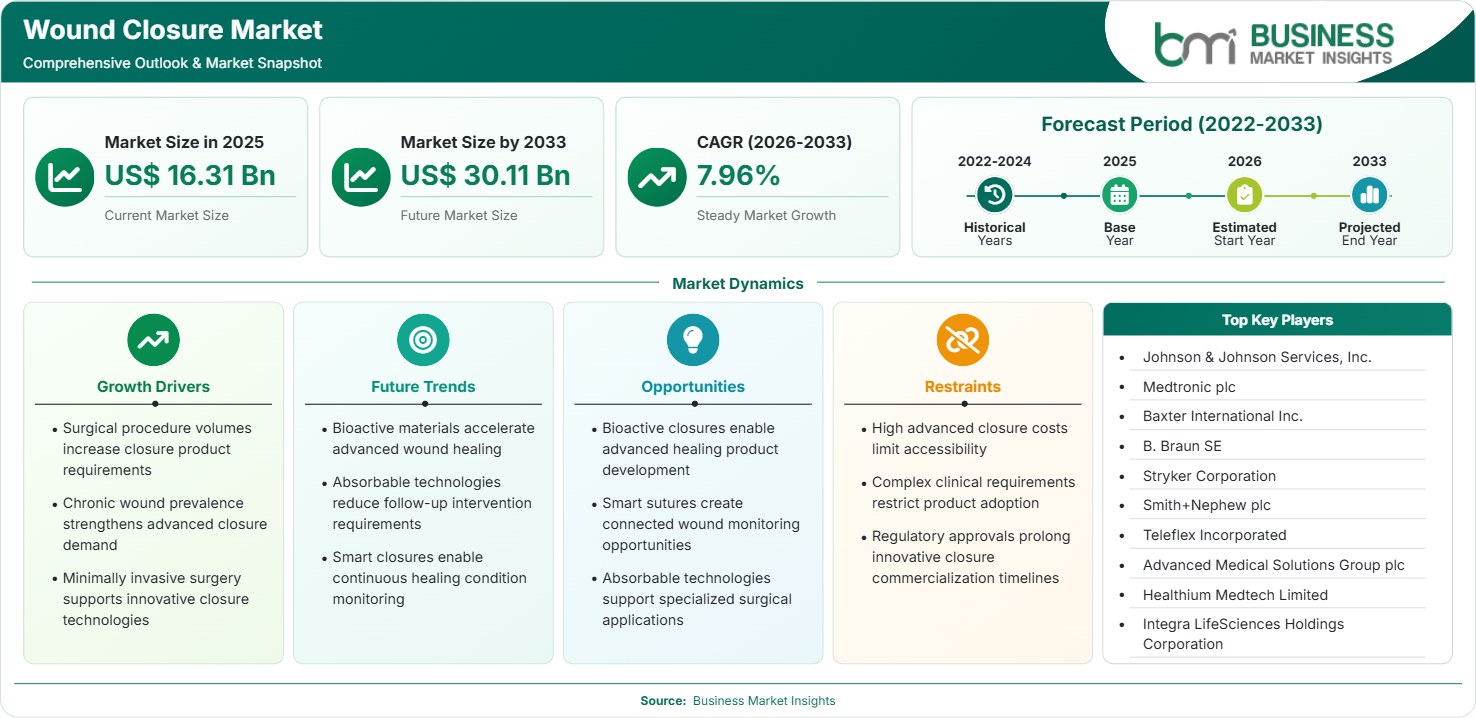
The Wound Closure Market size was valued at US$ 16.31 Billion in 2025 and is projected to reach US$ 30.11 Billion by 2033, growing at a CAGR of 7.96% during 2026–2033, driven by rising surgical volumes, minimally invasive procedures, advanced hemostatic technologies, outpatient surgery expansion, and demand for efficient closure products.

Report Coverage
  • Product Type: Sutures , Hemostatic Agents , Staplers , Others
  • Application: Orthopedics, Gynecology and Obstetrics, General Surgery, Ophthalmology, Cardiology, Others
  • End-User: Hospitals & ASCs, Specialty Clinics, Others
US$ 16.31 Bn Market size in 2025
US$ 30.11 Bn Market Size by 2033
7.96% CAGR, 2026 - 2033
2026-2033 Forecast Period

AI Overview

Wound Closure Market Summary

  • North America Region: Holds a Wound Closure Market share of 36%–39% in 2025, growing with a CAGR of 7.2%–7.8%, influenced by high surgical volumes, advanced hospitals, outpatient procedures, premium sutures, staplers, hemostatic products, and strong reimbursement environments.
  • Fastest Growing Region: Asia Pacific holds a market share of 20%–23% in 2025, growing with a CAGR of 9.0%–9.8%, supported by expanding surgical infrastructure, medical tourism, improving healthcare access, domestic manufacturing, and increasing adoption of advanced closure technologies.
  • Leading Segment: Sutures hold a market share of 42%–46% in 2025, growing with a CAGR of 7.2%–7.8%, supported by broad procedural applicability, recurring hospital demand, absorbable technology adoption, antimicrobial innovation, and established clinical familiarity.
  • High Growth Segment: Hemostatic Agents hold a Wound Closure Market share of 24%–28% in 2025, growing with a CAGR of 8.8%–9.6%, driven by bleeding-control requirements, complex surgeries, minimally invasive procedures, advanced formulations, and increasing preference for adjunctive hemostasis.
  • Key Market Opportunity: Rising ambulatory surgery volumes create opportunities for compact closure systems, faster application, reduced operating-room time, improved cosmetic outcomes, and products supporting standardized post-procedure care.
  • Major Market Players: Johnson & Johnson Services, Inc.; Medtronic plc; Baxter International Inc.; B. Braun SE; Stryker Corporation; Smith+Nephew plc; Teleflex Incorporated; Advanced Medical Solutions Group plc; Healthium Medtech Limited; Integra LifeSciences Holdings Corporation.
Strategic Insights

Wound Closure Market: Strategic Insights

Wound Closure Market Strategic Framework
FREE PDF
Request your free sample
Request free sample
Stakeholder View

Key Takeaways

  • The value chain extends from polymer, biomaterial, coating, and component suppliers to specialized closure manufacturers, distributors, hospitals, ambulatory surgery centers, and specialty clinics. Portfolio breadth increasingly influences supplier positioning because procurement teams can consolidate multiple closure categories through fewer vendors.
  • Hemostatic agents provide an attractive growth avenue because complex cardiovascular, orthopedic, oncology, and general surgical procedures frequently require adjunctive bleeding control. Combination products that integrate tissue approximation with hemostatic functionality can address procedural efficiency and clinical risk-management priorities.
  • Product development is moving toward knotless sutures, antimicrobial technologies, advanced staple-line control, bioactive materials, and closure systems designed around minimally invasive procedures. Johnson & Johnson reports clinical and economic evidence for several advanced closure technologies, including reduced operating-room time with selected knotless systems.
  • Asia Pacific offers the strongest expansion potential as surgical infrastructure, specialist availability, and healthcare expenditure improve. China, India, Japan, and South Korea provide differentiated opportunities across premium hospital systems, private healthcare networks, medical tourism, and increasingly capable domestic manufacturing ecosystems.
  • Strategic activity is increasingly centered on differentiated surgical technologies and portfolio optimization. Companies are combining internal innovation, acquisitions, manufacturing investments, and portfolio rationalization to concentrate resources on products with stronger clinical or commercial potential.
  • Hospitals increasingly assess closure products through total procedural economics rather than unit price alone. Reduced application time, lower complication risk, predictable handling, fewer additional interventions, and standardized inventory can materially influence purchasing decisions.
Geographic Outlook

Wound Closure Market Regional Highlights

North America Wound Closure Market

North America accounted for 36%–39% share in 2025 and is projected to expand at a 7.2%–7.8% CAGR during 2026–2033. Wound Closure Market share remains supported by high surgical volumes, advanced ambulatory infrastructure, premium closure technologies, and established reimbursement pathways. The United States represents the principal demand center, while Canada contributes through hospital modernization and increasing procedural capacity. Adoption increasingly favors products that improve operating-room efficiency, tissue handling, bleeding control, and postoperative outcomes across general, orthopedic, cardiovascular, and gynecological procedures.

  • Advanced staplers and knotless sutures are gaining traction where procedural efficiency and consistent tissue approximation influence operating-room economics, particularly across high-volume hospitals and ambulatory surgery centers.
  • Antimicrobial sutures and advanced hemostatic agents benefit from infection-control priorities and greater clinical attention to surgical-site complications, supporting premium product adoption across complex procedures.
  • Hospital consolidation encourages standardized procurement, favoring suppliers with broad portfolios spanning sutures, staplers, hemostats, and complementary surgical technologies.
  • Regulatory requirements and clinical evidence increasingly shape purchasing decisions, creating advantages for established manufacturers capable of supporting products with robust safety, efficacy, and economic evidence.

US Wound Closure Market

The US accounts for 78% - 82% of the total North America market in 2025, growing at a CAGR of 7.3%- 7.9% through 2033. The large surgical volume, advanced hospital infrastructure, high ambulatory surgery rate, and adoption of advanced devices in the US drive demand in the region. The US is also an important market for the commercialization of staplers, suturing devices, and hemostats. Product differentiation is driven by clinical data, usability, operating room efficiency, reimbursement considerations, and inclusion in standard surgical procedures.

  • Large hospital systems increasingly evaluate closure technologies through clinical outcomes and total procedure economics, encouraging manufacturers to demonstrate measurable benefits beyond basic tissue approximation.
  • Ambulatory surgery expansion supports compact, intuitive products that shorten application time while maintaining predictable wound security and reducing postoperative management requirements.
  • Premium closure technologies gain opportunities in orthopedic, cardiovascular, gynecological, and minimally invasive procedures where complication avoidance carries substantial economic implications.

Europe Wound Closure Market

Europe held a 25%-28% share in 2025 and is forecasted to grow at a CAGR of 7.3%-7.9% from 2026 to 2033 in the Wound Closure Market. Germany, the UK, France, Italy, and Spain are key demand countries, whereas Germany and the UK have strong expertise. High growth potential lies in Poland, Spain, and some Central European regions, which are developing their surgical facilities and private healthcare sector. The need for cost-effectiveness remains relevant and promotes solutions that perform well clinically and procedurally while further reducing resource use.

  • Germany benefits from sophisticated hospital infrastructure and strong surgical specialization, supporting adoption of advanced sutures, staplers, and hemostatic technologies.
  • The UK emphasizes healthcare efficiency and standardized procurement, increasing demand for closure products that demonstrate procedural, clinical, or economic advantages.
  • France and Italy provide established procedural markets, while outpatient and minimally invasive surgery creates opportunities for efficient closure systems.
  • Central and Eastern European healthcare modernization is broadening access to advanced closure products, although pricing and reimbursement remain important adoption determinants.

Asia Pacific Wound Closure Market

Asia Pacific region has accounted for 20% to 23% of the market share in 2025 and is expected to record the highest regional growth at a CAGR of 9.0% to 9.8% through 2033. China, Japan, India, South Korea, and Australia are key demand bases in the region, with India and China offering considerable opportunities for expansion. Regional growth can be attributed to the presence of hospitals, a rising number of surgeries, medical tourism, the availability of specialists, and the manufacture of medical devices. Wound Closure Market growth is increasingly supported by broader access to advanced closure technologies outside major metropolitan healthcare centers.

  • China combines large procedure volumes with expanding tertiary hospitals and domestic medical-device capabilities, supporting both premium products and cost-optimized closure solutions.
  • India offers strong long-term potential as hospital networks expand, surgical access improves, and domestic manufacturers increase production of sutures and related surgical products.
  • Japan emphasizes precision, reliability, and advanced surgical techniques, creating demand for sophisticated closure technologies suited to minimally invasive and complex procedures.
  • South Korea and Australia provide technologically advanced markets where specialized surgical centers support adoption of premium closure products and innovative hemostatic technologies.
  • Regional manufacturing expansion can improve product affordability and supply continuity while creating export opportunities for Asian manufacturers entering other emerging healthcare markets.

Rest of World Wound Closure Market

Rest of World share in 2025 is 12%-15% and is expected to grow at 6.5%-7.2% CAGR through 2033. Latin America will benefit from investments in private hospitals, urbanization, and access to surgeries. Brazil and Mexico will continue to be key players in the market. In the Middle East and Africa, there will be better prospects in Saudi Arabia, the United Arab Emirates, and South Africa due to healthcare upgrades, specialist hospitals, and medical tourism.

  • Brazil benefits from a large healthcare system and significant surgical demand, creating opportunities for established closure suppliers and competitively priced regional products.
  • Mexico is developing as an attractive market through private healthcare expansion, proximity to North American supply chains, and increasing access to specialized surgical services.
  • Gulf markets are investing in modern hospitals and specialist care, supporting premium wound closure products used in complex procedures and medical tourism.
  • South Africa serves as an important regional healthcare hub, while broader African markets offer longer-term opportunities as hospital infrastructure and surgical access improve.
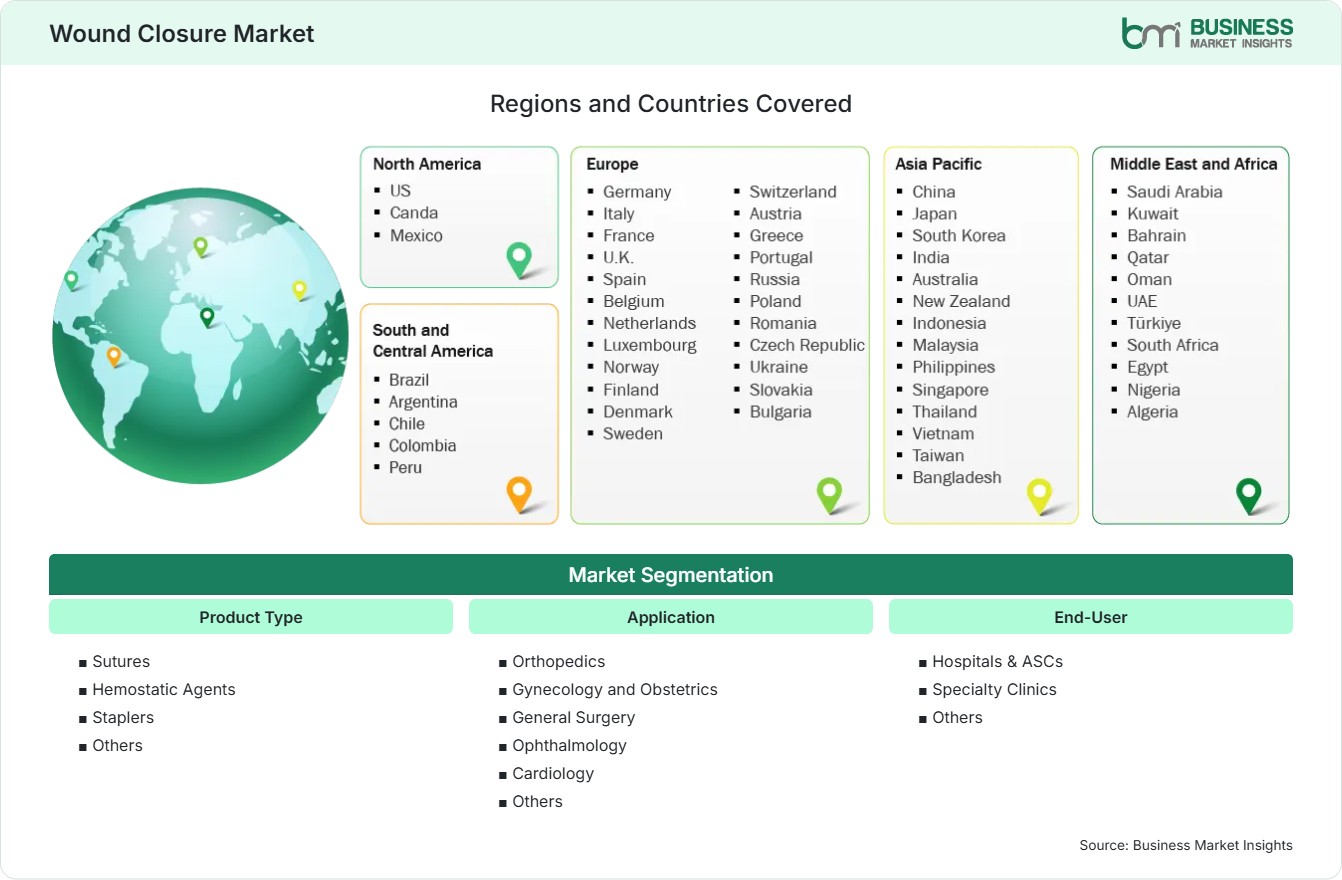
Global Market Geography
FREE PDF
Request your free sample
Request free sample
Segment Analysis

Wound Closure Market Segmentation

Product Type

The Product Type segment holds the largest market share, at 42% to 46% in 2025, and is expected to register a compound annual growth rate of 7.2% to 7.8% from 2026 to 2033. Sutures are at the core of the Wound Closure Market share, whereas hemostatic agents and staplers benefit from complex and minimally invasive surgeries, owing to their efficacy in tissue management.

  • Sutures: Absorbable sutures support internal tissue approximation and eliminate removal requirements, while non-absorbable products remain important where long-term tensile support and durable closure are clinically required.
  • Hemostatic Agents: Active hemostats accelerate bleeding control through biologically active mechanisms, supporting use in procedures where rapid management of diffuse or difficult-to-control bleeding is required.
  • Passive Hemostats: Passive products provide physical matrices that support clot formation and remain relevant across general, cardiovascular, orthopedic, and minimally invasive procedures requiring localized bleeding management.
  • Combination Hemostats: Combination technologies integrate complementary mechanisms to improve bleeding control, supporting complex procedures where conventional compression or single-mechanism products may be insufficient.
  • Staplers: Powered and manual systems provide rapid tissue approximation, with powered platforms increasingly targeting consistency, ergonomics, complex tissue handling, and efficient minimally invasive procedures.

Application

General Surgery is the application segment that will drive demand for the product, holding 21%-24% market share by 2025 and a CAGR of 7.4%-8.0% through 2033. The wound closure market comprises a range of surgeries, both high-volume and specialty, depending on the procedure performed.

  • Orthopedics: Joint replacement, trauma, and reconstructive procedures create recurring demand for strong, predictable closure technologies capable of supporting layered tissue repair and postoperative wound management.
  • Gynecology and Obstetrics: Cesarean delivery, hysterectomy, oncology procedures, and minimally invasive gynecological surgery sustain demand for absorbable sutures, hemostatic products, and efficient closure systems.
  • General Surgery: High procedure volumes across abdominal, gastrointestinal, hernia, and other interventions create broad demand for sutures, staplers, and hemostatic agents across hospital and ambulatory settings.
  • Ophthalmology: Microsurgical procedures require precision closure materials with controlled handling and tissue compatibility, supporting specialized sutures and smaller-format closure products.
  • Cardiology: Cardiovascular and structural procedures generate demand for reliable tissue approximation and bleeding-control technologies, particularly where procedural complexity increases the consequences of inadequate closure.

End-User

Hospitals & ASCs are the largest end-user category, with a share of 70%-74% in 2025, growing at a CAGR of 7.5%-8.1% through 2033. Wound closure market trends indicate that facilities seek standard products, expanded surgical offerings, and more efficient procurement processes. Specialty clinics drive incremental market revenue in line with the increasing number of outpatient procedures.

  • Hospitals & ASCs: High procedure volumes and diverse specialties support extensive consumption of sutures, staplers, and hemostatic products while centralized procurement encourages portfolio-based supplier selection.
  • Specialty Clinics: Expanding outpatient surgery increases demand for compact, easy-to-use closure systems that support rapid procedures, predictable wound management, and efficient patient discharge.
Market Forces

Wound Closure Market Dynamics

Key Market Drivers

Rising Surgical Volumes Across High-Need Specialties

The rising number of surgeries in orthopedics, cardiovascular surgery, general surgery, gynecology, and ophthalmology indicates a high need for tissue approximation and hemorrhage control. According to the World Health Organization, surgery is recognized as an important component of healthcare delivery. Aging populations and chronic conditions contribute to the growing demand for surgical treatment procedures. In other words, the Wound Closure Market growth is driven by the expansion of the volume of procedures. Joint replacement surgery, abdominal surgery, oncologic operations, cesarean section, and trauma care each create their own demands in wound closure. Manufacturers that offer product lines including absorbable and non-absorbable sutures, staplers, and hemostatics can meet the needs of various surgical procedures.

Shift Toward Advanced and Antimicrobial Closure Technologies

Modern hospitals are increasingly focusing on closure products that enable infection prevention, controlled tissue approximation, and uniform application. Antimicrobial sutures, knotless closure solutions, advanced staplers, and hemostats are closure products that meet the above needs by enhancing core closing features. Johnson & Johnson, for example, has cited scientific evidence that certain antibiotic sutures can help reduce the risk of surgical site infection, while also emphasizing the role of its closure solutions in enhancing operating room efficiency and wound-closure properties. This will have an impact on the Wound Closure Market because purchasing departments are increasingly basing their decisions on scientific evidence and subsequent costs rather than just purchase cost.

Expansion of Minimally Invasive and Ambulatory Surgery

Aesthetic wound closures must be effective in restricted-access sites, and rapid healing is also required. The increase in ambulatory surgeries will create greater demand for technology that simplifies applications, saves operating room time, and ensures predictable post-operative care. Devices such as powered staplers, knotless sutures, tissue adhesives, and advanced hemostats meet these criteria in some way or another. The impact on the market will extend beyond product substitution, as hospitals and clinics need technology that enables them to operate faster without compromising safety. The Wound Closure Market trends, therefore, favor companies that can provide time-saving, ergonomic, predictable handling, and a reduction in complications.

Key Market Opportunities

Premium Hemostatic Solutions for Complex Surgery

The need for highly complex surgical interventions creates opportunities for innovative hemostasis agents capable of arresting bleeding in situations where standard compression and closure approaches fail. Active, passive, and combined approaches could cater to varying patterns of hemorrhaging and tissues. The potential seems most obvious when cardiovascular surgeries, oncology procedures, trauma cases, and complex abdominal surgeries are concerned, where hemorrhage control might impact the procedure and resource management. Companies would differentiate themselves from their competitors by the speed of application, tissue adhesion, compatibility with minimally invasive procedures, and reliable absorption. Companies with innovative products that can demonstrate their value through clinical studies will find hospitals more willing to switch from traditional low-cost hemostatic agents. The Wound Closure Market encourages further investment in hemostatic solutions and technologies.

Growth of Localized Manufacturing and Emerging-Market Supply

Increasing manufacturing activity in Asia and other emerging regions offers opportunities to develop cost-efficient closures that comply with regulatory requirements. Manufacturing locally may help minimize logistics exposure and increase efficiency in meeting the needs of the hospital purchasing process. Both India and China are ideal candidates in this respect, as they have an increasing demand for health care within their own countries and are developing infrastructure to manufacture such products. Several strategies can be employed to enter these markets. Export-focused manufacturers can also look at getting certified in developed markets through this market opportunity. Wound Closure Market forecasts indicate that suppliers offering cost-efficient, high-quality products have scope for growth.

Integrated Closure Platforms and Procedure-Based Solutions

Healthcare professionals are favoring standardized surgical work processes to reduce variability and streamline purchasing. There is now an opportunity for medical device companies to bundle sutures, staplers, hemostatics, and other products used in the closure process into procedure-specific portfolios. Such bundling can help achieve cross-selling, better inventory management, and improved relationships with hospital systems by integrating multiple products into their surgical procedures. Technology can also be used to make product selection easier, support training, improve inventory control, and standardize processes. Medical device companies can enhance their product differentiation by building evidence on the economics of procedures versus the products used for them.

Market Restraints and Challenges

Pricing Pressure and Hospital Procurement Constraints

Factor: Cost-control mechanisms exist in hospitals and ASCs, particularly for traditional sutures and closures. Impact: Products with a premium reputation may take longer to enter the market, as it can be difficult to establish their additional value. More sophisticated hemostats, powered surgical staplers, antibiotic sutures, and new closures would need to offer more benefits than costs. Public procurement through tenders is likely to intensify price pressures, especially in publicly funded healthcare systems and emerging markets. In such an environment, manufacturers have to prove their efficiency in terms of saving operating time, reducing complications, readmission rates, or resource use, rather than technical superiority alone.

Regulatory Complexity and Clinical Validation Requirements

Factor: Closure products come into direct contact with tissue and thus could affect aspects such as bleeding, infection, healing, and postoperative care, thereby requiring a high level of quality control and regulatory oversight, including clinical data. Impact: The cost of product development and commercialization may rise significantly, especially when dealing with novel materials, antimicrobial technology, and hemostasis. Regulatory requirements vary by region, which adds to the complexity of entering international markets. There are many issues that need to be managed by companies, from biocompatibility and sterility to manufacturing consistency and labeling, to postmarket surveillance and clinical performance criteria. At the same time, pricing should remain competitive.

Company Analysis

Competitive Landscape

The competition in the industry includes multinational medical device manufacturers, closure manufacturers, and regional manufacturers. The Wound Closure Market analysis study reveals that the differentiation factors among competitors include portfolio strength, clinical data, manufacturing capabilities, regulatory expertise, and partnerships with hospitals. The major players have been focusing on innovations in staple guns, sutures, and procedure-based closures. Major companies such as Johnson & Johnson, Medtronic, Baxter, B. Braun, Stryker, Smith+Nephew, Teleflex, Advanced Medical Solutions, Healthium, and Integra LifeSciences have significant relevance across overlapping closure segments.

Company Name

Overview

Products and Services relevant to this market

Johnson & Johnson Services, Inc.

Major surgical technology supplier with a broad closure portfolio and extensive global hospital relationships.

ETHICON sutures, surgical staplers, hemostatic products, STRATAFIX devices, and DERMABOND closure technologies.

Medtronic plc

Global medical technology company with significant surgical and stapling capabilities across multiple procedural specialties.

Surgical staplers, reloads, advanced tissue management technologies, and related surgical instrumentation.

Baxter International Inc.

Diversified healthcare company with surgical products serving hospital-based procedural requirements globally.

Hemostatic agents, surgical stapling technologies, and complementary products used for tissue management.

B. Braun SE

Global healthcare supplier with established surgical and suture capabilities across mature and emerging markets.

Absorbable and non-absorbable sutures, surgical closure products, and related operating-room solutions.

Stryker Corporation

Major medical technology company with strong orthopedic and surgical exposure.

Surgical closure products and technologies supporting orthopedic and broader procedural applications.

Smith+Nephew plc

Medical technology company focused on advanced surgery, orthopedics, and wound management.

Sutures, soft-tissue fixation products, surgical technologies, and wound-management solutions.

Teleflex Incorporated

Specialty medical technology company supplying products across surgical and interventional procedures.

Surgical closure products, Weck-related technologies, sutures, clips, and complementary surgical instruments.

Advanced Medical Solutions Group plc

Specialist medical-device company focused strongly on advanced wound closure and tissue-management technologies.

Tissue adhesives, sutures, closure systems, and advanced wound-care technologies.

Healthium Medtech Limited

India-based medical-device manufacturer with broad surgical consumables and international distribution.

Surgical sutures, stapling products, wound closure devices, and related surgical consumables.

Integra LifeSciences Holdings Corporation

Diversified medical technology company serving complex surgical and wound-management applications.

Surgical reconstruction products, wound-care technologies, tissue management products, and related closure solutions.

Trust & Transparency

Research Methodology

The market analysis combines proprietary research with secondary data from government agencies, company disclosures, regulatory filings, industry databases and expert interviews. Market estimates are validated through data triangulation, cross-market benchmarking and analyst review.

View Full Research Methodology

Questions Answered

Frequently Asked Questions

Why is Asia Pacific becoming strategically important for wound closure suppliers?

Asia Pacific combines expanding surgical capacity, improving healthcare infrastructure, large patient populations, medical tourism, rising specialist availability, and growing domestic medical-device production. These factors create opportunities for both premium technologies and competitively priced products.

What should investors assess when evaluating the Wound Closure Market report?

Investors should assess procedure-volume trends, product differentiation, regulatory barriers, hospital procurement dynamics, geographic expansion, manufacturing economics, clinical evidence, and the ability of suppliers to establish recurring relationships with large healthcare networks.

How are ambulatory surgery centers influencing product development?

Ambulatory surgery centers favor closure technologies that are intuitive, fast to apply, reliable, and compatible with rapid patient discharge. This supports demand for knotless sutures, efficient staplers, compact hemostatic systems, and products that reduce procedural complexity.

Which product category has the strongest growth opportunity?

Hemostatic agents offer one of the strongest growth opportunities because complex surgery increasingly requires reliable bleeding control. Combination and advanced formulations can address difficult bleeding environments while supporting minimally invasive and high-acuity procedures.

What factors are increasing demand for advanced wound closure products?

Demand is being supported by rising surgical volumes, minimally invasive procedures, ambulatory surgery, complex tissue management, infection-control priorities, and the need to reduce procedural time. Advanced sutures, staplers, and hemostatic agents increasingly compete on measurable clinical and economic benefits rather than basic closure functionality alone.

Access the Full Wound Closure Market Report

Get segment-level forecasts, regional estimates, competitive benchmarking, company profiles and downloadable Excel datasets.

Access the full Wound Closure Market Report
350 pages PDF & Excel | 2026-09-23
Similar Research

Related Market Reports