Market Summary
Executive Summary and Global Market Analysis
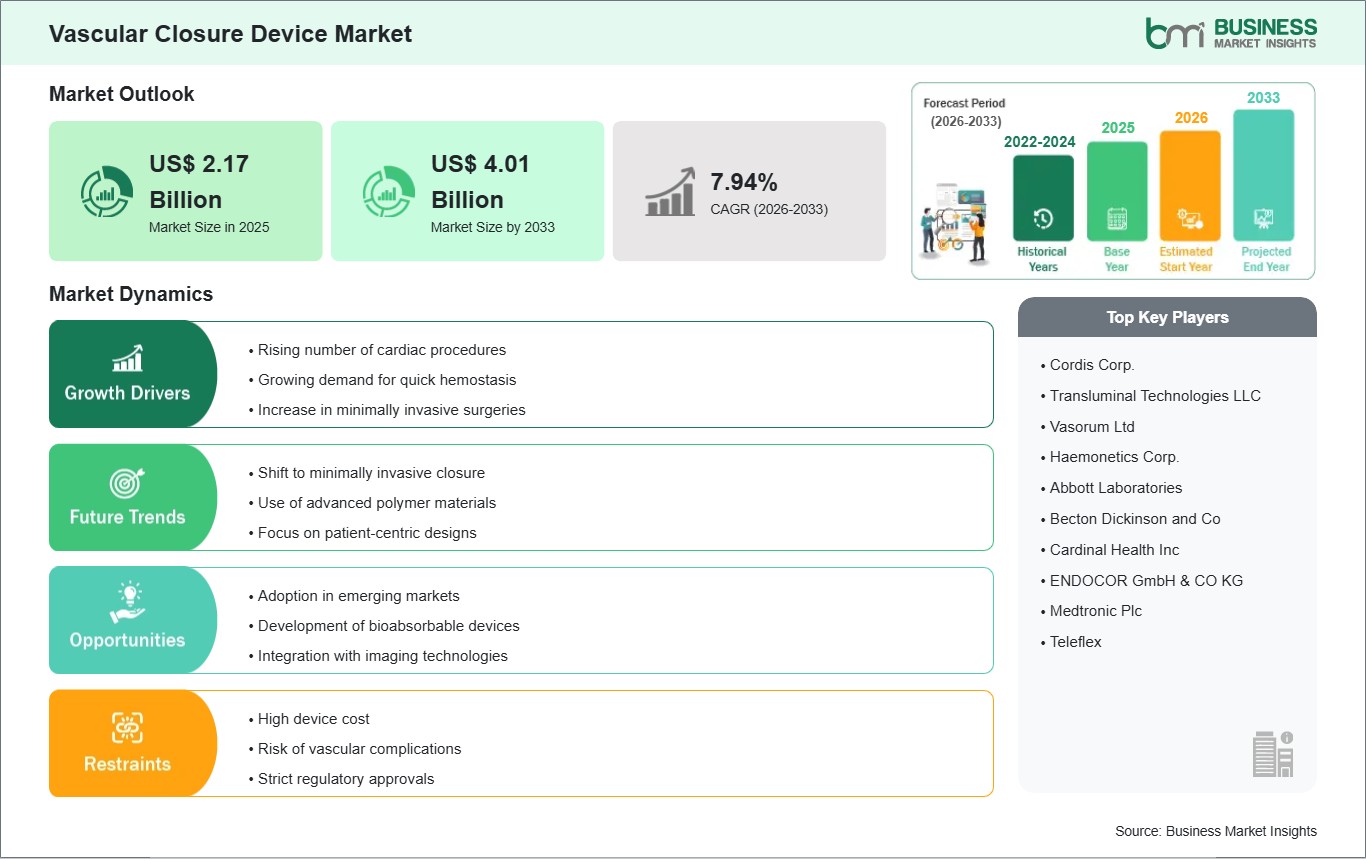
Vascular Closure Devices (VCDs) are purpose-built medical technologies that achieve hemostasis and seal arterial or venous access sites following diagnostic and interventional catheter-based procedures. Solutions span suture-mediated systems, bioabsorbable plug/PEG sealants, and clip/staple mechanisms, supporting femoral and radial access across interventional cardiology, electrophysiology, peripheral vascular, structural heart, and endovascular aneurysm repair workflows. Their value proposition centers on faster time-to-hemostasis, rapid ambulation, reduced nursing burden, and alignment with same-day discharge pathways.
The market contends with evolving regulatory requirements (e.g., EU MDR labeling/IFU transitions for legacy devices), operator learning curves in large-bore closure (TAVR, EVAR), variability in vascular anatomy (calcified vessels, posterior wall punctures), and institutional cost scrutiny comparing device-based closure to manual compression. Product-specific contraindications and technique sensitivity for high-French sheaths can elevate access-site complication risk in inexperienced settings. Procurement dynamics (GPO contracts, formulary preferences) and capital-constrained cath labs can slow portfolio updates even where clinical efficiencies are clear. Despite these challenges, the market holds immense opportunities, such as growth avenues in large-bore closure specialized for structural heart programs (e.g., plug-based devices purpose-designed for 12–25 Fr sheaths), expansion of venous-specific closure in EP labs, and broader adoption of bioabsorbable sealants that simplify deployment and shorten hemostasis. Ongoing investments by leading players to scale manufacturing, secure purchasing agreements, and showcase next-gen suture-mediated systems at major congresses are reinforcing clinician confidence and accelerating same-day surgical pathways.
Segment Analysis
Vascular Closure Device Market Segmentation
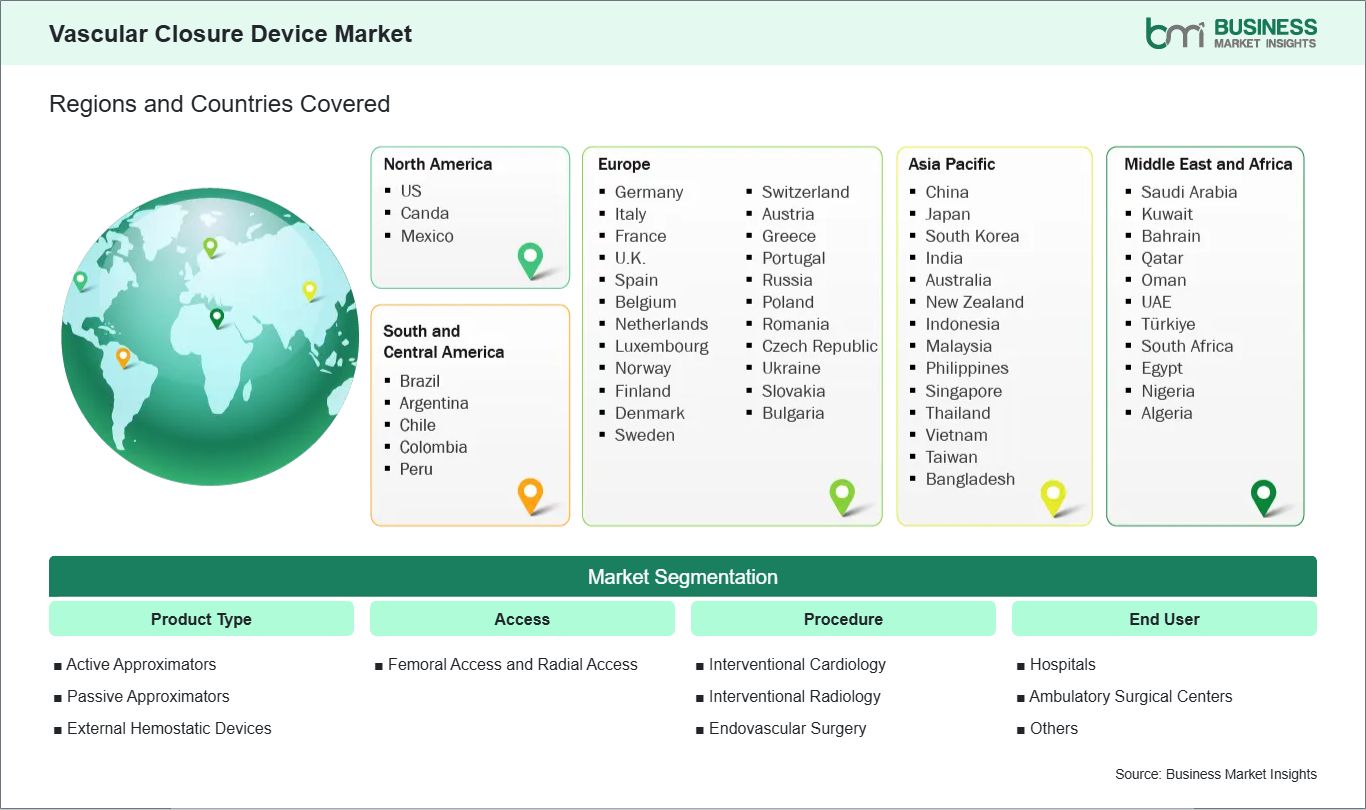
Key segments that contributed to the derivation of the Vascular Closure Device market analysis are product type, access, procedure, and end user.
- By Product Type, the market is segmented into Active Approximators, Passive Approximators, and External Hemostatic Devices.
- By Access, the market is bifurcated into Femoral Access and Radial Access.
- By Procedure, the market is segmented into Interventional Cardiology, Interventional Radiology, and Endovascular Surgery.
- By End User, the market is segmented into Hospitals, Ambulatory Surgical Centers, and Others
Market Forces
Vascular Closure Device Market Drivers and Opportunities
Shift to Same-Day Discharge and Operational Efficiency
Healthcare systems worldwide are under pressure to optimize resource utilization, reduce inpatient costs, and improve patient throughput. Same-day discharge protocols have become a strategic priority, particularly in interventional cardiology and electrophysiology programs. Vascular Closure Devices (VCDs) play a pivotal role in enabling these pathways by significantly reducing time-to-hemostasis and accelerating patient ambulation compared to manual compression. This efficiency translates into fewer nursing hours, lower bed occupancy, and improved cath lab turnover, critical metrics for hospitals seeking operational excellence. Devices like Teleflex's MANTA® large-bore closure system exemplify this trend, offering predictable closure for high-French sheaths used in structural heart procedures. Its design ensures rapid hemostasis and reproducible outcomes, which are essential for minimizing complications and supporting same-day discharge strategies.
Advances in Large-Bore and Venous-Specific Closure
The complexity of modern interventions, such as TAVR, EVAR, and advanced EP procedures, has driven demand for closure solutions tailored to large-bore arterial access and dedicated venous sites. Traditional manual compression is impractical for these cases due to prolonged hemostasis times and higher complication risks. Purpose-built devices address these challenges by combining ease of deployment with enhanced safety features. Plug-based systems now incorporate tactile, auditory, and visual cues to guide operators, reducing variability and improving confidence during closure. Meanwhile, suture-mediated platforms offer versatility across multiple sheath sizes and access points, making them indispensable in high-volume centers. Teleflex's MANTA® device, designed for 12–25 Fr outer diameter sheaths, and Abbott's Perclose™ ProStyle™ suture-mediated system are prime examples of innovation in this space. These technologies not only improve clinical outcomes but also expand the addressable market by supporting complex structural heart and EP workflows where reliable closure is mission-critical.
Size and Share Analysis
Vascular Closure Device Market Size and Share Analysis
The Vascular Closure Device market demonstrates steady growth, with size and share analysis revealing evolving trends and competitive positioning among key players. The report further examines subsegments categorized within product type, access, procedure, and end user, offering insights into their contribution to overall market performance.
For instance, within product types, active approximators, such as suture-mediated systems, are gaining traction in high-complexity procedures due to their ability to provide secure closure and versatility across sheath sizes. For access, femoral access remains the dominant application area, particularly in structural heart and endovascular interventions, where reliable closure is critical for large-bore sheaths. In terms of procedure, interventional cardiology continues to drive significant demand for closure devices, supported by the growing volume of PCI and complex coronary cases that require rapid hemostasis and early ambulation. Among end users, hospitals account for the largest share, as tertiary and academic centers perform high volumes of structural heart, EP, and peripheral interventions, necessitating advanced closure technologies to optimize workflow and patient outcomes.
Report Coverage
Vascular Closure Device Market Report Coverage and Deliverables
The Vascular Closure Device Market Size and Forecast (2022–2033) report provides a detailed analysis of the market covering below areas:
- Vascular Closure Device market size and forecast at global, regional, and country levels for all the key market segments covered under the scope
- Vascular Closure Device market trends, as well as market dynamics such as drivers, restraints, and key opportunities
- Vascular Closure Device market analysis covering key market trends, global and regional framework, major players, regulations, and recent market developments
- Industry landscape and competition analysis covering market concentration, heat map analysis, prominent players, and recent developments for the Vascular Closure Device market
- Detailed company profiles, including SWOT analysis
Geographic Insights
Vascular Closure Device Market Geographic Insights
The geographical scope of the Vascular Closure Device market report is divided into five regions: North America, Asia Pacific, Europe, the Middle East & Africa, and South & Central America.
Across North America, adoption is driven by mature interventional ecosystems and the push for same-day discharge protocols in structural heart and electrophysiology programs. Europe is navigating MDR compliance while expanding training initiatives to standardize closure techniques across diverse healthcare settings. In Asia Pacific, rapid growth in coronary and peripheral interventions, coupled with investments in cath lab infrastructure, is fueling demand for scalable closure solutions in emerging markets such as China, India, and Southeast Asia. The Middle East & Africa is also witnessing a gradual uptake as tertiary hospitals invest in advanced cardiovascular capabilities and clinician education. Meanwhile, South & Central America benefit from modernization efforts and strategic partnerships that broaden access to contemporary closure technologies in both public and private sectors.
Industry Activity
Recent Developments
The Vascular Closure Device market is evaluated by gathering qualitative and quantitative data post-primary and secondary research, which includes important corporate publications, association data, and databases. A few of the key developments in the Vascular Closure Device market are:
- In February 2024, Terumo Medical Corporation (TMC) broke ground on a new manufacturing facility at its Caguas, Puerto Rico site. This expansion is another investment by Terumo as global demand for the company's Angio-Seal Vascular Closure Device (VCD), manufactured in Puerto Rico, continues to increase.
- In July 2024, Cordis, a global leader in the development and manufacturing of interventional cardiovascular and endovascular technology, was awarded a national group purchasing agreement for Vascular Closure Devices with Premier.
Trust & Transparency
Research Methodology
The market analysis combines proprietary research with secondary data from government agencies, company disclosures, regulatory filings, industry databases and expert interviews. Market estimates are validated through data triangulation, cross-market benchmarking and analyst
review.
View Full Research Methodology
Key Sources Referred:
World Bank – Global Trade IndicatorsWorld Trade Organization (WTO)International Monetary Fund (IMF)International Trade Administration (ITA)Company WebsitesCompany Annual ReportsCompany Investor Presentations