Western Europe Wearable Injectors Market Outlook (2022-2033)

Historic Data: 2022-2024   |   Base Year: 2025   |   Forecast Period: 2026-2033
Report Content: Market Scope, Market Segmentation, Market Dynamics, and Competitive Analysis

Report Coverage:
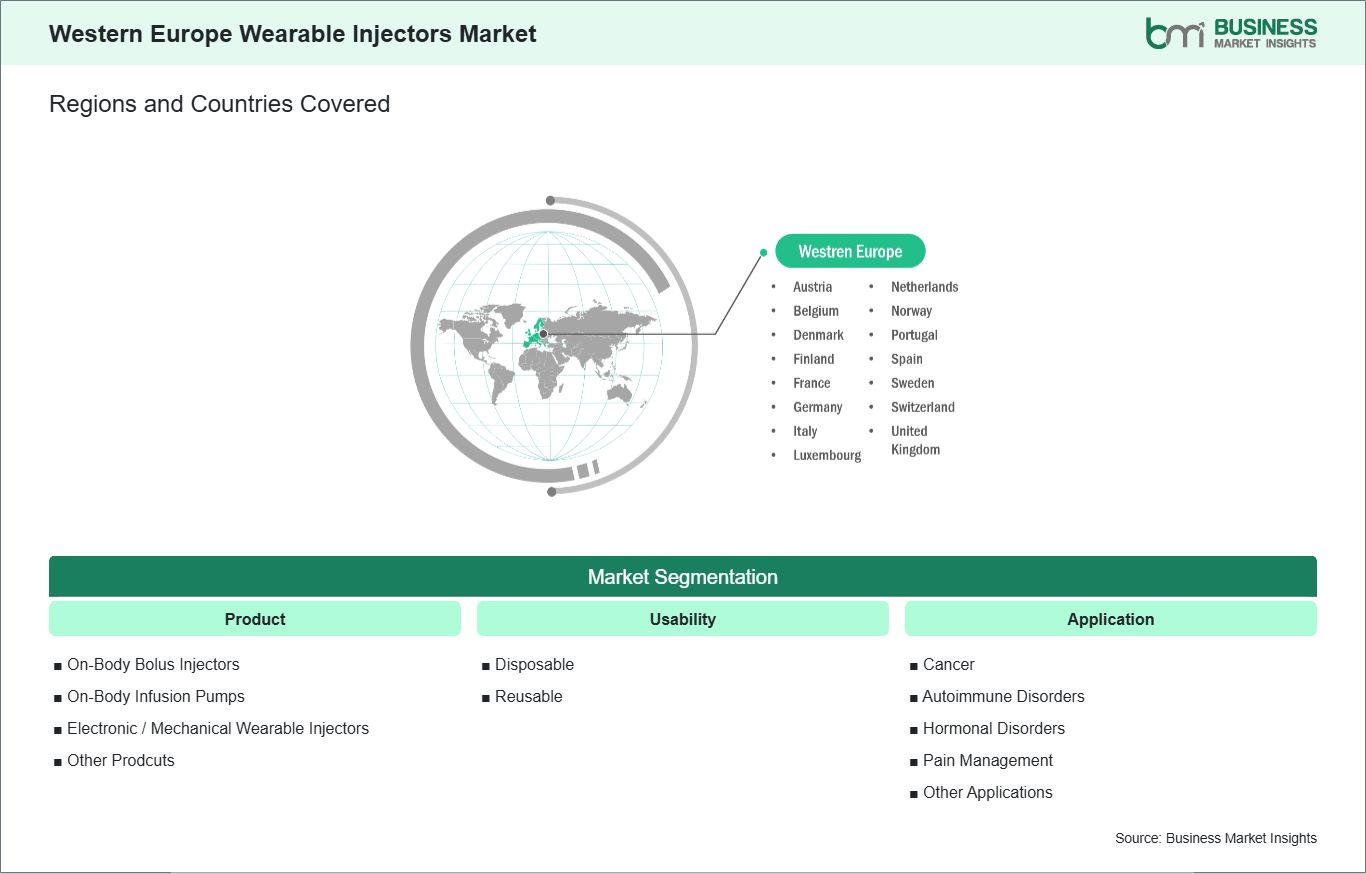
  • Product (On-Body Bolus Injectors, On-Body Infusion Pumps, Electronic / Mechanical Wearable Injectors, Other Prodcuts)
  • Usability (Disposable, Reusable)
  • Application (Cancer, Autoimmune Disorders, Hormonal Disorders, Pain Management, Other Applications)

No. of Pages: 150
Report Code: BMIPUB00034795
Category: Life Sciences
Western Europe Wearable Injectors Market

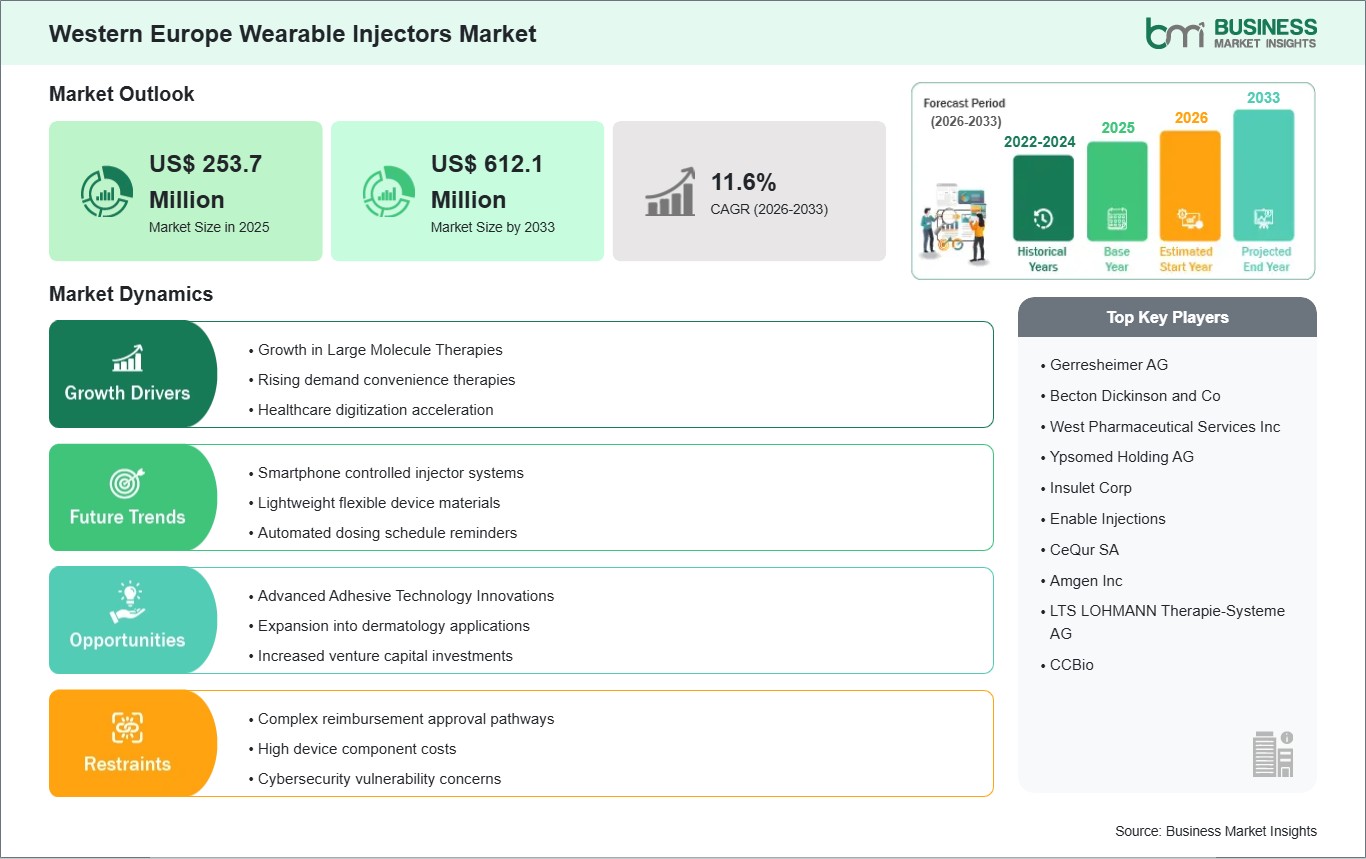
The Western Europe Wearable Injectors Market size is expected to reach US$ 612.1 million by 2033 from US$ 253.7 million in 2025. The market is estimated to record a CAGR of 11.6% from 2026 to 2033.

Executive Summary and Western Europe Wearable Injectors Market Analysis:

The Western Europe wearable injectors market is witnessing progressive growth, driven by rising prevalence of chronic diseases, advanced healthcare infrastructure, and increasing patient preference for self-administered therapies. Diabetes, autoimmune conditions, and oncology indications are fueling the demand for devices that allow safe, precise, and extended subcutaneous delivery of biologic therapies. Wearable injectors enable patients to manage treatments at home, reducing hospital visits while maintaining adherence and optimizing therapeutic outcomes. Market dynamics are dominated by established multinational medical device companies, supported by a network of regional distributors and specialty clinics. Differentiation is centered around device ergonomics, safety mechanisms, extended wear capabilities, and digital integration. Connected wearable injectors allow clinicians to remotely monitor therapy adherence, track dosing patterns, and intervene promptly when irregularities occur, aligning with Western Europe’s high standard of chronic disease management and patient empowerment. Regulatory frameworks in Western Europe are rigorous, with CE marking under the EU Medical Device Regulation (MDR) ensuring safety, efficacy, and quality compliance. Reimbursement policies across countries such as Germany, France, and the UK are generally supportive, enabling broader access for patients requiring chronic therapy. Adoption is driven by specialist hospital networks, outpatient clinics, and homecare services, while telemedicine integration and patient training programs further enhance usability and confidence. Despite high levels of adoption, pricing pressures and competitive innovation continue to shape market dynamics. Overall, Western Europe represents a highly structured, technology-driven market with steady adoption potential, supported by patient awareness, robust regulatory oversight, and increasing integration of digital health solutions.

Western Europe Wearable Injectors Market - Strategic Insights:

global-market-strategic-framework
Get more information on this report

Western Europe Wearable Injectors Market Segmentation Analysis:

Key segments that contributed to the derivation of the Western Europe wearable injectors market analysis are product, usability, and application.

  • By product, the wearable injectors market is segmented into on-body bolus injectors, on-body infusion pumps, electronic / mechanical wearable injectors, and others. The on-body bolus injectors segment dominated the market in 2025.
  • Based on usability, the wearable injectors market is categorized into disposable and reusable. The disposable segment dominated the market in 2025.
  • In terms of application, the market is classified into cancer, autoimmune disorders, hormonal disorders, pain management, and other applications. The autoimmune disorders segment dominated the market in 2025.

Western Europe Wearable Injectors Market Drivers and Opportunities:

Growth in Large Molecule Therapies

Western Europe is witnessing substantial growth in large molecule therapies, including monoclonal antibodies, therapeutic proteins, and biologics, driven by advancements in biotechnology and a growing focus on targeted treatment for chronic and complex diseases. Countries such as Germany, France, the UK, and Switzerland are increasingly incorporating these therapies into care pathways for autoimmune diseases, oncology, and rare disorders. Wearable injectors are gaining traction in the region as a preferred delivery method for large molecule drugs, offering consistent, precise dosing that supports both clinical efficacy and patient convenience, particularly in outpatient or home-based settings. Healthcare providers in Western Europe are adopting these devices to reduce patient dependency on hospital-based infusions, which are often resource-intensive and time-consuming. By enabling self-administration of high-volume biologics, wearable injectors improve treatment accessibility, especially for patients requiring frequent doses. The emphasis on patient-centric care in countries like Sweden and the Netherlands further strengthens the adoption of devices that reduce discomfort, minimize injection-related anxiety, and empower individuals to manage therapy independently while maintaining adherence to complex dosing regimens. Regional regulatory frameworks and reimbursement policies are also supporting wearable injector adoption for large molecule therapies. Health technology assessment bodies in Western Europe increasingly evaluate devices not just on cost but on their ability to improve clinical outcomes and quality of life. As a result, manufacturers designing wearable injectors for large molecule therapies must meet stringent safety and usability standards while demonstrating real-world value in enhancing adherence and therapy effectiveness. This combination of clinical need, patient preference, and regulatory support positions wearable injectors as a critical component in the growing ecosystem of large molecule therapeutics across Western Europe.

Advanced Adhesive Technology Innovations

Adhesive technology has become a key factor in the performance and acceptance of wearable injectors in Western Europe. Effective adhesion ensures that devices remain securely in place for extended dosing periods, accommodating both high-volume biologics and continuous subcutaneous delivery. Innovations in hypoallergenic and breathable adhesives are particularly important in this region, where patients often require long-duration wear and may have sensitive skin or allergy concerns. Manufacturers are investing in materials and design solutions that maximize comfort, prevent skin irritation, and maintain reliable device positioning across diverse patient populations. Patient feedback and clinical studies in countries such as Germany, France, and the UK have emphasized the importance of adhesives that support mobility and active lifestyles. Wearable injectors must remain affixed during routine activities, including exercise and travel, without compromising drug delivery performance. Advanced adhesive systems also facilitate safe removal, reducing the risk of skin trauma and improving the overall treatment experience. These innovations play a crucial role in enhancing adherence and encouraging broader adoption among patients managing chronic therapies, particularly for biologics and high-viscosity drugs. Healthcare providers and institutions are increasingly considering adhesive reliability when selecting wearable injectors for clinical practice. Strong performance in adhesion can reduce device-related complications, minimize patient discomfort, and support consistent dosing outcomes. Additionally, advanced adhesives contribute to the perception of wearable injectors as user-friendly and clinically robust, aligning with Western Europe’s patient-centered care priorities. As device developers continue to refine adhesive technologies, wearable injectors are positioned to expand their market share, providing both clinical and experiential benefits that reinforce their role in modern therapy delivery.

Western Europe Wearable Injectors Market Size and Share Analysis:

The Western Europe Wearable Injectors Market demonstrates steady growth, with size and share analysis highlighting evolving trends and competitive dynamics among key players. The report examines subsegments categorized within product, usability, and application, offering insights into their contribution to overall market performance.

By product, the on-body bolus injectors subsegment dominated the market in 2025, driven by strong patient preference for advanced wearable systems that provide accurate, high‑volume drug delivery with minimal healthcare supervision.

Based on usability, the disposable subsegment dominated the market in 2025, driven by widespread demand for simple, single‑use injectors that enhance safety and reduce device maintenance complexity.

In terms of application, the autoimmune disorders subsegment dominated the market in 2025, driven by high prevalence of chronic immune‑mediated conditions and robust uptake of biologic therapies requiring frequent self‑injection.

Western Europe Wearable Injectors Market Report Highlights:

Report Attribute Details
Market size in 2025 US$ 253.7 Million
Market Size by 2033 US$ 612.1 Million
CAGR (2026 - 2033)11.6%
Historical Data 2022-2024
Forecast period 2026-2033
Segments Covered By Product
  • On-Body Bolus Injectors
  • On-Body Infusion Pumps
  • Electronic / Mechanical Wearable Injectors
  • Other Prodcuts
By Usability
  • Disposable
  • Reusable
By Application
  • Cancer
  • Autoimmune Disorders
  • Hormonal Disorders
  • Pain Management
  • Other Applications
Regions and Countries Covered
Western Europe Belgium, the Netherlands, Luxembourg, Germany, France, Italy, Spain, Switzerland, Sweden, Austria, the United Kingdom, Denmark, Portugal, Norway, Finland
Market leaders and key company profiles
  • Gerresheimer AG
  • Becton Dickinson and Co
  • West Pharmaceutical Services Inc
  • Ypsomed Holding AG
  • Insulet Corp
  • Enable Injections
  • CeQur SA
  • Amgen Inc
  • LTS LOHMANN Therapie-Systeme AG
Get more information on this report

Western Europe Wearable Injectors Market Report Coverage and Deliverables:

The "Western Europe Wearable Injectors Market Size and Forecast (2022 - 2033)" report provides a detailed analysis of the market covering below areas:

  • Western Europe Wearable Injectors Market size and forecast at regional and country levels for all segments covered under the scope
  • Western Europe Wearable Injectors Market trends, as well as drivers, restraints, and opportunities
  • Western Europe Wearable Injectors Market analysis covering key trends, regional framework, major players, regulations, and recent developments
  • Industry landscape and competition analysis covering market concentration, heat map analysis, prominent players, and recent developments for the Western Europe Wearable Injectors Market
  • Detailed company profiles, including SWOT analysis

Western Europe Wearable Injectors Market Geographic Insights:

The geographical scope of the Western Europe Wearable Injectors Market report is divided into Belgium, the Netherlands, Luxembourg, Germany, France, Italy, Spain, Switzerland, Sweden, Austria, the UK, Denmark, Portugal, Norway, and Finland. Germany held the largest share in 2025.

Country-level dynamics in Western Europe reveal differentiated adoption patterns influenced by healthcare infrastructure, regulatory frameworks, reimbursement policies, and patient preferences. Germany is a leading market, supported by robust public and private healthcare systems, high biologic therapy usage, and extensive hospital networks in cities such as Berlin, Munich, and Frankfurt. Integration of wearable injectors into specialty care pathways, including oncology and autoimmune disease management, is strongly facilitated by reimbursement coverage and structured hospital procurement practices. France represents a significant market, with adoption concentrated in urban centers such as Paris, Lyon, and Marseille. National healthcare policies, high patient awareness, and private clinic networks contribute to steady growth, while physician training and patient education programs enhance acceptance of self-administered wearable devices. The UK demonstrates consistent uptake, with hospitals and homecare programs in London, Manchester, and Birmingham increasingly adopting connected drug delivery systems. Government initiatives promoting outpatient care and telemedicine integration provide a strong platform for adoption. The Netherlands and Switzerland exhibit moderate adoption, with urban specialty clinics and digital health integration supporting gradual expansion. Reimbursement policies, physician engagement, and patient education remain key drivers in these markets. Overall, Germany dominates the Western Europe wearable injectors market, while France, the UK, the Netherlands, and Switzerland provide complementary growth opportunities. Success in the region requires country-specific strategies addressing regulatory compliance, reimbursement, clinician engagement, digital health integration, and patient-centric support programs.

global-market-geography
Get more information on this report

Western Europe Wearable Injectors Market Research Report Guidance:

  • The report includes qualitative and quantitative data in the Western Europe Wearable Injectors Market across product, usability, application, and geography.
  • The report starts with the key takeaways (chapter 2), highlighting key trends and outlook of the Western Europe Wearable Injectors Market.
  • Chapter 3 focuses on the research methodology of the study.
  • Chapter 4 includes ecosystem analysis.
  • Chapter 5 highlights the major industry dynamics in the Western Europe Wearable Injectors Market, including factors that are driving the market, prevailing deterrents, potential opportunities, as well as future trends. Impact analysis of these drivers and restraints is also covered in this section.
  • Chapter 6 discusses the Western Europe Wearable Injectors Market scenario, in terms of historical market revenues, and forecast till the year 2033.
  • Chapters 7 to 10 cover Western Europe Wearable Injectors Market segments by product, usability, application, and geography across Belgium, the Netherlands, Luxembourg, Germany, France, Italy, Spain, Switzerland, Sweden, Austria, the UK, Denmark, Portugal, Norway, and Finland. They cover the market revenue, forecast, and factors driving the market.
  • Chapter 11 describes the competitive analysis along with the heat map analysis for the key players operating in the market.
  • Chapter 12 describes the industry landscape analysis. It provides detailed descriptions of business activities such as market initiatives, new developments, mergers, and joint ventures globally, along with a competitive landscape.
  • Chapter 13 provides detailed profiles of the major companies operating in the Western Europe Wearable Injectors Market. Companies have been profiled on the basis of their key facts, business descriptions, products, financial overview, SWOT analysis, and key developments.
  • Chapter 14, i.e., the appendix, is inclusive of a brief overview of the company, a list of abbreviations, and a disclaimer.

Western Europe Wearable Injectors Market News and Key Development:

The Western Europe Wearable Injectors Market is evaluated by gathering qualitative and quantitative data post primary and secondary research, which includes important corporate publications, association data, and databases. A few of the key developments in the Western Europe wearable injectors market are:

  • In March 2025, Enable Injections received CE mark approval under the European Union Medical Device Regulation (EU MDR) for its enFuse on‑body delivery system, enabling distribution of this large‑volume wearable injector technology throughout the EU. This regulatory milestone validates the device’s quality and safety and opens Western European markets for subcutaneous biologic delivery outside traditional infusion settings. Enable is now working with pharma partners to plan commercial launches of combination products using this wearable platform.
  • In June 2025, Enable Injections’ enFuse technology secured UK MHRA medical device registration, complementing its EU CE mark and allowing the company to expand wearable injector availability in the United Kingdom. This registration facilitates broader Western European access and alignment with local regulatory requirements for on‑body delivery systems designed for large volume subcutaneous drug administration.

Key Sources Referred:

  • World Health Organization (WHO)
  • Organisation for Economic Cooperation and Development (OECD)
  • The World Bank Group
  • Worldometer
  • The Lancet
  • International Bar Association
  • International Trade Administration
The List of Companies - Western Europe Wearable Injectors Market
  • Gerresheimer AG
  • Becton Dickinson and Co
  • West Pharmaceutical Services Inc
  • Ypsomed Holding AG
  • Insulet Corp
  • Enable Injections
  • CeQur SA
  • Amgen Inc
  • LTS LOHMANN Therapie-Systeme AG
  • CCBio
Frequently Asked Questions
How big is the Western Europe Wearable Injectors Market?

The Western Europe Wearable Injectors Market is valued at US$ 253.7 Million in 2025, it is projected to reach US$ 612.1 Million by 2033.

What is the CAGR for Western Europe Wearable Injectors Market by (2026 - 2033)?

As per our report Western Europe Wearable Injectors Market, the market size is valued at US$ 253.7 Million in 2025, projecting it to reach US$ 612.1 Million by 2033. This translates to a CAGR of approximately 11.6% during the forecast period.

What segments are covered in this report?

The Western Europe Wearable Injectors Market report typically cover these key segments-

  • Product (On-Body Bolus Injectors, On-Body Infusion Pumps, Electronic / Mechanical Wearable Injectors, Other Prodcuts)
  • Usability (Disposable, Reusable)
  • Application (Cancer, Autoimmune Disorders, Hormonal Disorders, Pain Management, Other Applications)

What is the historic period, base year, and forecast period taken for Western Europe Wearable Injectors Market?

The historic period, base year, and forecast period can vary slightly depending on the specific market research report. However, for the Western Europe Wearable Injectors Market report:

  • Historic Period : 2022-2024
  • Base Year : 2025
  • Forecast Period : 2026-2033
  • Who are the major players in Western Europe Wearable Injectors Market?

    The Western Europe Wearable Injectors Market is populated by several key players, each contributing to its growth and innovation. Some of the major players include:

  • Gerresheimer AG
  • Becton Dickinson and Co
  • West Pharmaceutical Services Inc
  • Ypsomed Holding AG
  • Insulet Corp
  • Enable Injections
  • CeQur SA
  • Amgen Inc
  • LTS LOHMANN Therapie-Systeme AG
  • CCBio
  • Who should buy this report?

    The Western Europe Wearable Injectors Market report is valuable for diverse stakeholders, including:

    • Investors: Provides insights for investment decisions pertaining to market growth, companies, or industry insights. Helps assess market attractiveness and potential returns.
    • Industry Players: Offers competitive intelligence, market sizing, and trend analysis to inform strategic planning, product development, and sales strategies.
    • Suppliers and Manufacturers: Helps understand market demand for components, materials, and services related to concerned industry.
    • Researchers and Consultants: Provides data and analysis for academic research, consulting projects, and market studies.
    • Financial Institutions: Helps assess risks and opportunities associated with financing or investing in the concerned market.

    Essentially, anyone involved in or considering involvement in the Western Europe Wearable Injectors Market value chain can benefit from the information contained in a comprehensive market report.

    Available Report Formats

    pdf-format excel-format pptx-format
    Buy Now
    Sales Assistance
    +1 646 791 7070 (US & UK)
    Customization Form

    Please tell us your area of interest
    (Market Segments/ Regions and Countries/ Companies)