Market Summary
Executive Summary and Market Analysis
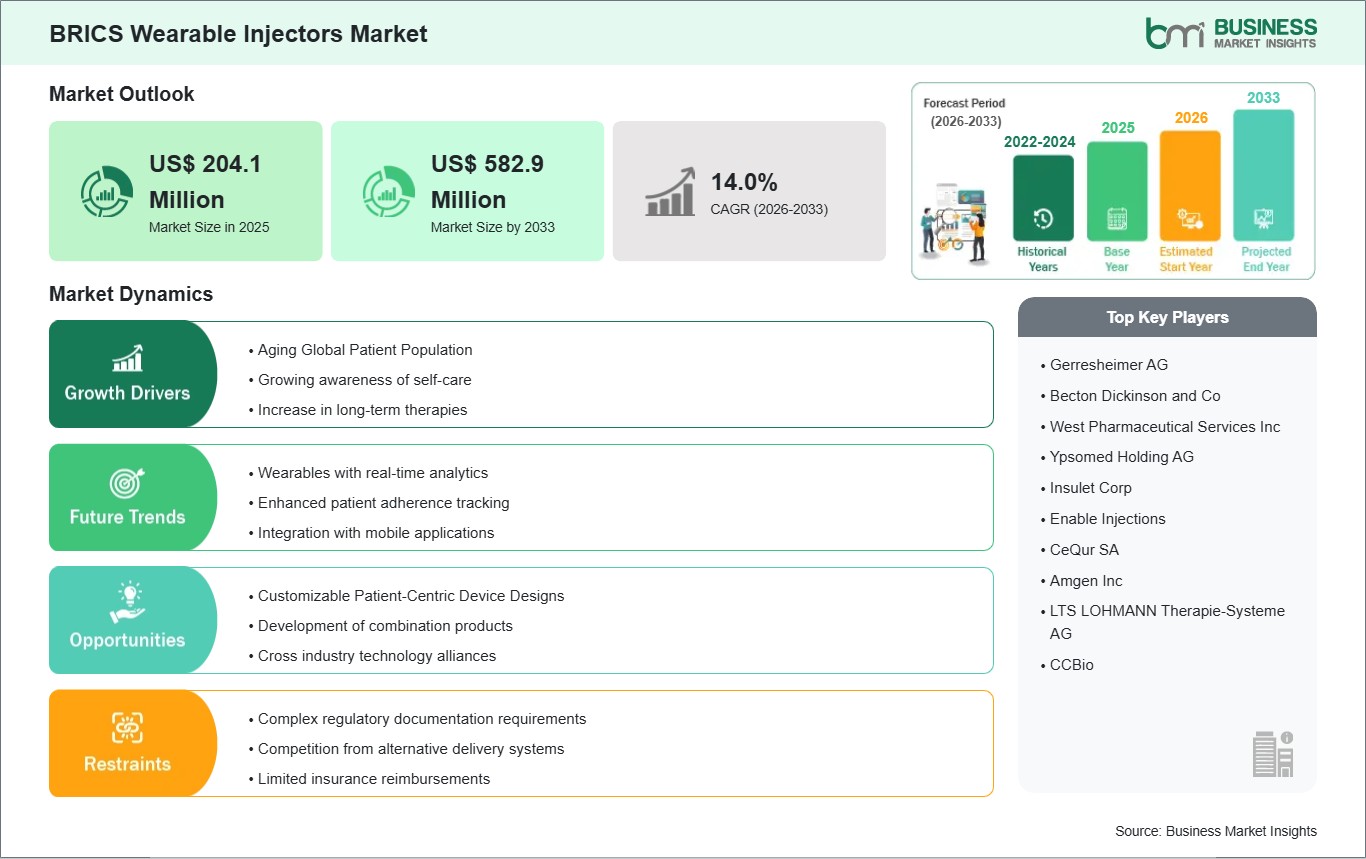
The BRICS wearable injectors market is rapidly evolving amid rising chronic disease prevalence and growing demand for patient-centric drug delivery solutions. Countries such as Brazil, Russia, India, China, and South Africa are experiencing a surge in diabetes, autoimmune disorders, and oncology indications, which require long-term, high-volume therapy administration. Wearable injectors are an effective alternative to hospital-based injections, enabling self-administration, improving adherence, and reducing the burden on healthcare facilities. Market dynamics within BRICS are influenced by global medical device manufacturers and emerging domestic players focusing on cost-effective, high-volume delivery solutions. Differentiation is driven by device ergonomics, extended wear capabilities, and the integration of digital health features, including remote monitoring and dose-tracking capabilities. Connectivity enables real-time interaction between patients and healthcare providers, allowing for adjustments in therapy and early intervention in case of non-adherence or dosing errors. Regulatory environments vary significantly across the BRICS countries. China and Brazil have more streamlined approval pathways that favor rapid commercialization, whereas India and South Africa require multi-layered regulatory navigation, which can prolong market entry timelines. Russia has a growing domestic manufacturing base, with regulatory modernization initiatives aimed at accelerating approvals for medical devices. Distribution channels leverage hospitals, specialty clinics, pharmacy networks, and increasingly e-commerce and telehealth-supported delivery services. Patient education and healthcare professional training are central to adoption, especially in regions where self-injection is a behavioral shift. Cost constraints and fragmented reimbursement schemes remain key challenges in some countries, while urbanized centers drive early adoption. Overall, BRICS markets are moving toward decentralized care models, positioning wearable injectors as a strategic solution for chronic disease management, with significant potential for growth as technology adoption and patient awareness continue to increase.
Segment Analysis
BRICS Wearable Injectors Market Segmentation
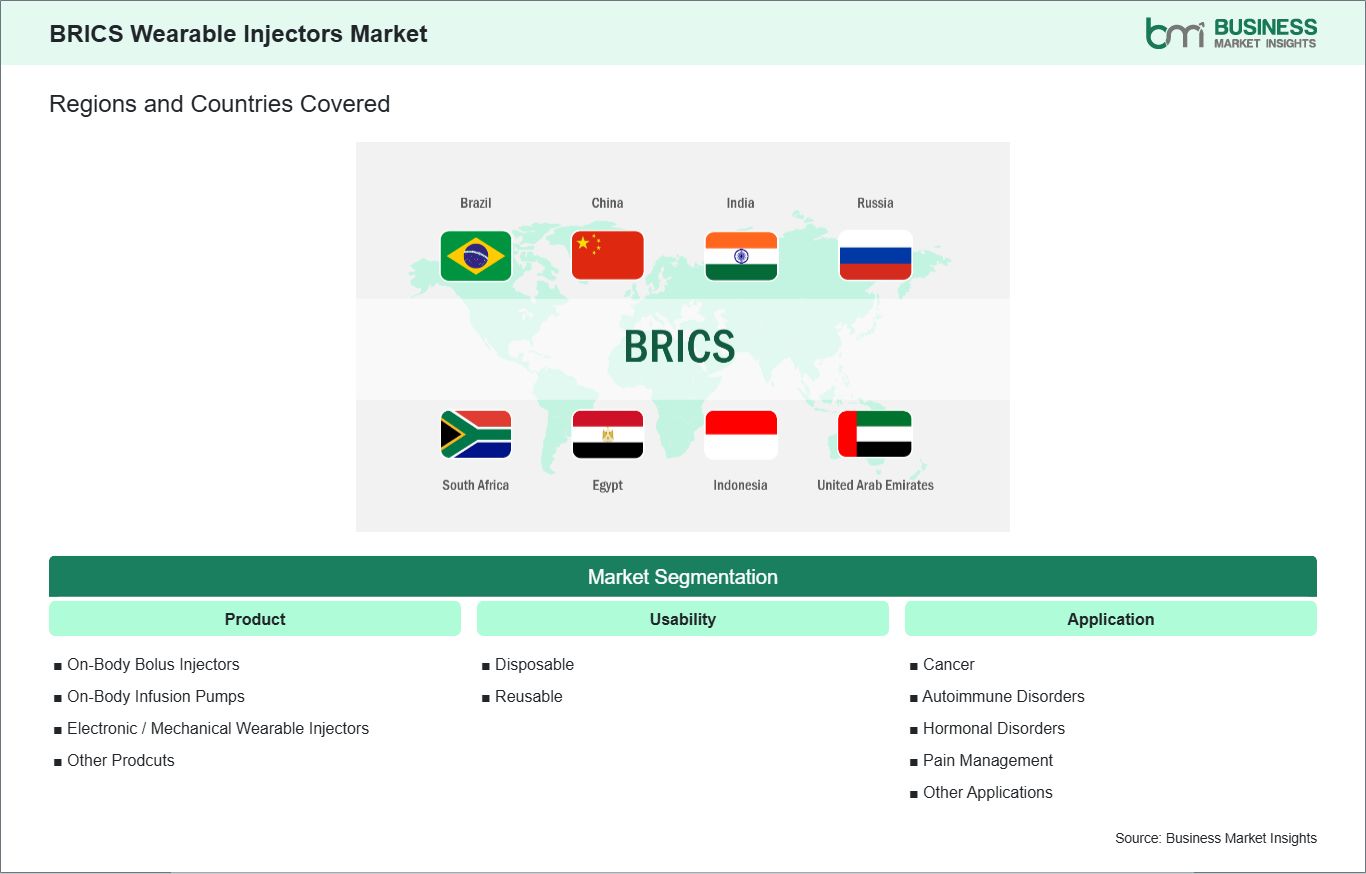
Key segments that contributed to the derivation of the BRICS wearable injectors market analysis are product, usability, and application.
- By product, the wearable injectors market is segmented into on-body bolus injectors, on-body infusion pumps, electronic / mechanical wearable injectors, and others. The on-body bolus injectors segment dominated the market in 2025.
- Based on usability, the wearable injectors market is categorized into disposable and reusable. The disposable segment dominated the market in 2025.
- In terms of application, the market is classified into cancer, autoimmune disorders, hormonal disorders, pain management, and other applications. The autoimmune disorders segment dominated the market in 2025.
Market Forces
BRICS Wearable Injectors Market Drivers and Opportunities
Aging Global Patient Population
The BRICS region—comprising Brazil, Russia, India, China, and South Africa—is experiencing a significant demographic shift toward older populations, which is influencing healthcare demand and the adoption of patient‑friendly medical technologies. As the number of senior individuals increases across these countries, there is a corresponding rise in chronic and age‑related conditions such as diabetes, cardiovascular diseases, and autoimmune disorders. This scenario is creating greater demand for therapies that require frequent or long‑term administration, and it has helped position wearable injectors as a compelling alternative to traditional delivery methods by reducing the need for repeated clinic visits and enhancing patient convenience. Within BRICS healthcare systems, policymakers and providers are placing a renewed emphasis on solutions that support aging populations in managing complex treatment regimens at home. In countries like China and India, where large segments of the population are entering middle age and beyond, there is growing recognition of the need to modernize drug delivery practices to improve treatment adherence and quality of life. Healthcare professionals increasingly view wearable injectors as tools that can help patients maintain independence while ensuring consistent delivery of biologic and high‑volume therapies—components that are critical for successful long‑term care among older adults. Across Brazil, Russia, and South Africa, healthcare systems are evolving to support decentralized care pathways that reduce pressure on inpatient facilities and integrate digital health monitoring. Wearable injectors fit within this broader shift by aligning with initiatives that emphasize patient‑centric care, remote support, and more efficient use of clinical resources. As BRICS governments and industry stakeholders increasingly prioritize sustainable care solutions for aging populations, wearable injectors are gaining visibility as part of a portfolio of technologies that can help address the complex needs of older patients across diverse market environments.
Customizable Patient-Centric Device Designs
Innovation in device design is a key driver for the wearable injectors market in the BRICS region, where diverse patient needs and healthcare delivery environments demand adaptable solutions. Manufacturers are focusing on developing wearable injectors with customizable features that cater to different user preferences, anatomical considerations, and therapy requirements. In markets such as India and Brazil, where the patient base includes a wide range of ages and health profiles, the ability to tailor device ergonomics, dosing schedules, and interface simplicity is essential to enhance user acceptance and adherence. These design considerations help differentiate wearable injectors from traditional injection methods and are expanding their appeal across multiple patient segments. BRICS healthcare stakeholders are also attentive to how device customization supports equitable access. Patients managing chronic conditions in urban centers may prioritise discreet, sleek form factors that integrate with personal electronics, while those in more rural areas may value robust designs that withstand variable environments and require minimal maintenance. In response, developers are creating modular platforms that can be configured for different use cases, incorporate multilingual instructional interfaces, and provide optional connectivity features for remote monitoring or clinician oversight. These adaptable design strategies align with regional healthcare priorities that emphasize both usability and scalability, particularly in systems transitioning toward more community‑based care. Collaboration between local research institutions, clinical practitioners, and global device manufacturers is further enhancing the focus on patient‑centric innovation in the BRICS wearable injectors market. Insights gathered from real‑world use across diverse populations inform iterative improvements and help ensure that devices address specific regional challenges, such as varying levels of digital literacy or differing healthcare access norms. This iterative co‑development approach is strengthening market confidence in advanced delivery systems and encouraging broader acceptance among clinicians and patients alike. As device design continues to evolve with patient needs at the forefront, wearable injectors are increasingly positioned not just as a medical tool but as an integral component of personalised treatment strategies across the BRICS healthcare landscape.
Size and Share Analysis
BRICS Wearable Injectors Market Size and Share Analysis
The BRICS Wearable Injectors Market demonstrates steady growth, with size and share analysis highlighting evolving trends and competitive dynamics among key players. The report examines subsegments categorized within product, usability, and application, offering insights into their contribution to overall market performance.
By product, the on-body bolus injectors subsegment dominated the market in 2025, driven by increasing demand for user‑friendly high‑volume delivery options in chronic and biologic therapies.
Based on usability, the disposable subsegment dominated the market in 2025, driven by the preference for affordable, single‑use wearable injectors that reduce cross‑contamination and maintenance burden.
In terms of application, the autoimmune disorders subsegment dominated the market in 2025, driven by growing patient populations with immune‑mediated diseases and rising access to self‑administered biologics in BRICS countries.
Report Coverage
BRICS Wearable Injectors Market Report Coverage and Deliverables
The "BRICS Wearable Injectors Market Size and Forecast (2022 - 2033)" report provides a detailed analysis of the market covering below areas:
- BRICS Wearable Injectors Market size and forecast at regional and country levels for all segments covered under the scope
- BRICS Wearable Injectors Market trends, as well as drivers, restraints, and opportunities
- BRICS Wearable Injectors Market analysis covering key trends, regional framework, major players, regulations, and recent developments
- Industry landscape and competition analysis covering market concentration, heat map analysis, prominent players, and recent developments for the BRICS Wearable Injectors Market
- Detailed company profiles, including SWOT analysis
Geographic Insights
BRICS Wearable Injectors Market Geographic Insights
The geographical scope of the BRICS Wearable Injectors Market report is divided into Russia, Brazil, South Africa, India, the UAE, and China. China held the largest share in 2025.
Country-level dynamics in the BRICS wearable injectors market highlight heterogeneous adoption patterns driven by healthcare infrastructure, regulatory environments, and patient behavior. China dominates the region due to its large patient population, high chronic disease burden, growing urban healthcare infrastructure, and government initiatives promoting home-based care. Urban centers such as Beijing, Shanghai, and Guangzhou have emerged as hubs for wearable injector adoption, with hospitals and specialty clinics incorporating connected devices for adherence monitoring. India is a rapidly growing market, particularly in metropolitan areas like Mumbai, Bengaluru, and Delhi. Adoption is driven by the expanding private healthcare sector, rising awareness of self-administration benefits, and local manufacturing initiatives that improve affordability. Challenges include fragmented insurance coverage, diverse regulatory requirements, and lower penetration in rural areas. Brazil exhibits steady adoption in major cities such as São Paulo and Rio de Janeiro, where private hospitals and specialty clinics are integrating wearable injectors into chronic therapy management. Regulatory reforms and strong physician engagement programs are facilitating adoption, although broader access remains constrained by reimbursement variability. Russia is witnessing early adoption, particularly in urban centers with high-income patient populations. The growing domestic manufacturing base and modernization of regulatory approval processes are expected to facilitate market expansion in the medium term. South Africa has a smaller but significant market, with adoption concentrated in private hospitals and specialty clinics in Johannesburg, Cape Town, and Durban. Awareness programs and partnerships between global manufacturers and local distributors are critical to expanding penetration in both urban and semi-urban areas. Overall, China and India represent the dominant and high-potential markets, while Brazil, Russia, and South Africa offer complementary growth opportunities. Success in BRICS requires tailored strategies that account for country-specific regulatory landscapes, infrastructure readiness, reimbursement policies, and patient engagement initiatives.
Industry Activity
Recent Developments
The BRICS Wearable Injectors Market is evaluated by gathering qualitative and quantitative data post primary and secondary research, which includes important corporate publications, association data, and databases. A few of the key developments in the BRICS wearable injectors market are:
- In August 2025, Enable Injections’ enFuse On‑Body Injectable Delivery System received regulatory approval from Brazil’s ANVISA, enabling the wearable drug delivery system to be legally marketed and used in Brazil for subcutaneous administration. This approval expands patient access to on‑body delivery outside clinical settings and supports broader BRICS wearable injector adoption. The enFuse® system is designed for fixed‑dose, large‑volume biologic delivery with factory‑filled options. The milestone also marked device registration progress toward broader Latin American market availability.
- In January 2026, ten23 health and Becton Dickinson announced a strategic collaboration to support full‑service commercialization and supply chain readiness of the BD Libertas Wearable Injector, enhancing its scalability for high‑volume subcutaneous drug delivery. The partnership combines BD’s injector technology with ten23’s development, aseptic filling, and quality services to help pharmaceutical partners bring wearable injectors to market more efficiently. Their joint work is designed to smooth regulatory pathways and support broader use of wearable injectables in clinical and at‑home settings. This collaboration reflects growing industry momentum toward integrating wearable injectors into standard therapeutic delivery strategies.
Trust & Transparency
Research Methodology
The market analysis combines proprietary research with secondary data from government agencies, company disclosures, regulatory filings, industry databases and expert interviews. Market estimates are validated through data triangulation, cross-market benchmarking and analyst
review.
View Full Research Methodology
Key Sources Referred:
World Health Organization (WHO)Organisation for Economic Cooperation and Development (OECD)The World Bank GroupWorldometerThe LancetInternational Bar AssociationInternational Trade Administration