Market Summary
Executive Summary and Market Analysis
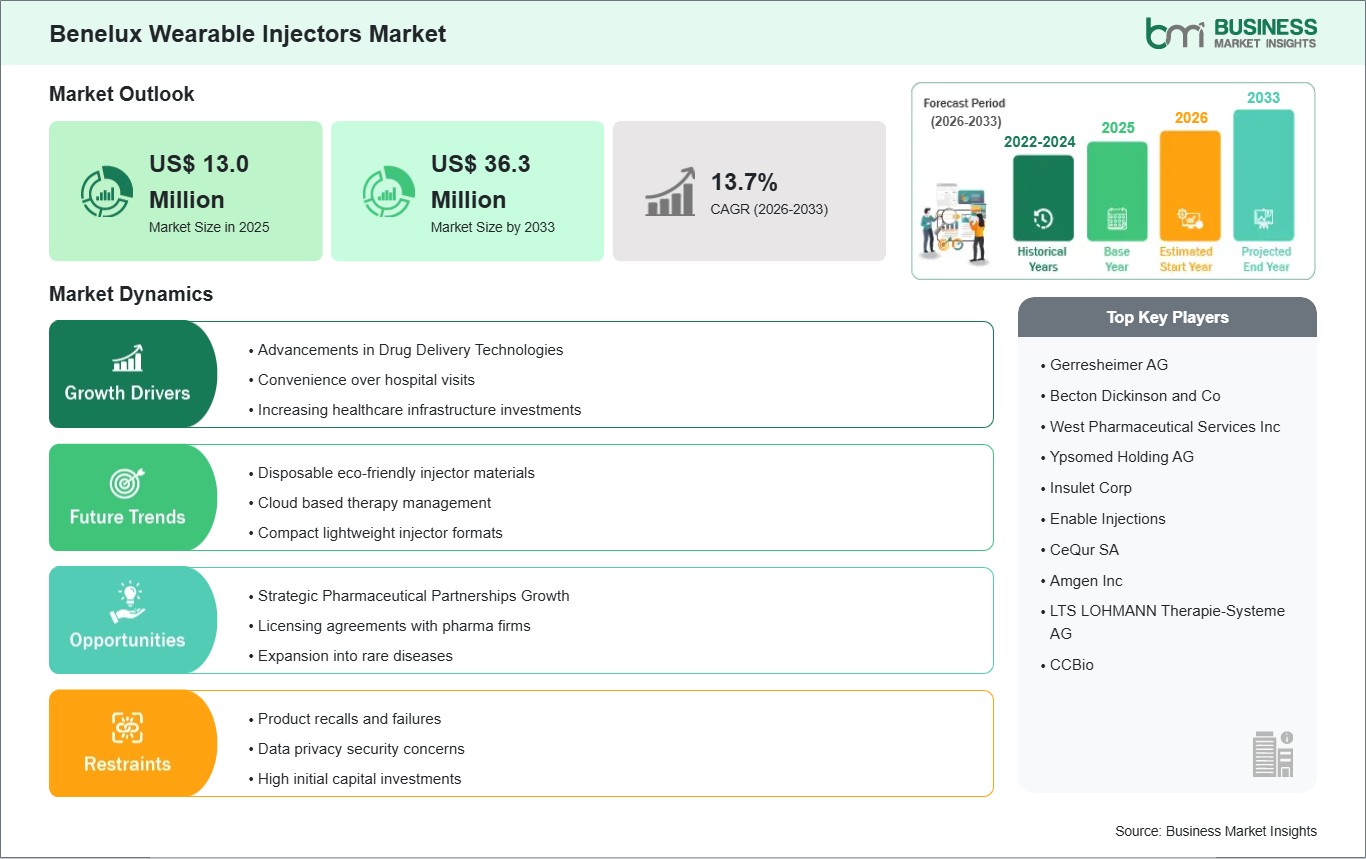
Wearable injectors are gaining prominence in Benelux’s advanced healthcare ecosystem, largely driven by the increasing prevalence of chronic and biologic-responsive diseases, such as diabetes and rheumatoid arthritis, as well as oncology indications. Patients and healthcare providers in Belgium, the Netherlands, and Luxembourg are increasingly seeking self-administration devices that reduce dependence on hospital-based injections, improve adherence, and optimize therapeutic outcomes. The adoption of wearable injectors in Benelux is facilitated by high health literacy, sophisticated medical infrastructure, and well-developed reimbursement and insurance frameworks, which collectively create a favorable environment for high-value medical devices. Market dynamics are characterized by a blend of multinational medical device manufacturers and local innovation-driven companies, emphasizing differentiation through user-centric design, extended wear capacity, and integration with digital monitoring platforms. Wearable injectors equipped with connected technology and remote dosing monitoring are gaining traction, enabling healthcare providers to track adherence, detect dosing errors, and adjust therapies in real time. Regulatory pathways in the Benelux region are streamlined relative to broader Europe, allowing relatively faster device approval while maintaining high standards for safety and efficacy. Distribution models in the region leverage both hospital networks and retail pharmacy channels, supplemented by digital health services for home delivery and patient support. Physician engagement, coupled with patient education programs, plays a central role in driving adoption, particularly for chronic therapy regimens where self-injection is still a behavioral shift. Cost containment, device reimbursement, and alignment with national healthcare guidelines remain important factors influencing adoption patterns. Overall, the Benelux market is poised for steady growth as wearable injectors become a mainstream therapeutic tool, complementing existing chronic care management strategies while supporting the broader shift toward decentralized, patient-centered care delivery.
Segment Analysis
Benelux Wearable Injectors Market Segmentation
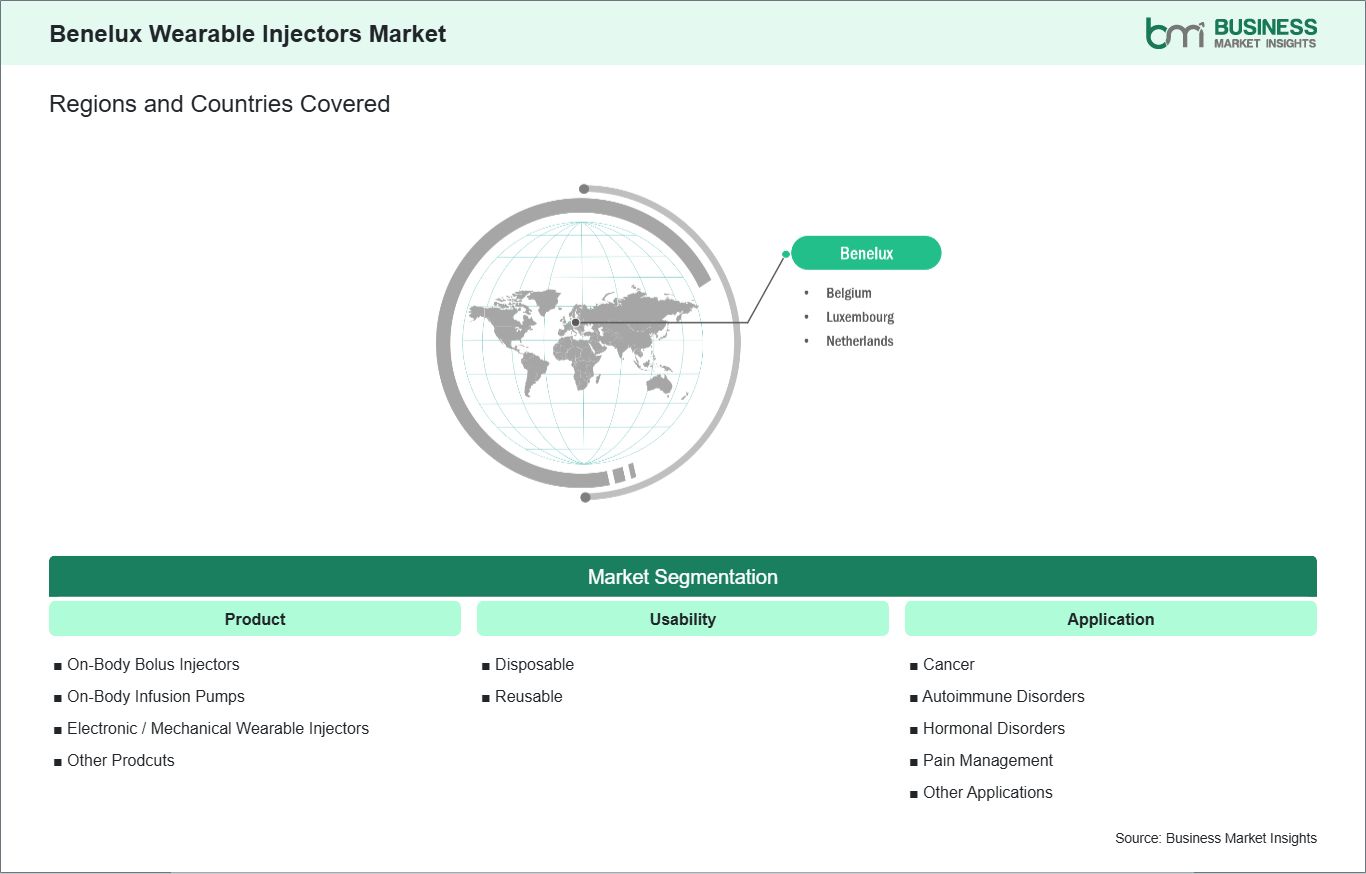
Key segments that contributed to the derivation of the Benelux wearable injectors market analysis are product, usability, and application.
- By product, the wearable injectors market is segmented into on-body bolus injectors, on-body infusion pumps, electronic / mechanical wearable injectors, and others. The on-body bolus injectors segment dominated the market in 2025.
- Based on usability, the wearable injectors market is categorized into disposable and reusable. The disposable segment dominated the market in 2025.
- In terms of application, the market is classified into cancer, autoimmune disorders, hormonal disorders, pain management, and other applications. The autoimmune disorders segment dominated the market in 2025.
Market Forces
Benelux Wearable Injectors Market Drivers and Opportunities
Advancements in Drug Delivery Technologies
Benelux is characterised by advanced healthcare infrastructure and a strong emphasis on innovation in medical technologies, which creates a supportive environment for the adoption of next‑generation drug delivery solutions. Within Belgium, the Netherlands, and Luxembourg, pharmaceutical stakeholders and medical device developers are actively exploring ways to differentiate therapeutic offerings through value‑added delivery mechanisms. Wearable injectors are increasingly considered an important component of this technological evolution, as they enable more patient‑centric administration of biologics and high‑volume therapies outside traditional clinical settings. The focus in Benelux is on devices that improve ease of use, accuracy of dosing, and overall patient experience, reflecting broader European healthcare priorities around quality and efficiency in drug delivery. Institutes and industry players in the region are also engaged in research and development efforts that aim to refine wearable drug delivery systems to meet evolving therapeutic demands. Given the high density of life science activity in the Benelux economic union, developers have access to a skilled workforce, strong clinical research networks, and proximity to major European regulatory bodies. These factors support iterative advancements in device design, such as miniaturization, ergonomic improvement, and integration with monitoring capabilities. The result is a local innovation ecosystem where drug delivery technologies like wearable injectors are continually refined to align with clinical needs and patient preferences. Healthcare practitioners in Benelux are already accustomed to leveraging advanced drug delivery tools and are receptive to adopting new systems that enhance treatment convenience and adherence. In particular, wearable injectors appeal to segments of the patient population that require frequent or long‑term subcutaneous therapy, offering a viable alternative to conventional syringe‑based administration. As both clinicians and patients become more familiar with the operational and therapeutic benefits of advanced drug delivery technologies, this regional familiarity bolsters market readiness for wearable injector adoption and supports ongoing investment in their development and commercialization.
Strategic Pharmaceutical Partnerships Growth
The Benelux wearable injectors market is also influenced by the region’s strong culture of strategic partnerships across pharmaceutical and medtech sectors. Collaboration between local manufacturers, multinational pharmaceutical companies, and specialised distribution partners is helping to bridge gaps between product innovation, regulatory navigation, and market access. These partnerships often aim to co‑develop, co‑promote, or co‑commercialise advanced delivery solutions, enabling stakeholders to share expertise and align strategic objectives to drive adoption of wearable injectors in clinical practice. Such cooperative ventures reflect a broader shift toward integrated delivery ecosystems where device capabilities and therapeutic value are jointly optimised. Cross‑industry partnerships are particularly important in navigating the regulatory and reimbursement landscape that characterizes the Benelux market. Companies seeking to introduce wearable injector technologies frequently engage with regional stakeholders who understand the unique pricing and reimbursement frameworks in Belgium, the Netherlands, and Luxembourg. These collaborations help device innovators tailor their commercial strategies to align with local healthcare policy priorities, streamline product launches, and ensure smoother integration into existing healthcare delivery pathways. Strategic alliances also often involve shared market research and education initiatives that build clinician confidence in adopting new drug delivery platforms. In addition, partnerships with contract commercialization firms and specialist sales organisations enhance the market reach of wearable injectors throughout the region. These service partners bring deep relationships with healthcare professionals, pharmacies, and insurers, helping to accelerate uptake and scale distribution. Through coordinated efforts with regional marketing and logistics experts, manufacturers can more effectively position wearable injectors as a compelling solution for both specialist clinics and community care settings. The growth of such strategic partnerships strengthens the overall market infrastructure in Benelux, creating a more resilient commercial environment for advanced drug delivery technologies and supporting long‑term adoption trends for wearable injectors.
Size and Share Analysis
Benelux Wearable Injectors Market Size and Share Analysis
The Benelux Wearable Injectors Market demonstrates steady growth, with size and share analysis highlighting evolving trends and competitive dynamics among key players. The report examines subsegments categorized within product, usability, and application, offering insights into their contribution to overall market performance.
By product, the on-body bolus injectors subsegment dominated the market in 2025, driven by increasing demand for compact, wearable devices that support flexible dosing schedules.
Based on usability, the disposable subsegment dominated the market in 2025, driven by growing preference for low‑risk, single-use injectors that simplify patient self-care.
In terms of application, the autoimmune disorders subsegment dominated the market in 2025, driven by rising prevalence of chronic autoimmune conditions and higher adoption of biologic therapies in the region.
Report Coverage
Benelux Wearable Injectors Market Report Coverage and Deliverables
The "Benelux Wearable Injectors Market Size and Forecast (2022 - 2033)" report provides a detailed analysis of the market covering below areas:
- Benelux Wearable Injectors Market size and forecast at regional and country levels for all segments covered under the scope
- Benelux Wearable Injectors Market trends, as well as drivers, restraints, and opportunities
- Benelux Wearable Injectors Market analysis covering key trends, regional framework, major players, regulations, and recent developments
- Industry landscape and competition analysis covering market concentration, heat map analysis, prominent players, and recent developments for the Benelux Wearable Injectors Market
- Detailed company profiles, including SWOT analysis
Geographic Insights
Benelux Wearable Injectors Market Geographic Insights
The geographical scope of the Benelux Wearable Injectors Market report is divided into Belgium, the Netherlands, and Luxembourg. The Netherlands held the largest share in 2025.
Country-level dynamics within the Benelux region highlight diverse adoption patterns driven by healthcare infrastructure maturity, regulatory frameworks, and patient behavior. The Netherlands emerges as a leading market in the region, driven by its advanced healthcare infrastructure, high patient awareness, and well-established reimbursement systems. Urban centers such as Amsterdam, Rotterdam, and Utrecht are witnessing strong adoption of wearable injectors in specialty clinics and hospital-based chronic care programs. Patients benefit from structured education programs and insurance coverage that reduce out-of-pocket costs, while healthcare providers increasingly integrate digital monitoring and telehealth tools to track adherence and optimize treatment outcomes. Belgium represents a mature and steadily growing market, particularly in urban hospitals and specialty clinics focused on chronic disease management. Reimbursement policies and robust private insurance coverage facilitate patient access to wearable injectors, while connected technologies allow physicians and homecare providers to monitor adherence, detect dosing issues, and intervene when necessary. Luxembourg, though smaller in scale, demonstrates early adoption of wearable injectors supported by high per capita healthcare spending and concentrated specialty care infrastructure. Hospitals and private clinics in Luxembourg City are integrating wearable injectors for biologics and other chronic therapies, with digital health solutions enabling seamless home-based monitoring. Across the Benelux region, adoption is influenced by clinician engagement, digital health integration, and patient readiness for self-administration. The Netherlands represents the dominant market with high adoption rates and a supportive regulatory and reimbursement environment. Belgium provides strong complementary growth potential, while Luxembourg serves as a niche market with high per capita value. Companies targeting the region must prioritize regulatory compliance, patient education, clinician training, and integration with connected health platforms to maximize uptake and establish a sustainable market presence.
Industry Activity
Recent Developments
The Benelux Wearable Injectors Market is evaluated by gathering qualitative and quantitative data post primary and secondary research, which includes important corporate publications, association data, and databases. A few of the key developments in the Benelux wearable injectors market are:
- In March 2025, enFuse Syringe Transfer System received EU MDR CE Mark approval, enabling its wider commercialization across EU countries, including those in Benelux.
- In October 2025, Incyte and Enable Injections signed a strategic agreement to develop and commercialize an investigational therapy with enFuse On‑Body Delivery System, illustrating a clinical expansion of wearable delivery into oncology portfolios with EU regulatory backing.
Trust & Transparency
Research Methodology
The market analysis combines proprietary research with secondary data from government agencies, company disclosures, regulatory filings, industry databases and expert interviews. Market estimates are validated through data triangulation, cross-market benchmarking and analyst
review.
View Full Research Methodology
Key Sources Referred:
World Health Organization (WHO)Organisation for Economic Cooperation and Development (OECD)The World Bank GroupWorldometerThe LancetInternational Bar AssociationInternational Trade Administration