Market Summary
Executive Summary and Market Analysis
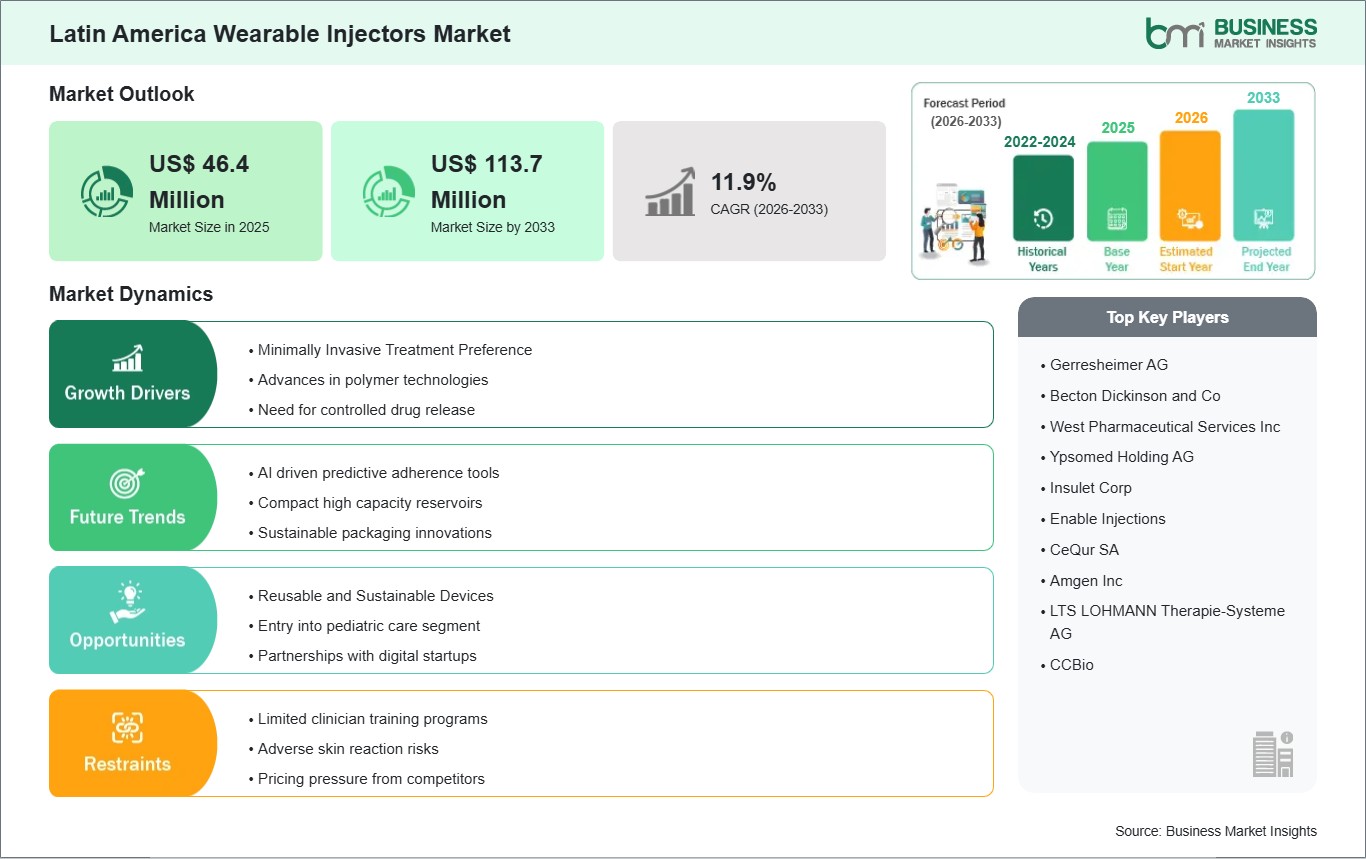
The Latin America wearable injectors market is undergoing gradual expansion driven by rising chronic disease prevalence, increasing adoption of biologic therapies, and an evolving focus on patient-centric healthcare. Countries such as Brazil, Mexico, Argentina, Colombia, and Chile are experiencing significant increases in diabetes, autoimmune disorders, and oncology indications, which necessitate precise and consistent drug delivery. Wearable injectors provide an alternative to traditional hospital-based injections, allowing patients to self-administer therapies, enhance treatment adherence, and reduce the strain on overstretched healthcare facilities. Market dynamics in Latin America are shaped by both global medical device manufacturers and emerging regional players. Key differentiation factors include device ergonomics, ease of use, extended wear capabilities, and the integration of digital monitoring systems. Connected wearable injectors enable clinicians to track dosing patterns in real-time, identify adherence challenges, and make informed therapy adjustments, improving patient outcomes and reducing complications. Regulatory frameworks across Latin America vary widely. Brazil and Mexico have relatively well-structured approval pathways, allowing for faster commercialization, while countries like Argentina and Colombia require more complex multi-tiered regulatory navigation. Distribution channels typically rely on hospital networks, specialty clinics, and pharmacy chains, increasingly supported by telemedicine and homecare services to enhance accessibility. Physician engagement, patient education, and training programs are central to adoption, particularly in markets where self-injection is a novel concept. Cost considerations, reimbursement variability, and limited insurance penetration in some countries remain barriers; however, rising awareness of home-based care benefits and technological adoption indicate substantial growth potential. Overall, the Latin America wearable injectors market is poised for steady expansion, driven by innovation, patient-centered care models, and the gradual integration of digital healthcare platforms.
Segment Analysis
Latin America Wearable Injectors Market Segmentation
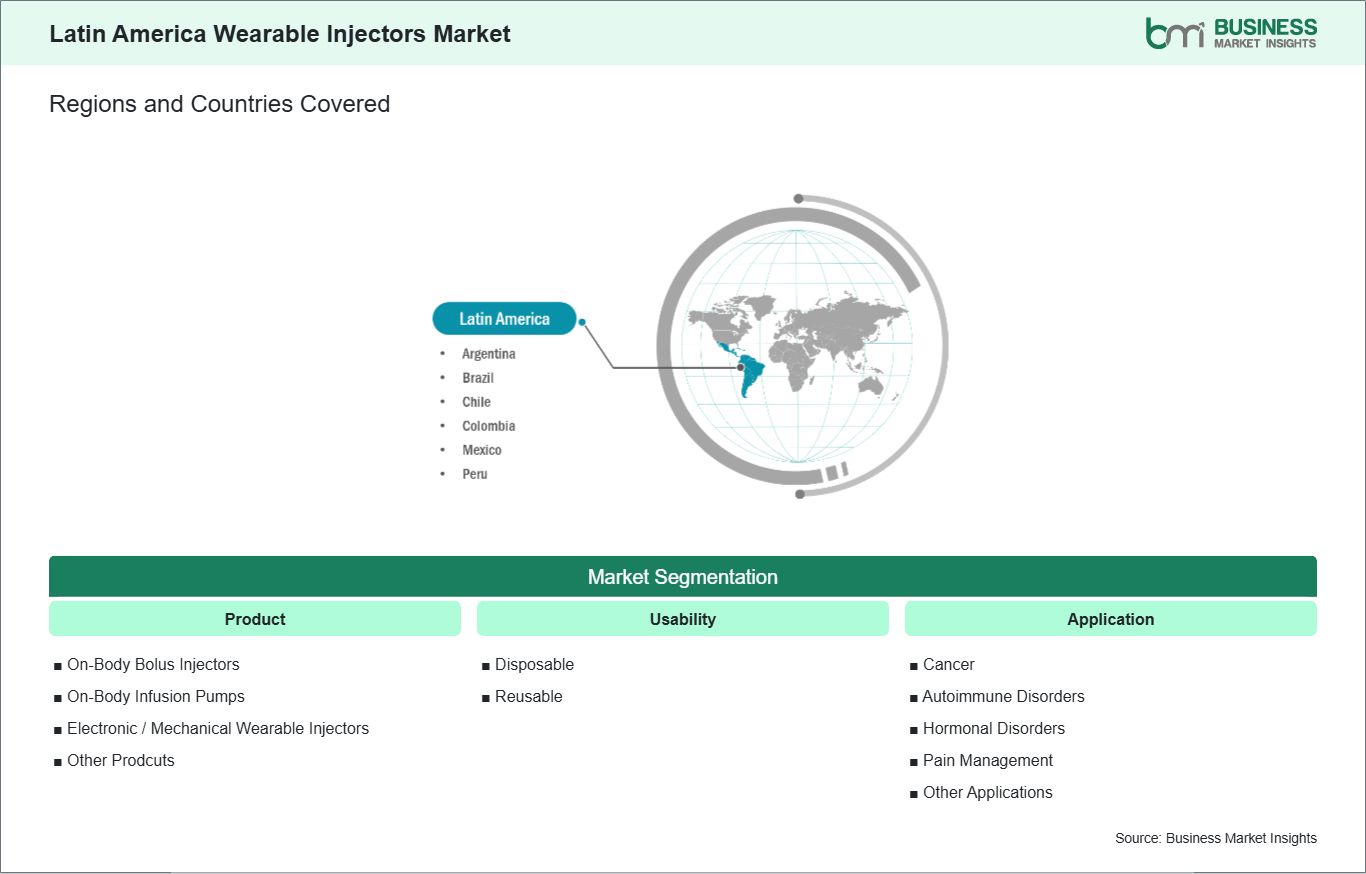
Key segments that contributed to the derivation of the Latin America wearable injectors market analysis are product, usability, and application.
- By product, the wearable injectors market is segmented into on-body bolus injectors, on-body infusion pumps, electronic / mechanical wearable injectors, and others. The on-body bolus injectors segment dominated the market in 2025.
- Based on usability, the wearable injectors market is categorized into disposable and reusable. The disposable segment dominated the market in 2025.
- In terms of application, the market is classified into cancer, autoimmune disorders, hormonal disorders, pain management, and other applications. The autoimmune disorders segment dominated the market in 2025.
Market Forces
Latin America Wearable Injectors Market Drivers and Opportunities
Minimally Invasive Treatment Preference
Healthcare delivery in Latin America is increasingly guided by patient-centric approaches that prioritize minimally invasive treatments. Countries such as Brazil, Mexico, and Colombia are expanding outpatient care services and integrating technologies that reduce the need for hospital stays while improving patient comfort. Wearable injectors fit directly into this paradigm by providing controlled, subcutaneous drug delivery without requiring frequent clinic visits or intravenous access. For chronic conditions and biologic therapies, these devices reduce the physical and psychological burden on patients, making treatment more accessible and less disruptive to daily life. Patients and caregivers in Latin America are also showing growing acceptance of self-administered and home-based therapies. Cultural preferences in many urban and semi-urban communities favor convenience and autonomy, particularly for long-term treatments such as diabetes management, autoimmune therapy, and hormone replacement regimens. Wearable injectors meet this demand by offering reliable dosing, simplified operation, and discreet wearability, which enhances adherence and improves therapeutic outcomes. As healthcare literacy increases, these devices are becoming more recognized as tools that empower patients to manage their health proactively. Healthcare providers are supporting this trend by recommending devices that minimize intervention and reduce clinical workload. In public and private clinics alike, wearable injectors allow medical staff to focus on higher-acuity cases while ensuring routine therapies continue without interruption. Furthermore, Latin American healthcare policies are increasingly encouraging adoption of technologies that facilitate outpatient treatment and reduce resource utilization, aligning with regional efforts to improve efficiency and reduce healthcare system strain. Collectively, patient preference for minimally invasive solutions is creating a favorable environment for wearable injector adoption across the region.
Reusable and Sustainable Devices
Sustainability and cost-effectiveness are emerging priorities in Latin American healthcare procurement, especially for high-volume injectable therapies. Many countries, including Chile, Argentina, and Peru, are exploring strategies to reduce medical waste and implement environmentally responsible solutions without compromising patient safety. Reusable or partially reusable wearable injectors are gaining traction as they combine convenience with sustainability, allowing multiple dosing cycles from a single device while maintaining strict sterility and safety standards. Manufacturers targeting Latin America are increasingly incorporating eco-conscious design features such as recyclable materials, refillable reservoirs, and energy-efficient components. These innovations are particularly relevant in urban hospitals and outpatient clinics that manage high patient volumes, where reducing single-use plastic and electronic waste can result in significant environmental and cost benefits. By integrating sustainable practices into wearable injector design, suppliers are not only meeting regulatory expectations but also appealing to healthcare institutions and patients who value long-term ecological responsibility. Adoption of reusable devices is also supported by education and training programs for clinicians and patients. Demonstrating proper use, cleaning protocols, and safe refilling practices ensures that reusable wearable injectors can be implemented effectively while minimizing contamination risk. Latin American healthcare systems increasingly recognize the economic advantages of reusable devices, particularly in regions with limited supply chain infrastructure or budget constraints. The combination of sustainability, cost savings, and patient convenience positions reusable wearable injectors as an attractive growth segment within the Latin American medical device landscape.
Size and Share Analysis
Latin America Wearable Injectors Market Size and Share Analysis
The Latin America Wearable Injectors Market demonstrates steady growth, with size and share analysis highlighting evolving trends and competitive dynamics among key players. The report examines subsegments categorized within product, usability, and application, offering insights into their contribution to overall market performance.
By product, the on-body bolus injectors subsegment dominated the market in 2025, driven by increasing demand for wearable solutions that support high‑volume biologic delivery with minimal clinical supervision.
Based on usability, the disposable subsegment dominated the market in 2025, driven by growing preference for simple, single‑use injectors that reduce training needs and contamination risks.
In terms of application, the autoimmune disorders subsegment dominated the market in 2025, driven by rising incidence of chronic immune‑mediated conditions and expanding access to self‑administrable therapies.
Report Coverage
Latin America Wearable Injectors Market Report Coverage and Deliverables
The "Latin America Wearable Injectors Market Size and Forecast (2022 - 2033)" report provides a detailed analysis of the market covering below areas:
- Latin America Wearable Injectors Market size and forecast at regional and country levels for all segments covered under the scope
- Latin America Wearable Injectors Market trends, as well as drivers, restraints, and opportunities
- Latin America Wearable Injectors Market analysis covering key trends, regional framework, major players, regulations, and recent developments
- Industry landscape and competition analysis covering market concentration, heat map analysis, prominent players, and recent developments for the Latin America Wearable Injectors Market
- Detailed company profiles, including SWOT analysis
Geographic Insights
Latin America Wearable Injectors Market Geographic Insights
The geographical scope of the Latin America Wearable Injectors Market report is divided into Mexico, Brazil, Argentina, Peru, Chile, and Colombia. Brazil held the largest share in 2025.
Country-level dynamics in the Latin America wearable injectors market reflect varied adoption patterns influenced by healthcare infrastructure, regulatory frameworks, and patient awareness. Brazil dominates the region, driven by its large population, rising prevalence of chronic diseases, and rapidly expanding private healthcare sector. Cities such as São Paulo, Rio de Janeiro, and Brasília lead adoption, with hospitals and specialty clinics increasingly integrating wearable injectors for biologics and high-volume therapies. Telemedicine programs and government-supported homecare initiatives further reinforce Brazil’s leadership position. Mexico represents a significant market, with adoption concentrated in urban centers such as Mexico City, Monterrey, and Guadalajara. Rising awareness of patient-centric care, coupled with private insurance coverage and partnerships between multinational manufacturers and local distributors, facilitates broader uptake. Argentina and Chile exhibit steady adoption, primarily in specialty hospitals and urban clinics. Argentina’s adoption is concentrated in Buenos Aires and Córdoba, while Chile’s focus is in Santiago and Valparaíso. Growth is supported by physician-led patient education programs and private healthcare networks, though regulatory complexity and reimbursement variability limit rapid scale-up. Colombia is emerging as a growth market, particularly in Bogotá and Medellín, where private hospitals are integrating wearable injectors for diabetes and oncology management. Awareness campaigns and collaborations with global device manufacturers are driving adoption. Peru is showing early-stage adoption in Lima and other major urban centers, supported by high-income patient populations and expanding private healthcare networks. Efforts to raise patient awareness and integrate digital monitoring tools are gradually facilitating market entry and adoption. Overall, Brazil dominates the Latin America wearable injectors market, while Mexico, Argentina, Chile, Colombia, and Peru provide complementary growth opportunities. Companies entering the region must develop tailored strategies addressing regulatory compliance, insurance coverage, clinician training, patient education, and digital health integration to maximize adoption and sustainable market presence.
Industry Activity
Recent Developments
The Latin America Wearable Injectors Market is evaluated by gathering qualitative and quantitative data post primary and secondary research, which includes important corporate publications, association data, and databases. A few of the key developments in the Latin America wearable injectors market are:
- In August 2025, Enable Injections, Inc. announced that Brazil’s Agencia Nacional de Vigilância Sanitaria (ANVISA) granted regulatory approval for its enFuse on‑body drug delivery system, allowing subcutaneous medication administration using this wearable injector platform throughout Brazil. The approval certifies that the enFuse system and its transfer components meet applicable Brazilian safety and quality criteria, enabling broader distribution of the device in Latin America’s largest market.
- In January 2026, ten23 health announced a manufacturing collaboration with BD to support supply chain readiness for the BD Libertas wearable injector as a fully integrated solution. The partnership is designed to help pharmaceutical companies bring large‑volume subcutaneous drug delivery programs to clinics and market by combining BD’s device platform with ten23’s aseptic fill‑finish and assembly services.
Trust & Transparency
Research Methodology
The market analysis combines proprietary research with secondary data from government agencies, company disclosures, regulatory filings, industry databases and expert interviews. Market estimates are validated through data triangulation, cross-market benchmarking and analyst
review.
View Full Research Methodology
Key Sources Referred:
World Health Organization (WHO)Organisation for Economic Cooperation and Development (OECD)The World Bank GroupWorldometerThe LancetInternational Bar AssociationInternational Trade Administration