Eastern Europe Wearable Injectors Market Outlook (2022-2033)

Historic Data: 2022-2024   |   Base Year: 2025   |   Forecast Period: 2026-2033
Report Content: Market Scope, Market Segmentation, Market Dynamics, and Competitive Analysis

Report Coverage:
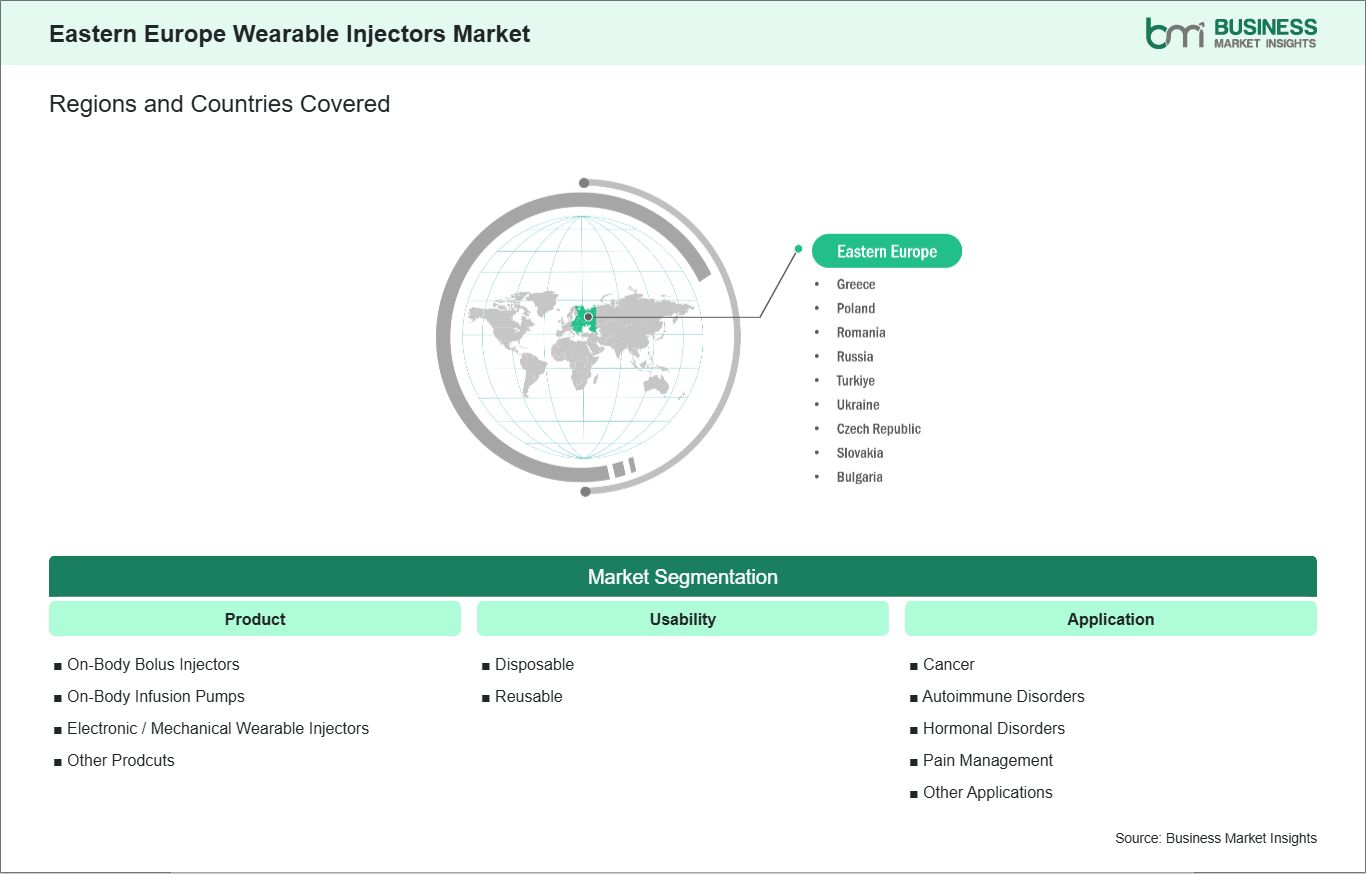
  • Product (On-Body Bolus Injectors, On-Body Infusion Pumps, Electronic / Mechanical Wearable Injectors, Other Prodcuts)
  • Usability (Disposable, Reusable)
  • Application (Cancer, Autoimmune Disorders, Hormonal Disorders, Pain Management, Other Applications)

No. of Pages: 150
Report Code: BMIPUB00034790
Category: Life Sciences
Eastern Europe Wearable Injectors Market

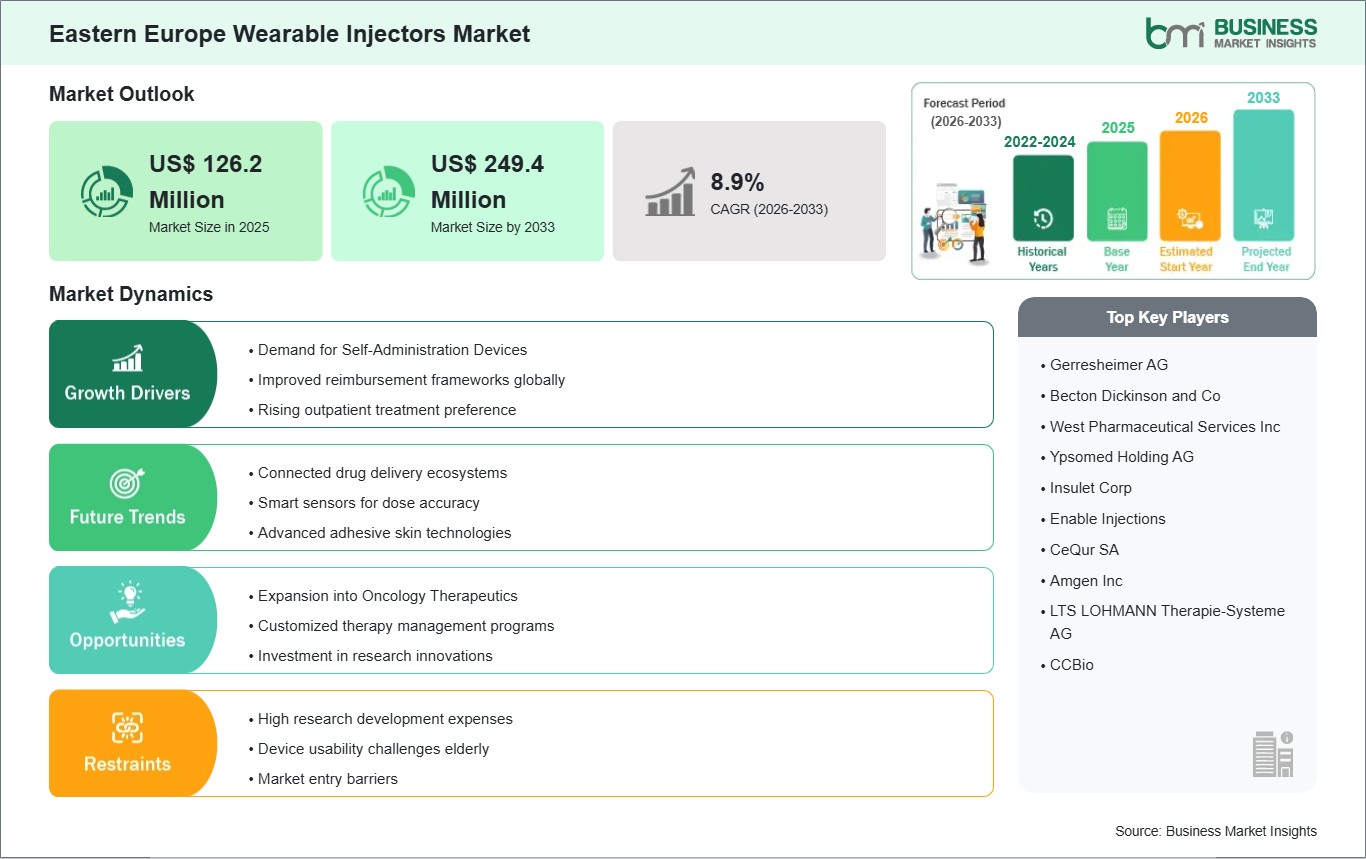
The Eastern Europe Wearable Injectors Market size is expected to reach US$ 249.4 million by 2033 from US$ 126.2 million in 2025. The market is estimated to record a CAGR of 8.9% from 2026 to 2033.

Executive Summary and Eastern Europe Wearable Injectors Market Analysis:

The Eastern Europe wearable injectors market is in a rapidly developing stage, reflecting a growing demand for patient-centric drug delivery solutions that improve adherence and reduce reliance on hospital-based injections. Rising prevalence of diabetes, autoimmune disorders, and oncology indications is driving healthcare providers to explore advanced delivery mechanisms capable of supporting home-based and outpatient care models. Urbanized healthcare centers in Poland, Czechia, Hungary, and Romania are witnessing the early adoption of wearable injectors, primarily among patients requiring biologics or high-volume therapies. Market dynamics are shaped by a combination of global medical device manufacturers and emerging local players, with competition centered around ergonomics, ease of self-administration, wear duration, and integration with digital health monitoring. Devices with wireless connectivity, dosing reminders, and remote adherence tracking are gaining traction, enabling clinicians to monitor therapy progress and intervene proactively when necessary. Regulatory frameworks in Eastern Europe vary significantly. Countries such as Poland and Czechia have relatively well-established pathways for device approval, enabling faster market entry, while nations such as Romania and Bulgaria require complex multi-tiered approvals. Distribution channels leverage hospital networks, specialty clinics, and pharmacy-based channels, often supplemented by telemedicine platforms to extend accessibility. Healthcare professional engagement and patient education are critical adoption levers in the region, particularly in markets where self-injection practices are still emerging. Cost considerations, fragmented reimbursement schemes, and infrastructure limitations continue to present challenges, but growing interest from private healthcare providers and rising awareness of home-based care solutions signal strong potential for market expansion. Overall, the Eastern Europe wearable injectors market is poised to evolve into a key component of chronic disease management, with innovation, patient engagement, and digital integration driving adoption.

Eastern Europe Wearable Injectors Market - Strategic Insights:

global-market-strategic-framework
Get more information on this report

Eastern Europe Wearable Injectors Market Segmentation Analysis:

Key segments that contributed to the derivation of the Eastern Europe wearable injectors market analysis are product, usability, and application.

  • By product, the wearable injectors market is segmented into on-body bolus injectors, on-body infusion pumps, electronic / mechanical wearable injectors, and others. The on-body bolus injectors segment dominated the market in 2025.
  • Based on usability, the wearable injectors market is categorized into disposable and reusable. The disposable segment dominated the market in 2025.
  • In terms of application, the market is classified into cancer, autoimmune disorders, hormonal disorders, pain management, and other applications. The autoimmune disorders segment dominated the market in 2025.

Eastern Europe Wearable Injectors Market Drivers and Opportunities:

Demand for Self-Administration Devices

Across countries like Poland, Hungary, Romania, and the Czech Republic, long‑term and chronic therapies are placing increasing strain on traditional clinical infrastructure, consequently creating greater interest in devices that enable patients to manage their treatments more independently and securely. Wearable injectors are an effective alternative that offer predictable and user‑friendly delivery of advanced therapies in home or community settings, freeing up clinical resources and streamlining the treatment experience for patients. Patient expectations are also shifting in Eastern Europe toward more convenient and flexible treatment modalities. Several individuals are inclining toward self‑administered care supported by digital tools as part of broader healthcare modernization efforts. Wearable injectors appeal to these preferences by combining simplicity of use with technology‑enabled features that support consistent delivery and reduce the discomfort often associated with frequent clinic visits. This evolving mindset among care recipients toward proactive self‑management encourages wider acceptance of wearable drug delivery platforms as a viable alternative to traditional administration methods. Healthcare providers in Eastern Europe are increasingly integrating self‑administration devices into therapeutic regimens, particularly where long‑term adherence and quality‑of‑life improvements are priorities. Providers recognise that wearable injectors can support adherence by reducing barriers to treatment continuity, especially for patients requiring regular biologic or injectable therapies. As national and regional healthcare strategies place greater emphasis on decentralised care and patient engagement, wearable injectors are gaining traction as tools that align with both practitioner goals and patient preferences, accelerating their incorporation into standard care pathways.

Expansion into Oncology Therapeutics

The Eastern European wearable injectors market is also evolving due to growing emphasis on innovative oncology therapeutics and supportive care solutions. Oncology care across the region is transitioning toward more targeted treatment regimens, including therapies that benefit from sustained subcutaneous or programmable administration outside of traditional infusion centers. Wearable injectors cater to this shift by providing devices capable of delivering complex oncology drugs in less resource‑intensive environments, thereby broadening access and fitting more seamlessly into evolving cancer care models. Clinicians and cancer care teams in Eastern Europe are recognising the potential for wearable injectors to enhance patient comfort and adherence, particularly for regimens that would otherwise require frequent hospital visits. As oncology treatment protocols increasingly prioritise patient convenience and quality of life, wearable injectors are positioned as supportive tools that enable outpatient administration of supportive therapies or even extended dosing schedules that complement core chemotherapy or targeted treatment plans. This potential to decentralise aspects of oncology therapy is prompting interest from both providers and payers seeking cost‑effective care models for long‑term cancer management. Manufacturers and innovators targeting the Eastern European market are increasingly exploring devices and service models geared toward oncology applications. There is a growing focus on developing wearable injectors that offer programmable delivery profiles, intuitive interfaces, and integration with care management systems to support oncology patients’ needs. By aligning product development with clinical priorities such as dose accuracy, patient comfort, and flexibility of use, device suppliers are positioning wearable injectors as credible options within the broader oncology treatment ecosystem. As care delivery continues to evolve in Eastern Europe toward more personalised, patient‑centric approaches, expansion of wearable injectors into oncology therapeutics is emerging as a strategic area of market development.

Eastern Europe Wearable Injectors Market Size and Share Analysis:

The Eastern Europe Wearable Injectors Market demonstrates steady growth, with size and share analysis highlighting evolving trends and competitive dynamics among key players. The report examines subsegments categorized within product, usability, and application, offering insights into their contribution to overall market performance.

By product, the on-body bolus injectors subsegment dominated the market in 2025, driven by rising preference for advanced, hands‑free delivery solutions that improve adherence to chronic treatment regimens.

Based on usability, the disposable subsegment dominated the market in 2025, driven by strong demand for low‑maintenance, hygienic devices that support safe self‑administration outside clinical settings.

In terms of application, the autoimmune disorders subsegment dominated the market in 2025, driven by increasing incidence of immune‑related conditions and expanding availability of biologic therapies requiring frequent injections.

Eastern Europe Wearable Injectors Market Report Highlights:

Report Attribute Details
Market size in 2025 US$ 126.2 Million
Market Size by 2033 US$ 249.4 Million
CAGR (2026 - 2033)8.9%
Historical Data 2022-2024
Forecast period 2026-2033
Segments Covered By Product
  • On-Body Bolus Injectors
  • On-Body Infusion Pumps
  • Electronic / Mechanical Wearable Injectors
  • Other Prodcuts
By Usability
  • Disposable
  • Reusable
By Application
  • Cancer
  • Autoimmune Disorders
  • Hormonal Disorders
  • Pain Management
  • Other Applications
Regions and Countries Covered
Eastern Europe Russia, Poland, Ukraine, Romania, the Czech Republic, Slovakia, Bulgaria, Greece
Market leaders and key company profiles
  • Gerresheimer AG
  • Becton Dickinson and Co
  • West Pharmaceutical Services Inc
  • Ypsomed Holding AG
  • Insulet Corp
  • Enable Injections
  • CeQur SA
  • Amgen Inc
  • LTS LOHMANN Therapie-Systeme AG
Get more information on this report

Eastern Europe Wearable Injectors Market Report Coverage and Deliverables:

The "Eastern Europe Wearable Injectors Market Size and Forecast (2022 - 2033)" report provides a detailed analysis of the market covering below areas:

  • Eastern Europe Wearable Injectors Market size and forecast at regional and country levels for all segments covered under the scope
  • Eastern Europe Wearable Injectors Market trends, as well as drivers, restraints, and opportunities
  • Eastern Europe Wearable Injectors Market analysis covering key trends, regional framework, major players, regulations, and recent developments
  • Industry landscape and competition analysis covering market concentration, heat map analysis, prominent players, and recent developments for the Eastern Europe Wearable Injectors Market
  • Detailed company profiles, including SWOT analysis

Eastern Europe Wearable Injectors Market Geographic Insights:

The geographical scope of the Eastern Europe Wearable Injectors Market report is divided into Russia, Poland, Ukraine, Romania, the Czech Republic, Slovakia, Bulgaria, and Greece. Russia held the largest share in 2025.

Country-level dynamics within Eastern Europe highlight diverse adoption patterns driven by healthcare infrastructure, regulatory frameworks, and patient behavior. Russia emerges as the dominant market, propelled by its large patient population, rising prevalence of diabetes, oncology, and autoimmune disorders, and the rapid expansion of private and specialty healthcare facilities. Major urban centers such as Moscow, St. Petersburg, and Kazan lead adoption, with hospitals and specialty clinics integrating wearable injectors for biologics and high-volume therapies. The growing awareness of self-administration benefits, combined with initiatives promoting home-based care and telemedicine, further reinforces Russia’s leadership position in the region. Poland represents a mature market, with adoption concentrated in urban hospitals and specialty clinics managing chronic disease and oncology care. Reimbursement policies and structured insurance schemes support patient access to wearable injectors, while healthcare providers increasingly leverage connected devices to monitor adherence and optimize therapy outcomes. Ukraine is an emerging market where adoption is primarily in major cities such as Kyiv, Lviv, and Odessa. The market is driven by increasing chronic disease prevalence and the expansion of private hospitals, though infrastructure gaps and fragmented reimbursement coverage present challenges for broader penetration. Romania shows gradual adoption, with wearable injectors being used predominantly in Bucharest and Cluj-Napoca specialty clinics. Awareness campaigns and partnerships with device manufacturers are facilitating incremental uptake, despite limited insurance coverage and regulatory complexity slowing wider adoption. The Czech Republic and Slovakia demonstrate steady adoption, with urban hospitals and specialty care networks actively integrating wearable injectors into chronic care management programs. High health literacy, supportive regulatory frameworks, and structured patient education programs facilitate acceptance in these markets. Bulgaria and Greece represent smaller but strategic markets, with adoption concentrated in urban centers and private healthcare facilities. While reimbursement and cost constraints limit rapid scale-up, targeted initiatives and digital health integration support gradual market expansion. Overall, Russia dominates the Eastern Europe wearable injectors market, while Poland, the Czech Republic, Slovakia, Ukraine, Romania, Bulgaria, and Greece offer complementary growth opportunities. Companies entering the region must implement country-specific strategies that address regulatory requirements, patient education, clinician engagement, and digital monitoring integration to maximize market impact and sustainable adoption.

global-market-geography
Get more information on this report

Eastern Europe Wearable Injectors Market Research Report Guidance:

  • The report includes qualitative and quantitative data in the Eastern Europe Wearable Injectors Market across product, usability, application, and geography.
  • The report starts with the key takeaways (chapter 2), highlighting key trends and outlook of the Eastern Europe Wearable Injectors Market.
  • Chapter 3 focuses on the research methodology of the study.
  • Chapter 4 includes ecosystem analysis.
  • Chapter 5 highlights the major industry dynamics in the Eastern Europe Wearable Injectors Market, including factors that are driving the market, prevailing deterrents, potential opportunities, as well as future trends. Impact analysis of these drivers and restraints is also covered in this section.
  • Chapter 6 discusses the Eastern Europe Wearable Injectors Market scenario, in terms of historical market revenues, and forecast till the year 2033.
  • Chapters 7 to 10 cover Eastern Europe Wearable Injectors Market segments by product, usability, application, and geography across Russia, Poland, Ukraine, Romania, the Czech Republic, Slovakia, Bulgaria, and Greece. They cover the market revenue, forecast, and factors driving the market.
  • Chapter 11 describes the competitive analysis along with the heat map analysis for the key players operating in the market.
  • Chapter 12 describes the industry landscape analysis. It provides detailed descriptions of business activities such as market initiatives, new developments, mergers, and joint ventures globally, along with a competitive landscape.
  • Chapter 13 provides detailed profiles of the major companies operating in the Eastern Europe Wearable Injectors Market. Companies have been profiled on the basis of their key facts, business descriptions, products, financial overview, SWOT analysis, and key developments.
  • Chapter 14, i.e., the appendix, is inclusive of a brief overview of the company, a list of abbreviations, and a disclaimer.

Eastern Europe Wearable Injectors Market News and Key Development:

The Eastern Europe Wearable Injectors Market is evaluated by gathering qualitative and quantitative data post primary and secondary research, which includes important corporate publications, association data, and databases. A few of the key developments in the Eastern Europe wearable injectors market are:

  • In March 2025, Enable Injections received the EU MDR CE Mark for its enFuse on‑body delivery system and syringe transfer technology, allowing market distribution of the wearable injector platform throughout the European Union. This approval validates the device’s safety and performance for subcutaneous drug delivery workflows in EU member states. It supports both in‑clinic and patient self‑administration of large‑volume biologics using an on‑body wearable format.
  • In June 2025, Sanofi issued a press release reporting new clinical data showing that the investigational subcutaneous use of Sarclisa via an on‑body injector showed comparable safety and efficacy to IV infusion, based on phase 2/3 studies presented at the ASCO Annual Meeting. The studies used an on‑body injector (Enable’s enFuse‑based system) as part of research toward potential regulatory submissions. Sanofi emphasized the patient convenience and provider workflow benefits of wearable injector delivery in oncology. This development provides context for wearable injector evaluation throughout European clinical practice.

Key Sources Referred:

  • World Health Organization (WHO)
  • Organisation for Economic Cooperation and Development (OECD)
  • The World Bank Group
  • Worldometer
  • The Lancet
  • International Bar Association
  • International Trade Administration
The List of Companies - Eastern Europe Wearable Injectors Market
  • Gerresheimer AG
  • Becton Dickinson and Co
  • West Pharmaceutical Services Inc
  • Ypsomed Holding AG
  • Insulet Corp
  • Enable Injections
  • CeQur SA
  • Amgen Inc
  • LTS LOHMANN Therapie-Systeme AG
  • CCBio
Frequently Asked Questions
How big is the Eastern Europe Wearable Injectors Market?

The Eastern Europe Wearable Injectors Market is valued at US$ 126.2 Million in 2025, it is projected to reach US$ 249.4 Million by 2033.

What is the CAGR for Eastern Europe Wearable Injectors Market by (2026 - 2033)?

As per our report Eastern Europe Wearable Injectors Market, the market size is valued at US$ 126.2 Million in 2025, projecting it to reach US$ 249.4 Million by 2033. This translates to a CAGR of approximately 8.9% during the forecast period.

What segments are covered in this report?

The Eastern Europe Wearable Injectors Market report typically cover these key segments-

  • Product (On-Body Bolus Injectors, On-Body Infusion Pumps, Electronic / Mechanical Wearable Injectors, Other Prodcuts)
  • Usability (Disposable, Reusable)
  • Application (Cancer, Autoimmune Disorders, Hormonal Disorders, Pain Management, Other Applications)

What is the historic period, base year, and forecast period taken for Eastern Europe Wearable Injectors Market?

The historic period, base year, and forecast period can vary slightly depending on the specific market research report. However, for the Eastern Europe Wearable Injectors Market report:

  • Historic Period : 2022-2024
  • Base Year : 2025
  • Forecast Period : 2026-2033
  • Who are the major players in Eastern Europe Wearable Injectors Market?

    The Eastern Europe Wearable Injectors Market is populated by several key players, each contributing to its growth and innovation. Some of the major players include:

  • Gerresheimer AG
  • Becton Dickinson and Co
  • West Pharmaceutical Services Inc
  • Ypsomed Holding AG
  • Insulet Corp
  • Enable Injections
  • CeQur SA
  • Amgen Inc
  • LTS LOHMANN Therapie-Systeme AG
  • CCBio
  • Who should buy this report?

    The Eastern Europe Wearable Injectors Market report is valuable for diverse stakeholders, including:

    • Investors: Provides insights for investment decisions pertaining to market growth, companies, or industry insights. Helps assess market attractiveness and potential returns.
    • Industry Players: Offers competitive intelligence, market sizing, and trend analysis to inform strategic planning, product development, and sales strategies.
    • Suppliers and Manufacturers: Helps understand market demand for components, materials, and services related to concerned industry.
    • Researchers and Consultants: Provides data and analysis for academic research, consulting projects, and market studies.
    • Financial Institutions: Helps assess risks and opportunities associated with financing or investing in the concerned market.

    Essentially, anyone involved in or considering involvement in the Eastern Europe Wearable Injectors Market value chain can benefit from the information contained in a comprehensive market report.

    Available Report Formats

    pdf-format excel-format pptx-format
    Buy Now
    Sales Assistance
    +1 646 791 7070 (US & UK)
    Customization Form

    Please tell us your area of interest
    (Market Segments/ Regions and Countries/ Companies)