Market Summary
Executive Summary and Market Analysis
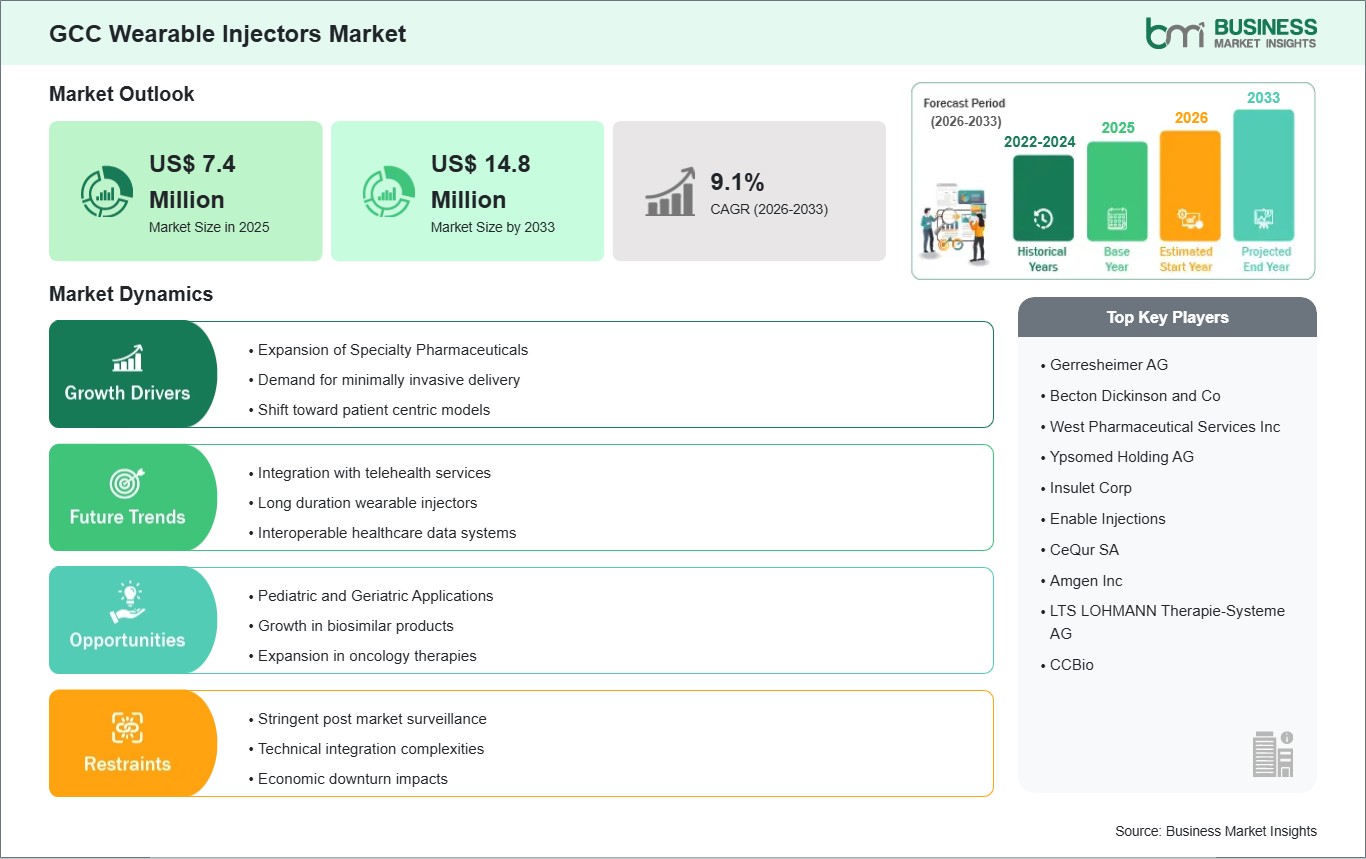
The GCC wearable injectors market is experiencing accelerated growth driven by rising chronic disease prevalence, increased adoption of biologic therapies, and a strategic shift toward patient-centric care. Countries such as Saudi Arabia, the United Arab Emirates, Qatar, Kuwait, Bahrain, and Oman are witnessing increasing incidences of diabetes, autoimmune disorders, and oncology conditions, which are driving demand for self-administration devices capable of delivering high-volume therapies with accuracy and convenience. Wearable injectors offer a viable alternative to hospital-based injections, reducing patient dependency on clinical visits and supporting home-based care initiatives. Market dynamics are characterized by competition between established multinational device manufacturers and emerging regional players focused on localized solutions. Device innovation is a key differentiator, with emphasis on ergonomics, user-friendliness, extended wear times, and smart connectivity features such as remote monitoring, dose tracking, and integration with mobile health platforms. These connected devices enable healthcare providers to monitor adherence, intervene proactively in case of dosing irregularities, and personalize therapy regimens, enhancing both clinical outcomes and patient satisfaction. Regulatory frameworks in the GCC are generally favorable, with countries such as Saudi Arabia and the UAE streamlining approval processes to encourage the adoption of advanced medical devices. Distribution channels leverage hospitals, specialty clinics, and pharmacy-led networks, while telemedicine-supported home delivery services are emerging as critical facilitators of accessibility. Physician engagement and patient education programs remain central to driving adoption, particularly in markets where self-injection is still gaining acceptance. Cost considerations, insurance coverage variability, and alignment with national healthcare strategies continue to influence adoption patterns. Nevertheless, increasing digital health penetration, government initiatives supporting chronic care management, and rising patient awareness of self-administration benefits indicate significant growth potential. Overall, the GCC wearable injectors market is positioned to expand steadily as the region embraces innovative, patient-centered, and digitally integrated therapeutic solutions.
Segment Analysis
GCC Wearable Injectors Market Segmentation
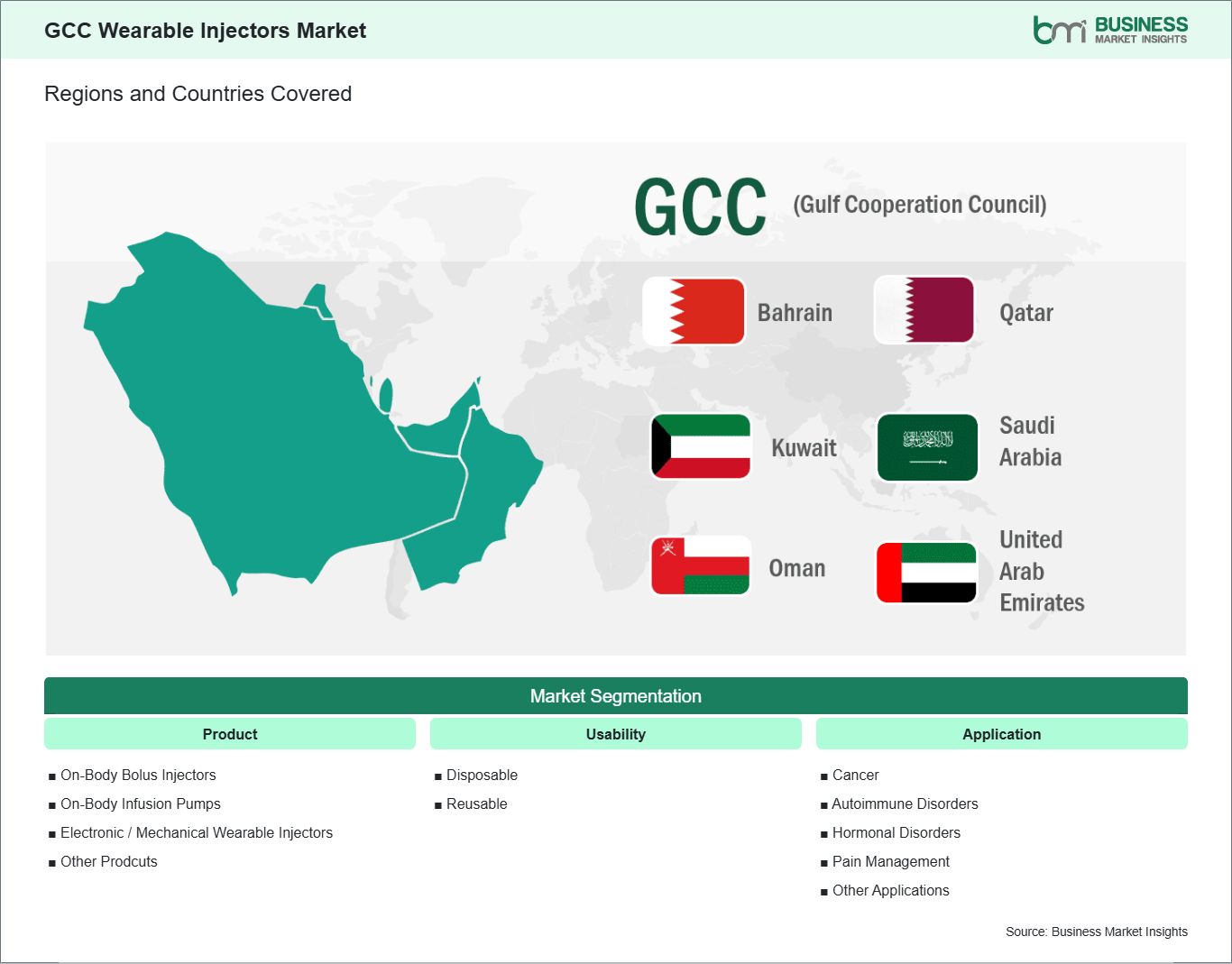
Key segments that contributed to the derivation of the GCC wearable injectors market analysis are product, usability, and application.
- By product, the wearable injectors market is segmented into on-body bolus injectors, on-body infusion pumps, electronic / mechanical wearable injectors, and others. The on-body bolus injectors segment dominated the market in 2025.
- Based on usability, the wearable injectors market is categorized into disposable and reusable. The disposable segment dominated the market in 2025.
- In terms of application, the market is classified into cancer, autoimmune disorders, hormonal disorders, pain management, and other applications. The autoimmune disorders segment dominated the market in 2025.
Market Forces
GCC Wearable Injectors Market Drivers and Opportunities
Expansion of Specialty Pharmaceuticals
The GCC region is witnessing a rapid shift toward high-value specialty pharmaceuticals, driven by government initiatives to improve treatment outcomes for complex and chronic diseases. Countries like Saudi Arabia and the UAE are actively supporting the introduction of advanced biologics, targeted therapies, and gene-based medications, reflecting a broader ambition to elevate the quality of care in line with global standards. This expansion is creating demand for drug delivery solutions that can manage the unique requirements of specialty medicines, including high viscosity, precise dosing, and stability concerns. Wearable injectors are increasingly positioned as the ideal delivery platform to complement these advanced therapies, enabling patients to safely self-administer medications outside hospital settings while maintaining treatment consistency. In addition, the growing private healthcare sector in the GCC is fostering the adoption of technologies that enhance patient convenience and improve operational efficiency. Specialty pharmaceuticals often require complex dosing schedules that can strain hospital resources if delivered exclusively through clinical visits. Wearable injectors address this challenge by decentralizing therapy administration, allowing patients to follow treatment plans at home or in community care settings. This aligns with regional health strategies that aim to reduce inpatient loads and optimize healthcare delivery efficiency, particularly in rapidly growing urban centers like Riyadh, Dubai, and Doha. Pharmaceutical companies operating in the GCC are also leveraging wearable injectors to differentiate their specialty drug offerings. By bundling therapy with advanced delivery devices, manufacturers can enhance perceived value and support adherence, while also gathering real-world usage data that informs ongoing therapy optimization. Collaborative efforts between local distributors, healthcare providers, and device manufacturers are creating integrated programs that ensure both patients and clinicians are confident in the safety and efficacy of self-administered specialty treatments. This ecosystem approach is fueling the market for wearable injectors as part of a broader strategy to expand specialty pharmaceutical adoption in the region.
Pediatric and Geriatric Applications
The GCC market is uniquely influenced by a dual demographic focus: a growing elderly population alongside a dynamic pediatric segment with evolving healthcare needs. In the geriatric population, chronic conditions such as diabetes, arthritis, and cardiovascular diseases require frequent or long-term injectable therapies. Wearable injectors offer an accessible solution by simplifying administration and reducing the physical strain associated with traditional injections, enabling older patients to manage their treatment independently while maintaining a higher quality of life. For pediatric patients, wearable injectors address both clinical and emotional challenges associated with repeated injections. Children with growth disorders, autoimmune conditions, or chronic illnesses often experience anxiety and discomfort with conventional therapy methods. Wearable injectors designed with child-friendly ergonomics and minimal pain delivery can enhance adherence and improve overall treatment experience. Caregivers in the GCC are increasingly receptive to these devices as they offer reassurance, reduce the burden of frequent hospital visits, and fit seamlessly into family routines, supporting continuity of care for young patients. Healthcare systems in the GCC are also adapting clinical protocols and support services to optimize the use of wearable injectors across age groups. Training programs for caregivers, guidance for clinicians, and integration with digital health monitoring are becoming standard practices in larger hospitals and private clinics. Device manufacturers are responding by developing injectors with adjustable dosing, user-friendly interfaces, and features that accommodate varying mobility and dexterity levels. This emphasis on patient-centered design for both children and older adults strengthens the adoption potential of wearable injectors, highlighting the GCC market as one that values devices tailored to the full spectrum of patient needs.
Size and Share Analysis
GCC Wearable Injectors Market Size and Share Analysis
The GCC Wearable Injectors Market demonstrates steady growth, with size and share analysis highlighting evolving trends and competitive dynamics among key players. The report examines subsegments categorized within product, usability, and application, offering insights into their contribution to overall market performance.
By product, the on-body bolus injectors subsegment dominated the market in 2025, driven by a growing focus on advanced drug delivery solutions that support enhanced mobility and adherence for chronic conditions.
Based on usability, the disposable subsegment dominated the market in 2025, driven by a strong preference for cost‑effective, low‑risk single‑use devices that simplify self‑administration.
In terms of application, the autoimmune disorders subsegment dominated the market in 2025, driven by rising prevalence of immune‑mediated diseases and increased access to biologic therapies requiring frequent injections.
Report Coverage
GCC Wearable Injectors Market Report Coverage and Deliverables
The "GCC Wearable Injectors Market Size and Forecast (2022 - 2033)" report provides a detailed analysis of the market covering below areas:
- GCC Wearable Injectors Market size and forecast at regional and country levels for all segments covered under the scope
- GCC Wearable Injectors Market trends, as well as drivers, restraints, and opportunities
- GCC Wearable Injectors Market analysis covering key trends, regional framework, major players, regulations, and recent developments
- Industry landscape and competition analysis covering market concentration, heat map analysis, prominent players, and recent developments for the GCC Wearable Injectors Market
- Detailed company profiles, including SWOT analysis
Geographic Insights
GCC Wearable Injectors Market Geographic Insights
The geographical scope of the GCC Wearable Injectors Market report is divided into the UAE, Bahrain, Saudi Arabia, Oman, Qatar, and Kuwait. The UAE held the largest share in 2025.
Country-level dynamics in the GCC wearable injectors market demonstrate diverse adoption patterns driven by healthcare infrastructure, regulatory support, and patient behavior. Saudi Arabia emerges as the dominant market, fueled by a large patient population, increasing chronic disease burden, and robust private and public healthcare infrastructure. Urban centers such as Riyadh, Jeddah, and Dammam are leading adoption, with hospitals and specialty clinics integrating wearable injectors into chronic disease management programs. Government initiatives supporting home-based care and telemedicine further strengthen Saudi Arabia’s leadership position. The United Arab Emirates represents a highly advanced market, characterized by early adoption of wearable injectors in Dubai and Abu Dhabi specialty clinics. Integration with telehealth platforms and strong insurance coverage enable patients to access connected devices, while urbanized healthcare networks provide training and monitoring support. Qatar and Kuwait demonstrate growing adoption in urban centers, driven by high-income patient populations and expanding private hospitals. Adoption is primarily concentrated in diabetes and oncology care programs, with digital health integration facilitating patient engagement and therapy adherence. Bahrain and Oman represent smaller but emerging markets, where adoption is concentrated in specialty clinics in Manama and Muscat. Awareness campaigns, digital health initiatives, and partnerships with multinational manufacturers are critical for expanding penetration. Across the GCC, Saudi Arabia dominates the market, while the UAE, Qatar, Kuwait, Bahrain, and Oman provide complementary growth opportunities. Companies entering the region must adopt country-specific strategies focusing on regulatory compliance, clinician training, patient education, and integration with telemedicine and digital health platforms to maximize adoption and establish a sustainable presence.
Industry Activity
Recent Developments
The GCC Wearable Injectors Market is evaluated by gathering qualitative and quantitative data post primary and secondary research, which includes important corporate publications, association data, and databases. A few of the key developments in the GCC wearable injectors market are:
- In December 2025, Enable Injections, Inc. announced that its EMPAVELI Injector, based on the enFuse on‑body delivery system, received regulatory approval from the Saudi Food and Drug Authority (SFDA) under the country’s medical device authorization framework—a key step enabling legal sale and distribution of this large‑volume subcutaneous injection device in the Kingdom of Saudi Arabia.
- In January 2026, Enable Injections announced a US$ 30 million investment from Sanofi aimed at accelerating manufacturing capabilities for its enFuse wearable drug delivery platform, strengthening production readiness for global and GCC launches.
Trust & Transparency
Research Methodology
The market analysis combines proprietary research with secondary data from government agencies, company disclosures, regulatory filings, industry databases and expert interviews. Market estimates are validated through data triangulation, cross-market benchmarking and analyst
review.
View Full Research Methodology
Key Sources Referred:
World Health Organization (WHO)Organisation for Economic Cooperation and Development (OECD)The World Bank GroupWorldometerThe LancetInternational Bar AssociationInternational Trade Administration