Market Summary
Executive Summary and Market Analysis
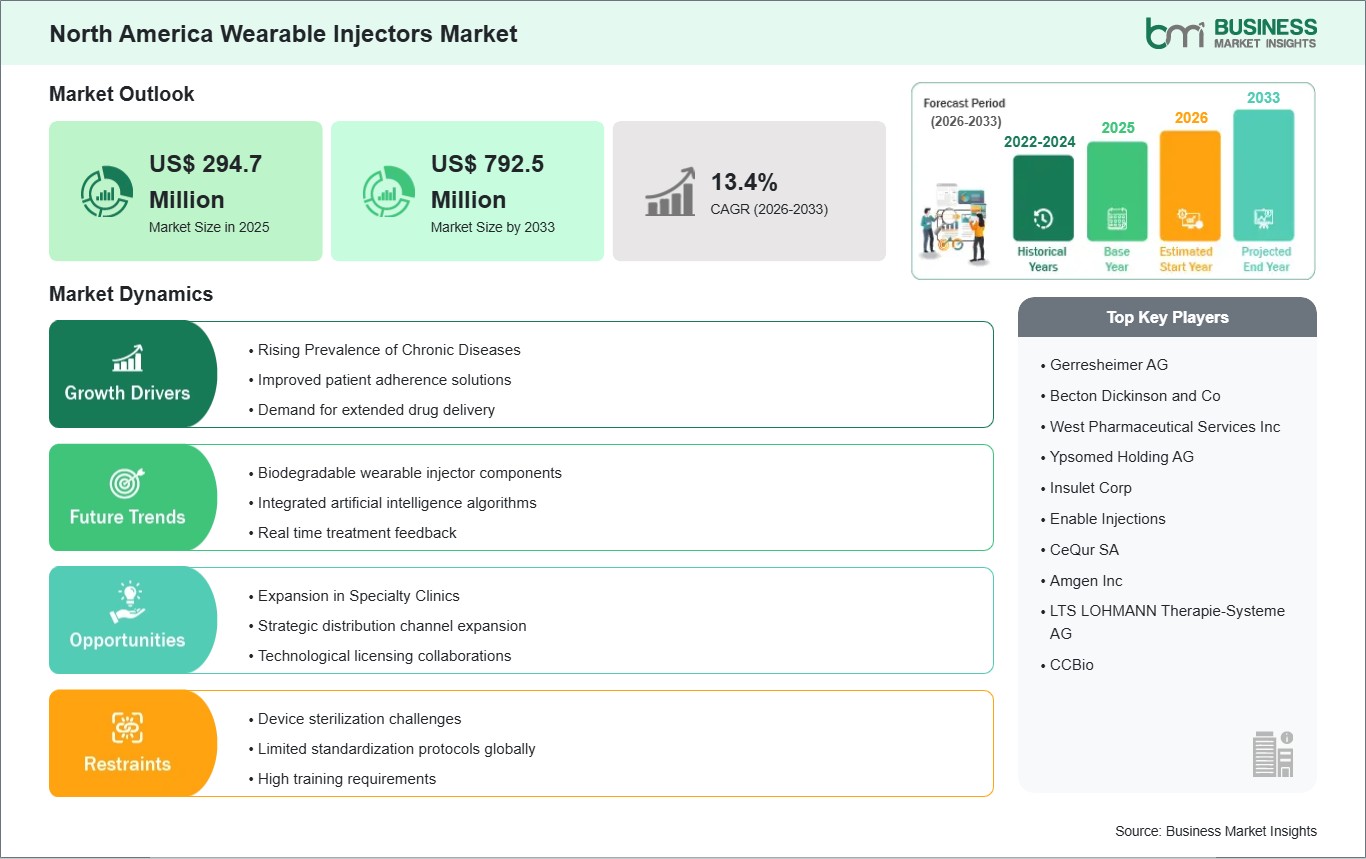
The North America wearable injectors market is witnessing rapid expansion driven by increasing adoption of biologic therapies, rising prevalence of chronic diseases, and a growing focus on patient-centric care models. Diabetes, autoimmune disorders, and oncology indications are fueling demand for advanced drug delivery solutions that improve dosing accuracy, reduce treatment errors, and enhance patient convenience. Wearable injectors enable continuous subcutaneous delivery of high-volume therapeutics, allowing patients to self-administer treatments at home or in outpatient settings while reducing dependency on hospital visits. Market dynamics are dominated by established multinational medical device manufacturers, complemented by innovative start-ups introducing connected and digital-enabled solutions. Device differentiation focuses on ergonomics, usability, safety features, and integration with digital health platforms for real-time adherence monitoring. North American clinicians increasingly value devices that enable data collection on patient adherence, dosing patterns, and therapy outcomes, facilitating proactive intervention and personalized treatment optimization. Regulatory frameworks in the United States and Canada are highly structured, with FDA and Health Canada approvals ensuring safety and efficacy. Reimbursement policies, particularly in the United States through private insurers and government programs, play a critical role in shaping adoption patterns. Distribution channels primarily include hospitals, specialty clinics, and homecare providers, with pharmacy-led models supplementing access in certain regions. High patient awareness and the cultural acceptance of self-administered therapies further support uptake. Despite pricing pressures and rigorous regulatory requirements, North America remains the most technologically advanced and competitive market for wearable injectors, with sustained adoption expected across both chronic disease and specialty therapy segments.
Segment Analysis
North America Wearable Injectors Market Segmentation
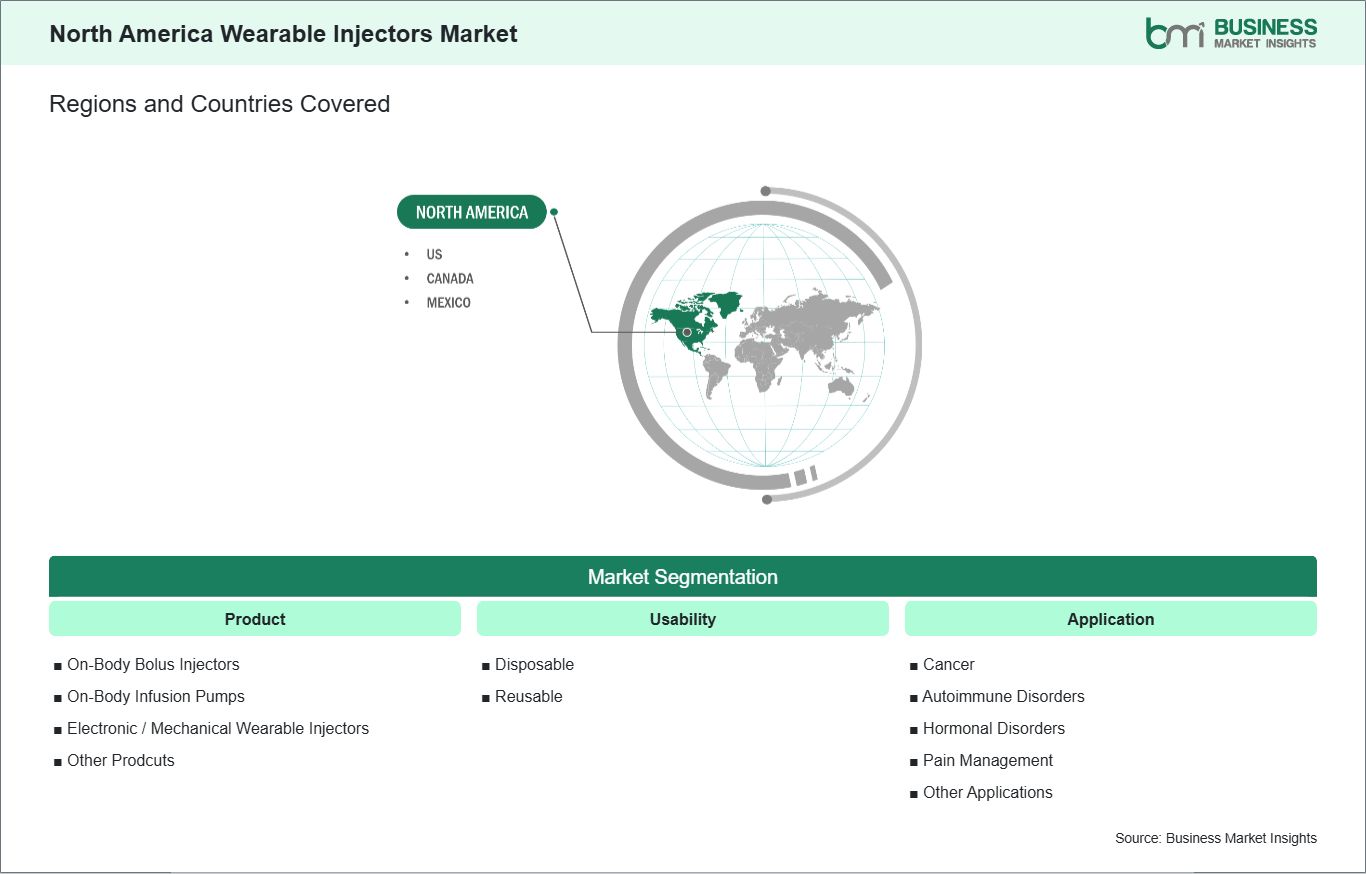
Key segments that contributed to the derivation of the North America wearable injectors market analysis are product, usability, and application.
- By product, the wearable injectors market is segmented into on-body bolus injectors, on-body infusion pumps, electronic / mechanical wearable injectors, and others. The on-body bolus injectors segment dominated the market in 2025.
- Based on usability, the wearable injectors market is categorized into disposable and reusable. The disposable segment dominated the market in 2025.
- In terms of application, the market is classified into cancer, autoimmune disorders, hormonal disorders, pain management, and other applications. The autoimmune disorders segment dominated the market in 2025.
Market Forces
North America Wearable Injectors Market Drivers and Opportunities
Rising Prevalence of Chronic Diseases
Patients managing long-term therapies require consistent dosing schedules, often involving high-volume or biologic medications. Wearable injectors offer an effective solution, enabling patients to self-administer therapy at home while maintaining precision and adherence. By reducing the need for frequent hospital visits or clinic-based injections, these devices help mitigate both patient burden and the strain on healthcare infrastructure. Healthcare providers are increasingly emphasizing patient-centric care approaches to address the complexities of chronic disease management. In the United States and Canada, the adoption of wearable injectors aligns with programs aimed at improving long-term treatment adherence and minimizing complications from missed or irregular dosing. The convenience and ease-of-use provided by these devices empower patients to maintain independence while supporting clinical objectives. This trend is further strengthened by educational programs, patient support services, and remote monitoring initiatives that complement wearable injector use, ensuring patients receive both guidance and reassurance while managing chronic conditions. Insurance providers and health systems are also recognizing the cost-saving potential of wearable injectors in chronic disease management. By reducing hospital visits, preventing treatment errors, and improving adherence, these devices contribute to more predictable healthcare expenditures over time. In addition, the growing integration of digital health platforms enhances the value proposition of wearable injectors, enabling real-time tracking of administration patterns and providing clinicians with actionable insights. The combination of rising chronic disease prevalence, patient empowerment initiatives, and cost containment priorities is driving steady growth in wearable injector adoption across North America.
Expansion in Specialty Clinics
Specialty clinics in North America are increasingly serving as hubs for complex disease management, offering focused care in areas such as endocrinology, oncology, rheumatology, and immunology. These clinics require advanced delivery solutions that support both high-precision dosing and patient convenience. Wearable injectors meet this demand by enabling outpatient or home-based administration of biologics and other injectables, reducing reliance on in-clinic infusions while allowing physicians to maintain control over therapy compliance and monitoring. The expansion of specialty clinics also fosters innovation in device design and functionality. Clinics are prioritizing features such as programmable dosing, ergonomic wearability, and minimal learning curves to improve patient adherence and reduce treatment-related stress. By integrating wearable injectors into their care pathways, specialty clinics can optimize workflow efficiency, enhance patient engagement, and differentiate themselves through value-added services. These devices are particularly advantageous for chronic or high-frequency therapies, where simplifying administration improves both clinical outcomes and patient satisfaction. Moreover, specialty clinics located in urban centers and academic medical hubs in North America are serving as early adopters of wearable injector technologies. Pilot programs conducted in these clinics allow manufacturers to collect real-world data, refine device performance, and adjust training programs for both patients and clinicians. The collaborative environment between innovators and specialty providers accelerates the adoption of wearable injectors and reinforces their role as integral components of modern, patient-focused care models. This combination of specialized expertise, patient-centric design, and operational efficiency is helping expand the wearable injector market across the region.
Size and Share Analysis
North America Wearable Injectors Market Size and Share Analysis
The North America Wearable Injectors Market demonstrates steady growth, with size and share analysis highlighting evolving trends and competitive dynamics among key players. The report examines subsegments categorized within product, usability, and application, offering insights into their contribution to overall market performance.
By product, the on-body bolus injectors subsegment dominated the market in 2025, driven by strong adoption of innovative drug delivery technologies that enhance patient convenience and adherence.
Based on usability, the disposable subsegment dominated the market in 2025, driven by preference for easy‑to‑use, low‑maintenance single‑use devices that reduce infection risk and training burden.
In terms of application, the autoimmune disorders subsegment dominated the market in 2025, driven by the high prevalence of immune‑mediated conditions and widespread use of self‑administered biologics requiring frequent injections.
Report Coverage
North America Wearable Injectors Market Report Coverage and Deliverables
The "North America Wearable Injectors Market Size and Forecast (2022 - 2033)" report provides a detailed analysis of the market covering below areas:
- North America Wearable Injectors Market size and forecast at regional and country levels for all segments covered under the scope
- North America Wearable Injectors Market trends, as well as drivers, restraints, and opportunities
- North America Wearable Injectors Market analysis covering key trends, regional framework, major players, regulations, and recent developments
- Industry landscape and competition analysis covering market concentration, heat map analysis, prominent players, and recent developments for the North America Wearable Injectors Market
- Detailed company profiles, including SWOT analysis
Geographic Insights
North America Wearable Injectors Market Geographic Insights
The geographical scope of the North America Wearable Injectors Market report is divided into US, Canada, and Mexico. The US held the largest share in 2025.
Country-level dynamics within North America reveal nuanced adoption patterns shaped by healthcare infrastructure, reimbursement mechanisms, and patient behavior. The United States is the dominant market, with adoption driven by its large patient population, high prevalence of chronic conditions, and advanced healthcare delivery networks. Major urban centers such as New York, Los Angeles, and Chicago lead integration of wearable injectors within specialty clinics, hospital systems, and homecare programs. Strong private and public reimbursement coverage, combined with high patient acceptance of self-administered therapies, reinforce the United States’ leadership position in the region. Canada represents a smaller but highly structured market, with adoption concentrated in metropolitan areas such as Toronto, Vancouver, and Montreal. Publicly funded healthcare systems and national reimbursement frameworks ensure access for chronic disease management, while clinician-led training programs facilitate proper device utilization. Integration with digital health platforms and telemedicine initiatives supports remote adherence monitoring, enabling proactive intervention by healthcare providers. Mexico is an emerging market for wearable injectors, with adoption primarily in private hospitals and specialty clinics in Mexico City and Monterrey. Awareness campaigns, growing demand for biologics, and increased private insurance coverage are driving gradual uptake, although reimbursement variability and cost sensitivity continue to limit rapid expansion. Overall, the United States dominates the North America wearable injectors market, while Canada and Mexico provide complementary growth opportunities. Companies entering the region must implement country-specific strategies that address regulatory compliance, reimbursement, clinician education, patient engagement, and digital health integration to optimize adoption and sustain market growth.
Industry Activity
Recent Developments
The North America Wearable Injectors Market is evaluated by gathering qualitative and quantitative data post primary and secondary research, which includes important corporate publications, association data, and databases. A few of the key developments in the North America wearable injectors market are:
- In July 2025, Becton, Dickinson and Company (BD) launched the first pharma‑sponsored clinical trial of its Libertas Wearable Injector for subcutaneous delivery of complex biologic drugs in the US. This phase of clinical evaluation follows extensive preclinical testing and is a significant milestone toward large‑volume drug delivery outside infusion centers. The Libertas device supports high‑viscosity therapies and underscores BD’s leadership in wearable biologic injection technology.
- In October 2023, the FDA approved the Empaveli Injector, a wearable device based on enFuse technology from Enable Injections, for at‑home use in adults with paroxysmal nocturnal hemoglobinuria. This hands‑free, on‑body injector enables subcutaneous delivery of larger volumes of medication outside clinical settings, expanding the applicability of wearable injectors beyond traditional insulin pumps.
Trust & Transparency
Research Methodology
The market analysis combines proprietary research with secondary data from government agencies, company disclosures, regulatory filings, industry databases and expert interviews. Market estimates are validated through data triangulation, cross-market benchmarking and analyst
review.
View Full Research Methodology
Key Sources Referred:
World Health Organization (WHO)Organisation for Economic Cooperation and Development (OECD)The World Bank GroupWorldometerThe LancetInternational Bar AssociationInternational Trade Administration