Market Summary
Executive Summary and Market Analysis
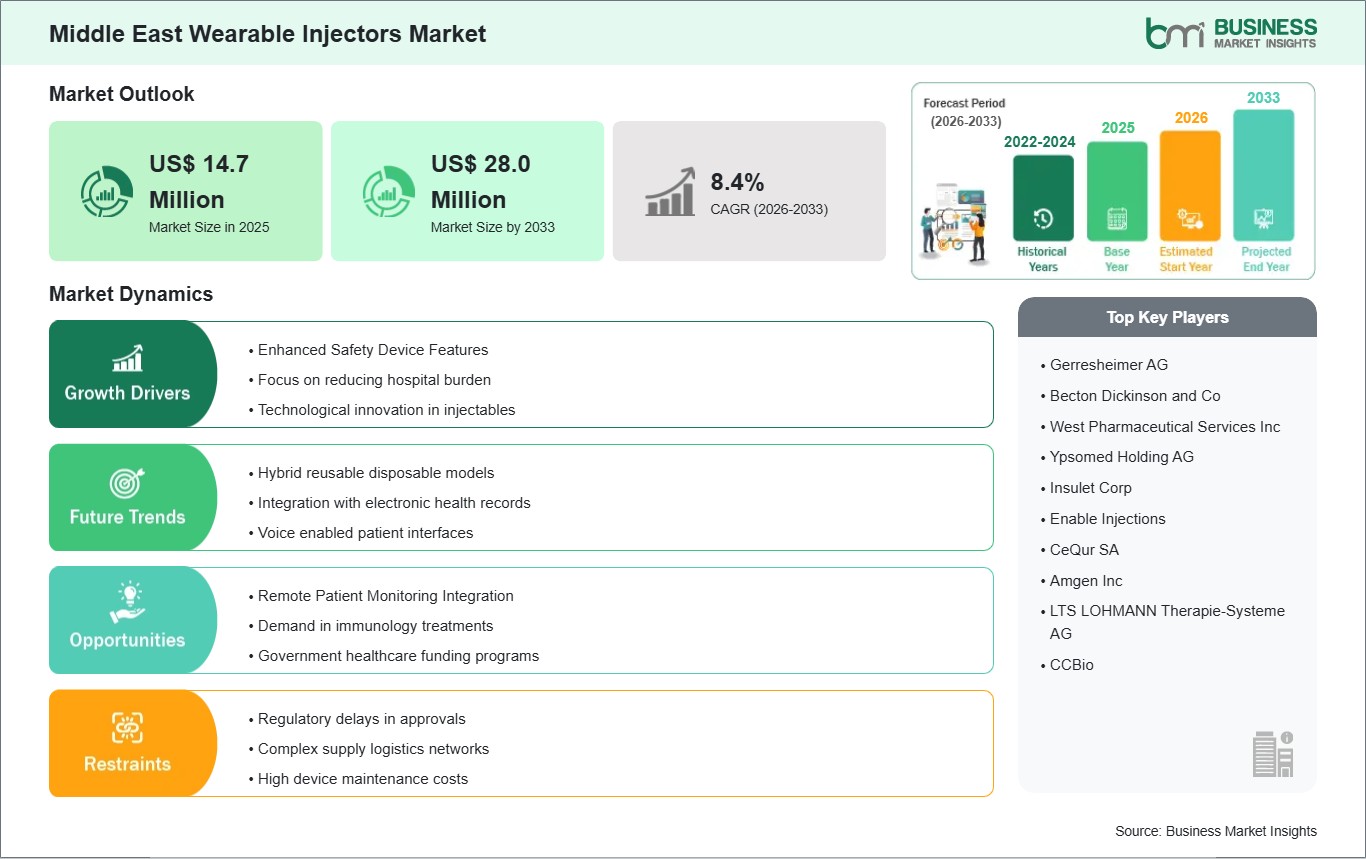
The Middle East wearable injectors market is gaining traction as healthcare systems across the region modernize and shift toward outpatient-centric care delivery models. The increasing prevalence of chronic diseases such as diabetes, oncology disorders, and autoimmune conditions is creating sustained demand for advanced drug delivery solutions that enhance dosing precision and patient convenience. Wearable injectors, designed to administer high-volume biologic therapies subcutaneously over extended periods, are increasingly recognized as a viable alternative to repeated hospital-based injections. Market activity is primarily concentrated in economically advanced countries with structured healthcare systems and significant public healthcare spending. Adoption is strongest in urban tertiary hospitals and specialty clinics that manage long-term biologic therapies. Competitive dynamics are shaped by multinational device manufacturers partnering with regional distributors to navigate regulatory approvals and hospital procurement processes. Product differentiation focuses on reliability, ease of application, safety mechanisms, and compatibility with specialty pharmaceuticals. Regulatory environments across the Middle East are relatively structured, particularly in Gulf countries where centralized authorities oversee medical device approvals. However, procurement is often influenced by government tenders, hospital group purchasing committees, and national healthcare strategies. Private healthcare networks are playing an increasingly important role in early adoption, particularly where insurance penetration is high. Despite favorable infrastructure in leading markets, broader regional adoption remains influenced by cost considerations, physician familiarity with wearable technologies, and alignment with national reimbursement frameworks. Overall, the market is positioned as a specialized but expanding segment within the Middle East’s broader chronic care and biologics ecosystem.
Segment Analysis
Middle East Wearable Injectors Market Segmentation
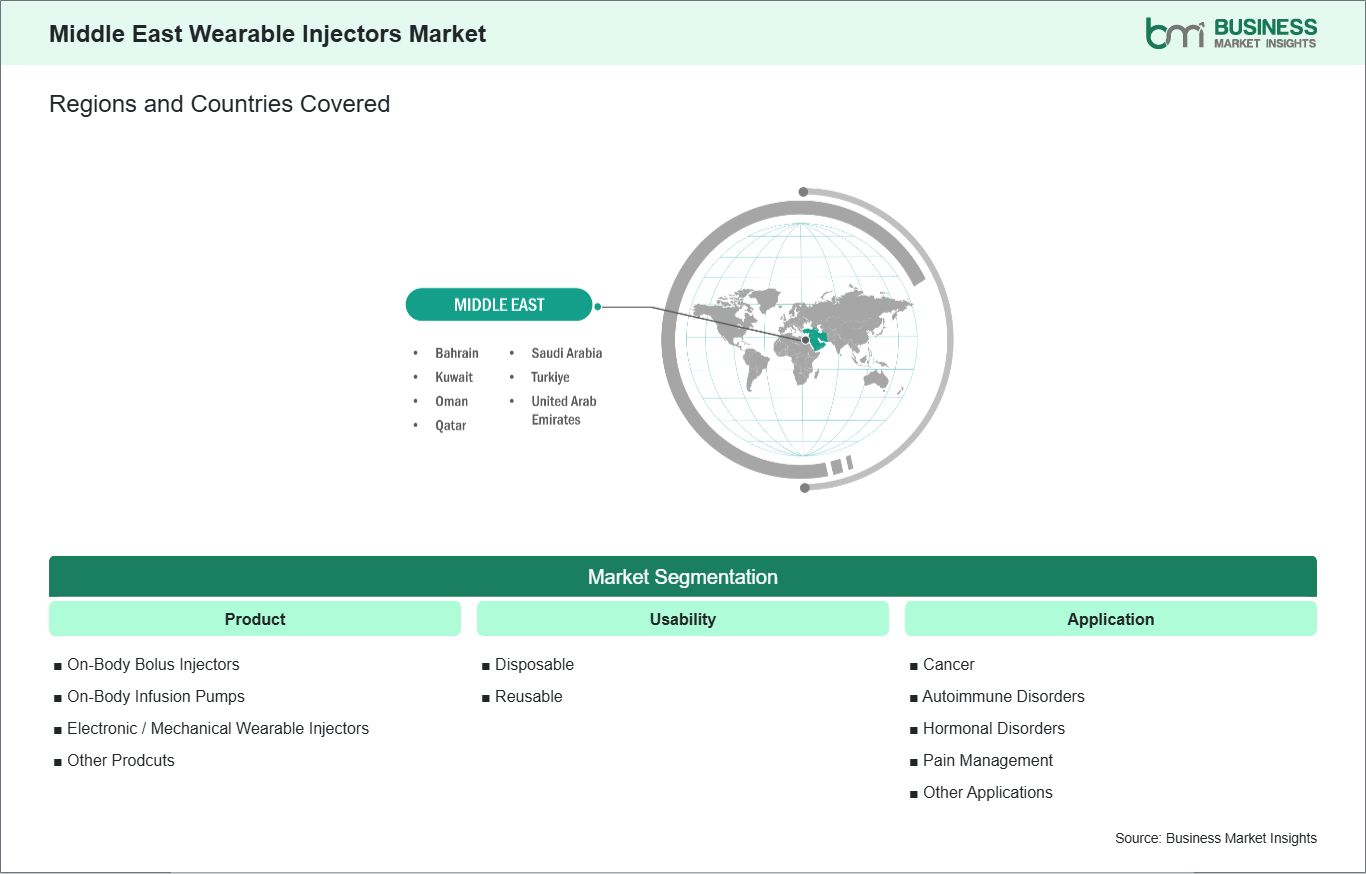
Key segments that contributed to the derivation of the Middle East wearable injectors market analysis are product, usability, and application.
- By product, the wearable injectors market is segmented into on-body bolus injectors, on-body infusion pumps, electronic / mechanical wearable injectors, and others. The on-body bolus injectors segment dominated the market in 2025.
- Based on usability, the wearable injectors market is categorized into disposable and reusable. The disposable segment dominated the market in 2025.
- In terms of application, the market is classified into cancer, autoimmune disorders, hormonal disorders, pain management, and other applications. The autoimmune disorders segment dominated the market in 2025.
Market Forces
Middle East Wearable Injectors Market Drivers and Opportunities
Enhanced Safety Device Features
Hospitals and specialty clinics in countries such as Saudi Arabia, the United Arab Emirates, and Qatar are increasingly evaluating drug delivery technologies based not only on convenience but also on built-in safeguards that reduce dosing errors, prevent needle exposure, and ensure controlled administration of high-value biologics. Enhanced safety features such as automated needle insertion and retraction, audible and visual dose confirmation, and lockout mechanisms are becoming important differentiators for wearable injector manufacturers targeting the region. The growing prevalence of chronic diseases, including diabetes and autoimmune disorders, in the Middle East has amplified the need for reliable long-term injectable therapies. In response, healthcare providers are seeking devices that minimize user error and support proper adherence outside hospital environments. Wearable injectors equipped with fail-safe activation systems and tamper-resistant designs are particularly attractive in markets where patient self-administration is expanding, but clinical oversight remains a priority. This balance between innovation and safety aligns with regional health transformation strategies that aim to combine advanced care delivery with strict quality assurance standards. Regulatory authorities and procurement bodies in the Gulf Cooperation Council are also strengthening device evaluation frameworks to ensure imported technologies meet international benchmarks. As a result, manufacturers entering the Middle East wearable injectors market must demonstrate compliance with rigorous safety and performance criteria. Devices that integrate advanced sensor feedback, temperature monitoring for biologic stability, and error notification systems are more likely to gain acceptance in both public and private healthcare settings. This focus on enhanced safety is shaping product development strategies and reinforcing confidence among clinicians and patients considering wearable injectors as part of routine therapeutic protocols.
Remote Patient Monitoring Integration
Countries such as the United Arab Emirates and Saudi Arabia are advancing telehealth frameworks and national digital health platforms that connect patients, providers, and medical devices through secure data networks. Wearable injectors that can integrate with remote monitoring systems are well-positioned within this landscape, as they enable clinicians to track therapy adherence, review dosing histories, and receive alerts without requiring in-person visits. This capability is especially valuable for managing chronic conditions that require continuous oversight. In geographically dispersed areas or regions with uneven specialist distribution, remote monitoring integration enhances care accessibility. Patients in secondary cities or rural communities can maintain consistent treatment regimens while remaining connected to healthcare providers through digital platforms. Wearable injectors equipped with Bluetooth or cloud-based connectivity can transmit administration data to centralized systems, supporting follow-up consultations and early intervention if irregularities are detected. This model aligns with Middle Eastern healthcare objectives focused on improving service reach while reducing pressure on major tertiary hospitals in metropolitan centers like Riyadh, Dubai, and Doha. Private healthcare groups and specialty clinics are increasingly incorporating connected devices into premium care offerings, viewing remote monitoring as a value-added service that improves patient engagement. Integration of wearable injectors with mobile health applications and hospital information systems allows for comprehensive disease management programs, particularly in endocrinology and immunology segments. As digital infrastructure continues to expand and regulatory frameworks evolve to support secure data exchange, the integration of remote patient monitoring with wearable injectors is expected to become a central growth driver in the Middle East market, reinforcing a shift toward more connected and patient-centered healthcare delivery models.
Size and Share Analysis
Middle East Wearable Injectors Market Size and Share Analysis
The Middle East Wearable Injectors Market demonstrates steady growth, with size and share analysis highlighting evolving trends and competitive dynamics among key players. The report examines subsegments categorized within product, usability, and application, offering insights into their contribution to overall market performance.
By product, the on-body bolus injectors subsegment dominated the market in 2025, driven by expanding demand for technologically advanced drug delivery systems that enable controlled, high-dose administration in outpatient settings.
Based on usability, the disposable subsegment dominated the market in 2025, driven by increasing preference for safe, ready-to-use injectors that minimize sterilization requirements and operational complexity.
In terms of application, the autoimmune disorders subsegment dominated the market in 2025, driven by growing diagnosis rates and improving access to biologic therapies for chronic inflammatory diseases across the region.
Report Coverage
Middle East Wearable Injectors Market Report Coverage and Deliverables
The "Middle East Wearable Injectors Market Size and Forecast (2022 - 2033)" report provides a detailed analysis of the market covering below areas:
- Middle East Wearable Injectors Market size and forecast at regional and country levels for all segments covered under the scope
- Middle East Wearable Injectors Market trends, as well as drivers, restraints, and opportunities
- Middle East Wearable Injectors Market analysis covering key trends, regional framework, major players, regulations, and recent developments
- Industry landscape and competition analysis covering market concentration, heat map analysis, prominent players, and recent developments for the Middle East Wearable Injectors Market
- Detailed company profiles, including SWOT analysis
Geographic Insights
Middle East Wearable Injectors Market Geographic Insights
The geographical scope of the Middle East Wearable Injectors Market report is divided into the UAE, Saudi Arabia, Bahrain, Oman, Kuwait, Qatar, and Turkiye. Turkiye held the largest share in 2025.
Country-level dynamics across the Middle East demonstrate varied adoption patterns influenced by healthcare investment, regulatory structure, insurance penetration, and specialty care capacity. Turkiye emerges as the dominant market in the region, driven by its large population base, well-developed hospital infrastructure, and strategic positioning as a medical hub bridging Europe and the Middle East. Major metropolitan centers such as Istanbul, Ankara, and Izmir are witnessing increasing integration of wearable injectors within tertiary hospitals and specialty clinics managing oncology, endocrinology, and autoimmune therapies. Turkiye benefits from a structured regulatory framework, expanding domestic medical device capabilities, and a strong private healthcare sector that supports early adoption of advanced drug delivery technologies. Additionally, growing patient awareness of self-administration benefits and an expanding outpatient treatment ecosystem reinforce its leadership position. Saudi Arabia represents a significant secondary market, supported by substantial public healthcare spending and national transformation programs aimed at enhancing chronic disease management. Adoption is concentrated in major cities, including Riyadh and Jeddah, where specialty care centers are incorporating wearable injectors into biologic therapy pathways. The United Arab Emirates demonstrates strong uptake within private hospital networks in Dubai and Abu Dhabi. High insurance coverage, advanced healthcare infrastructure, and a focus on medical innovation support the integration of connected drug delivery systems. Qatar and Kuwait show steady demand, primarily within specialized urban healthcare facilities serving high-income populations. Meanwhile, Oman and Bahrain represent smaller but developing markets where adoption is concentrated in select specialty clinics. Overall, Turkiye leads the Middle East wearable injectors market, while Saudi Arabia and the UAE provide substantial complementary opportunities. Market participants must implement country-specific regulatory strategies, clinician engagement programs, and localized distribution partnerships to effectively capture growth across this diverse regional landscape.
Industry Activity
Recent Developments
The Middle East Wearable Injectors Market is evaluated by gathering qualitative and quantitative data post primary and secondary research, which includes important corporate publications, association data, and databases. A few of the key developments in the Middle East wearable injectors market are:
- In January 2026, Ypsomed Holding AG announced a partnership with Novo Nordisk to develop and supply large‑volume wearable patch injectors, broadening choices for subcutaneous self‑administration of biologics and aligning with demand for patient‑friendly delivery systems.
- In December 2025, Enable Injections received regulatory approval from the Saudi Food and Drug Authority (SFDA) for the EMPAVELI Injector based on its enFuse On‑Body Delivery System, enabling legal marketing and distribution of this large‑volume subcutaneous delivery device in Saudi Arabia. This clearance allows wearable injector technology to support patient self‑administration of therapies in the Kingdom.
Trust & Transparency
Research Methodology
The market analysis combines proprietary research with secondary data from government agencies, company disclosures, regulatory filings, industry databases and expert interviews. Market estimates are validated through data triangulation, cross-market benchmarking and analyst
review.
View Full Research Methodology
Key Sources Referred:
World Health Organization (WHO)Organisation for Economic Cooperation and Development (OECD)The World Bank GroupWorldometerThe LancetInternational Bar AssociationInternational Trade Administration