Market Summary
Executive Summary and Market Analysis
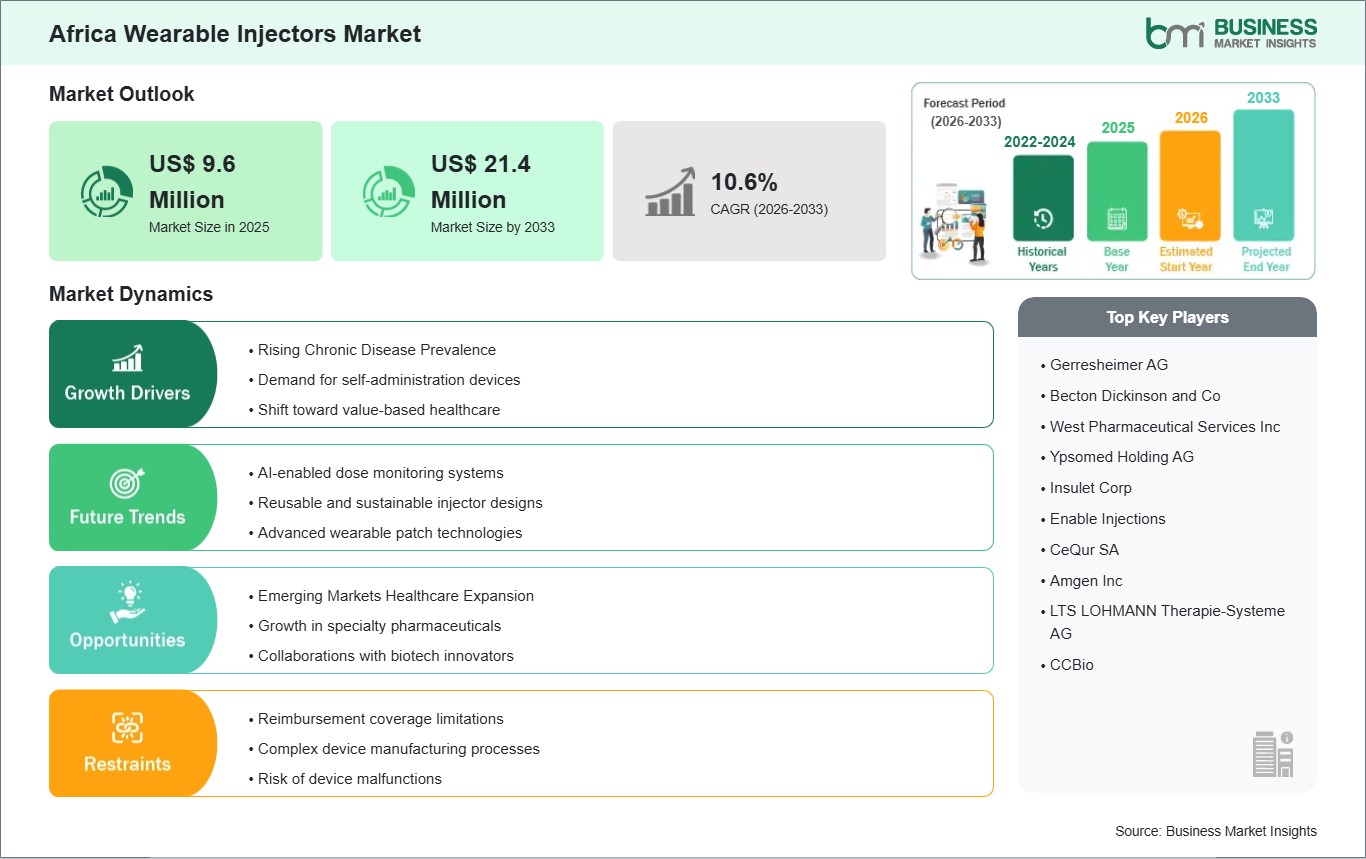
The Africa wearable injectors market is evolving within a broader transformation of the continent’s healthcare delivery landscape, marked by a gradual shift toward patient-centric and decentralized treatment models. Wearable injectors, designed to facilitate controlled subcutaneous administration of biologics and high-volume therapies, are gaining attention as healthcare providers seek solutions that enhance adherence and reduce dependency on hospital-based infusion services. Market activity is currently concentrated in urbanized healthcare clusters where specialty care infrastructure and private sector participation are stronger. Demand is being influenced by the growing prevalence of chronic conditions such as diabetes, oncology indications, and autoimmune disorders, which require long-term and often complex therapeutic regimens. From a competitive standpoint, multinational device manufacturers dominate product availability, typically operating through regional distribution alliances and hospital procurement networks. However, limited reimbursement frameworks and high import dependency continue to influence pricing strategies and accessibility. Regulatory pathways differ considerably across African jurisdictions, requiring country-specific compliance approaches and extended approval timelines in certain markets. Additionally, physician knowledge and patient awareness remain critical determinants of uptake, as self-administration require a behavioral transition from traditional injection practices. Overall, the market is characterized by early-stage penetration, selective institutional adoption, and increasing strategic interest from healthcare stakeholders aiming to modernize drug delivery infrastructure.
Segment Analysis
Africa Wearable Injectors Market Segmentation
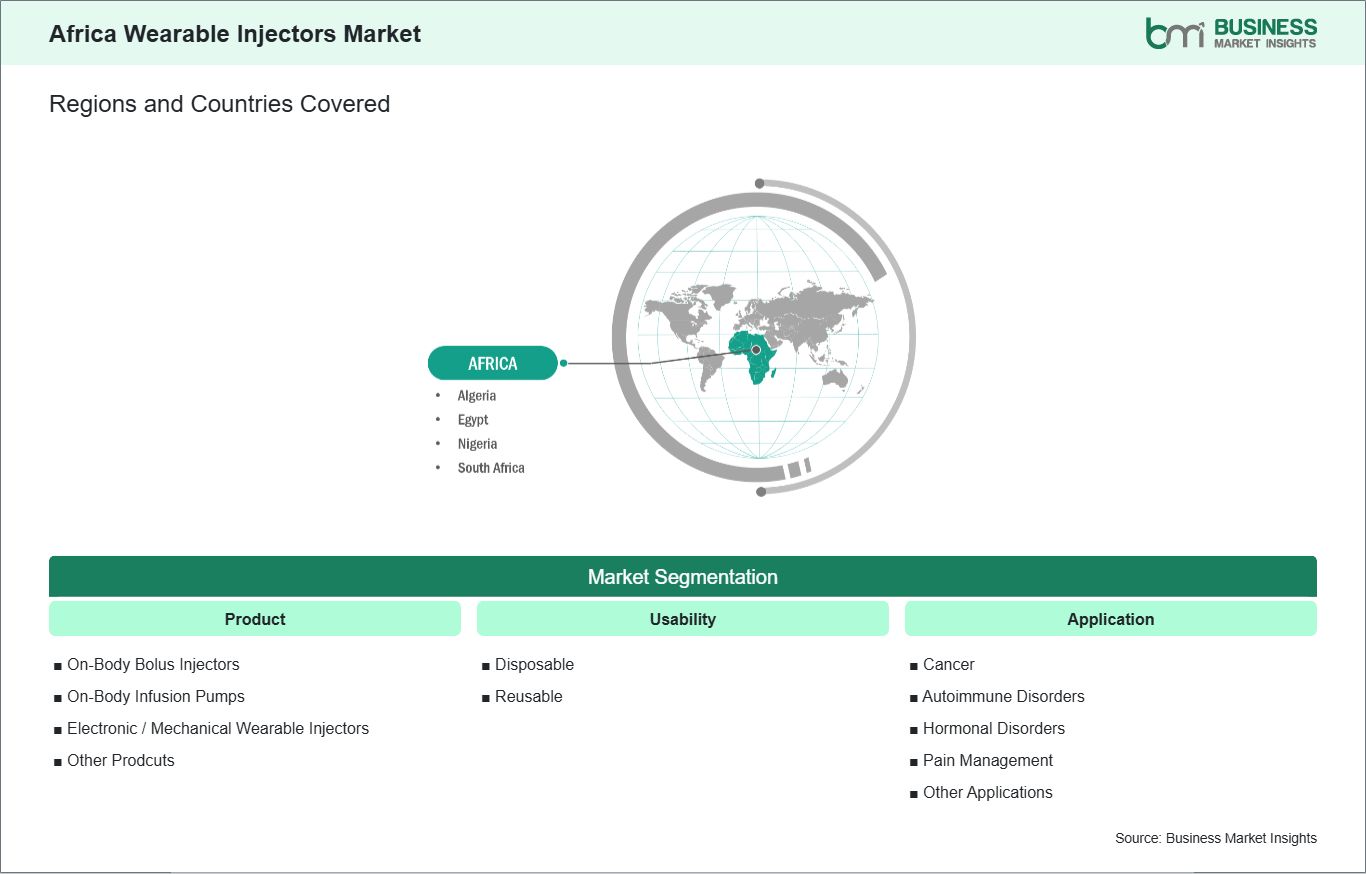
Key segments that contributed to the derivation of the Africa wearable injectors market analysis are product, usability, and application.
- By product, the wearable injectors market is segmented into on-body bolus injectors, on-body infusion pumps, electronic / mechanical wearable injectors, and others. The on-body bolus injectors segment dominated the market in 2025.
- Based on usability, the wearable injectors market is categorized into disposable and reusable. The disposable segment dominated the market in 2025.
- In terms of application, the market is classified into cancer, autoimmune disorders, hormonal disorders, pain management, and other applications. The autoimmune disorders segment dominated the market in 2025.
Market Forces
Africa Wearable Injectors Market Drivers and Opportunities
Rising Chronic Disease Prevalence
As more patients require long-term therapies, healthcare systems are seeking solutions that allow safe, efficient, and patient-friendly medication delivery outside hospital settings. Wearable injectors, with their convenience and ability to deliver consistent doses, are increasingly seen as a critical tool in managing ongoing treatments, reducing the burden on clinics, and improving patient adherence. Diabetes, cardiovascular diseases, and autoimmune disorders are becoming more widespread across diverse demographics. This shift is creating a growing patient population requiring frequent self-administered therapies. Wearable injectors can address challenges related to traditional injection methods, including discomfort, dosing errors, and the need for regular clinical visits, making them an attractive alternative for long-term management. Healthcare providers and policymakers are recognizing the potential of wearable injectors to improve outcomes for chronic disease patients. With increasing awareness about patient-centered care, these devices are being integrated into treatment approaches that emphasize convenience, adherence, and safety. The market is evolving to support devices that can be easily used in home settings, promoting independence for patients while maintaining consistent therapeutic delivery. Thus, the growing incidence of chronic diseases in Africa is driving the wearable injectors market growth.
Emerging Markets Healthcare Expansion
Investments in modern healthcare facilities, enhanced supply chains, and training programs are enabling the adoption of advanced medical devices. Wearable injectors are increasingly being incorporated into healthcare strategies that emphasize efficiency, accessibility, and patient convenience, supporting both urban and semi-urban healthcare expansion. Government initiatives and private sector collaborations are enhancing the availability of healthcare services, creating an environment where advanced drug delivery devices can be successfully introduced. Expanding healthcare networks and the growing focus on patient-centered care are driving demand for technologies that simplify treatment and reduce the reliance on hospital-based administration. Wearable injectors fit this model by providing reliable, user-friendly solutions for patients requiring frequent medication. The expansion of healthcare markets also encourages partnerships between device manufacturers and local healthcare providers. Such collaborations support training, maintenance, and integration of wearable injectors into treatment plans. As healthcare systems modernize, there is a growing emphasis on technologies that improve patient adherence, reduce clinical workload, and offer scalable solutions for chronic disease management, positioning wearable injectors as a key component in the evolving African healthcare landscape.
Size and Share Analysis
Africa Wearable Injectors Market Size and Share Analysis
The Africa Wearable Injectors Market demonstrates steady growth, with size and share analysis highlighting evolving trends and competitive dynamics among key players. The report examines subsegments categorized within product, usability, and application, offering insights into their contribution to overall market performance.
By product, the on-body bolus injectors subsegment dominated the market in 2025, driven by widespread adoption of patient‑friendly, self‑administrable drug delivery systems that support extended and controlled dosing of high‑volume biologics, improving adherence and convenience in chronic therapy settings.
Based on usability, the disposable subsegment dominated the market in 2025, driven by a strong preference for single‑use devices that minimize contamination risk, simplify operation and maintenance, and enhance safety and convenience in home‑based and outpatient care.
In terms of application, the autoimmune disorders subsegment dominated the market in 2025, driven by rising prevalence of chronic autoimmune conditions requiring regular biologic therapy and the shift toward home‑based, self‑administrable wearable delivery to improve patient quality of life.
Report Coverage
Africa Wearable Injectors Market Report Coverage and Deliverables
The "Africa Needle-free Injectors Market Size and Forecast (2022 - 2033)" report provides a detailed analysis of the market covering below areas:
- Africa Needle-free Injectors Market size and forecast at regional and country levels for all market segments covered under the scope
- Africa Needle-free Injectors Market trends, as well as drivers, restraints, and opportunities
- Africa Needle-free Injectors Market analysis covering key trends, regional framework, major players, regulations, and recent developments
- Industry landscape and competition analysis covering market concentration, heat map analysis, prominent players, and recent developments for the Africa Needle-free Injectors Market
- Detailed company profiles, including SWOT analysis
Geographic Insights
Africa Wearable Injectors Market Geographic Insights
The geographical scope of the Africa Wearable Injectors Market report is divided into Egypt, South Africa, Nigeria, and Algeria. Nigeria held the largest share in 2025.
Within the African wearable injectors market, Nigeria stands out as the dominant market, driven by its large population base, increasing prevalence of chronic conditions such as diabetes and autoimmune diseases, and a growing private healthcare sector that is actively adopting innovative drug delivery solutions. Urban centers like Lagos and Abuja are witnessing the highest penetration of wearable injectors, supported by specialty clinics and hospital networks focusing on patient-centered care. Rising awareness among patients about self-administration convenience and adherence benefits is also contributing to strong demand, making Nigeria a strategic hub for device manufacturers targeting West Africa. South Africa represents a more structured market with established private healthcare networks, insurance coverage, and tertiary hospitals capable of supporting advanced drug delivery technologies. While overall adoption is slower than in Nigeria due to cost considerations and regulatory requirements, specialty clinics and urban hospitals in Johannesburg and Cape Town are increasingly incorporating wearable injectors for therapies requiring frequent dosing, such as biologics and oncology treatments. The market in Egypt is steadily emerging, aided by ongoing regulatory reforms and expanding urban healthcare infrastructure. Hospitals and specialty clinics in Cairo and Alexandria are gradually introducing wearable injector solutions, particularly for chronic disease management and biologic therapies. Government initiatives to modernize healthcare delivery and the growing emphasis on home-based care models are expected to further boost adoption, though affordability and awareness remain limiting factors. Algeria presents a nascent but promising market. Adoption is currently concentrated in major cities like Algiers and Oran, where private healthcare facilities are investing in modern therapeutic delivery systems. While regulatory processes are evolving, limited insurance penetration and import dependencies present hurdles. Nonetheless, increasing interest from both hospitals and private clinics in patient-centric care models positions Algeria as a market with mid-term growth potential. Across these four countries, Nigeria’s scale and rapid uptake position it as the regional leader, while South Africa, Egypt, and Algeria represent complementary growth markets with differentiated adoption drivers, regulatory landscapes, and healthcare infrastructure maturity. Tailored strategies that address country-specific reimbursement, clinician training, and patient education are essential to capture value across the region.
Industry Activity
Recent Developments
The Africa Wearable Injectors Market is evaluated by gathering qualitative and quantitative data post primary and secondary research, which includes important corporate publications, association data, and databases. A few of the key developments in the Africa wearable injectors market are:
- In July 2025, Becton Dickinson (BD) announced the first pharmaceutical‑sponsored clinical trial using its BD Libertas wearable injector for subcutaneous delivery of complex biologics, marking a key step toward broader clinical adoption of wearable biologic delivery solutions. The trial follows extensive pre‑clinical and clinical evaluations and aims to offer more flexible self‑administration options compared with traditional infusions.
- In October 2025, Enable Injections and Incyte announced a strategic partnership to use the enFuse wearable on‑body delivery system with Incyte’s targeted therapies for essential thrombocythemia and myelofibrosis, aiming to improve patient access and comfort in delivering high‑volume subcutaneous treatments.
Trust & Transparency
Research Methodology
The market analysis combines proprietary research with secondary data from government agencies, company disclosures, regulatory filings, industry databases and expert interviews. Market estimates are validated through data triangulation, cross-market benchmarking and analyst
review.
View Full Research Methodology
Key Sources Referred:
World Health Organization (WHO)Organisation for Economic Cooperation and Development (OECD)The World Bank GroupWorldometerThe LancetInternational Bar AssociationInternational Trade Administration