Western Europe Cancer Targeted Therapy Market Report Outlook (2021–2031)

Historic Data: 2021-2023   |   Base Year: 2024   |   Forecast Period: 2025-2031
Report Content: Market Scope, Market Segmentation, Market Dynamics, and Competitive Analysis

Report Coverage:
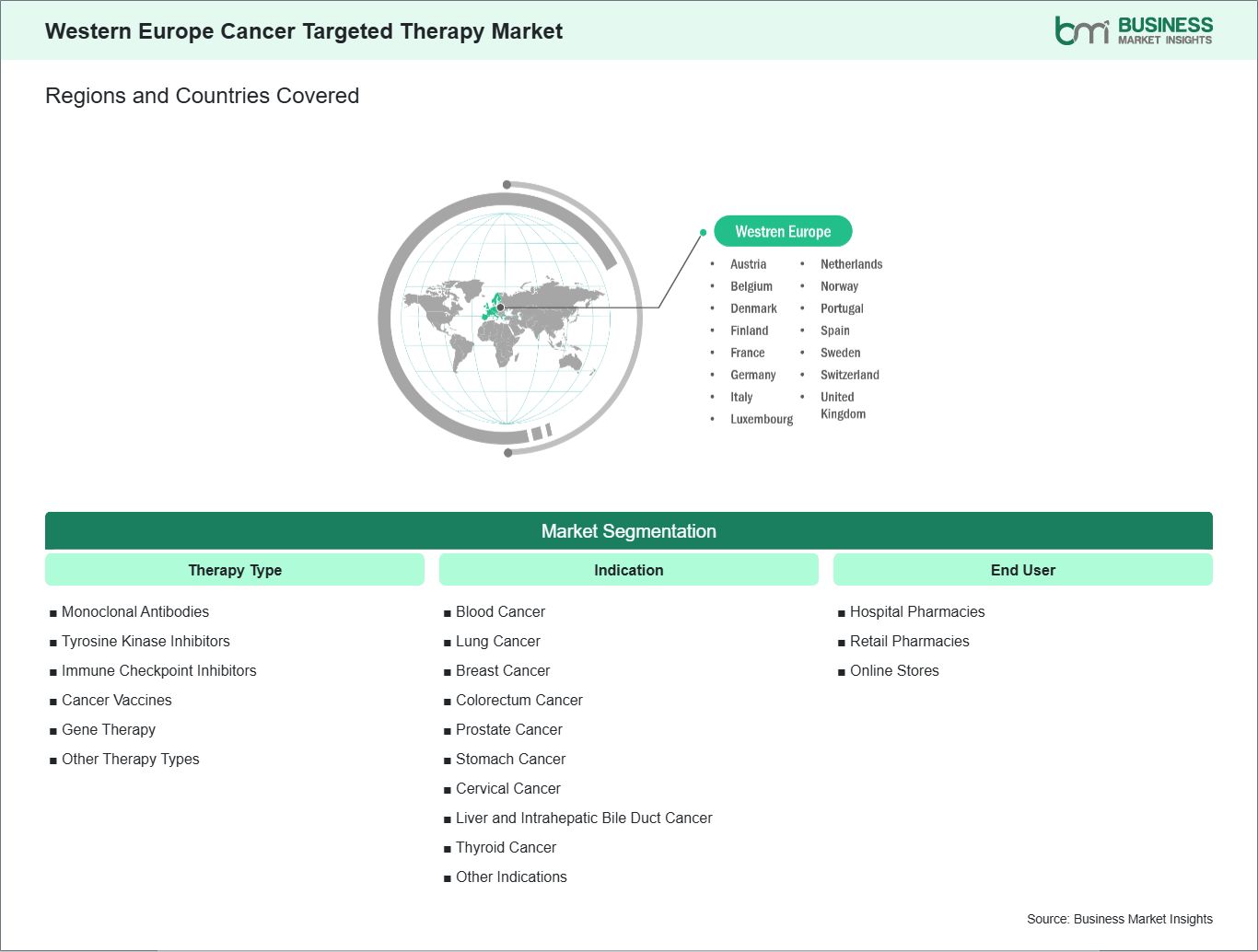
  • Therapy Type (Monoclonal Antibodies, Tyrosine Kinase Inhibitors, Immune Checkpoint Inhibitors, Cancer Vaccines, Gene Therapy, Other Therapy Types)
  • Indication (Blood Cancer, Lung Cancer, Breast Cancer, Colorectum Cancer, Prostate Cancer, Stomach Cancer, Cervical Cancer, Liver and Intrahepatic Bile Duct Cancer, Thyroid Cancer, Other Indications)
  • End User (Hospital Pharmacies, Retail Pharmacies, Online Stores)

No. of Pages: 105
Report Code: BMIPUB00033510
Category: Life Sciences
Western Europe Cancer Targeted Therapy Market
Buy Now

The North America Cancer Targeted Therapy Market size is expected to reach US$ 97,104.7 million by 2031 from US$ 39,623.9 million in 2024. The market is estimated to record a CAGR of 13.8 % from 2025 to 2031.

Executive Summary and Western Europe Cancer Targeted Therapy Market Analysis:

The Western European cancer targeted therapy market is high‑value and innovation‑driven, characterized by strong healthcare systems, early adoption of precision medicine, and robust regulatory frameworks within the broader oncology landscape. Countries such as Germany, France, the UK, Italy, Spain, and the Nordics contribute significantly to the regional market, reflecting strong demand for monoclonal antibodies, tyrosine kinase inhibitors (TKIs), and advanced immuno‑oncology combinations.

Targeted therapies are increasingly displacing traditional chemotherapy as standard care across key cancer indications—including lung, breast, colorectal, and hematologic cancers—due to their tumor‑specific mechanisms and improved safety profiles. Public healthcare systems and statutory insurance coverage in most Western European countries support access to high‑cost targeted agents, particularly those with compelling clinical benefits.

Various reforms in regulatory pathways—such as adaptive licensing and joint health technology assessments—have reduced barriers to market entry for new targeted agents, further accelerating uptake. Western Europe continues to evolve as a strategic market for global pharmaceutical companies seeking early adoption, real‑world evidence generation, and strong commercial returns in precision oncology.

Western Europe Cancer Targeted Therapy Market - Strategic Insights:

global-market-strategic-framework
Get more information on this report

Western Europe Cancer Targeted Therapy Market Segmentation Analysis:

Key segments that contributed to the derivation of the Western Europe Cancer Targeted Therapy market analysis are therapy type, indication, and distribution channel.

  • By therapy type, the cancer targeted therapy market is segmented into monoclonal antibodies, tyrosine kinase inhibitors, immune checkpoint inhibitors, cancer vaccines, gene therapy, and others. The monoclonal antibodies segment dominated the market in 2024.
  • Based on indication, the cancer targeted therapy market is segmented into blood cancer, lung cancer, breast cancer, colorectum cancer, prostate cancer, stomach cancer, cervical cancer, liver and intrahepatic bile duct cancer, thyroid cancer, and other indications. The lung cancer segment dominated the market in 2024.
  • In terms of distribution channel, the market is segmented into hospital pharmacies, retail pharmacies, and online stores. The hospital pharmacies segment dominated the market in 2024.

Western Europe Cancer Targeted Therapy Market Drivers and Opportunities:

Next-Generation Genomic Profiling and Biomarker Discovery

Advancements in genomic profiling and biomarker discovery are key market drivers. Widespread adoption of next‑generation sequencing (NGS), liquid biopsy assays, and comprehensive molecular diagnostics permits clinicians to identify actionable genetic mutations such as EGFR, ALK, HER2, PIK3CA, and NTRK fusions, enabling precision therapy tailored to tumor biology. These technologies support patient stratification for targeted agents, improving clinical outcomes and reducing unnecessary exposure to less effective treatments.

Healthcare systems in Western Europe—particularly in Germany, France, and the UK—have integrated genomic profiling into clinical pathways for common cancers such as lung and breast cancer. Companion diagnostic programs are supported by public reimbursement, ensuring that patients eligible for targeted therapies receive appropriate molecular testing. This integration accelerates the transition from one‑size‑fits‑all chemotherapy to precision oncology, elevating the role of targeted therapies in standard care.

Liquid biopsies—which analyze circulating tumor DNA—have expanded monitoring capabilities beyond initial diagnosis to include treatment response and resistance detection. The accumulation of region‑specific genomic data also fuels research collaboration, enabling novel target discovery and optimizing clinical trial design.

Investments in digital health platforms and AI‑driven analytics further enhance biomarker discovery efficiency, making it easier to translate discoveries into clinical practice. Collectively, these developments reinforce the clinical value of targeted therapies, establish strong physician confidence, and drive sustained market growth.

Next-Generation Targeted Therapies for Rare Genetic Cancers

Expanding targeted therapies into rare cancers and tumors defined by specific genetic mutations represents a strategic market opportunity. Historically, rare cancers have been underserved due to limited patient numbers and high development costs. However, advanced genomic profiling has revealed that many rare malignancies share actionable mutations found in more common tumors, such as NTRK fusions, RET rearrangements, and BRAF alterations. Tumor‑agnostic therapies that target these genetic drivers can be used across multiple rare cancer types, significantly expanding the addressable patient population.

Regulatory incentives such as orphan drug designations and accelerated approval pathways in the European Union encourage pharmaceutical investment in rare cancer therapeutics. These incentives and approvals have resulted in an expanding pipeline of precision oncology agents evaluated in innovative clinical trial designs such as basket and umbrella trials, which allow simultaneous testing of therapies across diverse tumor types sharing a genetic signature.

Western European healthcare systems and cancer centers are well-positioned to adopt these advanced therapies due to their access to molecular diagnostics and strong clinical research networks. Early access programs and real‑world evidence generation support regulatory decision‑making and reimbursement negotiations, enhancing market entry strategies for rare cancer therapies.

Furthermore, patient advocacy organizations and clinician education programs raise awareness of rare cancer diagnostics and treatment options, increasing demand for targeted agents. As genomics becomes integral to cancer care, therapies for rare, mutation‑defined cancers will play a growing role in regional treatment paradigms, fostering deeper market penetration and stronger revenue growth for targeted therapy portfolios.

Western Europe Cancer Targeted Therapy Market Size and Share Analysis:

The Western Europe Cancer Targeted Therapy market demonstrates steady growth, with size and share analysis highlighting evolving trends and competitive dynamics among key players. The report examines subsegments categorized within therapy type, indication, and distribution channel, offering insights into their contribution to overall market performance.

By therapy type, the monoclonal antibodies subsegment dominated the market in 2024, driven by their clinical versatility and strong evidence base across multiple indications, including breast, colorectal, and lung cancers.

Based on indication, the lung cancer subsegment dominated the market in 2024, driven by the high prevalence and the availability of numerous targeted agents addressing key genetic drivers (EGFR, ALK, ROS1, PD‑L1).

By distribution channel, the hospital pharmacies subsegment dominated the market in 2024, driven by targeted therapies, especially monoclonal antibodies and ADCs, which require clinical administration, monitoring, and adherence support.

Western Europe Cancer Targeted Therapy Market Report Highlights:

Report Attribute Details
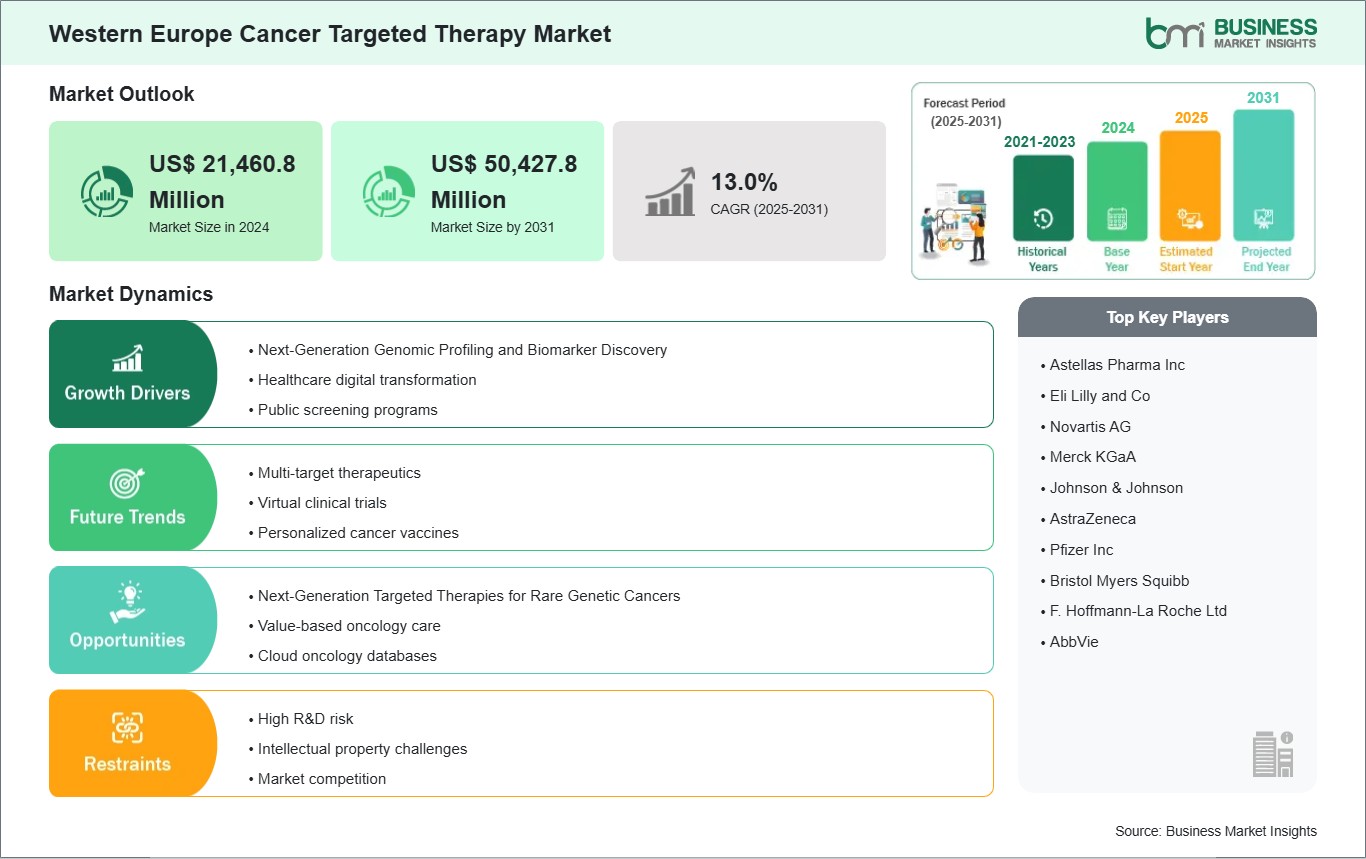
Market size in 2024 US$ 21,460.8 Million
Market Size by 2031 US$ 50,427.8 Million
CAGR (2025 - 2031)13.0%
Historical Data 2021-2023
Forecast period 2025-2031
Segments Covered By Therapy Type
  • Monoclonal Antibodies
  • Tyrosine Kinase Inhibitors
  • Immune Checkpoint Inhibitors
  • Cancer Vaccines
  • Gene Therapy
  • Other Therapy Types
By Indication
  • Blood Cancer
  • Lung Cancer
  • Breast Cancer
  • Colorectum Cancer
  • Prostate Cancer
  • Stomach Cancer
  • Cervical Cancer
  • Liver and Intrahepatic Bile Duct Cancer
  • Thyroid Cancer
  • Other Indications
By End User
  • Hospital Pharmacies
  • Retail Pharmacies
  • Online Stores
Regions and Countries Covered Western Europe
  • Belgium
  • the Netherlands
  • Luxembourg
  • Germany
  • France
  • Italy
  • Spain
  • Switzerland
  • Sweden
  • Austria
  • the United Kingdom
  • Denmark
  • Portugal
  • Norway
  • Finland
Market leaders and key company profiles
  • Astellas Pharma Inc
  • Eli Lilly and Co
  • Novartis AG
  • Merck KGaA
  • Johnson & Johnson
  • AstraZeneca
  • Pfizer Inc
  • Bristol Myers Squibb
  • F. Hoffmann-La Roche Ltd
  • AbbVie
Get more information on this report

Western Europe Cancer Targeted Therapy Market Report Coverage and Deliverables:

The "Western Europe Cancer Targeted Therapy Market Size and Forecast (2021–2031)" report provides a detailed analysis of the market covering below areas:

  • Western Europe Cancer Targeted Therapy market size and forecast at regional and country levels for key segments covered under the scope
  • Western Europe Cancer Targeted Therapy market trends, as well as market dynamics such as drivers, restraints, and key opportunities
  • Western Europe Cancer Targeted Therapy market analysis covering key trends, regional framework, major players, regulations, and recent market developments
  • Industry landscape and competition market concentration, heat map analysis, prominent players, and recent developments for the Western Europe Cancer Targeted Therapy market
  • Detailed company profiles, including SWOT analysis

Western Europe Cancer Targeted Therapy Market Geographic Insights:

The geographical scope of the Western Europe Cancer Targeted Therapy market report is divided into: Belgium, the Netherlands, Luxembourg, Germany, France, Italy, Spain, Switzerland, Sweden, Austria, the UK, Denmark, Portugal, Norway, and Finland. Germany held the largest share in 2024.

Germany continues to lead the market due to its large population, high healthcare spending, and dense network of cancer centers and clinical research institutions. German hospitals and oncology centers routinely implement molecular profiling and precision treatment strategies, supported by favorable reimbursement frameworks and early benefit assessments that accelerate access to breakthrough therapies.

France is another major contributor, with a national genomic screening rollout and streamlined health technology assessment (HTA) processes that shorten time to market for targeted therapies. Centralized purchasing and coordinated oncology networks facilitate widespread distribution across urban and regional hospitals.

In the UK, despite post‑Brexit regulatory alignment shifts, mutual recognition arrangements with EMA dossiers ensure continued access to innovative targeted oncology drugs. The National Health Service (NHS) and bodies such as NICE influence adoption through cost‑effectiveness evaluations and reimbursement guidance.

Italy and Spain show increasing targeted therapy uptake supported by enhanced oncology spending and growing biosimilar use that improves affordability. Healthcare reforms emphasize precision medicine and early adoption of validated targeted agents, particularly for breast and lung cancers.

Nordic and Benelux countries leverage digital registries and coordinated screening initiatives to optimize patient selection and therapy outcomes. Across Western Europe, hospital pharmacies remain the dominant distribution channel for intravenous biologics, while oral-targeted therapies are increasingly accessible through retail and specialty pharmacies. Robust public insurance systems and multinationals' regional subsidiaries ensure broad access, making Western Europe a mature and growth‑oriented market for cancer-targeted therapies.

global-market-geography
Get more information on this report

Western Europe Cancer Targeted Therapy Market Research Report Guidance:

  • The report includes qualitative and quantitative data in the Western Europe Cancer Targeted Therapy market across therapy type, indication, distribution channel, and geography.
  • The report starts with the key takeaways (chapter 2), highlighting key trends and outlook of the Western Europe Cancer Targeted Therapy market.
  • Chapter 3 includes the research methodology of the study.
  • Chapter 4 includes ecosystem analysis.
  • Chapter 5 highlights the major industry dynamics in the Western Europe Cancer Targeted Therapy market, including factors that are driving the market, prevailing deterrents, potential opportunities, as well as future trends. Impact analysis of these drivers and restraints is also covered in this section.
  • Chapter 6 discusses the Western Europe Cancer Targeted Therapy market scenario, in terms of historical market revenues, and forecast till the year 2031.
  • Chapters 7 to 11 cover Western Europe Cancer Targeted Therapy market segments by therapy type, indication, distribution channel, and geography across Belgium, the Netherlands, Luxembourg, Germany, France, Italy, Spain, Switzerland, Sweden, Austria, the UK, Denmark, Portugal, Norway, and Finland. They cover the market revenue, forecast, and factors driving the market.
  • Chapter 12 describes the competitive analysis along with the heat map analysis for the key players operating in the market.
  • Chapter 13 describes the industry landscape analysis. It provides detailed descriptions of business activities such as market initiatives, new developments, mergers, and joint ventures globally, along with a competitive landscape.
  • Chapter 14 provides detailed profiles of the major companies operating in the Cancer Targeted Therapy market. Companies have been profiled on the basis of their key facts, business descriptions, products, financial overview, SWOT analysis, and key developments.
  • Chapter 15, i.e., the appendix, is inclusive of a brief overview of the company, a list of abbreviations, and a disclaimer.

Western Europe Cancer Targeted Therapy Market News and Key Development:

The Western Europe Cancer Targeted Therapy market is evaluated by gathering qualitative and quantitative data post primary and secondary research, which includes important corporate publications, association data, and databases. A few of the key developments in the Western Europe cancer targeted therapy market are:

  • In June 2025, the European Medicines Agency granted marketing authorization for inavolisib (Itovebi)—a PIK3CA‑targeted inhibitor for advanced breast cancer with PIK3CA mutations—expanding Roche's precision oncology portfolio. This approval reinforces targeted options for hormone receptor‑positive, HER2‑negative breast cancer in Western Europe, further validating the region's role as a priority launch market for precision agents.
  • In March 2025, the EMA authorized tisotumab vedotin (Tivdak), an antibody‑drug conjugate for recurrent or metastatic cervical cancer. This authorization broadens the spectrum of targeted therapies available in Western Europe for gynecologic oncology and highlights the increasing role of ADCs in delivering cytotoxic payloads directly to tumors.

Key Sources Referred:

  • World Health Organization (WHO)
  • World Heart Federation (WHF)
  • Organisation for Economic Cooperation and Development (OECD)
  • The World Bank Group
  • Worldometer
  • The Lancet
  • International Bar Association
  • International Trade Administration

The List of Companies - Western Europe Cancer Targeted Therapy Market

  • <p>
  • Astellas Pharma Inc
  • Eli Lilly and Co
  • Novartis AG
  • Merck KGaA
  • Johnson &amp; Johnson
  • AstraZeneca
  • Pfizer Inc
  • Bristol Myers Squibb
  • F. Hoffmann-La Roche Ltd
  • AbbVie</p>
Frequently Asked Questions
How big is the Western Europe Cancer Targeted Therapy Market?

The Western Europe Cancer Targeted Therapy Market is valued at US$ 21,460.8 Million in 2024, it is projected to reach US$ 50,427.8 Million by 2031.

What is the CAGR for Western Europe Cancer Targeted Therapy Market by (2025 - 2031)?

As per our report Western Europe Cancer Targeted Therapy Market, the market size is valued at US$ 21,460.8 Million in 2024, projecting it to reach US$ 50,427.8 Million by 2031. This translates to a CAGR of approximately 13.0% during the forecast period.

What segments are covered in this report?

The Western Europe Cancer Targeted Therapy Market report typically cover these key segments-

  • Therapy Type (Monoclonal Antibodies, Tyrosine Kinase Inhibitors, Immune Checkpoint Inhibitors, Cancer Vaccines, Gene Therapy, Other Therapy Types)
  • Indication (Blood Cancer, Lung Cancer, Breast Cancer, Colorectum Cancer, Prostate Cancer, Stomach Cancer, Cervical Cancer, Liver and Intrahepatic Bile Duct Cancer, Thyroid Cancer, Other Indications)
  • End User (Hospital Pharmacies, Retail Pharmacies, Online Stores)

What is the historic period, base year, and forecast period taken for Western Europe Cancer Targeted Therapy Market?

The historic period, base year, and forecast period can vary slightly depending on the specific market research report. However, for the Western Europe Cancer Targeted Therapy Market report:

  • Historic Period : 2021-2023
  • Base Year : 2024
  • Forecast Period : 2025-2031
  • Who are the major players in Western Europe Cancer Targeted Therapy Market?

    The Western Europe Cancer Targeted Therapy Market is populated by several key players, each contributing to its growth and innovation. Some of the major players include:

  • Astellas Pharma Inc
  • Eli Lilly and Co
  • Novartis AG
  • Merck KGaA
  • Johnson & Johnson
  • AstraZeneca
  • Pfizer Inc
  • Bristol Myers Squibb
  • F. Hoffmann-La Roche Ltd
  • AbbVie
  • Who should buy this report?

    The Western Europe Cancer Targeted Therapy Market report is valuable for diverse stakeholders, including:

    • Investors: Provides insights for investment decisions pertaining to market growth, companies, or industry insights. Helps assess market attractiveness and potential returns.
    • Industry Players: Offers competitive intelligence, market sizing, and trend analysis to inform strategic planning, product development, and sales strategies.
    • Suppliers and Manufacturers: Helps understand market demand for components, materials, and services related to concerned industry.
    • Researchers and Consultants: Provides data and analysis for academic research, consulting projects, and market studies.
    • Financial Institutions: Helps assess risks and opportunities associated with financing or investing in the concerned market.

    Essentially, anyone involved in or considering involvement in the Western Europe Cancer Targeted Therapy Market value chain can benefit from the information contained in a comprehensive market report.

    Available Report Formats

    pdf-format excel-format pptx-format
    Buy Now

    Customization Form

    Please tell us your area of interest
    (Market Segments/ Regions and Countries/ Companies)