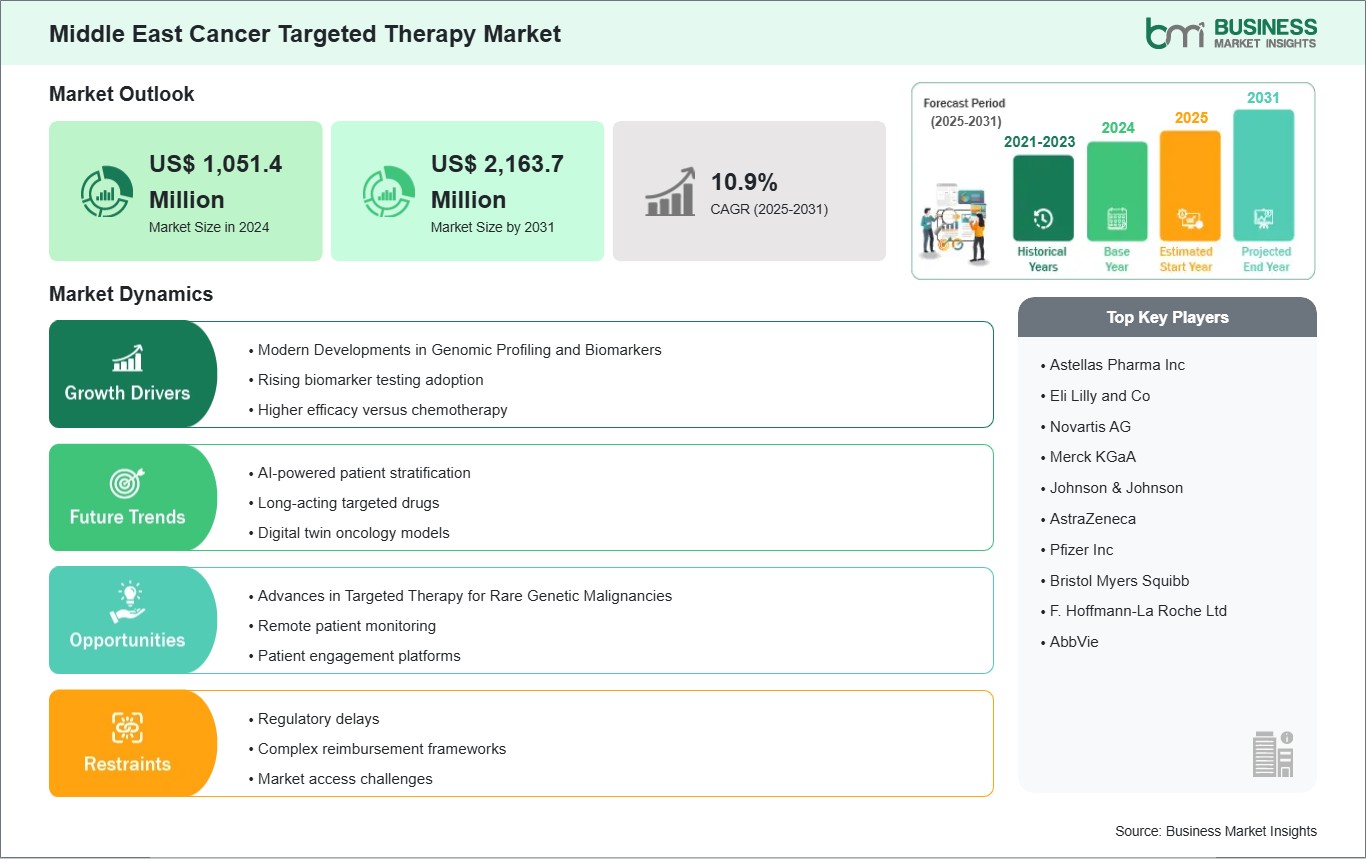
The Middle East Cancer Targeted Therapy Market size is expected to reach US$ 2,163.7 million by 2031 from US$ 1,051.4 million in 2024. The market is estimated to record a CAGR of 10.9 % from 2025 to 2031.
The Middle East cancer targeted therapy market is witnessing robust growth due to rising cancer incidence, increased healthcare spending, and the adoption of precision medicine. Key countries driving this growth include Saudi Arabia, UAE, Qatar, and Kuwait, where modern oncology infrastructure and advanced diagnostic facilities support widespread use of targeted therapies, including monoclonal antibodies, tyrosine kinase inhibitors, immune checkpoint inhibitors, and antibody–drug conjugates.
Precision oncology is becoming the standard of care in these countries, enabled by the integration of genomic profiling, molecular biomarker testing, and next-generation sequencing. Targeted therapies offer improved efficacy and safety compared to conventional chemotherapy, encouraging adoption among oncologists and patients. Hospital pharmacies and specialized oncology centers dominate the distribution of intravenous biologics, while oral targeted therapies are increasingly dispensed through retail and specialty pharmacies.
Government initiatives and national cancer control programs provide reimbursement and support access to high-cost targeted therapies, making the Middle East a high-potential region for pharmaceutical companies expanding oncology portfolios. Multinational companies actively collaborate with local distributors and hospitals to facilitate the adoption of precision oncology solutions, while ongoing clinical trials further validate the use of targeted therapies in the region.

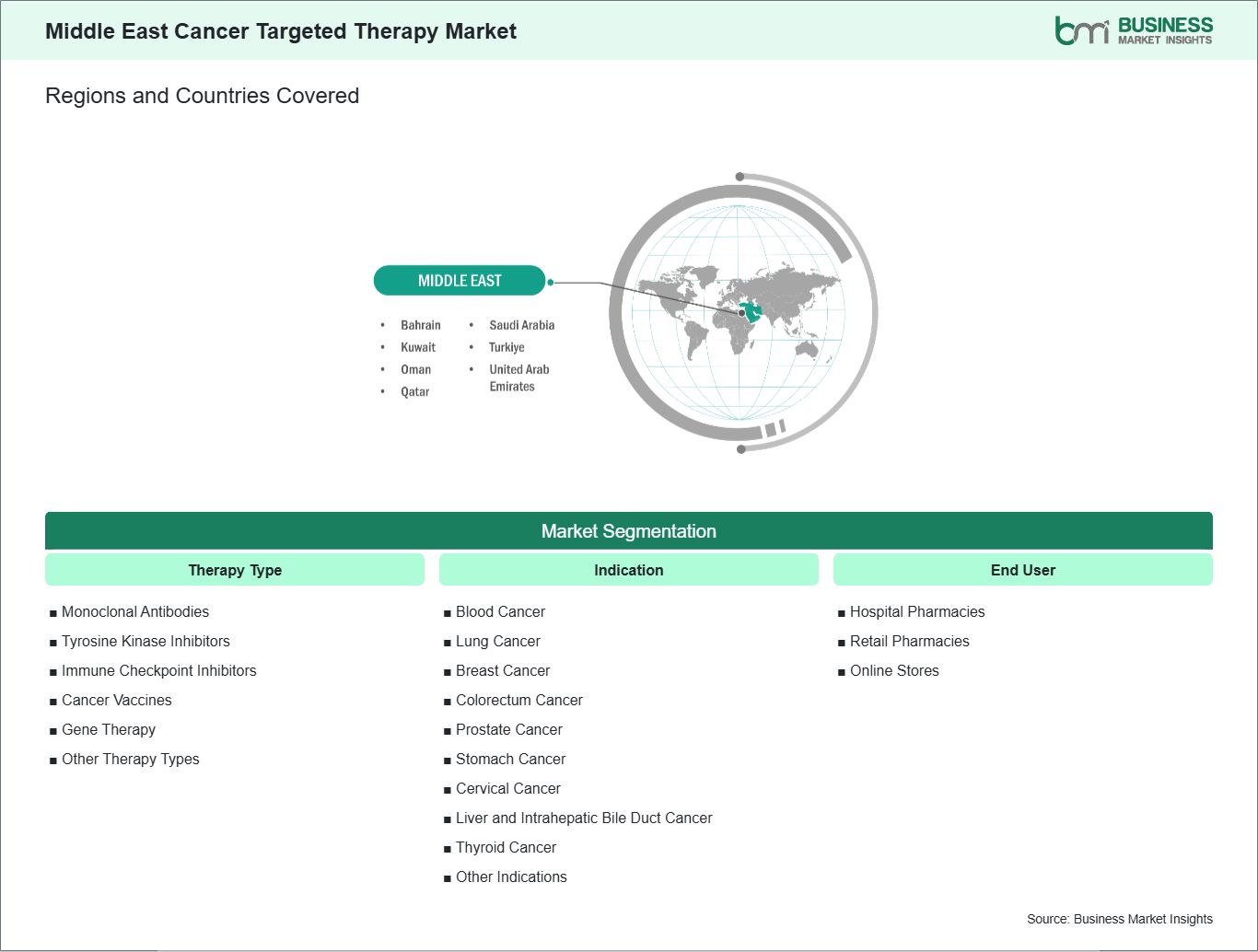
Key segments that contributed to the derivation of the Middle East Cancer Targeted Therapy market analysis are therapy type, indication, and distribution channel.
The growth of the Middle East cancer targeted therapy market is strongly driven by advancements in genomic profiling and biomarker discovery. Molecular diagnostics—such as next-generation sequencing, liquid biopsies, and companion diagnostics—allow oncologists to detect genetic alterations such as EGFR, HER2, ALK, and BRAF mutations, which directly inform therapy selection. This precision medicine approach ensures therapies are administered only to patients likely to benefit, reducing adverse effects and improving clinical outcomes.
Saudi Arabia, the UAE, Qatar, and Kuwait have invested heavily in modern oncology centers, integrating molecular diagnostics into routine care. Hospitals and specialized clinics now conduct biomarker-based testing to guide monoclonal antibody, tyrosine kinase inhibitor, and immune checkpoint inhibitor therapy. Liquid biopsy adoption is increasing—enabling early detection, minimal residual disease monitoring, and identification of treatment resistance—thereby extending therapy duration and improving overall survival.
Pharmaceutical companies are collaborating with hospitals and diagnostic labs to expand access to biomarker testing, enhancing patient stratification for clinical trials and commercial therapies. The collection of regional genomic data supports the identification of novel targets and the development of therapies tailored to Middle Eastern populations. Combined with supportive reimbursement policies and government programs to promote precision medicine, these advancements are driving widespread adoption of targeted therapies, positioning the Middle East as a leading market for innovative oncology treatments.
Targeted therapies for rare cancers and tumors with specific genetic mutations present a substantial opportunity in the Middle East. Traditionally, rare cancers were underserved due to small patient populations and high development costs. However, genomic profiling has revealed actionable mutations shared across multiple tumor types, enabling tumor-agnostic therapy strategies. Therapies targeting NTRK fusions, RET rearrangements, BRAF, and FGFR mutations can treat diverse rare cancers with a single agent, significantly expanding market potential.
Next-generation sequencing and molecular testing programs in leading oncology centers allow early identification of rare mutations in patients, particularly in urban hospitals in Saudi Arabia, the UAE, and Qatar. Innovative trial designs—including basket and umbrella trials—reduce development timelines and facilitate early patient access. Orphan drug designations, accelerated approvals, and market exclusivity for rare cancer therapies incentivize global pharmaceutical companies to invest in these regions.
Strategic partnerships between multinational companies and regional distributors, hospitals, and patient support programs help expand access to these therapies. Increased awareness among physicians and training programs for clinical staff further drives adoption. As molecular testing becomes more integrated into standard care, a growing number of patients with rare, mutation-defined cancers become eligible for targeted therapy. This not only addresses unmet clinical needs but also strengthens pipelines, diversifies revenue streams, and positions the Middle East as a promising growth region in precision oncology.

The Middle East Cancer Targeted Therapy market demonstrates steady growth, with size and share analysis highlighting evolving trends and competitive dynamics among key players. The report examines subsegments categorized within therapy type, indication, and distribution channel, offering insights into their contribution to overall market performance.
By therapy type, the monoclonal antibodies subsegment dominated the market in 2024, driven by high specificity, clinical efficacy, and applicability across lung, breast, and colorectal cancers.
Based on indication, the lung cancer subsegment dominated the market in 2024, driven by the high prevalence, urban population risk factors (smoking, pollution), and availability of EGFR, ALK, and PD-L1-targeted therapies.
By distribution channel, the hospital pharmacies subsegment dominated the market in 2024, driven by the centralized administration of complex oncology therapies, greater access to specialized oncology care, and hospitals serving as primary sites for cancer diagnosis, treatment initiation, and monitoring.
| Report Attribute | Details |
|---|---|
| Market size in 2024 | US$ 1,051.4 Million |
| Market Size by 2031 | US$ 2,163.7 Million |
| CAGR (2025 - 2031) | 10.9% |
| Historical Data | 2021-2023 |
| Forecast period | 2025-2031 |
| Segments Covered | By Therapy Type
|
| Regions and Countries Covered | Middle East
|
| Market leaders and key company profiles |
|
The "Middle East Cancer Targeted Therapy Market Size and Forecast (2021–2031)" report provides a detailed analysis of the market covering below areas:
The geographical scope of the Middle East Cancer Targeted Therapy market report is divided into: the UAE, Saudi Arabia, Bahrain, Oman, Kuwait, Qatar, and Turkiye. Turkiye held the largest share in 2024.
The Middle East cancer targeted therapy market is shaped by differences in healthcare infrastructure, government policies, and private-sector investment. Saudi Arabia and the UAE are the largest markets, supported by advanced hospital networks, oncology centers equipped with molecular diagnostics, and strong government funding for cancer care. National cancer control programs provide reimbursement for high-cost targeted therapies, increasing patient access. These countries also participate in regional and global clinical trials, enabling early adoption of new therapies.
Qatar, Kuwait, and Oman are emerging markets where adoption is growing due to government investment in healthcare infrastructure and oncology services. Specialized hospitals in urban centers have begun integrating molecular diagnostics and precision therapies into standard oncology care, though access in rural regions remains limited. Public-private partnerships and patient assistance programs help bridge affordability gaps and improve therapy access.
Across the Middle East, hospital pharmacies dominate distribution for intravenous biologics, while oral targeted therapies are increasingly dispensed through retail and specialty pharmacies. Multinational companies—including Roche, AstraZeneca, Merck, and Novartis—maintain a strong presence through regional subsidiaries, partnerships, and training initiatives for oncologists. Differences in adoption patterns require country-specific strategies, including premium positioning and early adoption in GCC countries, a focus on affordability in smaller economies, and investment in education and infrastructure to expand therapy penetration. Overall, the Middle East presents a high-potential, heterogeneous market driven by infrastructure, policy support, and growing awareness of precision medicine.

The Middle East Cancer Targeted Therapy market is evaluated by gathering qualitative and quantitative data post primary and secondary research, which includes important corporate publications, association data, and databases. A few of the key developments in the Middle East cancer targeted therapy market are:
The Middle East Cancer Targeted Therapy Market is valued at US$ 1,051.4 Million in 2024, it is projected to reach US$ 2,163.7 Million by 2031.
As per our report Middle East Cancer Targeted Therapy Market, the market size is valued at US$ 1,051.4 Million in 2024, projecting it to reach US$ 2,163.7 Million by 2031. This translates to a CAGR of approximately 10.9% during the forecast period.
The Middle East Cancer Targeted Therapy Market report typically cover these key segments-
The historic period, base year, and forecast period can vary slightly depending on the specific market research report. However, for the Middle East Cancer Targeted Therapy Market report:
The Middle East Cancer Targeted Therapy Market is populated by several key players, each contributing to its growth and innovation. Some of the major players include:
The Middle East Cancer Targeted Therapy Market report is valuable for diverse stakeholders, including:
Essentially, anyone involved in or considering involvement in the Middle East Cancer Targeted Therapy Market value chain can benefit from the information contained in a comprehensive market report.
Please tell us your area of interest
(Market Segments/ Regions and Countries/ Companies)