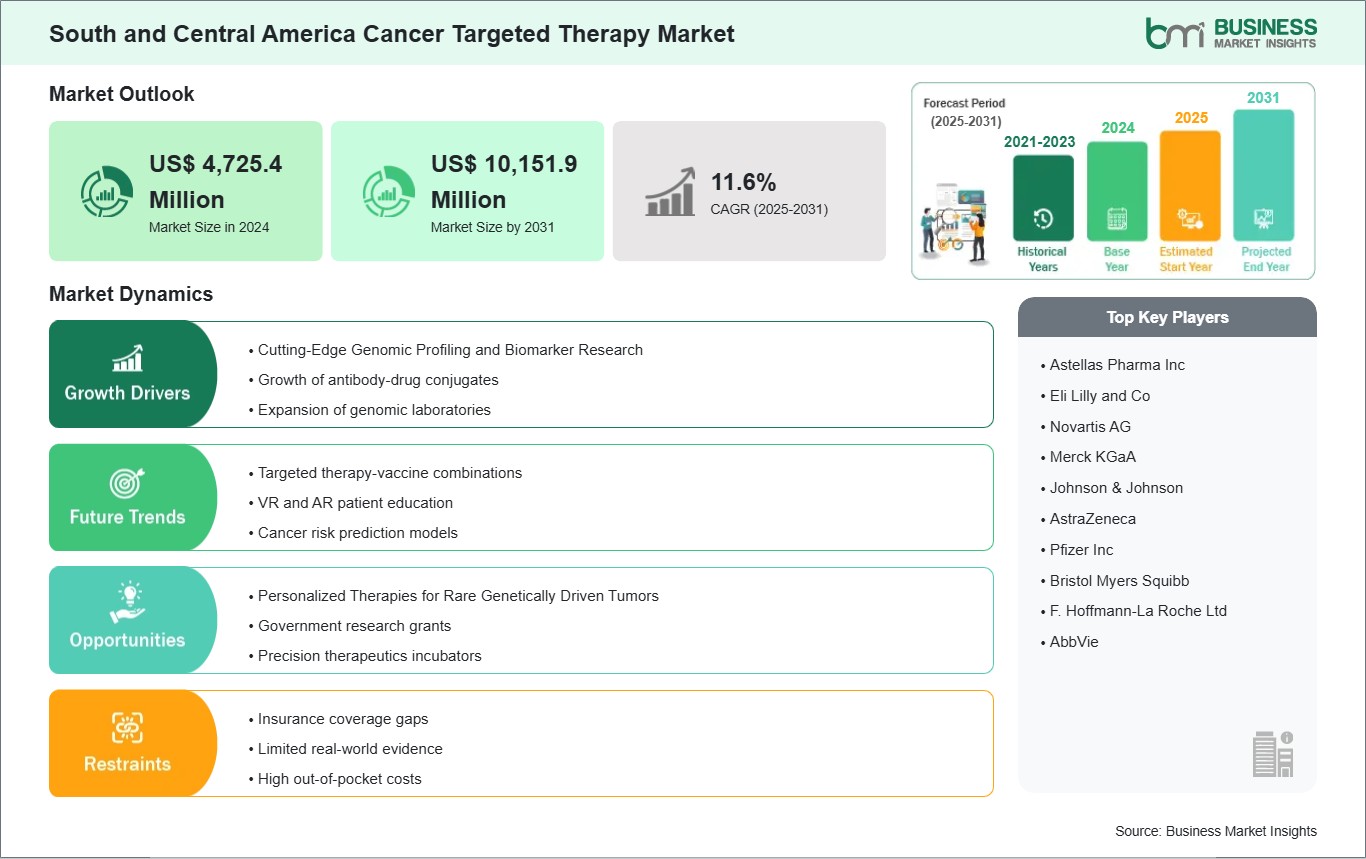
The South and Central America Cancer Targeted Therapy Market size is expected to reach US$ 10,151.9 million by 2031 from US$ 4,725.4 million in 2024. The market is estimated to record a CAGR of 11.6% from 2025 to 2031.
The South and Central America cancer targeted therapy market is witnessing steady growth, driven by rising cancer incidence, increasing healthcare investments, and growing adoption of precision oncology in major urban centers. The region includes countries such as Brazil, Mexico, Argentina, Colombia, Chile, and Peru, each with distinct healthcare infrastructure, regulatory environments, and economic dynamics influencing market adoption.
Targeted therapies—including monoclonal antibodies, tyrosine kinase inhibitors, immune checkpoint inhibitors, cancer vaccines, and gene therapies—are gradually being integrated into standard oncology practice. Adoption is concentrated in metropolitan areas where advanced hospitals, oncology centers, and diagnostic labs are available. Hospital pharmacies are the primary distribution channel due to the complexity of therapy administration, although retail and specialty pharmacies are expanding access to oral targeted therapies.
Pharmaceutical companies are actively partnering with regional hospitals, government programs, and local distributors to improve accessibility. National cancer programs and government incentives in countries such as Brazil and Mexico support the integration of advanced cancer therapies, although cost and reimbursement remain significant challenges. Clinical trial networks in the region facilitate early access to novel therapies, particularly in urban hospitals.
The South and Central America market presents opportunities for global pharmaceutical companies through localized strategies, expansion of precision oncology initiatives, and education programs for healthcare providers, making it an emerging but high-potential market for targeted cancer therapies.

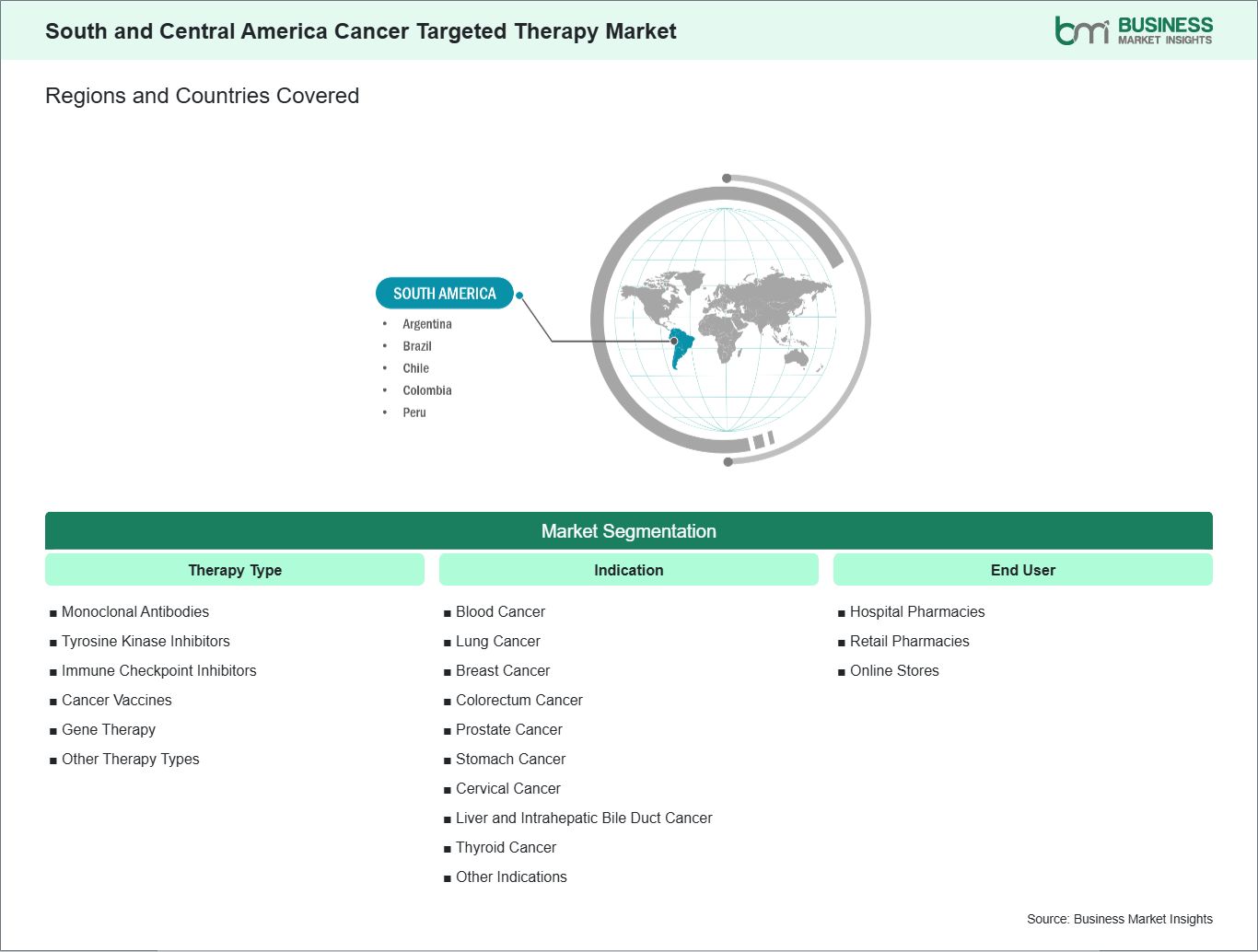
Key segments that contributed to the derivation of the South and Central America Cancer Targeted Therapy market analysis are therapy type, indication, and distribution channel.
Advancements in genomic profiling and biomarker discovery are critical market drivers. Technologies such as next-generation sequencing (NGS), liquid biopsy, and molecular diagnostics enable the identification of mutations such as EGFR, ALK, HER2, BRAF, and PIK3CA. These technologies allow precision-guided therapy, enhancing efficacy and minimizing adverse effects.
The adoption of these technologies is concentrated in urban hospitals and academic medical centers in Brazil, Mexico, and Argentina, supported by local investments and international partnerships. Clinical integration of biomarker-driven therapy selection enables oncologists to administer monoclonal antibodies, tyrosine kinase inhibitors, and immune checkpoint inhibitors to patients who are most likely to benefit.
Liquid biopsy adoption allows for disease monitoring, early detection of treatment resistance, and identification of minimal residual disease, improving patient outcomes. Regional genomic initiatives and collaborations with global pharmaceutical companies accelerate the identification of targetable mutations and expand eligible patient populations.
Although cost and access challenges remain in rural areas, government programs and public-private partnerships are gradually expanding infrastructure. Increasing insurance coverage for high-cost therapies, combined with international collaborations, ensures broader adoption of precision oncology. Collectively, advancements in genomic profiling and biomarker discovery are enabling more personalized, effective, and accessible cancer treatment in South and Central America.
The expansion of targeted therapies into rare cancers represents a significant market opportunity. Historically, rare cancers have limited treatment options due to small patient populations, high development costs, and restricted access to therapies. Advances in genomic profiling allow detection of actionable mutations—such as NTRK fusions, RET rearrangements, BRAF, and FGFR alterations—enabling tumor-agnostic therapies for multiple cancer types.
Urban hospitals and oncology centers in Brazil, Mexico, and Argentina are participating in clinical trials for mutation-driven therapies, supported by partnerships with global pharmaceutical companies such as Roche, Merck, AstraZeneca, Novartis, and Bristol-Myers Squibb. Basket and umbrella trial designs allow simultaneous evaluation of therapies across rare tumor types, reducing development timelines and facilitating regulatory approvals.
Orphan drug designations and accelerated regulatory pathways in countries such as Brazil and Mexico encourage pharmaceutical companies to invest in rare cancer therapeutics. Early adoption of novel therapies in metropolitan hospitals and academic centers improves patient outcomes while demonstrating commercial potential.
Additionally, increasing awareness among clinicians, investment in molecular diagnostics, and patient access programs enhance the feasibility of introducing targeted therapies for rare cancers. As a result, companies can expand their portfolios, address unmet medical needs, and tap into new revenue streams.

The South and Central America Cancer Targeted Therapy market demonstrates steady growth, with size and share analysis highlighting evolving trends and competitive dynamics among key players. The report examines subsegments categorized within therapy type, indication, and distribution channel, offering insights into their contribution to overall market performance.
By therapy type, the monoclonal antibodies subsegment dominated the market in 2024, driven by high efficacy in breast, lung, and colorectal cancers, and established clinical guidelines supporting their use.
Based on indication, the lung cancer subsegment dominated the market in 2024, driven by the high prevalence, environmental risk factors, and availability of multiple approved targeted therapies for EGFR, ALK, and PD-L1 mutations.
By distribution channel, the hospital pharmacies subsegment dominated the market in 2024, driven by targeted therapies that require clinical administration, monitoring, and cold-chain storage.
| Report Attribute | Details |
|---|---|
| Market size in 2024 | US$ 4,725.4 Million |
| Market Size by 2031 | US$ 10,151.9 Million |
| CAGR (2025 - 2031) | 11.6% |
| Historical Data | 2021-2023 |
| Forecast period | 2025-2031 |
| Segments Covered | By Therapy Type
|
| Regions and Countries Covered | South and Central America
|
| Market leaders and key company profiles |
|
The "South and Central America Cancer Targeted Therapy Market Size and Forecast (2021–2031)" report provides a detailed analysis of the market covering below areas:
The geographical scope of the South and Central America Cancer Targeted Therapy market report is divided into: Brazil, Argentina, Peru, Chile, and Colombia. Brazil held the largest share in 2024.
Brazil is the largest market in South and Central America, driven by a combination of high cancer prevalence, advanced healthcare infrastructure in urban areas, and a growing focus on precision medicine. Hospital pharmacies and specialized oncology centers dominate distribution, while molecular diagnostic labs facilitate biomarker-guided therapy. Public and private hospitals implement reimbursement programs, and international pharmaceutical companies frequently conduct clinical trials in urban centers to enable early access to novel therapies. Argentina, Chile, and Colombia exhibit moderate adoption, with access concentrated in metropolitan hospitals. Clinical trials and public-private partnerships help expand the availability of monoclonal antibodies, immune checkpoint inhibitors, and tyrosine kinase inhibitors.
Insurance coverage and government programs increasingly support high-cost therapies, although rural regions face access and affordability challenges. Across South and Central America, hospitals remain the dominant end users, while retail pharmacies and specialty centers facilitate access to oral targeted therapies. Multinational companies such as Roche, Merck, AstraZeneca, Novartis, and Bristol-Myers Squibb maintain strong regional presence through partnerships, clinical trial participation, and education initiatives. The region's diverse healthcare infrastructure necessitates localized strategies, combining premium adoption in urban hospitals with affordability-focused approaches in emerging areas, making it a promising market for targeted oncology therapies.

The South and Central America Cancer Targeted Therapy market is evaluated by gathering qualitative and quantitative data post primary and secondary research, which includes important corporate publications, association data, and databases. A few of the key developments in the South and Central America cancer targeted therapy market are:
The South and Central America Cancer Targeted Therapy Market is valued at US$ 4,725.4 Million in 2024, it is projected to reach US$ 10,151.9 Million by 2031.
As per our report South and Central America Cancer Targeted Therapy Market, the market size is valued at US$ 4,725.4 Million in 2024, projecting it to reach US$ 10,151.9 Million by 2031. This translates to a CAGR of approximately 11.6% during the forecast period.
The South and Central America Cancer Targeted Therapy Market report typically cover these key segments-
The historic period, base year, and forecast period can vary slightly depending on the specific market research report. However, for the South and Central America Cancer Targeted Therapy Market report:
The South and Central America Cancer Targeted Therapy Market is populated by several key players, each contributing to its growth and innovation. Some of the major players include:
The South and Central America Cancer Targeted Therapy Market report is valuable for diverse stakeholders, including:
Essentially, anyone involved in or considering involvement in the South and Central America Cancer Targeted Therapy Market value chain can benefit from the information contained in a comprehensive market report.
Please tell us your area of interest
(Market Segments/ Regions and Countries/ Companies)