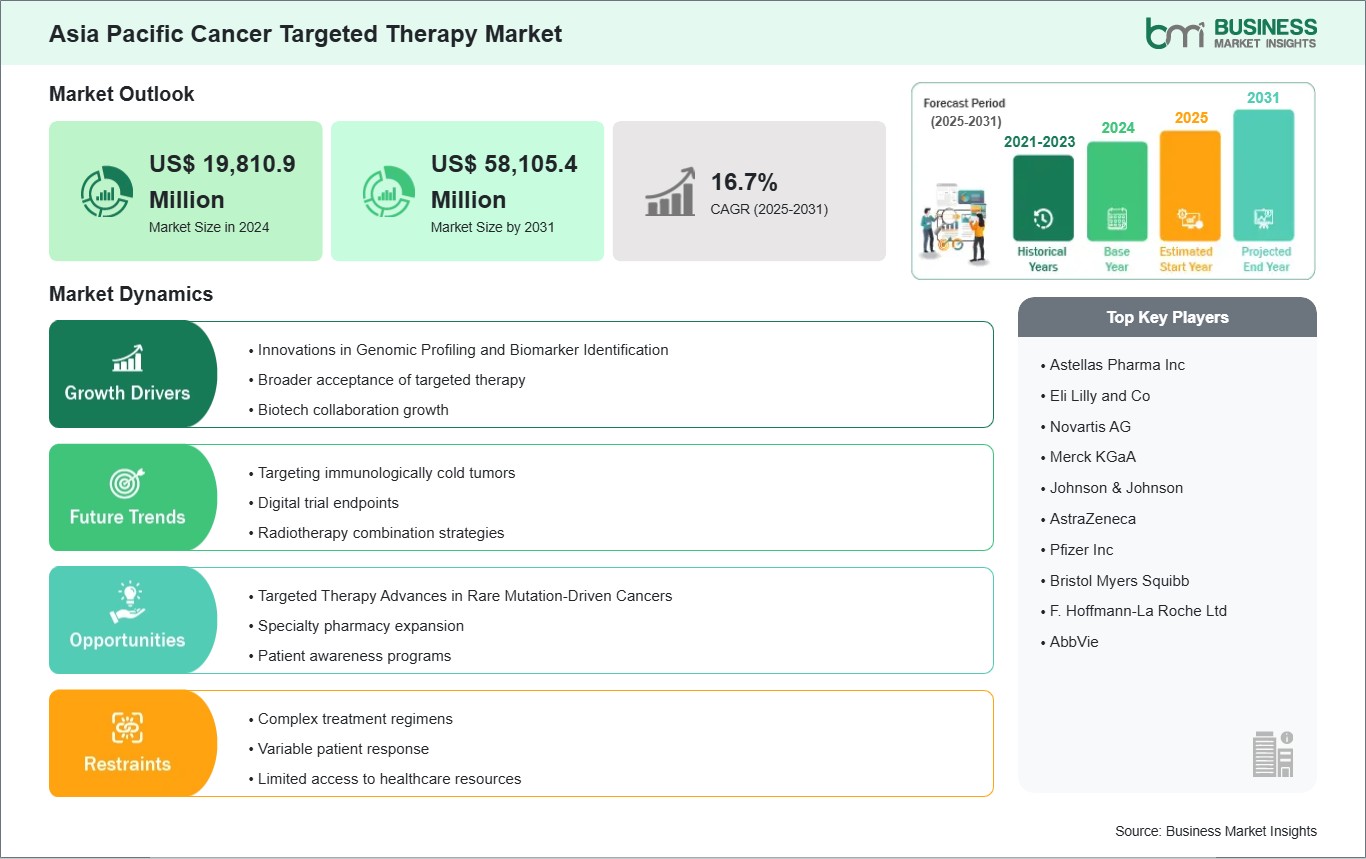
The Asia Pacific Cancer Targeted Therapy Market size is expected to reach US$ 58,105.4 million by 2031 from US$ 19,810.9 million in 2024. The market is estimated to record a CAGR of 16.7% from 2025 to 2031.
The Asia Pacific cancer targeted therapy market is experiencing robust growth, driven by rising adoption of precision oncology, growing access to genomic testing, and a strong pipeline of monoclonal antibodies, tyrosine kinase inhibitors, and immune checkpoint inhibitors. Countries such as Japan, China, South Korea, Australia, and Singapore serve as innovation hubs for oncology research and clinical trials, facilitating early adoption of targeted therapies. Regulatory support for accelerated approvals, combined with public and private reimbursement initiatives, enables wider therapy access. Hospitals and specialized oncology centers remain the primary sites for administration of targeted therapies, supported by centralized pharmacy and molecular diagnostic services.
Despite disparities in healthcare infrastructure between developed and emerging Asia Pacific markets, public-private collaborations, cross-border clinical trials, and regional manufacturing expansions are improving treatment availability. Overall, the region presents a mix of high-end precision oncology adoption in Japan, Australia, and South Korea, alongside emerging opportunities in China, India, and Southeast Asia, positioning Asia Pacific as a rapidly expanding market for cancer-targeted therapies.

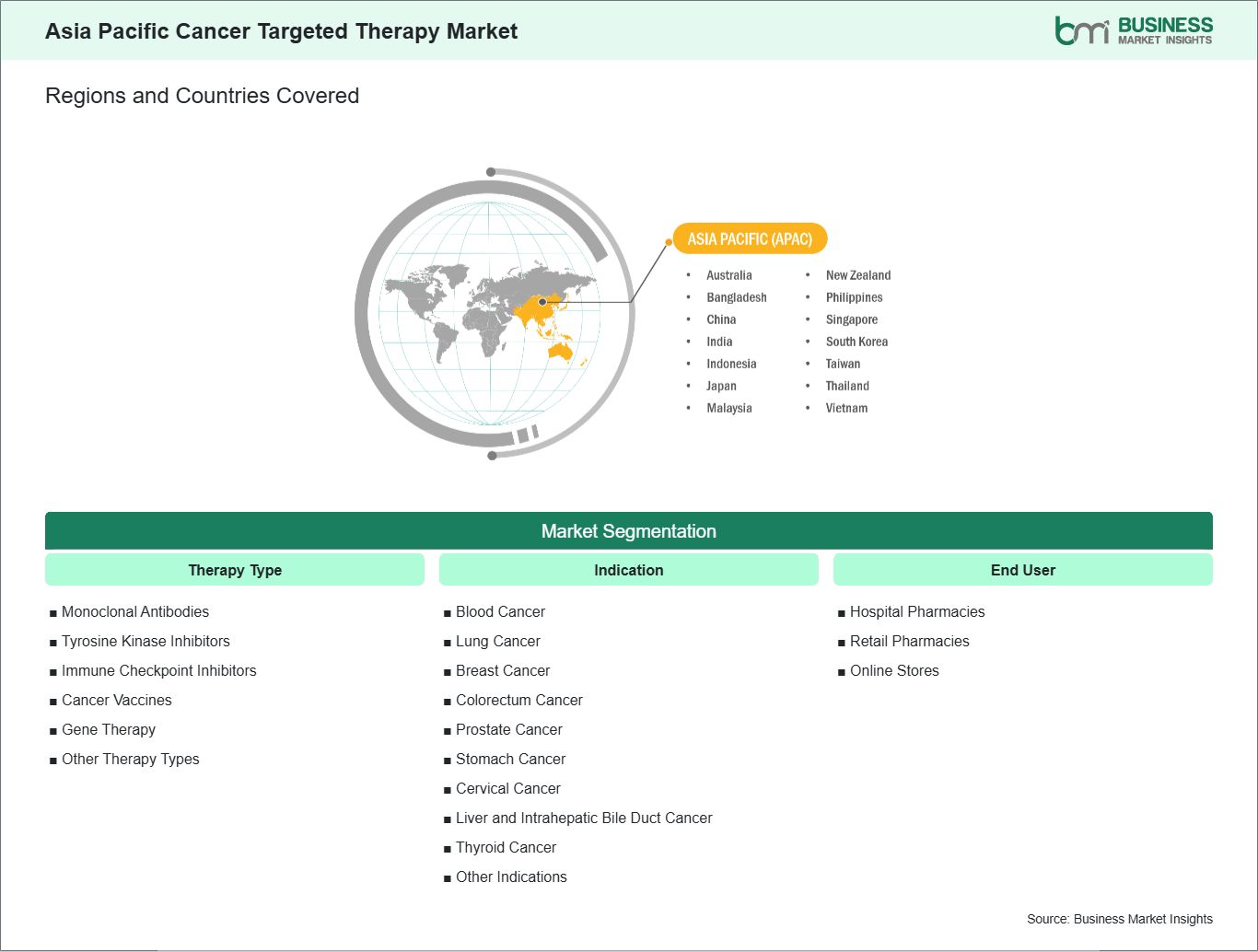
Key segments that contributed to the derivation of the Asia Pacific Cancer Targeted Therapy market analysis are therapy type, indication, and distribution channel.
The cancer targeted therapy market in Asia Pacific is driven by significant advancements in genomic profiling and biomarker discovery. Next-generation sequencing, liquid biopsy, and molecular diagnostics allow the detection of mutations such as EGFR, ALK, BRAF, RET, and PIK3CA with high precision. Countries such as Japan, South Korea, Singapore, and China have invested in central genomic testing infrastructure, enabling precision therapy adoption and patient stratification.
Public and private reimbursement programs are expanding, reducing cost barriers, and improving patient access. Regional clinical trials leverage molecular profiling for therapy matching, accelerating regulatory approvals. Artificial intelligence and bioinformatics enhance biomarker validation and treatment resistance monitoring. Growing genomic databases support real-world evidence, strengthening treatment guidelines and payer confidence. These factors collectively increase therapy adoption, enhance clinical outcomes, and sustain market growth in monoclonal antibodies, tyrosine kinase inhibitors, and immune checkpoint inhibitors.
The expansion of targeted therapies into rare cancers and genetically defined tumors represents a key opportunity in Asia Pacific. Advances in molecular profiling reveal actionable mutations in rare cancers, allowing tumor-agnostic treatment approaches targeting NTRK fusions, RET rearrangements, FGFR alterations, and BRAF mutations. Orphan drug pathways, conditional approvals, and market exclusivity enable faster commercialization and increased viability for rare indications.
Countries such as Japan, South Korea, Singapore, and Australia are adopting basket and umbrella trial designs to accelerate patient enrollment and clinical development. Access to molecular testing has improved rare mutation detection in emerging markets such as China, India, and Thailand, expanding the addressable population. Partnerships between multinational pharmaceutical companies and regional research institutions further support pipeline development and real-world evidence generation. As awareness of molecularly guided treatments grows, the market for niche targeted therapies is expected to expand rapidly, providing long-term opportunities and strengthening precision oncology adoption across Asia Pacific.

The Asia Pacific Cancer Targeted Therapy market demonstrates steady growth, with size and share analysis highlighting evolving trends and competitive dynamics among key players. The report examines subsegments categorized within therapy type, indication, and distribution channel, offering insights into their contribution to overall market performance.
By therapy type, the monoclonal antibodies subsegment dominated the market in 2024, driven by high clinical efficacy, broad immuno-oncology adoption, and combination therapy approvals.
Based on indication, the lung cancer subsegment dominated the market in 2024, driven by high disease prevalence, environmental risk factors, and the availability of multiple approved targeted therapies.
By distribution channel, the hospital pharmacies subsegment dominated the market in 2024, driven by centralized therapy administration, access to specialized oncology care, and hospitals serving as primary sites for diagnosis, treatment initiation, and monitoring.
| Report Attribute | Details |
|---|---|
| Market size in 2024 | US$ 19,810.9 Million |
| Market Size by 2031 | US$ 58,105.4 Million |
| CAGR (2025 - 2031) | 16.7% |
| Historical Data | 2021-2023 |
| Forecast period | 2025-2031 |
| Segments Covered | By Therapy Type
|
| Regions and Countries Covered | Asia-Pacific
|
| Market leaders and key company profiles |
|
The "Asia Pacific Cancer Targeted Therapy Market Size and Forecast (2021–2031)" report provides a detailed analysis of the market covering below areas:
The geographical scope of the Asia Pacific Cancer Targeted Therapy market report is divided into: China, India, Japan, Australia, Bangladesh, Indonesia, Malaysia, New Zealand, Philippines, Singapore, South Korea, Taiwan, Thailand, and Vietnam. China held the largest share in 2024.
The Asia Pacific cancer targeted therapy market exhibits significant regional variation. China is the most mature market, driven by high healthcare expenditure, strong precision oncology adoption, and robust insurance coverage for biomarker-guided therapies. South Korea follows closely with high clinical trial activity, advanced molecular testing infrastructure, and rapid uptake of immune checkpoint inhibitors. Singapore acts as a regional hub for clinical research and early therapy adoption, supported by government initiatives promoting personalized medicine. Australia combines high per-capita access to targeted therapies with strong public-private partnerships in oncology research. Emerging markets such as India, Thailand, and Malaysia are witnessing rapid growth due to increasing awareness of cancer care, improving hospital infrastructure, and expanding access to molecular diagnostics.
Reimbursement policies and cost-effectiveness analyses are gradually enhancing therapy affordability, while regional collaborations between multinational pharma, local biotech companies, and academic institutions improve access to cutting-edge treatments. Hospitals and specialized oncology centers dominate as end users, whereas private clinics and specialty pharmacies are increasingly investing in targeted therapies to expand service offerings. Collectively, the region presents a mix of mature and high-potential markets, where differentiated strategies—premium precision oncology in Japan, Singapore, and Australia, and affordability-driven expansion in China, India, and Southeast Asia—will define long-term market growth.

The Asia Pacific Cancer Targeted Therapy market is evaluated by gathering qualitative and quantitative data post primary and secondary research, which includes important corporate publications, association data, and databases. A few of the key developments in the Asia Pacific cancer targeted therapy market are:
The Asia Pacific Cancer Targeted Therapy Market is valued at US$ 19,810.9 Million in 2024, it is projected to reach US$ 58,105.4 Million by 2031.
As per our report Asia Pacific Cancer Targeted Therapy Market, the market size is valued at US$ 19,810.9 Million in 2024, projecting it to reach US$ 58,105.4 Million by 2031. This translates to a CAGR of approximately 16.7% during the forecast period.
The Asia Pacific Cancer Targeted Therapy Market report typically cover these key segments-
The historic period, base year, and forecast period can vary slightly depending on the specific market research report. However, for the Asia Pacific Cancer Targeted Therapy Market report:
The Asia Pacific Cancer Targeted Therapy Market is populated by several key players, each contributing to its growth and innovation. Some of the major players include:
The Asia Pacific Cancer Targeted Therapy Market report is valuable for diverse stakeholders, including:
Essentially, anyone involved in or considering involvement in the Asia Pacific Cancer Targeted Therapy Market value chain can benefit from the information contained in a comprehensive market report.
Please tell us your area of interest
(Market Segments/ Regions and Countries/ Companies)