Market Summary
Executive Summary and Market Analysis
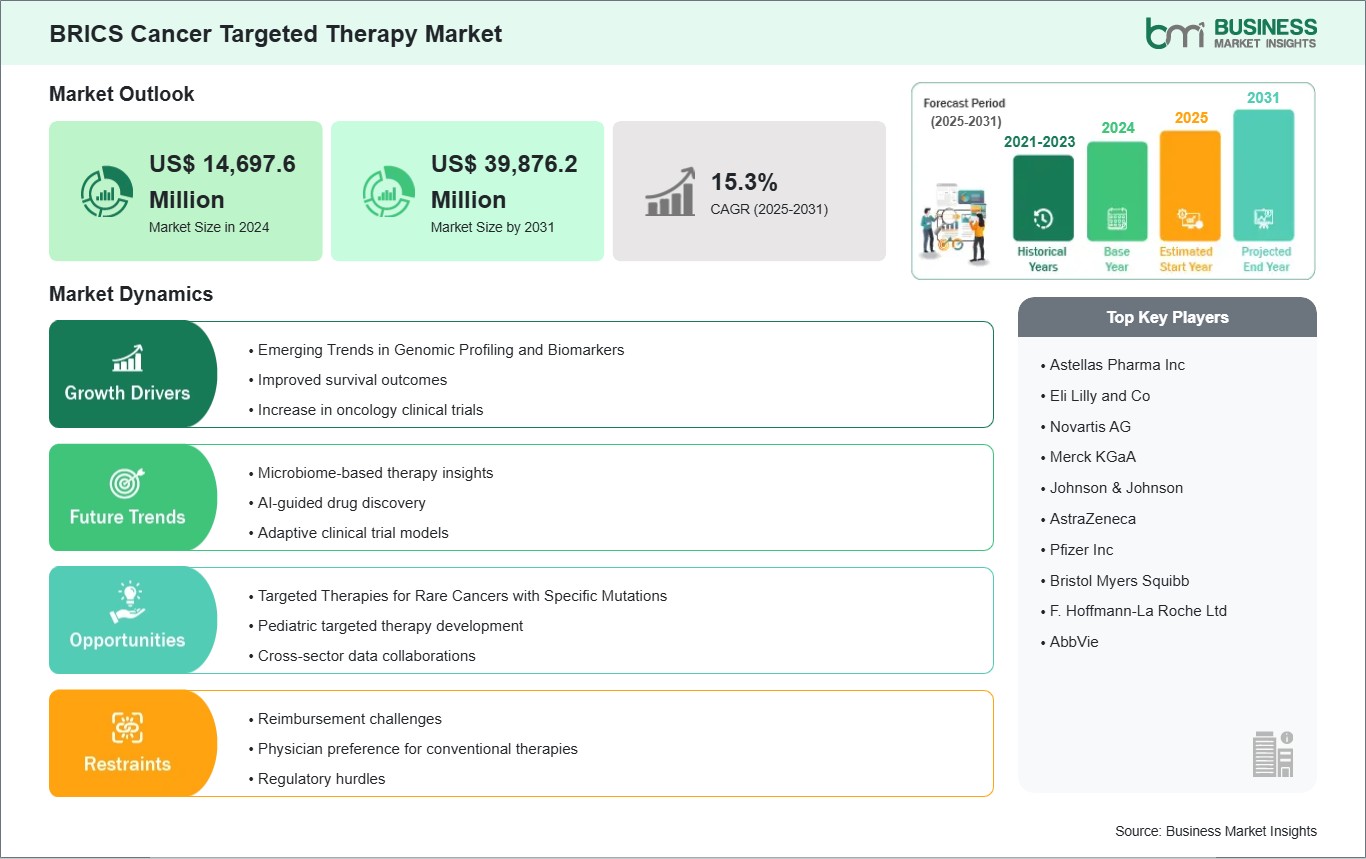
The BRICS cancer targeted therapy market is experiencing dynamic expansion driven by rising cancer prevalence, rapid adoption of precision oncology, enhanced genomic profiling, and increasing healthcare investment. BRICS nations—Brazil, Russia, India, China, and South Africa—collectively represent a significant share of global cancer incidence, with lung, breast, colorectal, and hematological cancers foremost among target indications. These countries are progressively integrating next‑generation sequencing (NGS), liquid biopsy, and companion diagnostics into routine clinical workflows, enabling earlier detection of actionable mutations and customized treatment planning tailored to patient genomics. Healthcare systems in China and India have particularly accelerated investment in oncology infrastructure, including molecular diagnostic labs, immuno-oncology programs, and clinical trial networks, narrowing the gap with developed markets.
Government support and public‑private partnerships are strengthening the adoption of targeted therapies, while locally developed targeted agents and biosimilars are improving affordability and access. The market features extensive clinical trial activity, supportive regulatory reforms, and a growing oncology workforce familiar with immunotherapy combinations and targeted small molecules. However, disparities in access persist across rural and urban areas—especially in India and South Africa—highlighting opportunities for capacity building and broader reimbursement coverage. Collectively, these factors position BRICS as a growth engine and strategic innovation cluster in the global oncology landscape. Continued emphasis on research, regulatory harmonization, and healthcare system strengthening will be pivotal in realizing the full potential of targeted therapy adoption across the BRICS region.
Segment Analysis
BRICS Cancer Targeted Therapy Market Segmentation
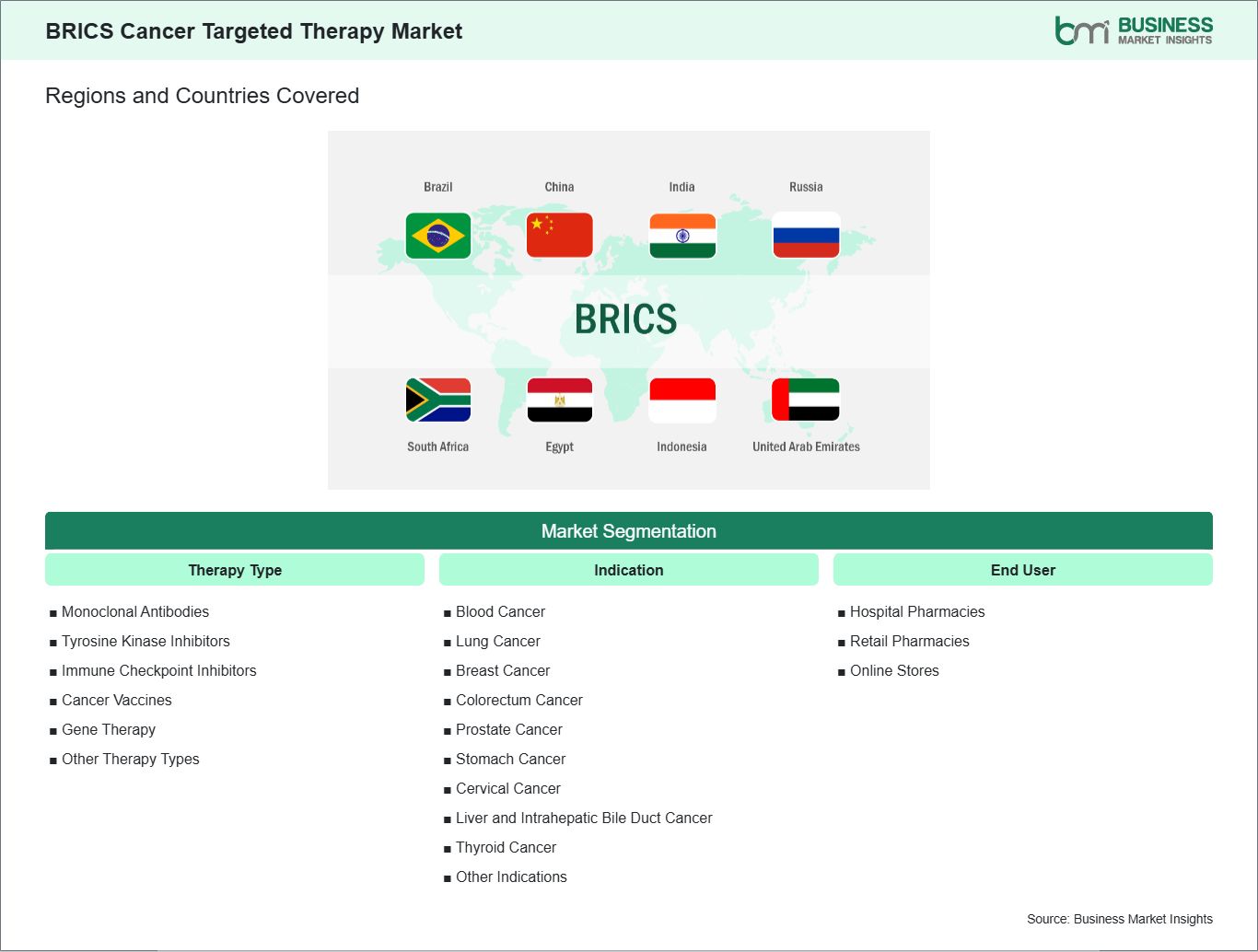
Key segments that contributed to the derivation of the BRICS Cancer Targeted Therapy market analysis are therapy type, indication, and distribution channel.
- By therapy type, the cancer targeted therapy market is segmented into monoclonal antibodies, tyrosine kinase inhibitors, immune checkpoint inhibitors, cancer vaccines, gene therapy, and others. The monoclonal antibodies segment dominated the market in 2024.
- Based on indication, the cancer targeted therapy market is segmented into blood cancer, lung cancer, breast cancer, colorectum cancer, prostate cancer, stomach cancer, cervical cancer, liver and intrahepatic bile duct cancer, thyroid cancer, and other indications. The lung cancer segment dominated the market in 2024.
- In terms of distribution channel, the market is segmented into hospital pharmacies, retail pharmacies, and online stores. The hospital pharmacies segment dominated the market in 2024.
Market Forces
BRICS Cancer Targeted Therapy Market Drivers and Opportunities
Emerging Trends in Genomic Profiling and Biomarkers
Advancements in genomic profiling and biomarker discovery serve as foundational catalysts, allowing clinicians to map cancer genomes and identify actionable mutations such as EGFR, ALK, BRAF, RET, and PIK3CA. These insights enable precision medicine, where therapies are selected based on tumor biology rather than histology alone, improving response rates and patient outcomes compared to conventional chemotherapy. In China and India, major healthcare institutions and private diagnostic networks are investing in next‑generation sequencing (NGS) platforms and liquid biopsy technologies, expanding early detection and enabling therapy monitoring, minimal residual disease tracking, and real‑time resistance profiling. Enhanced diagnostic capabilities create larger populations of patients eligible for targeted therapies, driving adoption across indications.
Regulatory reforms in BRICS nations—including expanded approval pathways and supportive frameworks for companion diagnostics—further accelerate market growth by facilitating faster market entry of new targeted agents and biosimilars. Public‑private collaborations and international clinical research partnerships enhance local oncology research infrastructure, accelerating evidence generation for novel therapies in diverse genetic populations characteristic of BRICS countries. Digital health, artificial intelligence (AI)‑enabled analytics, and real‑world data platforms are also strengthening biomarker validation and treatment optimization. Rising cancer incidence, expanding healthcare coverage, and growing awareness among clinicians and patients about personalized oncology further reinforce demand. These drivers collectively position BRICS as a high‑growth regional market for cancer-targeted therapies.
Targeted Therapies for Rare Cancers with Specific Mutations
A primary opportunity lies in expanding precision oncology adoption in underserved and emerging sub‑markets within BRICS. Urban centers in China, Brazil, and India have relatively mature oncology infrastructures, whereas rural and secondary cities remain underserved. Targeted programs to widen genomic testing access and digital oncology platforms can bridge these gaps and unlock large untapped patient pools. Another major opportunity lies in biosimilar development and local manufacturing of targeted therapeutics. BRICS countries are increasingly focusing on producing cost‑effective biosimilars for monoclonal antibodies and other biologics, reducing therapy costs and widening affordability. Regulatory harmonization between BRICS nations through working groups enhances cross‑market clinical trial acceptance and streamlines joint submissions, lowering time‑to‑market costs for new targeted agents.
The region also presents opportunities in tumor‑agnostic and mutation‑driven indications—such as NTRK, RET, and FGFR alterations—where expanding basket and umbrella trial designs accelerate indication expansions across multiple tumor types. Investment in rare cancer targeted therapies is another growth vector—orphan drug incentives and conditional approval pathways can make rare cancer development commercially viable in BRICS, especially for pediatric and genetically defined tumors. Public‑private partnerships and global pharma collaborations with local research institutions further enhance pipeline depth and technology transfer. Real‑world evidence generation specific to BRICS populations can drive more effective health technology assessments and reimbursement decisions, expanding therapy coverage. Collectively, these opportunities underscore the potential for both localized innovation and global integration in targeted cancer therapeutics.
Size and Share Analysis
BRICS Cancer Targeted Therapy Market Size and Share Analysis
The BRICS Cancer Targeted Therapy market demonstrates steady growth, with size and share analysis highlighting evolving trends and competitive dynamics among key players. The report examines subsegments categorized within therapy type, indication, and distribution channel, offering insights into their contribution to overall market performance.
By therapy type, the monoclonal antibodies subsegment dominated the market in 2024, driven by their established efficacy and integration in standard treatment protocols. TKIs and immune checkpoint inhibitors follow closely, with expanding indications driving uptake.
Based on indication, the lung cancer subsegment dominated the market in 2024, driven by a high incidence of smoking‑related and environmental pollution‑associated disease, especially in China and India.
By distribution channel, the hospital pharmacies subsegment dominated the market in 2024, driven by the centralized administration of complex oncology regimens, availability of specialized oncology teams, and hospital‑based diagnostic facilities required for companion testing.
Report Coverage
BRICS Cancer Targeted Therapy Market Report Coverage and Deliverables
The "BRICS Cancer Targeted Therapy Market Size and Forecast (2021–2031)" report provides a detailed analysis of the market covering below areas:
- BRICS Cancer Targeted Therapy market size and forecast at regional and country levels for key segments covered under the scope
- BRICS Cancer Targeted Therapy market trends, as well as market dynamics such as drivers, restraints, and key opportunities
- BRICS Cancer Targeted Therapy market analysis covering key trends, regional framework, major players, regulations, and recent market developments
- Industry landscape and competition analysis covering market concentration, heat map analysis, prominent players, and recent developments for the BRICS Cancer Targeted Therapy market
- Detailed company profiles, including SWOT analysis
Geographic Insights
BRICS Cancer Targeted Therapy Market Geographic Insights
The geographical scope of the BRICS Cancer Targeted Therapy market report is divided into: Russia, Brazil, South Africa, India, the UAE, and China. China held the largest share in 2024.
The BRICS nations exhibit diverse country‑specific dynamics shaped by healthcare infrastructure, regulatory evolution, and local oncology ecosystems. China, as the largest regional market, benefits from extensive genomic testing networks, a high incidence of lung and liver cancers, and a thriving biotech sector that accelerates targeted therapy innovation. Urban centers drive the adoption of precision oncology, supported by hospital networks, reimbursement expansion, and strong clinical trial ecosystems. India presents a rapidly emerging market where major cancer centers in metropolitan hubs integrate molecular profiling with treatment decisions, though access gaps persist in rural regions. Government initiatives and private investment are enhancing oncology diagnostic capabilities and clinical research activity.
Brazil maintains a strong public health infrastructure with growing adoption of targeted biologics and immunotherapies. Collaborative efforts with global pharma and local biotech firms support therapy access and research expansion. Russia shows specialized adoption in larger oncology centers, where targeted therapies for breast, hematologic, and lung cancers are increasingly used alongside international standards. South Africa continues to build capacity through partnerships, diagnostic upgrades, and participation in multinational clinical trials, positioning itself for incremental growth in targeted oncology. Across BRICS, regulatory reforms, biosimilar policies, and clinical evidence generation play key roles in shaping therapy access and uptake.
Industry Activity
Recent Developments
The BRICS Cancer Targeted Therapy market is evaluated by gathering qualitative and quantitative data post primary and secondary research, which includes important corporate publications, association data, and databases. A few of the key developments in the BRICS cancer targeted therapy market are:
- In May 2025, India's Central Drugs Standard Control Organization (CDSCO) approved an expanded indication for Enhertu (trastuzumab deruxtecan), a HER2‑directed antibody‑drug conjugate co‑developed by AstraZeneca and Daiichi Sankyo. The new approval covers use in unresectable or metastatic HER2‑positive solid tumors, beyond its earlier breast and gastric cancer indications.
- In September 2025, China's National Medical Products Administration (NMPA) granted conditional approval for a novel therapy targeting EZH2 (Enhancer of Zeste Homolog 2) in patients with relapsed or refractory peripheral T‑cell lymphoma (PTCL). EZH2 is an epigenetic regulator implicated in tumor progression, and inhibiting it represents a new therapeutic strategy for aggressive blood cancers.
Trust & Transparency
Research Methodology
The market analysis combines proprietary research with secondary data from government agencies, company disclosures, regulatory filings, industry databases and expert interviews. Market estimates are validated through data triangulation, cross-market benchmarking and analyst
review.
View Full Research Methodology
Key Sources Referred:
World Health Organization (WHO) World Heart Federation (WHF) Organisation for Economic Cooperation and Development (OECD) The World Bank Group Worldometer The Lancet International Bar Association International Trade Administration