Market Summary
Executive Summary and Market Analysis
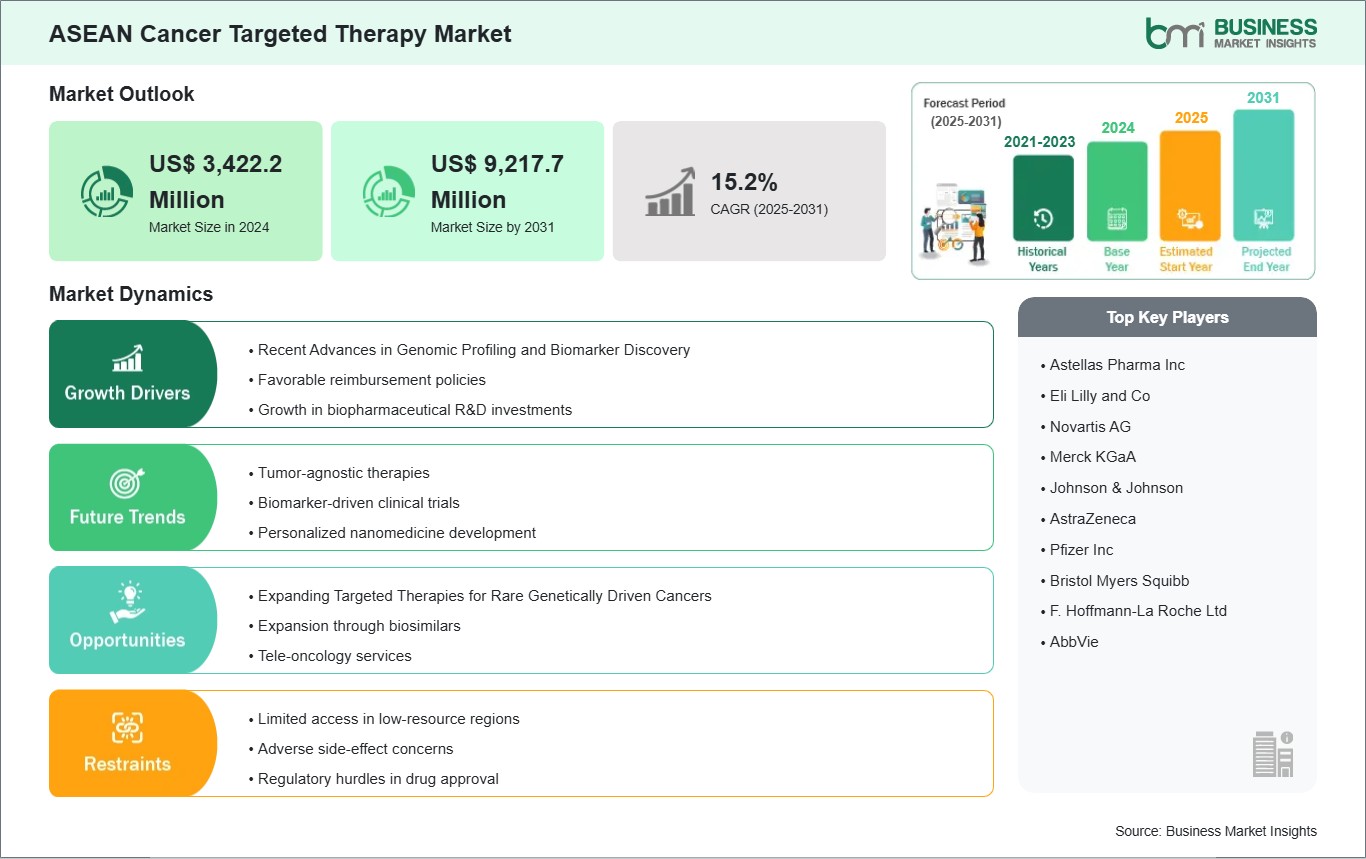
The cancer targeted therapy market in ASEAN is experiencing accelerated growth, fueled by investments in precision oncology, regional genomic initiatives, and strong collaboration between pharmaceutical companies and academic research centers. Advanced diagnostic infrastructure in Singapore, Malaysia, and Thailand supports early adoption of monoclonal antibodies, tyrosine kinase inhibitors, and immune checkpoint inhibitors. Multinational companies are increasingly conducting clinical trials in the region, leveraging diverse patient populations and streamlined regulatory pathways.
Regulatory frameworks are evolving to allow faster approvals, particularly for therapies addressing unmet needs and rare genetically driven cancers. Integration of genomic profiling into clinical workflows is growing, especially for lung, breast, colorectal, and hematological cancers. Hospital pharmacies and specialized oncology centers remain the primary administration points, supported by centralized care and treatment monitoring systems. Regional government initiatives and public-private collaborations are reducing disparities in access to targeted therapies. Overall, the market reflects a blend of innovation, regulatory progress, and infrastructure expansion, positioning it as a high-potential region for targeted oncology therapies.
Segment Analysis
ASEAN Cancer Targeted Therapy Market Segmentation
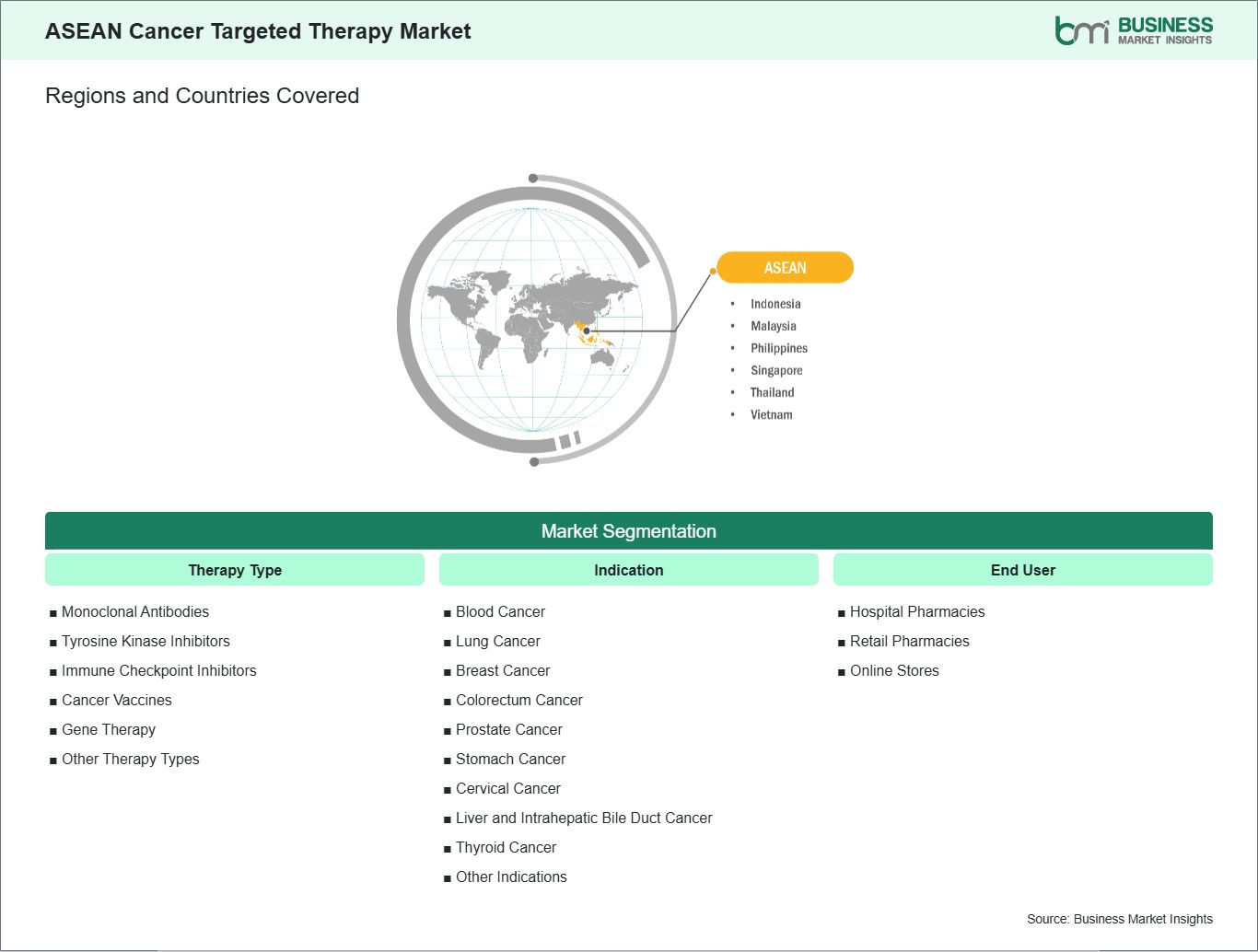
Key segments that contributed to the derivation of the ASEAN Cancer Targeted Therapy market analysis are therapy type, indication, and distribution channel.
- By therapy type, the cancer targeted therapy market is segmented into monoclonal antibodies, tyrosine kinase inhibitors, immune checkpoint inhibitors, cancer vaccines, gene therapy, and others. The monoclonal antibodies segment dominated the market in 2024.
- Based on indication, the cancer targeted therapy market is segmented into blood cancer, lung cancer, breast cancer, colorectum cancer, prostate cancer, stomach cancer, cervical cancer, liver and intrahepatic bile duct cancer, thyroid cancer, and other indications. The lung cancer segment dominated the market in 2024.
- In terms of distribution channel, the market is segmented into hospital pharmacies, retail pharmacies, and online stores. The hospital pharmacies segment dominated the market in 2024.
Market Forces
ASEAN Cancer Targeted Therapy Market Drivers and Opportunities
Recent Advances in Genomic Profiling and Biomarker Discovery
The ASEAN cancer targeted therapy market is primarily driven by advancements in genomic profiling and biomarker discovery, which are enabling precision oncology adoption across the region. Next-generation sequencing (NGS), liquid biopsy technologies, and molecular diagnostics allow clinicians to detect actionable genetic alterations such as EGFR, ALK, BRAF, RET, and PIK3CA mutations with high precision. These biomarkers guide therapy selection, improving patient outcomes, reducing adverse events, and minimizing unnecessary chemotherapy exposure. Countries such as Singapore, Malaysia, and Thailand have invested heavily in central genomic testing networks and integrated diagnostic pathways, enabling the timely identification of patients eligible for targeted therapies. Public and private reimbursement programs are gradually expanding, reducing cost barriers, and widening access. Regional clinical trials increasingly leverage molecular profiling to match patients to precision therapies, accelerating drug development and regulatory approvals. Artificial intelligence and bioinformatics tools are strengthening biomarker validation, resistance profiling, and personalized treatment strategies. The proliferation of regional genomic databases and collaborative networks further supports real-world evidence generation, informing treatment guidelines and reimbursement policies. Collectively, these factors create an enabling ecosystem for precision oncology in ASEAN, driving the adoption of monoclonal antibodies, immune checkpoint inhibitors, and tyrosine kinase inhibitors, while contributing to sustained market growth.
Expanding Targeted Therapies for Rare Genetically Driven Cancers
The ASEAN cancer targeted therapy market presents significant opportunities in expanding treatments into rare cancers and genetically defined tumor subtypes. Advances in genomic sequencing and biomarker testing have revealed that several rare and low-incidence cancers harbor actionable mutations, making mutation-driven therapies commercially viable across multiple indications. Tumor-agnostic approaches targeting NTRK fusions, RET rearrangements, FGFR alterations, and BRAF mutations allow pharmaceutical companies to broaden indications for a single therapy across diverse malignancies. Regional regulatory frameworks—including orphan drug pathways and conditional approvals—support faster market entry and extended exclusivity for rare cancer therapies. ASEAN countries are increasingly adopting basket and umbrella trial designs to accelerate clinical development timelines while optimizing patient enrollment.
Access to comprehensive molecular testing has improved the detection of rare mutations in Indonesia, Malaysia, and Vietnam, expanding the addressable patient population. Growing integration of precision medicine into treatment guidelines across Singapore and Thailand encourages the adoption of targeted therapies for rare indications. Partnerships between multinational pharmaceutical companies and regional research institutions further enable pipeline expansion and clinical trial support. As awareness of molecularly guided treatments rises among healthcare providers and patients, market penetration for niche therapies is expected to grow rapidly. These factors collectively represent a strategic opportunity for companies to invest in rare cancer therapeutics and leverage ASEAN's diverse population to strengthen long-term revenue streams, while advancing precision oncology in the region.
Size and Share Analysis
ASEAN Cancer Targeted Therapy Market Size and Share Analysis
The ASEAN Cancer Targeted Therapy market demonstrates steady growth, with size and share analysis highlighting evolving trends and competitive dynamics among key players. The report examines subsegments categorized within therapy type, indication, and distribution channel, offering insights into their contribution to overall market performance.
By therapy type, the monoclonal antibodies subsegment dominated the market in 2024, driven by high efficacy, broad application across oncology indications, and strong pipeline expansion supported by regulatory approvals and combination therapies.
Based on indication, the lung cancer subsegment dominated the market in 2024, driven by rising regional prevalence, increasing environmental pollution, smoking risk factors, and the availability of targeted and immunotherapy options addressing actionable genetic mutations.
By distribution channel, the hospital pharmacies subsegment dominated the market in 2024, driven by centralized administration, specialized oncology care centers, and hospitals serving as primary sites for diagnosis, therapy initiation, monitoring, and follow-up care.
Report Coverage
ASEAN Cancer Targeted Therapy Market Report Coverage and Deliverables
The "ASEAN Cancer Targeted Therapy Market Size and Forecast (2021–2031)" report provides a detailed analysis of the market covering below areas:
- ASEAN Cancer Targeted Therapy market size and forecast at regional and country levels for key market segments covered under the scope
- ASEAN Cancer Targeted Therapy market trends, as well as market dynamics such as drivers, restraints, and key opportunities
- ASEAN Cancer Targeted Therapy market analysis covering key trends, regional framework, major players, regulations, and recent market developments
- Industry landscape and competition analysis covering market concentration, heat map analysis, prominent players, and recent developments for the ASEAN Cancer Targeted Therapy market
- Detailed company profiles, including SWOT analysis
Geographic Insights
ASEAN Cancer Targeted Therapy Market Geographic Insights
The geographical scope of the ASEAN Cancer Targeted Therapy market report is divided into: Indonesia, Malaysia, the Philippines, Singapore, Thailand, and Vietnam. Singapore held the largest share in 2024.
The ASEAN cancer targeted therapy market exhibits diverse adoption patterns shaped by healthcare infrastructure, government initiatives, and private sector engagement. Singapore leads the region with advanced hospitals, strong insurance coverage, and centralized oncology networks, enabling rapid adoption of monoclonal antibodies, immune checkpoint inhibitors, and tyrosine kinase inhibitors. Malaysia benefits from public-private partnerships, extensive molecular testing adoption, and supportive government policies promoting precision oncology. Thailand demonstrates strong growth through participation in international clinical trials, national cancer programs, and investments in genomic testing infrastructure. Indonesia and Vietnam are emerging markets, experiencing incremental uptake due to the gradual expansion of oncology centers, increasing awareness of precision therapies, and cost-sensitive healthcare models.
Across the region, hospitals remain the dominant end users. Specialty oncology centers and private clinics are increasingly investing in targeted therapies and diagnostic capabilities. Variations in reimbursement coverage, affordability, and infrastructure maturity influence adoption rates, requiring tailored market strategies. Singapore and Thailand focus on high-end precision oncology and early access programs, whereas Indonesia and Vietnam emphasize accessibility and partnership-driven adoption models. ASEAN's country-level dynamics underscore a balance between mature markets with rapid adoption of cutting-edge therapies and developing markets with incremental growth, offering significant opportunities for pharmaceutical companies to expand their regional presence, strengthen partnerships, and leverage genomic and clinical trial networks for sustainable growth in cancer targeted therapies.
Industry Activity
Recent Developments
The ASEAN Cancer Targeted Therapy market is evaluated by gathering qualitative and quantitative data post primary and secondary research, which includes important corporate publications, association data, and databases. A few of the key developments in the ASEAN cancer targeted therapy market are:
- In March 2025, Singapore‑based EBD Biosciences began a Phase 2 clinical trial of a bispecific antibody designed to target EGFR and PD‑L1 in patients with non‑small cell lung cancer. This approach is particularly relevant in Asia, where EGFR mutations are common drivers of lung cancer, and PD‑L1 blockade has become a cornerstone of immunotherapy.
- In February 2025, Indonesia's Kalbe Farma initiated an early‑stage clinical trial for a novel FGFR inhibitor. This drug is being developed to treat cholangiocarcinoma, a bile duct cancer with high incidence in Southeast Asia, as well as other rare cancers driven by FGFR genetic alterations.
Trust & Transparency
Research Methodology
The market analysis combines proprietary research with secondary data from government agencies, company disclosures, regulatory filings, industry databases and expert interviews. Market estimates are validated through data triangulation, cross-market benchmarking and analyst
review.
View Full Research Methodology
Key Sources Referred:
World Health Organization (WHO) World Heart Federation (WHF) Organisation for Economic Cooperation and Development (OECD) The World Bank Group Worldometer The Lancet International Bar Association International Trade Administration