Market Summary
Executive Summary and Market Analysis
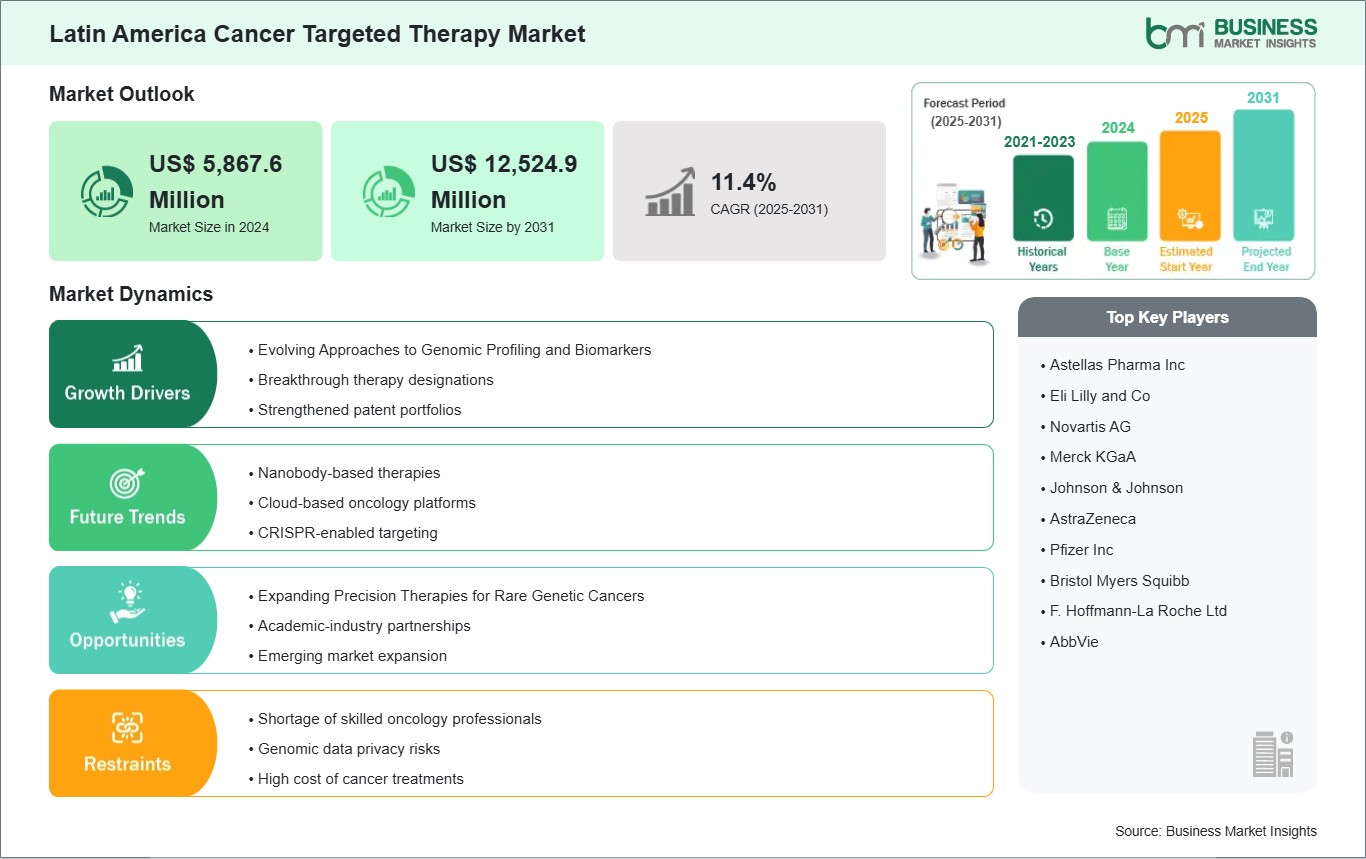
The Latin America cancer targeted therapy market is experiencing steady growth, supported by rising cancer incidence, expanding healthcare infrastructure, and increasing adoption of precision medicine approaches. Targeted therapies—including monoclonal antibodies, small molecule inhibitors, and immune checkpoint inhibitors—are gaining traction as treatment options for major cancers such as breast, lung, colorectal, and hematological malignancies. Latin American countries—particularly Brazil, Mexico, Argentina, and Colombia—account for the majority of market share due to larger healthcare expenditures, stronger private sector oncology services, and concentrated biotechnology adoption.
Growth in the region is driven by improvements in diagnostic capabilities such as genomic profiling and biomarker testing, which help clinicians match patients with targeted treatment regimens that offer better clinical outcomes and reduced systemic toxicity. Hospitals and specialized cancer centers remain primary points of care, especially for IV‑administered therapies, while retail and online pharmacies support the distribution of oral targeted drugs. However, disparities in access persist across public healthcare systems due to cost constraints, limited reimbursement coverage, and infrastructure variability.
Despite these challenges, regional policymakers are increasingly focused on integrating precision oncology into national cancer control programs, expanding screening initiatives, and establishing public–private collaborations to enhance access to advanced cancer care. The market reflects a dynamic balance of unmet needs, burgeoning innovation interest, and ongoing efforts to bridge healthcare access gaps.
Segment Analysis
Latin America Cancer Targeted Therapy Market Segmentation
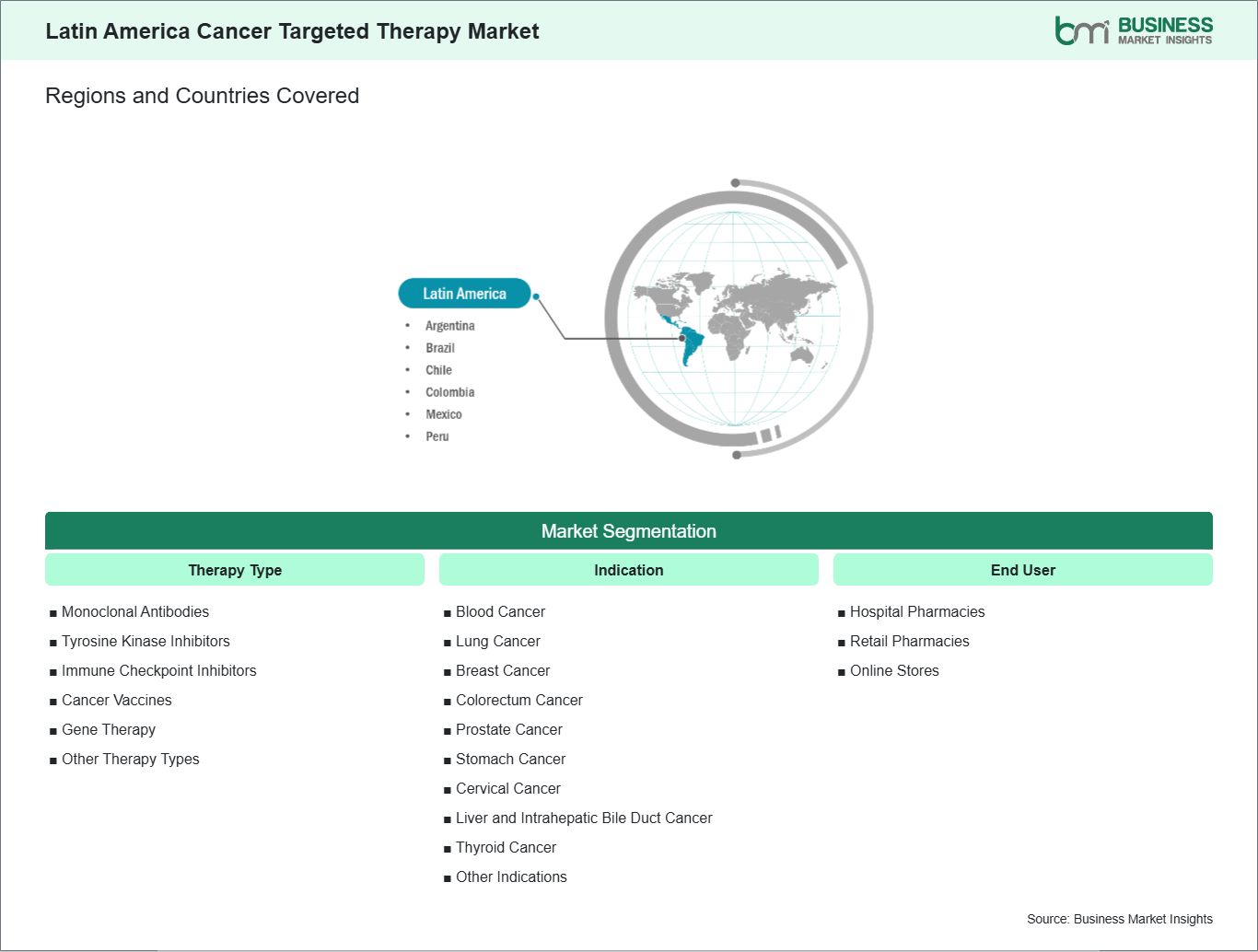
Key segments that contributed to the derivation of the Latin America Cancer Targeted Therapy market analysis are therapy type, indication, and distribution channel.
- By therapy type, the cancer targeted therapy market is segmented into monoclonal antibodies, tyrosine kinase inhibitors, immune checkpoint inhibitors, cancer vaccines, gene therapy, and others. The monoclonal antibodies segment dominated the market in 2024.
- Based on indication, the cancer targeted therapy market is segmented into blood cancer, lung cancer, breast cancer, colorectum cancer, prostate cancer, stomach cancer, cervical cancer, liver and intrahepatic bile duct cancer, thyroid cancer, and other indications. The lung cancer segment dominated the market in 2024.
- In terms of distribution channel, the market is segmented into hospital pharmacies, retail pharmacies, and online stores. The hospital pharmacies segment dominated the market in 2024.
Market Forces
Latin America Cancer Targeted Therapy Market Drivers and Opportunities
Evolving Approaches to Genomic Profiling and Biomarkers
Advancements in genomic profiling and biomarker discovery have become powerful market drivers. The widespread adoption of next‑generation sequencing (NGS), whole‑exome sequencing, and liquid biopsy technologies supports the precise identification of genetic alterations such as HER2, EGFR, ALK, and PIK3CA mutations. This molecular-level understanding has fostered precision medicine approaches where therapies are tailored to an individual patient's tumor profile, moving away from one‑size‑fits‑all chemotherapy regimens. Improved biomarker discovery enhances drug development efficiency, enables better patient stratification, and increases the likelihood of successful clinical outcomes.
Biomarker testing also facilitates real‑time disease monitoring and minimal residual disease tracking, broadening the clinical use of targeted therapies beyond initial treatment. As healthcare systems in Latin America gradually adopt reimbursement frameworks for genomic testing, clinicians increasingly rely on precision diagnostics to guide therapeutic decisions. Collectively, advancements in genomic profiling are expanding eligible patient populations, improving outcomes, and driving sustained growth in the targeted therapy market across the region.
Expanding Precision Therapies for Rare Genetic Cancers
Expansion of targeted therapies into rare cancers and genetically defined tumor subtypes presents a major market opportunity. Rare tumors historically suffered from limited treatment options due to small patient numbers and high development costs. However, genomic profiling has revealed actionable genetic drivers across multiple tumor types that can be addressed by targeted therapies.
Tumor‑agnostic treatment approaches—targeting biomarkers such as NTRK fusions, RET rearrangements, and BRAF mutations—enable therapies to be used based on genetic profiles rather than tumor origin, broadening their clinical applicability. These advances allow pharmaceutical companies to expand indications across rare malignancies, significantly increasing potential patient populations. Supportive regulatory frameworks and orphan drug incentives in some Latin American countries can improve commercial viability and accelerate access.
From a clinical perspective, targeted therapies often offer superior efficacy and tolerability compared to traditional chemotherapy in genetically defined cancers. Participation in multinational basket and umbrella trials also reduces development timelines and fosters inclusion of Latin American patient cohorts. As health systems strengthen molecular diagnostic adoption and real‑world evidence collection, expansion into rare, mutation-driven cancers represents a strategic growth avenue for targeted therapy uptake in Latin America.
Size and Share Analysis
Latin America Cancer Targeted Therapy Market Size and Share Analysis
The Latin America Cancer Targeted Therapy market demonstrates steady growth, with size and share analysis highlighting evolving trends and competitive dynamics among key players. The report examines subsegments categorized within therapy type, indication, and distribution channel, offering insights into their contribution to overall market performance.
By therapy type, the monoclonal antibodies subsegment dominated the market in 2024, driven by their high specificity, proven clinical efficacy, and broad applicability across multiple cancer types.
Based on indication, the lung cancer subsegment dominated the market in 2024, driven by high prevalence, early detection initiatives, and the availability of multiple approved targeted therapies.
By distribution channel, the hospital pharmacies subsegment dominated the market in 2024, driven by the complexity of targeted therapies, their administration requirements, and centralized healthcare practices.
Report Coverage
Latin America Cancer Targeted Therapy Market Report Coverage and Deliverables
The "Latin America Cancer Targeted Therapy Market Size and Forecast (2021–2031)" report provides a detailed analysis of the market covering below areas:
- Latin America Cancer Targeted Therapy market size and forecast at regional and country levels for key segments covered under the scope
- Latin America Cancer Targeted Therapy market trends, as well as market dynamics such as drivers, restraints, and key opportunities
- Latin America Cancer Targeted Therapy market analysis covering key trends, regional framework, major players, regulations, and recent market developments
- Industry landscape and competition analysis covering market concentration, heat map analysis, prominent players, and recent developments for the Latin America Cancer Targeted Therapy market
- Detailed company profiles, including SWOT analysis
Geographic Insights
Latin America Cancer Targeted Therapy Market Geographic Insights
The geographical scope of the Latin America Cancer Targeted Therapy market report is divided into: Mexico, Brazil, Argentina, Peru, Chile, and Colombia. Brazil held the largest share in 2024.
Brazil dominates the Latin America cancer targeted therapy market due to its large population, advanced oncology infrastructure, and stronger pharmaceutical distribution networks. Brazil's private and public oncology centers have greater access to targeted therapies and precision diagnostic services compared to other regional markets. Mexico follows closely, supported by expanding healthcare expenditure, growing clinical research participation, and enhanced access to molecular testing across major urban centers. Mexico's oncology landscape reflects improved adoption of targeted regimens for breast, lung, and colorectal cancers. Argentina and Colombia show robust incremental growth as healthcare systems integrate targeted therapies into treatment guidelines and expand diagnostic capabilities. Smaller markets such as Chile and Peru are registering early gains in targeted therapy uptake as investments in cancer centers, clinician training, and reimbursement frameworks evolve. Across the region, hospitals and specialized cancer clinics are primary end users of targeted therapies due to centralized treatment protocols and the need for clinical administration. Retail pharmacies increasingly facilitate access to oral targeted agents, while online channels support broader patient reach.
Industry Activity
Recent Developments
The Latin America Cancer Targeted Therapy market is evaluated by gathering qualitative and quantitative data post primary and secondary research, which includes important corporate publications, association data, and databases. A few of the key developments in the Latin America cancer targeted therapy market are:
- In May 2025, Roche's Mexico oncology research unit advanced multicenter clinical trials focusing on HER2‑positive and triple‑negative breast cancer, integrating genomic profiling into precision treatment protocols across Latin American sites. This expansion highlights the company's commitment to regional oncology research and real‑world evidence generation.
- In March 2025, AstraZeneca unveiled plans to acquire EsoBiotec, a biotech developing in‑vivo cell therapy technologies for cancer. The deal—with an upfront payment of US$ 425 million and up to US$ 575 million in milestones—aims to transform cell therapy by genetically modifying immune cells inside the body, complementing the company's targeted oncology strategies.
Trust & Transparency
Research Methodology
The market analysis combines proprietary research with secondary data from government agencies, company disclosures, regulatory filings, industry databases and expert interviews. Market estimates are validated through data triangulation, cross-market benchmarking and analyst
review.
View Full Research Methodology
Key Sources Referred:
World Health Organization (WHO) World Heart Federation (WHF) Organisation for Economic Cooperation and Development (OECD) The World Bank Group Worldometer The Lancet International Bar Association International Trade Administration