Wearable AI Market Regional Highlights
North America Wearable AI Market
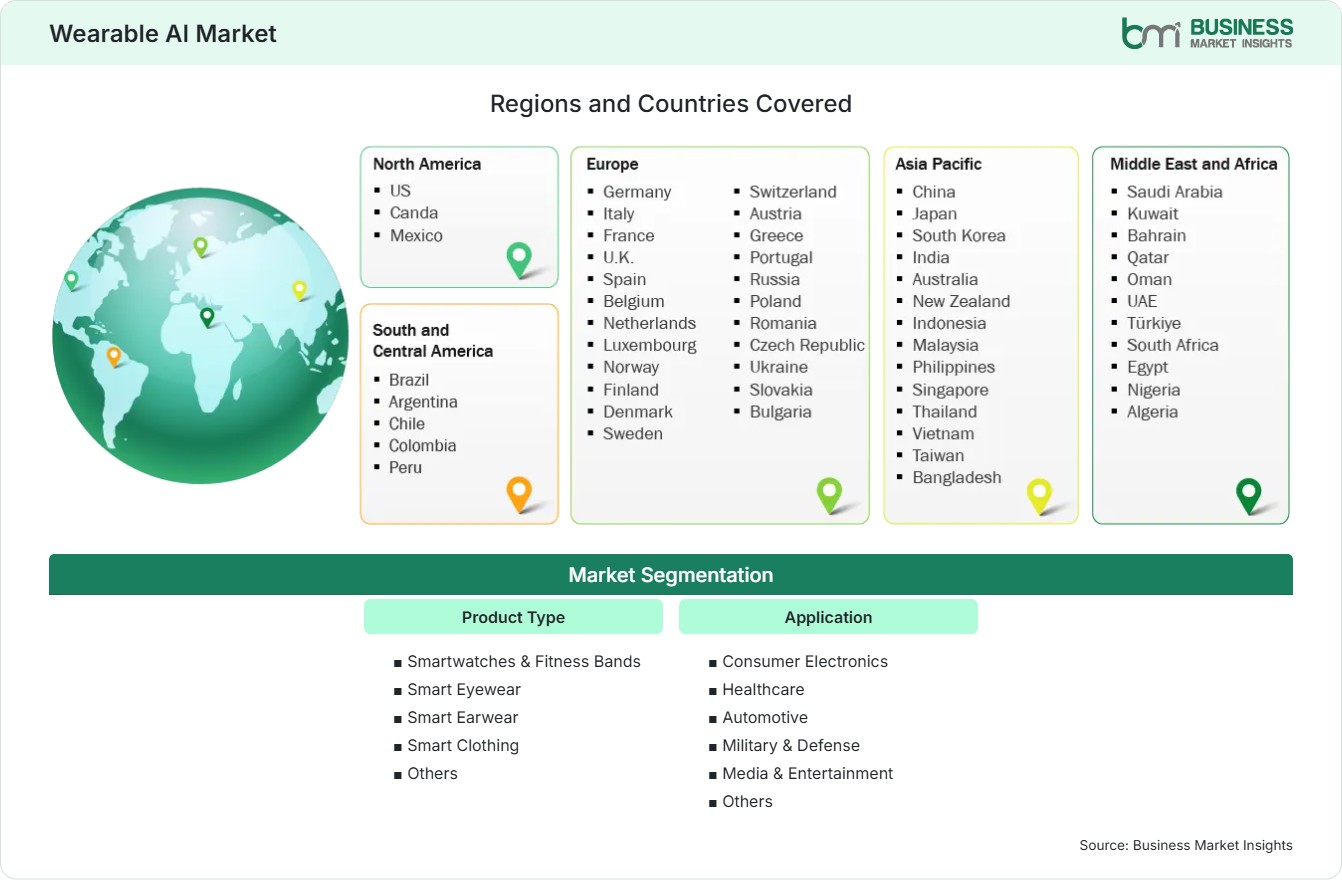
North America represented a 35%–36% share in 2025, with a 26%–31% CAGR outlook. Public market benchmarks identify the region as a leading market, supported by technology infrastructure, healthcare digitization, and high purchasing power. The Wearable AI Market share reflects strong U.S. contribution, while Canada and Mexico provide additional expansion potential. AI-enabled health monitoring, enterprise productivity, smart eyewear, and premium smartwatches remain important adoption areas.
- Strong technology clusters enable the rapid integration of AI processors, advanced sensors, voice assistants, and cloud-connected wearable platforms into a variety of consumer and healthcare applications.
- Healthcare providers are increasingly using connected devices for continuous monitoring, which provides opportunities for predictive analytics and remote patient management, but at the same time raises the demand for clinical validation and privacy.
- The fact that consumers with a high level of purchasing power enable the production of more sophisticated devices, which include advanced displays, powerful processors, biometric sensors, cellular connectivity, and AI-based personalization.
- The United States still acts as the central force in the region, whereas Canada has comparatively greater potential for growth since digital health is being adopted and the use of connected devices is increasing.
US Wearable AI Market
The U.S. accounted for 22.1% of global Wearable AI Market revenue in 2025, according to a current industry benchmark, with a 27%–28% CAGR outlook through 2033. The country benefits from major technology companies, advanced healthcare infrastructure, venture funding, and high consumer adoption. Clinical applications, premium smartwatches, smart earwear, and AI assistants are widening monetization beyond hardware sales and supporting recurring software opportunities.
- The position of the United States is supported by consumer ecosystems that connect watches, smartphones, headphones, health applications, and subscription-based wellness services.
- The FDA's focus on AI-enabled medical-device lifecycle management is leading to more rigorous validation, better documentation, greater transparency, and stronger post-market controls for wearable applications designed for use in health care.
- Enterprise deployments can be extended by means of improved worker safety, assistance with productivity, remote collaboration, and easy access to information without having to use smartphones, especially in situations where smartphones are inconvenient.
Europe Wearable AI Market
Europe is estimated to have a 16%–19% Wearable AI Market share in 2025, with a 24%–28% CAGR range. Germany, the United Kingdom, and France remain leading adoption markets, while the Nordic countries provide strong digital-health and connected-device environments. The regional outlook is shaped by healthcare modernization, privacy requirements, AI governance, and consumer demand for wellness technologies.
- Germany has a highly developed healthcare infrastructure together with strong capabilities in industrial technology, which enables medical monitoring, the use of enterprise wearables, and applications in connected manufacturing.
- The United Kingdom offers a favorable environment for experimenting with digital health, in particular when the data generated by wearables can be used to supplement remote monitoring and preventive-care initiatives.
- France provides opportunities in the fields of healthcare, consumer electronics, and smart mobility, although regulatory compliance continues to be a major factor when developing products.
- Sweden and Denmark have a high level of digital maturity and well-developed connected-health ecosystems, which in turn support premium wearables and data-driven wellness services.
Asia Pacific Wearable AI Market
Asia Pacific held approximately 32%–34% Wearable AI Market share in 2025, while public market research places its underlying market CAGR at 28.2% from 2026 to 2033. China, Japan, South Korea, and India are leading demand centers. India is among the fastest-growing countries, with a reported 29.2% CAGR for 2026–2033. Manufacturing scale, smartphone penetration, affordability, and expanding digital-health programs support regional momentum.
- China has the advantages of having a vast electronics manufacturing sector, large technology ecosystems, its own development in the field of artificial intelligence, and strong consumer familiarity with connected watches and earphones.
- The rapid adoption of smartphone use, together with digital-health programs, increasing disposable income, and the development of local technology, is being supported by India.
- Japan offers opportunities in the areas of health monitoring related to aging, robotics-linked interfaces, wellness applications, and highly reliable sensor technologies.
- South Korea possesses expertise in semiconductors, offers high-end consumer electronics, and has well-developed mobile ecosystems, all of which support the development of sophisticated AI-enabled wearables.
Rest of World Wearable AI Market
Rest of World is estimated at a 11%–15% Wearable AI Market share in 2025, with a 25%–32% CAGR range. Latin American adoption is led by Brazil, where public market research indicates approximately 28% CAGR through 2033. The Middle East and Africa show strong potential from connected healthcare, premium consumer electronics, and smart-city investments, although affordability and infrastructure remain uneven across countries and applications.
- Brazil presents the greatest opportunity in Latin America since it has a large number of consumers, is seeing an expansion of its digital services, and is gaining increasing interest in health and fitness monitoring.
- Gulf markets can speed up the adoption of premium wearable devices by means of their smart-city initiatives, the digitalization of healthcare, tourism technology, and by targeting affluent consumer groups.
- Although affordability and infrastructure are still important factors in the commercialization of products, South Africa provides a technological center for connected healthcare and enterprise applications.
- The UAE and Saudi Arabia offer investment opportunities via their digitally enabled healthcare systems, government technology initiatives, and their premium consumer-device ecosystems.