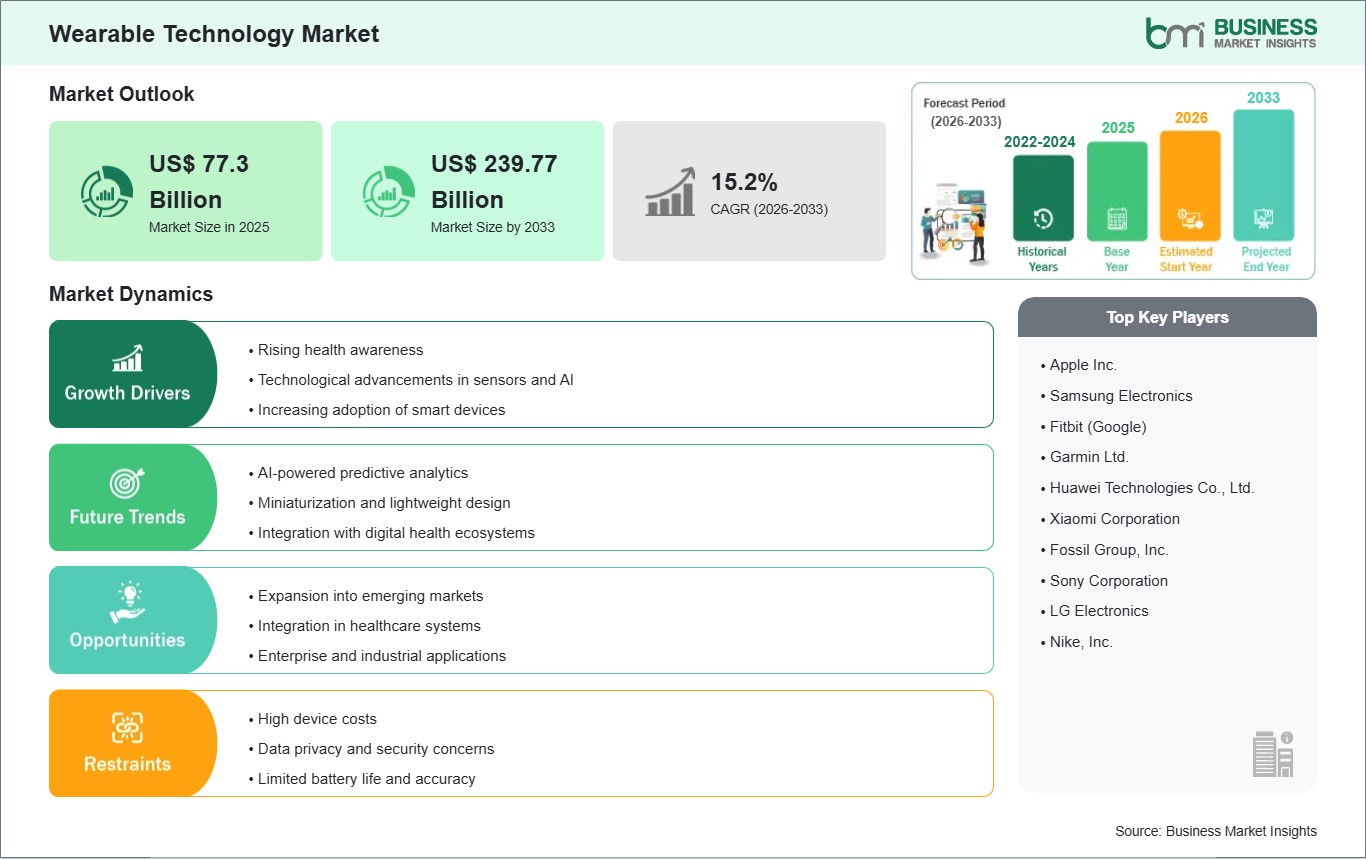
The wearable technology market size is expected to reach US$ 239.77 billion by 2033 from US$ 77.30 billion in 2024. The market is estimated to record a CAGR of 15.2% from 2025 to 2033.
Wearable technology plays an increasingly important role in how people monitor their health, stay connected, and enhance daily productivity. These devices—including smartwatches, fitness trackers, hearables, and medical wearables—are widely used across consumer electronics, healthcare, sports, and enterprise applications. Wearables offer several advantages such as real-time health tracking, convenience, mobility, and personalized insights, helping users better understand their physical activity, sleep patterns, and overall well-being. Growing health awareness, rising adoption of connected devices, and the increasing integration of AI and IoT technologies are driving strong demand for wearable technology globally. In addition, the expansion of digital healthcare, remote patient monitoring, and fitness-focused lifestyles is further accelerating market growth.
However, the wearable technology market also faces certain challenges that may limit its expansion. These include high device costs, data privacy and security concerns, limited battery life, and accuracy issues in health monitoring for some devices. The market is also sensitive to economic conditions, as wearables are often considered discretionary consumer products. Despite these challenges, significant opportunities exist, supported by increasing demand for medical-grade wearables, growth in preventive healthcare, and wider adoption of wearables in enterprise and industrial settings. Continuous innovation in sensors, battery technology, and AI-driven analytics, along with a growing focus on sustainability and eco-friendly materials, is expected to create new growth opportunities for the wearable technology market in the coming years.

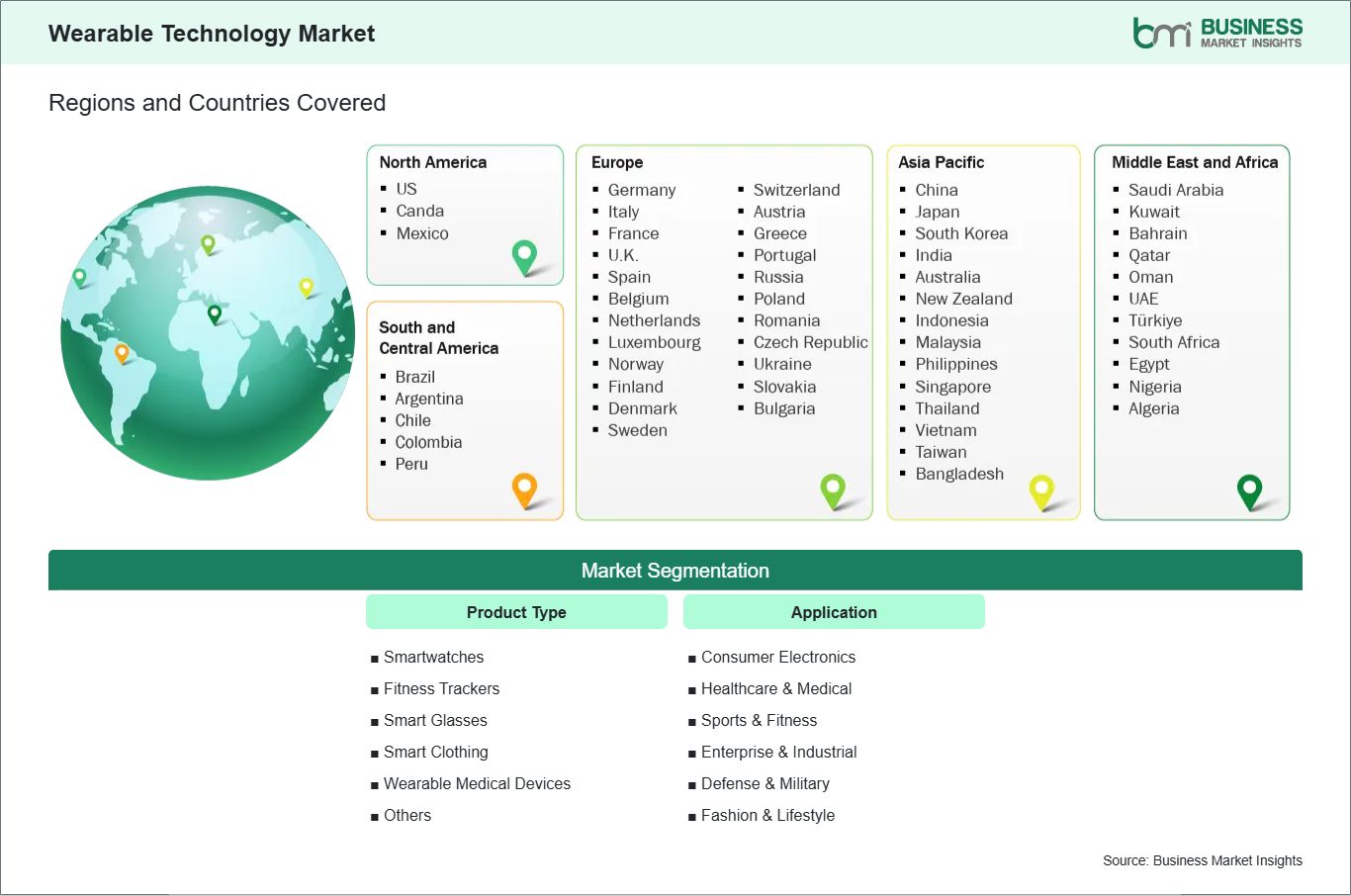
Key segments that contributed to the derivation of the wearable technology market analysis are type, destination, and end user.
The increasing global focus on health, wellness, and active lifestyles has emerged as a major driver of the wearable technology market. Consumers are becoming more conscious of their physical activity, sleep quality, heart health, and overall well-being, leading to higher adoption of wearable devices such as smartwatches, fitness trackers, and hearables. These devices provide real-time health data, personalized insights, and long-term tracking, empowering users to take control of their health. The rising prevalence of lifestyle-related conditions, including obesity, cardiovascular diseases, and stress-related disorders, is further accelerating demand for continuous health monitoring solutions.
Additionally, the integration of wearables into daily routines has expanded beyond fitness into areas such as workplace wellness programs, sports performance tracking, and preventive healthcare. Healthcare providers and insurers are increasingly recognizing the value of wearable-generated data for early detection and long-term health management. As digital health ecosystems grow and consumer trust in wearable technology improves, demand for advanced, accurate, and user-friendly wearable devices is expected to rise steadily, supporting sustained market growth.
Rapid technological advancements are creating strong growth opportunities for the wearable technology market. Continuous improvements in sensor technology, artificial intelligence, and connectivity have significantly enhanced device performance, accuracy, and functionality. Modern wearables are now capable of advanced health monitoring features such as ECG tracking, blood oxygen measurement, stress analysis, and sleep diagnostics. AI-driven software enables personalized recommendations, predictive health alerts, and deeper insights, increasing the value proposition of wearable devices for consumers and healthcare professionals alike.
Beyond consumer use, wearable technology is expanding into new applications such as remote patient monitoring, enterprise workforce safety, and industrial productivity tracking. As battery life improves and devices become more compact and comfortable, adoption across diverse user groups is expected to increase. Furthermore, integration with smartphones, cloud platforms, and digital health records is strengthening the wearable ecosystem. These advancements are expected to unlock new revenue streams and position wearable technology as a critical component of future connected health and smart lifestyle solutions.

By product type, the wearable technology market is segmented into smartwatches, fitness trackers, smart glasses, smart clothing, wearable medical devices, and others. The smartwatches segment held a significant share of the market in 2024. Smartwatches are widely adopted due to their multifunctionality, combining fitness and health tracking with communication, notifications, and app integration in a single device. Their ease of use, compatibility with smartphones, and continuous advancements in features such as heart rate monitoring, sleep tracking, ECG, and blood oxygen measurement have made them a preferred choice among consumers. In addition, strong brand presence, frequent product launches, and growing consumer interest in health and lifestyle monitoring have further supported the dominance of the smartwatches segment within the wearable technology market.
By application, the wearable technology market is segmented into consumer electronics, healthcare & medical, sports & fitness, enterprise & industrial, defense & military, and fashion & lifestyle. The consumer electronics segment held the largest share of the market in 2024. Wearable devices in this segment, such as smartwatches and fitness trackers, are widely used for daily activity tracking, communication, and lifestyle enhancement. High consumer adoption, frequent product upgrades, and strong integration with smartphones and digital ecosystems have driven demand within this segment. In addition, growing health awareness, increasing disposable income, and the popularity of connected devices have further supported the dominance of the consumer electronics segment in the wearable technology market.
| Report Attribute | Details |
|---|---|
| Market size in 2025 | US$ 77.3 Billion |
| Market Size by 2033 | US$ 239.77 Billion |
| Global CAGR (2026 - 2033) | 15.2% |
| Historical Data | 2022-2024 |
| Forecast period | 2026-2033 |
| Segments Covered | By Product Type
|
|
Regions and Countries Covered
| |
| North America | US, Canada, Mexico |
| Europe | Belgium, Austria, Finland, Denmark, Greece, Poland, Romania, Russia, Ukraine, Czech Republic, Slovakia, Bulgaria, Italy, Luxembourg, Germany, Switzerland, France, Netherlands, Norway, Portugal, Spain, Sweden, United Kingdom |
| Asia-Pacific | Australia, China, India, Japan, South Korea, Indonesia, Malaysia, Philippines, Singapore, Thailand, Vietnam, Bangladesh, New Zealand, Taiwan |
| South and Central America | Brazil, Argentina, Peru, Chile, Colombia |
| Middle East and Africa | Bahrain, Kuwait, Oman, Qatar, Saudi Arabia, United Arab Emirates, Turkiye, South Africa, Egypt, Algeria, Nigeria |
| Market leaders and key company profiles |
|
The "Wearable Technology Market Size and Forecast (2022–2033)" report provides a detailed analysis of the market covering below areas:
The geographical scope of the wearable technology market report is divided into five regions: North America, Asia Pacific, Europe, Middle East & Africa, and South & Central America. The wearable technology market in Asia Pacific is expected to grow significantly during the forecast period.
The Asia-Pacific wearable technology market is segmented into China, Japan, South Korea, India, Australia, New Zealand, Indonesia, Malaysia, the Philippines, Singapore, Thailand, Vietnam, Taiwan, Bangladesh, and the Rest of Asia. The Asia-Pacific market is experiencing robust growth, driven by rising health awareness, growing disposable incomes, and increasing adoption of connected devices. Major economies like China, Japan, and India are leading the way, fueled by rapid smartphone penetration, expanding e-commerce platforms, and a tech-savvy consumer base.
The region is also witnessing increased adoption of advanced wearable technologies, including AI-powered health monitoring, real-time activity tracking, and integration with cloud-based health ecosystems. Growing interest in preventive healthcare, fitness, and lifestyle tracking is boosting demand across consumer electronics, healthcare, and sports segments. Additionally, the expansion of online retail channels, frequent product launches, and rising awareness of smart medical devices are positioning Asia-Pacific as a key hub for wearable technology adoption. Supportive government initiatives, improvements in digital infrastructure, and investment in research and development further strengthen the region’s dominant position in the global wearable technology market.

The wearable technology market is evaluated by gathering qualitative and quantitative data post primary and secondary research, which includes important corporate publications, association data, and databases. A few of the key developments in the wearable technology market are:
The Wearable Technology Market is valued at US$ 77.3 Billion in 2025, it is projected to reach US$ 239.77 Billion by 2033.
As per our report Wearable Technology Market, the market size is valued at US$ 77.3 Billion in 2025, projecting it to reach US$ 239.77 Billion by 2033. This translates to a CAGR of approximately 15.2% during the forecast period.
The Wearable Technology Market report typically cover these key segments-
The historic period, base year, and forecast period can vary slightly depending on the specific market research report. However, for the Wearable Technology Market report:
The Wearable Technology Market is populated by several key players, each contributing to its growth and innovation. Some of the major players include:
The Wearable Technology Market report is valuable for diverse stakeholders, including:
Essentially, anyone involved in or considering involvement in the Wearable Technology Market value chain can benefit from the information contained in a comprehensive market report.
Please tell us your area of interest
(Market Segments/ Regions and Countries/ Companies)