Market Summary
Executive Summary and Global Market Analysis
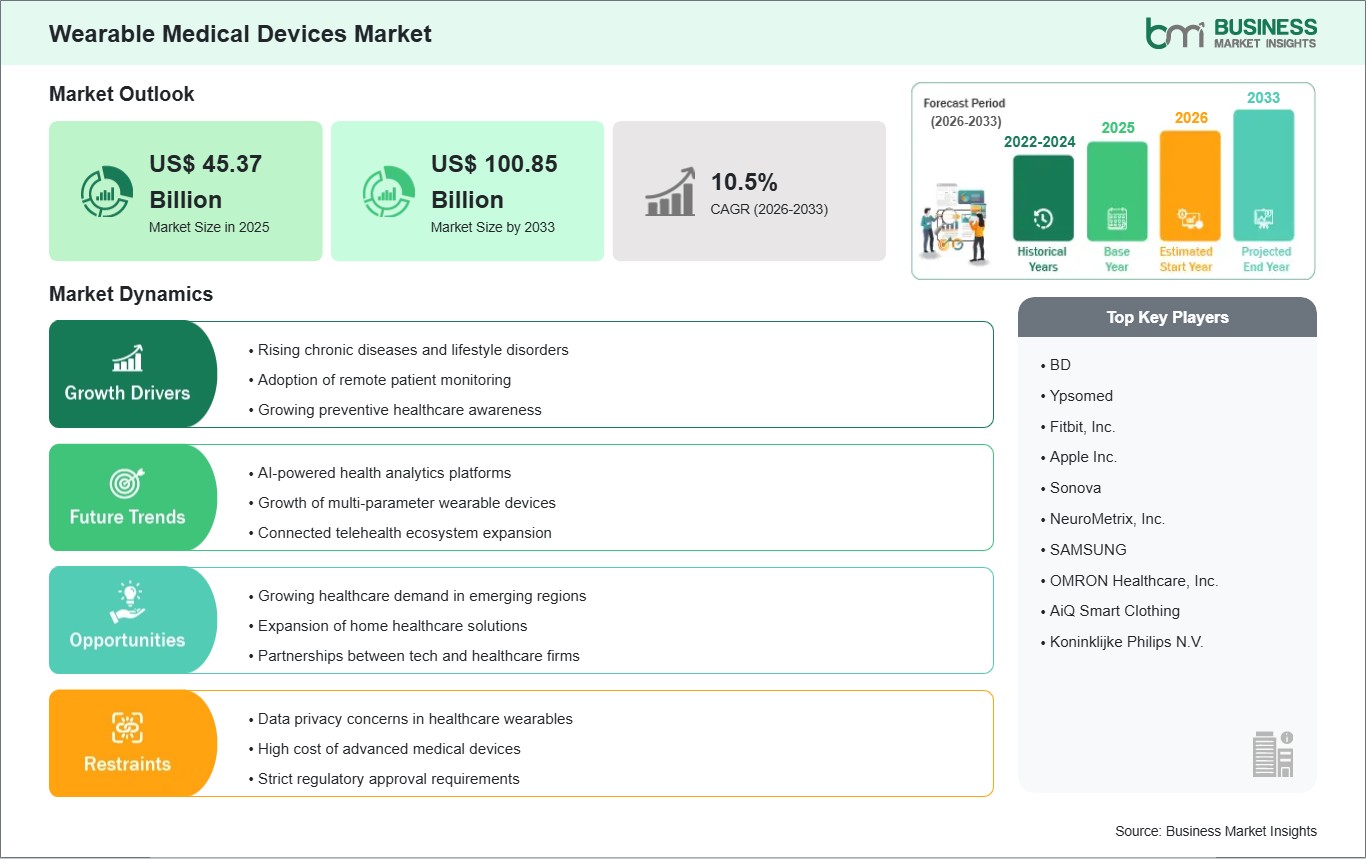
Wearable medical devices represent a sophisticated class of health-integrated technology worn directly on the body to facilitate the continuous, non-invasive acquisition of physiological data. These devices, ranging from bio-sensing smartwatches to advanced wearable injectors and patches, leverage miniaturized sensors and high-speed wireless connectivity to bridge the gap between episodic clinical visits and daily life. By providing a longitudinal view of heart rate variability, glucose fluctuations, and respiratory patterns, they are fundamental to the shift toward proactive, data-driven medicine.
However, the market faces complex challenges that could stifle widespread adoption. Primary among these are stringent regulatory requirements and the high cost associated with clinical-grade accuracy, which often places these tools out of reach for uninsured populations. Additionally, the industry grapples with "alert fatigue" among clinicians and significant technical hurdles, such as ensuring sensor reliability across diverse skin tones and maintaining cybersecurity in the face of increasing medical data breaches.
Despite these deterrents, the market is entering a lucrative era driven by the "hospital-at-home" movement and the global aging population. The integration of edge-based Artificial Intelligence (AI) presents a transformative opportunity, allowing devices to perform real-time diagnostic inference rather than mere data collection. Furthermore, the expansion of 5G and future 6G networks will enable ultra-low-latency remote monitoring, making real-time intervention a reality for high-risk patients. As healthcare systems globally prioritize value-based care and the reduction of hospital readmissions, wearable medical devices stand as a primary vehicle for achieving cost-efficient, personalized health outcomes through 2033.
Segment Analysis
Wearable Medical Devices Market Segmentation
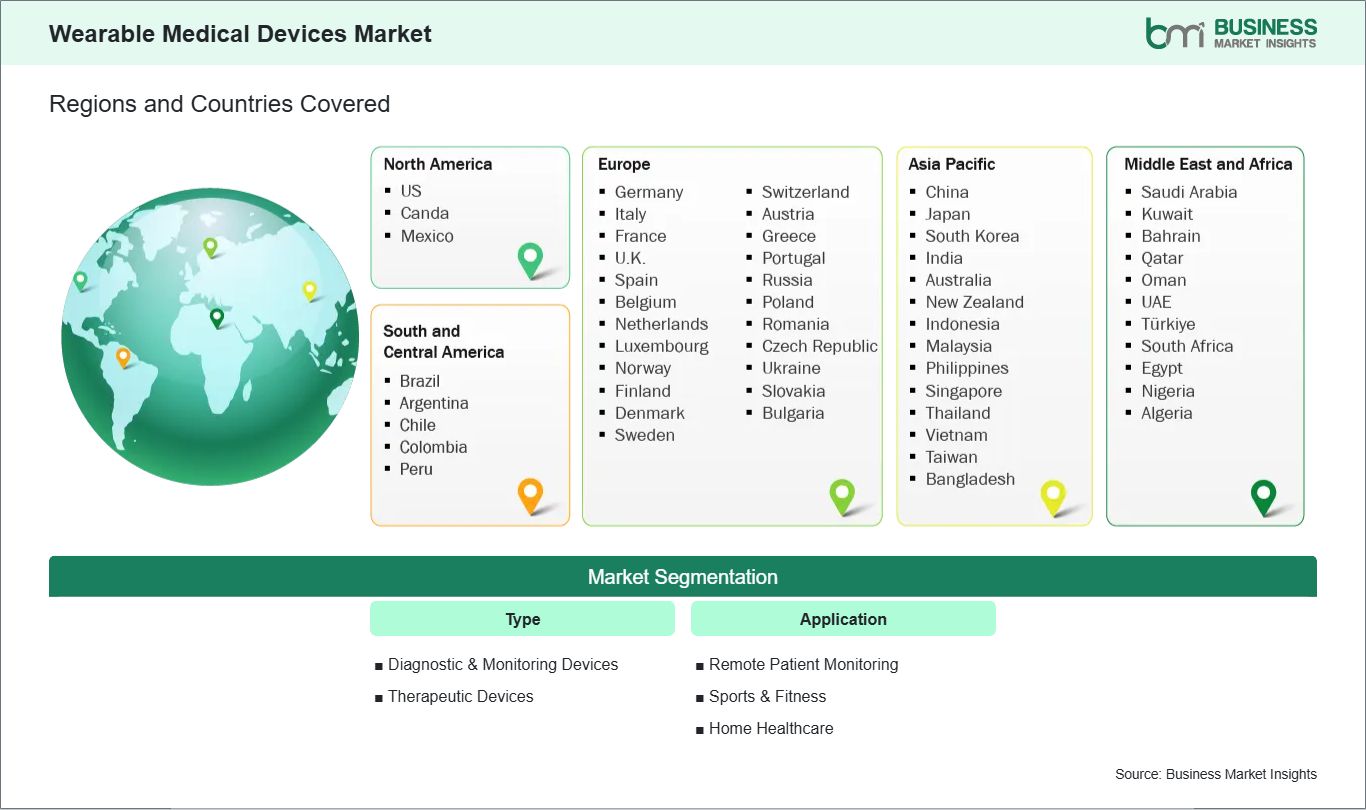
Key segments that contributed to the derivation of the Wearable Medical Devices market analysis are Type and Application.
- By Type, the market is segmented into Diagnostic & Monitoring Devices and Therapeutic Devices.
- By Application, the market is categorized into Remote Patient Monitoring, Sports & Fitness, and Home Healthcare.
Market Forces
Wearable Medical Devices Market Drivers and Opportunities
Global Surge in Chronic Conditions and the Shift Toward Value-Based Care
The primary driver for the wearable medical devices market is the increasing prevalence of chronic diseases such as diabetes, hypertension, and cardiovascular disorders. These conditions require constant vigilance rather than occasional check-ups to prevent life-threatening complications. In response, global healthcare systems are rapidly transitioning toward value-based care models, where medical providers are incentivized based on patient outcomes and the prevention of acute episodes. Wearable devices act as the essential bridge for this model, providing a continuous stream of physiological data that allows for early intervention and personalized treatment adjustments.
This technology empowers patients to manage their health from the comfort of their homes, significantly reducing the frequency of hospital readmissions and the overall economic strain on public health infrastructures. As populations age and the burden of lifestyle-related diseases grows, the medical community is increasingly relying on these tools to maintain high standards of care outside traditional clinical settings. The shift toward this decentralized, patient-centric approach ensures a sustained and growing demand for devices that offer both convenience and clinical-grade reliability.
Integration of Intelligent Sensing and AI-Driven Predictive Health Insights
A significant opportunity in the market lies in the evolution of wearable hardware from passive data collectors into active diagnostic partners through the integration of Artificial Intelligence and advanced biosensing. While early generations of wearables focused on simple tracking, the future of the industry is defined by the ability to interpret complex biological signals into actionable medical insights. AI-enabled wearables can now detect subtle patterns in heart rate or breathing disturbances that may precede a major health event, such as a cardiac irregularity or a respiratory flare-up.
This "predictive" capability allows for a shift from reactive medicine to a truly preventative framework, where potential issues are flagged long before a patient becomes symptomatic. For manufacturers, this technological leap opens new avenues for specialized services and subscription-based health platforms that provide tailored wellness guidance. Furthermore, the development of sensors capable of monitoring diverse biomarkers—such as hydration levels or biochemical changes in sweat—promises to expand the utility of wearables into specialized medical fields like oncology and neurology. This convergence of hardware and intelligent software represents the next frontier for long-term market expansion and clinical adoption.
Size and Share Analysis
Wearable Medical Devices Market Size and Share Analysis
The Wearable Medical Devices market demonstrates steady growth, with size and share analysis revealing evolving trends and competitive positioning among key players. The report further examines subsegments categorized within Type and Application, offering insights into their contribution to overall market performance.
Within the Type category, the Diagnostic & Monitoring Devices sub-segment represents a dominant share as users prioritize real-time vital sign tracking.
When it comes to Application, the Home Healthcare sub-segment is seeing rapid expansion as healthcare delivery moves away from traditional hospital environments.
Report Coverage
Wearable Medical Devices Market Report Coverage and Deliverables
The "Wearable Medical Devices Market Size and Forecast (2022 - 2033)" report provides a detailed analysis of the market covering below areas:
- Wearable Medical Devices market size and forecast at global, regional, and country levels for all the key market segments covered under the scope
- Wearable Medical Devices market trends, as well as market dynamics such as drivers, restraints, and key opportunities
- Wearable Medical Devices market analysis covering key market trends, global and regional framework, major players, regulations, and recent market developments
- Industry landscape and competition analysis covering market concentration, heat map analysis, prominent players, and recent developments for the Wearable Medical Devices market
- Detailed company profiles, including SWOT analysis
Geographic Insights
Wearable Medical Devices Market Geographic Insights
The geographical scope of the Wearable Medical Devices market report is divided into five regions: North America, Asia Pacific, Europe, the Middle East & Africa, and South & Central America.
In North America, the market is primarily propelled by a sophisticated healthcare ecosystem, high consumer awareness regarding personal health tracking, and robust reimbursement policies that favor remote patient monitoring technologies. The European region emphasizes stringent regulatory compliance and the gradual integration of wearable data into national healthcare systems to manage an aging demographic and rising chronic disease rates. Asia Pacific serves as a critical growth engine, benefiting from a massive electronics manufacturing infrastructure and an expanding middle class that is increasingly adopting smartphone-compatible health devices.
The Middle East and Africa are witnessing a strategic shift toward digital health as governments invest in smart city initiatives and modernized telecommunications to bridge gaps in traditional medical infrastructure. Meanwhile, South and Central America are experiencing a steady rise in adoption as the digital transformation of the regional industrial sectors enhances the accessibility and affordability of mobile health solutions for underserved populations. Collectively, these regional activities foster a resilient global market as local economies continue to prioritize the modernization of digital and clinical health frameworks to improve overall patient outcomes.
Industry Activity
Recent Developments
The Wearable Medical Devices market is evaluated by gathering qualitative and quantitative data post primary and secondary research, which includes important corporate publications, association data, and databases. A few of the key developments in the Wearable Medical Devices market are:
- In November 2025, Dexcom, Inc. announced that the Dexcom G7 15 Day Continuous Glucose Monitoring (CGM) System for people over the age of 18 with diabetes would launch in the United States on December 1. At the initial launch, this advanced iteration of Wearable Medical Devices was made available for users who received their sensors through DME providers. The G7 15 Day system was also covered for Medicare beneficiaries, as it met the specific category requirements for therapeutic CGM systems set forth by the U.S. Centers for Medicare & Medicaid Services. For individuals between the ages of 2 and 18, the standard Dexcom G7 remained the most accurate continuous glucose monitoring system available on the market.
Trust & Transparency
Research Methodology
The market analysis combines proprietary research with secondary data from government agencies, company disclosures, regulatory filings, industry databases and expert interviews. Market estimates are validated through data triangulation, cross-market benchmarking and analyst
review.
View Full Research Methodology
Key Sources Referred:
World Bank - Global Trade IndicatorsWorld Trade Organization (WTO)International Monetary Fund (IMF)International Trade Administration (ITA)Company websiteCompany annual reportsCompany investor presentations