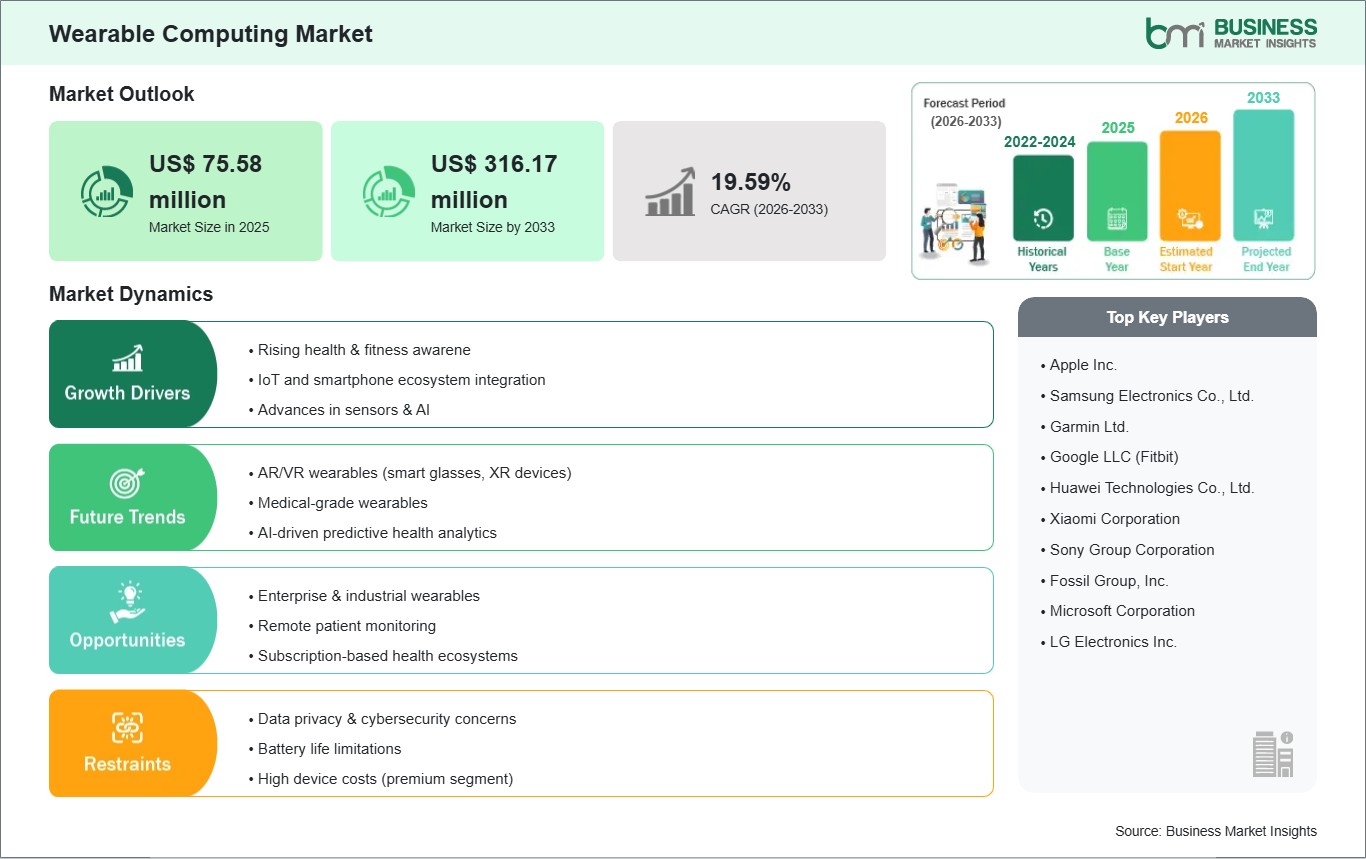
The Wearable Computing Market size is expected to reach US$ 316.17 million by 2033 from US$ 75.58 million in 2025. The market is estimated to record a CAGR of 19.59% from 2026 to 2033.
Wearable computing refers to the integrated application of compact, body-worn electronic devices engineered to provide continuous data processing, biometric sensing, and hands-free interaction. By utilizing miniaturized sensors, low-power microprocessors, and advanced wireless connectivity, these systems transform physiological and environmental data into actionable digital insights. This technology is fundamental to the modernization of personal health management, industrial workforce safety, and immersive consumer entertainment. Market expansion is being propelled by the rapid integration of on-device artificial intelligence (AI), the global rollout of 5G networks enabling ultra-low-latency synchronization, and a decisive institutional shift toward remote patient monitoring and spatial computing interfaces.
However, several factors may restrain market progression. The high capital intensity associated with flagship head-mounted displays (HMDs) and medical-grade smartwatches remains a significant hurdle for mass-market adoption in price-sensitive regions. The industry also faces persistent technical challenges regarding battery energy density, as the requirement for always-on biometric monitoring often necessitates frequent charging cycles that can lead to user fatigue and device abandonment. Additionally, the increasing collection of sensitive health and location data has heightened concerns regarding biometric sovereignty and cybersecurity, necessitating rigorous compliance with evolving global data privacy mandates. These hurdles, compounded by persistent supply-chain sensitivities for specialized semiconductor components, increase the total cost of ownership and limit the deployment of high-performance wearables in budget-restricted environments.
Despite these hurdles, the market outlook remains favorable. Opportunities are emerging through the adoption of invisible wearables, such as smart rings and e-textiles, which offer a discrete and ergonomic alternative to traditional wrist-worn devices. The expansion of the enterprise sector is gaining traction, with a rising demand for industrial-grade augmented reality (AR) glasses that provide frontline workers with real-time technical overlays and hands-free communication. Furthermore, the rise of predictive wellness ecosystems, utilizing edge-based AI to detect early indicators of chronic conditions, aligns with global goals for preventive healthcare. Collectively, these innovations position the wearable computing industry for sustained long-term development as a cornerstone of the modern, data-driven, and hyper-connected global digital landscape.

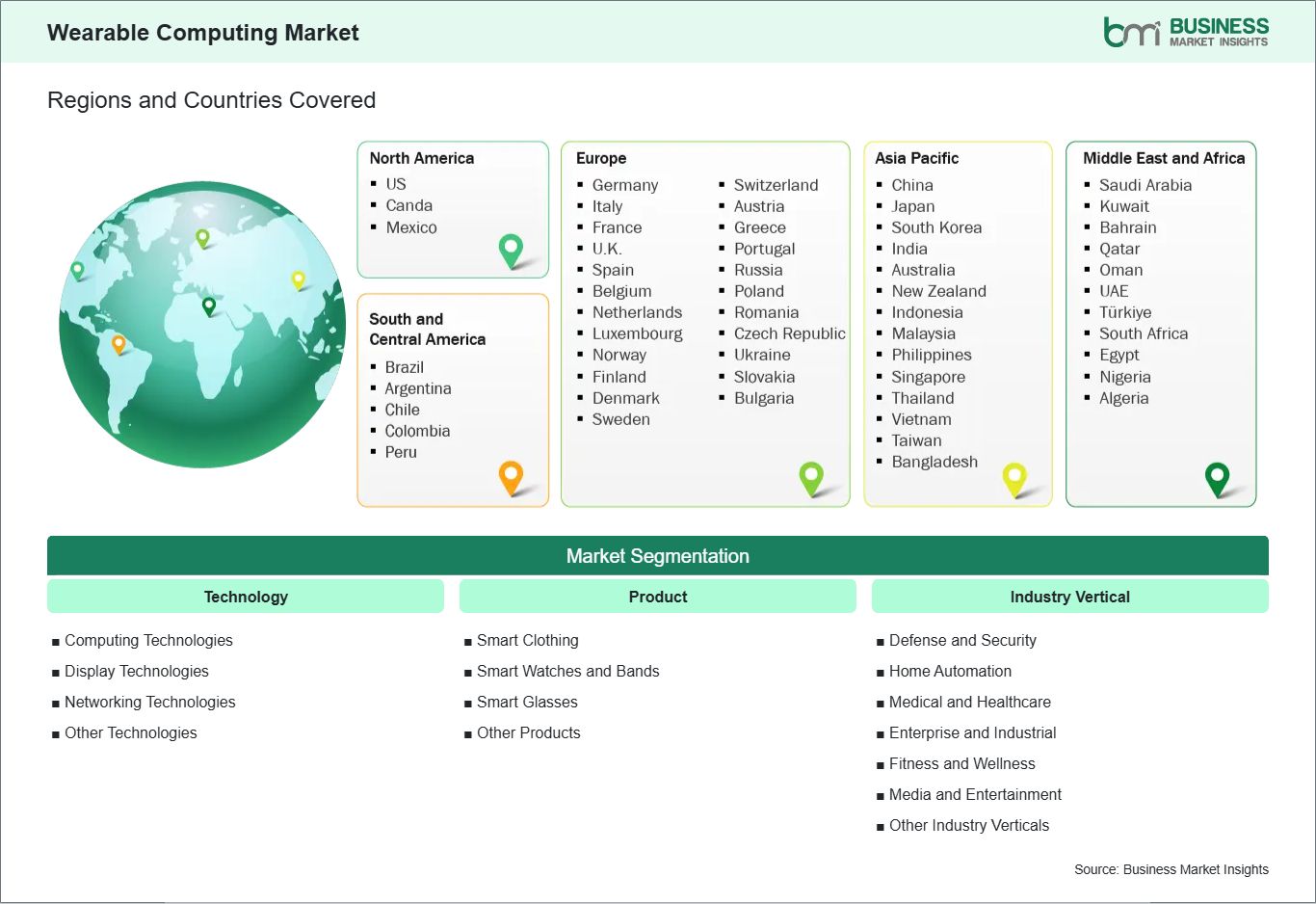
Key segments that contributed to the derivation of the Wearable Computing market analysis are technology, product, and industry vertical.
The wearable computing market is being driven by the growing need for seamless connectivity, productivity enhancement, and health monitoring across consumer and enterprise applications. Devices such as smartwatches, smart glasses, fitness trackers, and wearable medical devices are increasingly integrated into daily life, offering real‑time access to data, communication, and analytics. The expansion of mobile ecosystems and 5G networks is amplifying adoption, as wearable computing enables faster, more reliable connections for both personal and professional use. Enterprises are leveraging wearable devices to improve workforce efficiency, safety, and collaboration, particularly in logistics, manufacturing, and healthcare.
Rising consumer awareness of health and wellness is reinforcing demand, with wearables providing continuous monitoring of vital signs, fitness levels, and lifestyle metrics. Additionally, the hybrid work culture and digital transformation initiatives are fueling adoption of wearable computing solutions that support remote collaboration and productivity. Collectively, connectivity, health awareness, and enterprise modernization are propelling sustained growth in the global wearable computing market.
Opportunities in the wearable computing market are expanding through the integration of artificial intelligence, augmented/virtual reality (AR/VR), and cross‑industry applications. AI‑enabled wearables can deliver predictive insights, personalized recommendations, and adaptive user experiences, creating new pathways for engagement and efficiency. AR/VR‑powered wearable computing devices are opening lucrative opportunities in gaming, education, healthcare, and enterprise collaboration, where immersive environments enhance learning, diagnostics, and productivity. The growing emphasis on IoT ecosystems is fueling demand for interoperable wearables that connect seamlessly with smart homes, vehicles, and industrial systems. Emerging applications in healthcare, such as remote patient monitoring and telemedicine, are driving innovation, as wearable computing enhances diagnostic accuracy and patient outcomes.
Additionally, the expansion of smart cities and digital workplaces is creating demand for advanced wearable solutions that support safety, mobility, and real‑time decision‑making. Sustainability trends are encouraging the development of eco‑friendly, energy‑efficient devices, aligning with global environmental goals. Vendors who focus on cost‑effective, AI‑driven, and cross‑industry wearable computing platforms are well‑positioned to capture growth. The convergence of AI, AR/VR, and IoT underscores a transformative trajectory for the global wearable computing market.

The Wearable Computing market demonstrates steady growth, with size and share analysis revealing evolving trends and competitive positioning among key players. The report examines subsegments categorized within technology, product, and industry vertical, offering insights into their contribution to overall market performance.
Based on Technology, the Computing Technologies subsegment holds the primary market presence. These technologies are indispensable for enabling data processing, analytics, and AI‑driven insights directly on wearable devices. They power applications such as health monitoring, fitness tracking, and enterprise productivity by ensuring real‑time performance with minimal latency. The Display Technologies subsegment is essential for delivering interactive user interfaces, ranging from smartwatch screens to augmented reality glasses, enhancing usability and engagement. The Networking Technologies subsegment anchors demand by enabling connectivity through Bluetooth, Wi‑Fi, and 5G, ensuring seamless integration with smartphones, IoT ecosystems, and enterprise systems.
| Report Attribute | Details |
|---|---|
| Market size in 2025 | US$ 75.58 million |
| Market Size by 2033 | US$ 316.17 million |
| Global CAGR (2026 - 2033) | 19.59% |
| Historical Data | 2022-2024 |
| Forecast period | 2026-2033 |
| Segments Covered | By Technology
|
|
Regions and Countries Covered
| |
| North America | US, Canada, Mexico |
| Europe | Belgium, Austria, Finland, Denmark, Greece, Poland, Romania, Russia, Ukraine, Czech Republic, Slovakia, Bulgaria, Italy, Luxembourg, Germany, Switzerland, France, Netherlands, Norway, Portugal, Spain, Sweden, United Kingdom |
| Asia-Pacific | Australia, China, India, Japan, South Korea, Indonesia, Malaysia, Philippines, Singapore, Thailand, Vietnam, Bangladesh, New Zealand, Taiwan |
| South and Central America | Brazil, Argentina, Peru, Chile, Colombia |
| Middle East and Africa | Bahrain, Kuwait, Oman, Qatar, Saudi Arabia, United Arab Emirates, Turkiye, South Africa, Egypt, Algeria, Nigeria |
| Market leaders and key company profiles |
|
The "Wearable Computing Market Size and Forecast (2022 - 2033)" report provides a detailed analysis of the market covering below areas:
The geographical scope of the Wearable Computing market report is divided into five regions: North America, Asia Pacific, Europe, Middle East & Africa, and South & Central America.
North America maintains a preeminent position within the global industry, a status reinforced by the presence of primary technology pioneers and a sophisticated digital health infrastructure. The regional landscape is characterized by high-density investments in the United States and Canada, where the transition toward Clinical-Grade Biometric Sensing has become a strategic priority for both individual wellness and institutional healthcare. This market leadership is further supported by a mature ecosystem of research and development, alongside a high consumer readiness for advanced computing form factors such as smart rings and high-performance head-mounted displays.
Technological progression in the United States and Canada is largely driven by a decisive shift toward On-Device AI and Edge Computing. These advanced systems utilize specialized neural engines to provide real-time health diagnostics and immersive augmented reality experiences without the latency of cloud-based processing. Furthermore, the region is witnessing an increasing utilization of Wearables for Chronic Disease Management, as healthcare providers integrate continuous monitoring data into patient care frameworks. This focus on Predictive Personal Health allows North American operators to improve patient outcomes while simultaneously reducing the administrative burden on traditional medical facilities.

The Wearable Computing market is evaluated by gathering qualitative and quantitative data post primary and secondary research, which includes important corporate publications, association data, and databases. A few of the key developments in the Wearable Computing market are:
The Wearable Computing Market is valued at US$ 75.58 million in 2025, it is projected to reach US$ 316.17 million by 2033.
As per our report Wearable Computing Market, the market size is valued at US$ 75.58 million in 2025, projecting it to reach US$ 316.17 million by 2033. This translates to a CAGR of approximately 19.59% during the forecast period.
The Wearable Computing Market report typically cover these key segments-
The historic period, base year, and forecast period can vary slightly depending on the specific market research report. However, for the Wearable Computing Market report:
The Wearable Computing Market is populated by several key players, each contributing to its growth and innovation. Some of the major players include:
The Wearable Computing Market report is valuable for diverse stakeholders, including:
Essentially, anyone involved in or considering involvement in the Wearable Computing Market value chain can benefit from the information contained in a comprehensive market report.
Please tell us your area of interest
(Market Segments/ Regions and Countries/ Companies)