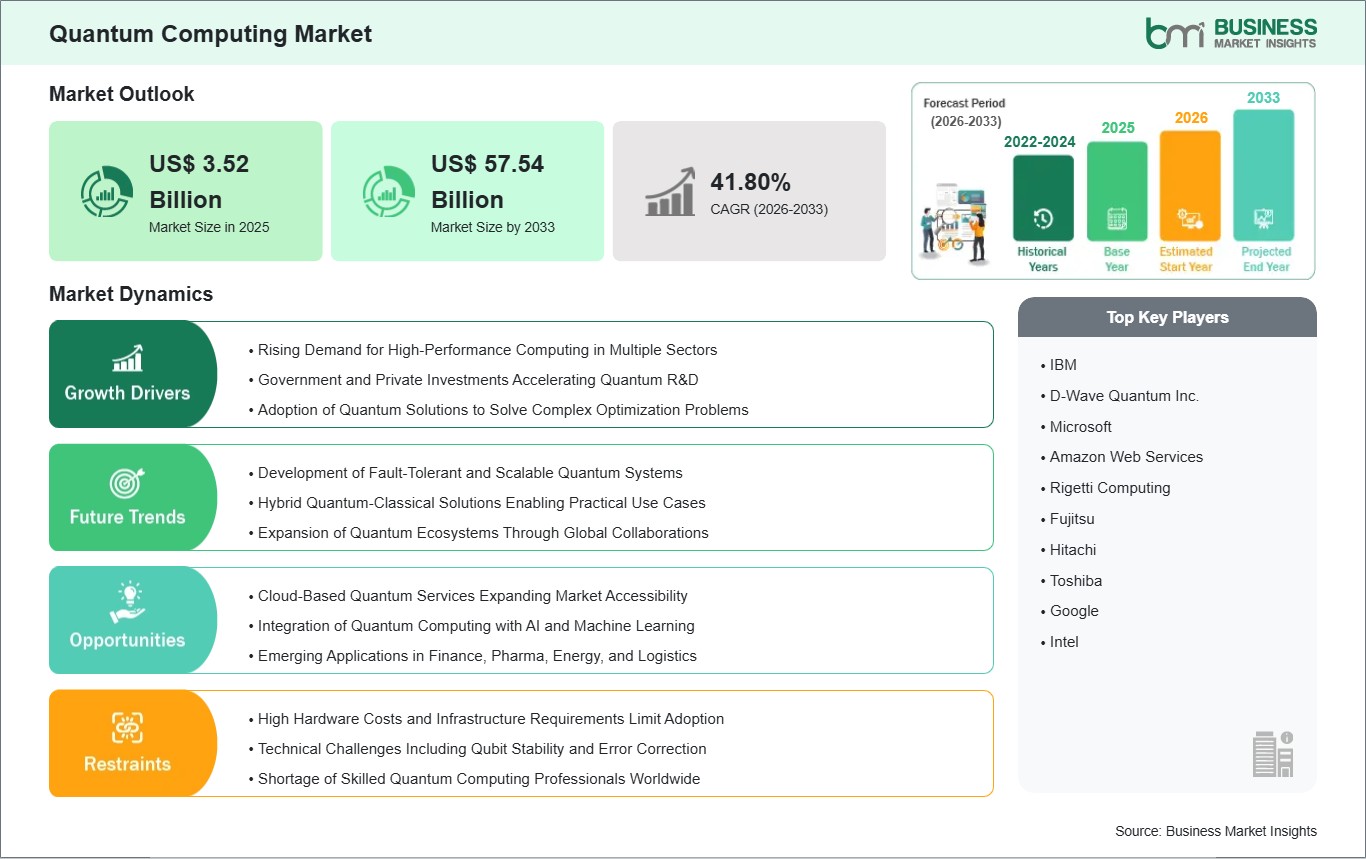
The Quantum Computing Market size is expected to reach US$ 57.54 billion by 2033 from US$ 3.52 billion in 2025. The market is estimated to record a CAGR of 41.80% from 2026 to 2033.
The quantum computing market, as a global industry, is in the process of shifting from being a research-oriented technology to an emerging technology with immense potential for transforming various sectors of the economy. Quantum computing, as a technology, is a paradigm shift in the way computation is done, as it uses the principles of quantum mechanics, such as superposition and entanglement, to solve problems that are computationally intractable for classical computers. Some of the sectors that are being transformed by quantum computing include the pharmaceutical, logistics, finance, materials, energy, and cybersecurity industries, among others.
Some of the factors driving the quantum computing market as a global industry include the increased need for high-performance computing (HPC) solutions that are capable of solving problems that are intractable for classical computers, particularly in drug discovery, climate studies, cryptography, and supply chain optimization. Additionally, various governments in key countries are driving the quantum computing research and development sector, which has created an innovation ecosystem for quantum computing, particularly in academia, startups, and R&D in enterprises. Various strategic partnerships are being formed in the quantum computing sector. The availability of cloud-based quantum services provided by global technology companies is reducing the entry costs, and many organizations are using such platforms to experiment with different quantum algorithms without the need to purchase expensive hardware. This is providing an opportunity for many businesses across different geographical locations to experiment with the applications of quantum technology before it is fully adopted.
In addition, investments in different software tools and applications are increasing the availability of quantum technology, which is making it more applicable in different situations despite the current state of noisy intermediate-scale quantum technology. However, there are many restrains that are acting on the market. The technical constraints are one of the biggest restrains that is acting on the market. Quantum technology is sensitive and requires expensive infrastructure.
Moreover, the lack of talent with quantum skills limits development and adoption due to difficulties in finding experts in quantum algorithms, hardware engineering, and quantum software development. Although training and workforce development are improving, the development of global expertise will take some time. In spite of all these challenges, the promise of quantum computing innovation will drive investment by both governments and private entities across the globe, ensuring the market’s long-term growth prospects as technological innovations prepare the way for a more stable quantum computing market.

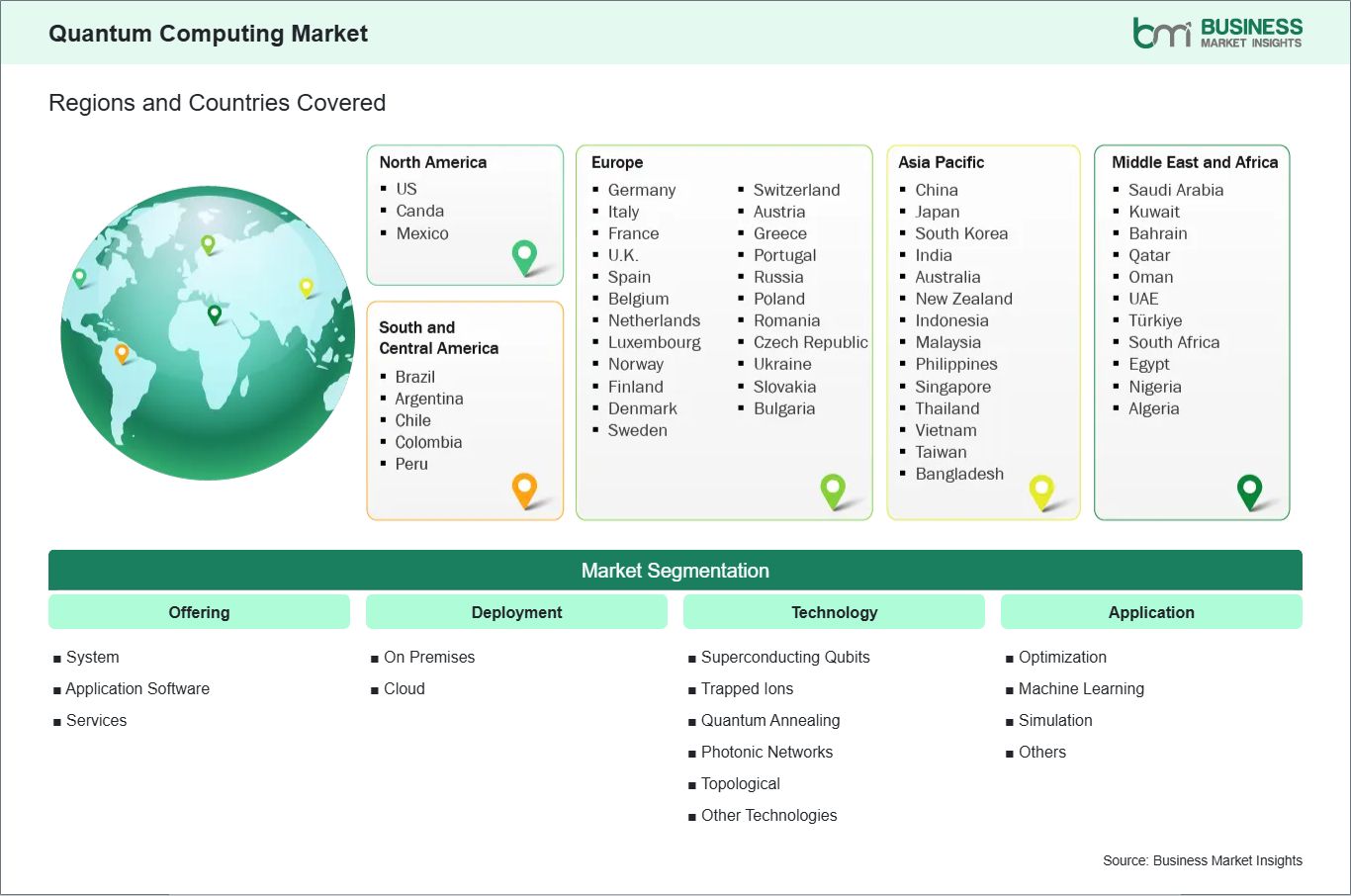
Key segments that contributed to the derivation of the quantum computing market analysis are offering, deployment, technology, application, and end-use industry.
Across industries worldwide, the rising demand for high‑performance computing (HPC) is driving interest in quantum computing as a next‑generation solution capable of addressing problems that classical systems struggle with. In pharmaceuticals and life sciences, researchers are exploring quantum algorithms to model complex molecular interactions and accelerate drug discovery processes that would otherwise take years using traditional computing. Financial institutions in North America and Europe are evaluating quantum approaches to optimize portfolios, assess risk, and price complex derivatives, where conventional modeling methods are computationally intensive.
Energy and materials companies are also looking to quantum systems for optimization tasks, such as power grid planning and the design of novel materials with specific properties. Logistics and transportation sectors in Asia Pacific are examining quantum techniques to refine routing and supply chain strategies in real time, aiming to improve delivery efficiency and reduce operational costs. Even though fully fault‑tolerant quantum machines remain in development, the perceived potential to outperform classical HPC in select applications is encouraging enterprises globally to invest in quantum research and pilot projects.
Cloud‑based quantum services are significantly enhancing access to quantum computing capabilities, enabling organizations worldwide to experiment with quantum processors without owning expensive hardware. Major technology companies in North America and Europe have opened quantum processors through cloud platforms, allowing researchers and developers in emerging markets, academic institutions, and startups to run quantum algorithms remotely. This model lowers entry barriers and fosters global collaboration in building and testing quantum solutions.
In Asia Pacific, cloud‑delivered quantum services are helping universities and innovation labs explore quantum applications using remote resources, accelerating skills development in regions that might not yet have physical quantum systems. Cloud access also supports hybrid quantum‑classical workflows, where classical pre‑ and post‑processing combine with quantum problem solving to explore real‑world use cases in finance, chemistry, and optimization. This hybrid model is gaining traction as a practical pathway toward broader adoption while fully scalable quantum hardware continues to advance.
The quantum computing market demonstrates steady growth, with size and share analysis highlighting evolving trends and competitive dynamics among key players. The report examines subsegments categorized within offering, deployment, technology, application, and end-use industry, offering insights into their contribution to overall market performance.
By offering, the services subsegment dominated the market in 2025, driven by the growing demand for managed quantum computing solutions, consulting, and support to help enterprises integrate quantum technologies.
Based on deployment, the cloud subsegment dominated the market in 2025, driven by the need for remote access to quantum computing resources without high upfront infrastructure costs.
On the basis of technology, the superconducting qubits subsegment dominated the market in 2025, driven by their advanced scalability, lower error rates, and widespread adoption by leading quantum hardware providers.
Based on application, the optimization subsegment dominated the market in 2025, driven by the high applicability of quantum algorithms in solving complex optimization problems across industries.
In terms of end-use industry, the banking & finance subsegment dominated the market in 2025, driven by the strong adoption of quantum computing for risk analysis, portfolio optimization, and fraud detection.
| Report Attribute | Details |
|---|---|
| Market size in 2025 | US$ 3.52 Billion |
| Market Size by 2033 | US$ 57.54 Billion |
| Global CAGR (2026 - 2033) | 41.80% |
| Historical Data | 2022-2024 |
| Forecast period | 2026-2033 |
| Segments Covered | By Offering
|
|
Regions and Countries Covered
| |
| North America | US, Canada, Mexico |
| Europe | Belgium, Austria, Finland, Denmark, Greece, Poland, Romania, Russia, Ukraine, Czech Republic, Slovakia, Bulgaria, Italy, Luxembourg, Germany, Switzerland, France, Netherlands, Norway, Portugal, Spain, Sweden, United Kingdom |
| Asia-Pacific | Australia, China, India, Japan, South Korea, Indonesia, Malaysia, Philippines, Singapore, Thailand, Vietnam, Bangladesh, New Zealand, Taiwan |
| South and Central America | Brazil, Argentina, Peru, Chile, Colombia |
| Middle East and Africa | Bahrain, Kuwait, Oman, Qatar, Saudi Arabia, United Arab Emirates, Turkiye, South Africa, Egypt, Algeria, Nigeria |
| Market leaders and key company profiles |
|
The "Quantum Computing Market Size and Forecast (2022 - 2033)" report provides a detailed analysis of the market covering below areas:
The geographical scope of the Quantum Computing Market report is divided into North America, Asia Pacific, Europe, Middle East & Africa, and South & Central America. North America held the largest share in 2025.
The Quantum Computing Market has varied geographical trends, with North America leading the pack as the most dominant region in the global market. This is because of the presence of a robust research environment and advanced technology infrastructure in the region, in addition to considerable investments made by the government and private entities in the field of quantum technology.
The United States is leading in the global market with a number of startups, established technology giants, and national research laboratories working in collaboration with each other to build scalable qubit technology, error correction mechanisms, and quantum software platforms. Cloud-based quantum technology services provided by North American companies are also driving the adoption of the technology in the region.
Europe is an important market with huge potential, fueled by the European Union’s astute investments in quantum research and innovation, and other joint ventures such as the Quantum Flagship program, which emphasizes secure communications, quantum algorithms, and industrial applications in finance, energy, and materials science.
Asia Pacific is an emerging market with huge growth potential, with Asia Pacific countries such as China, Japan, South Korea, and Australia investing heavily in the development of quantum hardware and software. China is making rapid progress in superconducting qubit technology, photonics-based quantum technology, and national quantum communication networks.
The Middle East & Africa region has an emerging market, driven by research activities in the region, including the UAE and Israel, where governments are investing in quantum research centers and education programs to create a future-ready workforce.
The South & Central America region is in the early adoption stage, with countries including Brazil and Argentina establishing quantum research programs in local universities and partnering with global organizations to explore the application of quantum technology in the fields of cryptography, optimization, and research activities. Overall, the markets in these regions are driven by the ongoing investment in hardware and software, strategic partnerships, and the focus on building quantum-ready infrastructure, but the region that remains dominant in the quantum technology market is North America.

The Quantum Computing Market is evaluated by gathering qualitative and quantitative data post primary and secondary research, which includes important corporate publications, association data, and databases. A few of the key developments in the quantum computing market are:
The Quantum Computing Market is valued at US$ 3.52 Billion in 2025, it is projected to reach US$ 57.54 Billion by 2033.
As per our report Quantum Computing Market, the market size is valued at US$ 3.52 Billion in 2025, projecting it to reach US$ 57.54 Billion by 2033. This translates to a CAGR of approximately 41.80% during the forecast period.
The Quantum Computing Market report typically cover these key segments-
The historic period, base year, and forecast period can vary slightly depending on the specific market research report. However, for the Quantum Computing Market report:
The Quantum Computing Market is populated by several key players, each contributing to its growth and innovation. Some of the major players include:
The Quantum Computing Market report is valuable for diverse stakeholders, including:
Essentially, anyone involved in or considering involvement in the Quantum Computing Market value chain can benefit from the information contained in a comprehensive market report.
Please tell us your area of interest
(Market Segments/ Regions and Countries/ Companies)