Market Summary
Executive Summary and Global Market Analysis
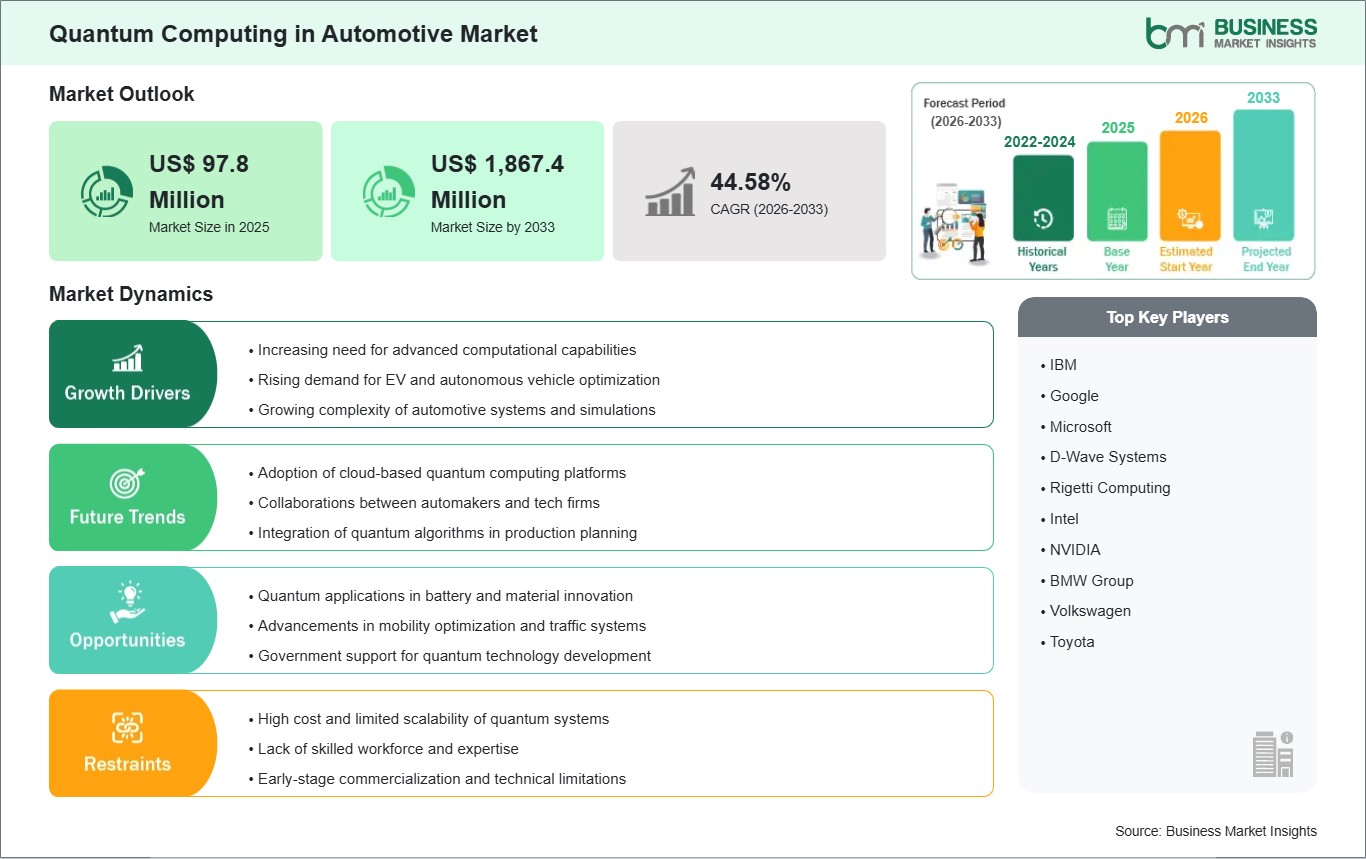
The global quantum computing in automotive market is rapidly emerging as a transformative segment within the automotive and advanced computing ecosystem. Quantum computing enables automakers and suppliers to solve highly complex computational problems related to vehicle design, manufacturing optimization, battery development, and traffic management, significantly enhancing operational efficiency and innovation.
Automotive companies are increasingly leveraging quantum computing to address challenges such as electric vehicle (EV) battery optimization, real-time traffic routing, and autonomous driving decision-making. The market benefits from growing collaborations between automotive manufacturers, technology providers, and research institutions. Leading players integrate quantum algorithms into production planning, material simulation, and supply chain optimization, improving efficiency and reducing costs. Cloud-based quantum computing platforms provide scalable, cost-effective access.
Segment Analysis
Quantum Computing in Automotive Market Segmentation
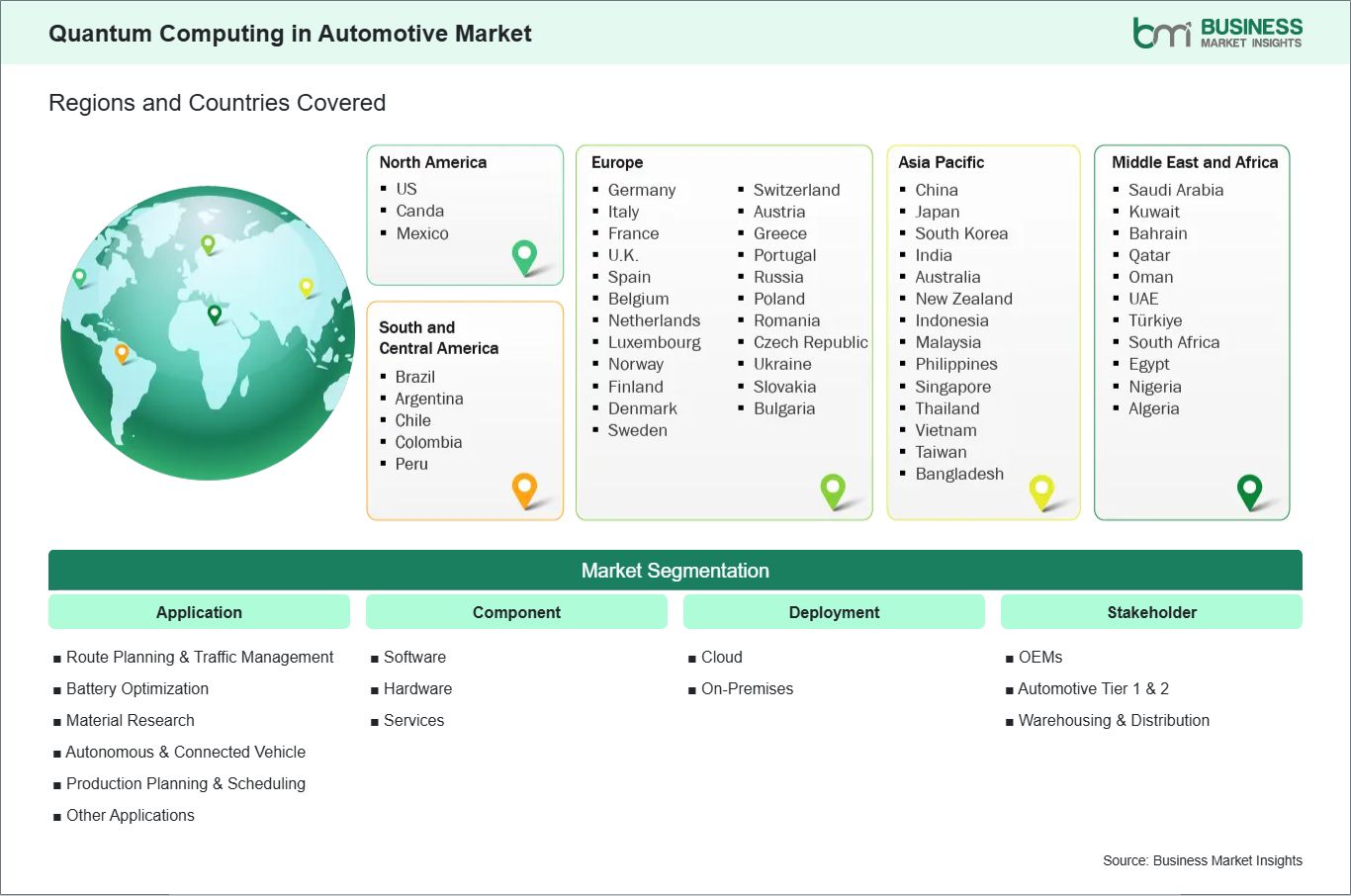
Key segments that contributed to the derivation of the quantum computing in automotive market analysis are application, component, deployment, and stakeholder.
- By application, the market is segmented into route planning & traffic management, battery optimization, material research, autonomous & connected vehicle, production planning & scheduling, and others. The route planning & traffic management segment dominated the market in 2025.
- By component, the market is segmented into software, hardware, and services. The software segment dominated in 2025.
- By deployment, the market is segmented into cloud and on-premises. The cloud segment dominated in 2025.
- By stakeholder, the market is segmented into OEMs, automotive Tier 1 & 2 suppliers, and warehousing & distribution. The OEMs segment dominated in 2025.
Market Forces
Quantum Computing in Automotive Market Drivers and Opportunities
Increasing Need for Advanced Computational Capabilities
The growing complexity of modern automotive systems drives adoption of quantum computing. Advanced functionalities such as autonomous driving, real-time navigation, predictive maintenance, and connected mobility require processing massive datasets and solving highly complex optimization problems. Quantum computing can perform simulations and optimization tasks faster than classical systems, enhancing vehicle design, aerodynamic modeling, and crash analysis.
Electric and autonomous vehicles increase demand for high-performance computing. Quantum computing optimizes battery performance, improves energy efficiency, and accelerates development of next-generation vehicle technologies. As automotive systems evolve toward software-defined, data-driven architectures, demand for advanced computational tools continues to grow.
Expanding Applications in Battery Innovation, Materials Science, and Mobility Optimization
Quantum computing enables more accurate modeling of battery materials, molecular interactions, and chemical processes. This improves EV battery energy density, reduces charging times, and lowers production costs. It also supports autonomous and connected vehicle advancements through faster data processing and improved machine learning models.
Government and public institution investments, along with OECD-highlighted national strategies, support commercialization and development of quantum technologies, creating substantial growth opportunities in the automotive sector.
Size and Share Analysis
Quantum Computing in Automotive Market Size and Share Analysis
The Quantum Computing in Automotive Market demonstrates steady growth, with size and share analysis highlighting evolving trends and competitive dynamics among key players. The report examines subsegments categorized within application, component, deployment, and stakeholder, offering insights into their contribution to overall market performance.
By application, the route planning & traffic management segment dominated the market in 2025, driven by the need to optimize transportation networks and reduce congestion using advanced quantum algorithms.
Based on component, the software segment dominated the market in 2025, driven by the rising demand for quantum development frameworks, simulation tools, and algorithm platforms.
In terms of deployment, the cloud segment dominated the market in 2025, driven by the growing adoption of quantum computing-as-a-service platforms that enable scalable and cost-effective access.
By stakeholder, the OEMs segment dominated the market in 2025, driven by the leading investments in quantum computing to enhance product development, manufacturing processes, and next-generation mobility solutions.
Report Coverage
Quantum Computing in Automotive Market Report Coverage and Deliverables
The "Quantum Computing in Automotive Market Size and Forecast (2022 - 2033)" report provides a detailed analysis of the market covering below areas:
- Quantum Computing in Automotive Market size and forecast at global, regional, and country levels for all the key market segments covered under the scope
- Quantum Computing in Automotive Market trends, as well as drivers, restraints, and opportunities
- Quantum Computing in Automotive Market analysis covering key trends, global and regional framework, major players, regulations, and recent developments
- Industry landscape and competition analysis covering market concentration, heat map analysis, prominent players, and recent developments for the Quantum Computing in Automotive Market
- Detailed company profiles, including SWOT analysis
Geographic Insights
Quantum Computing in Automotive Market Geographic Insights
The geographical scope of the Quantum Computing in Automotive Market report is divided into North America, Asia Pacific, Europe, Middle East & Africa, and South & Central America. North America held the largest share in 2025.
North America’s leadership is driven by strong investments in quantum research, advanced digital infrastructure, and the presence of leading technology companies and automotive innovators. Governments in the region are actively supporting quantum technology development through funding programs and national strategies aimed at strengthening technological leadership and economic competitiveness.
Europe is another key region, characterized by strong automotive manufacturing capabilities and increasing focus on sustainable mobility and electrification.
The Asia Pacific region is expected to witness the fastest growth during the forecast period, driven by rapid industrialization, expanding automotive production, and increasing government support for advanced technologies.
Meanwhile, the Middle East & Africa and South & Central America are at a nascent stage of adoption but are gradually exploring quantum technologies through academic research and pilot projects.
Across all regions, government initiatives, research funding, and collaboration between industry and academia are playing a crucial role in shaping the adoption and commercialization of quantum computing technologies in the automotive sector.
Industry Activity
Recent Developments
The Quantum Computing in Automotive Market is evaluated by gathering qualitative and quantitative data post primary and secondary research, which includes important corporate publications, association data, and databases. A few of the key developments in the quantum computing in automotive market are:
- In April 2025, Terra Quantum announced a strategic partnership with Siemens Cre8Ventures to integrate a Quantum‑as‑a‑Service platform into Siemens’ Digital Twin Marketplace. The collaboration enables next‑generation automotive and drone applications, including system design, simulation, and optimization using hybrid quantum algorithms, supporting real‑world engineering workflows and EU Chips Act sovereignty goals.
- In February 2025, BMW Group expanded its quantum computing initiatives through collaborations with NVIDIA and Classiq, applying quantum computing to vehicle design optimization, battery integration, and production processes. Use cases include drivetrain optimization, cooling systems, and robot route planning in manufacturing, demonstrating direct adoption of quantum computing in automotive engineering.
Trust & Transparency
Research Methodology
The market analysis combines proprietary research with secondary data from government agencies, company disclosures, regulatory filings, industry databases and expert interviews. Market estimates are validated through data triangulation, cross-market benchmarking and analyst
review.
View Full Research Methodology
Key Sources Referred:
World Health Organization (WHO)Organisation for Economic Cooperation and Development (OECD)The World Bank GroupWorld Economic Forum (WEF)International Trade Administration