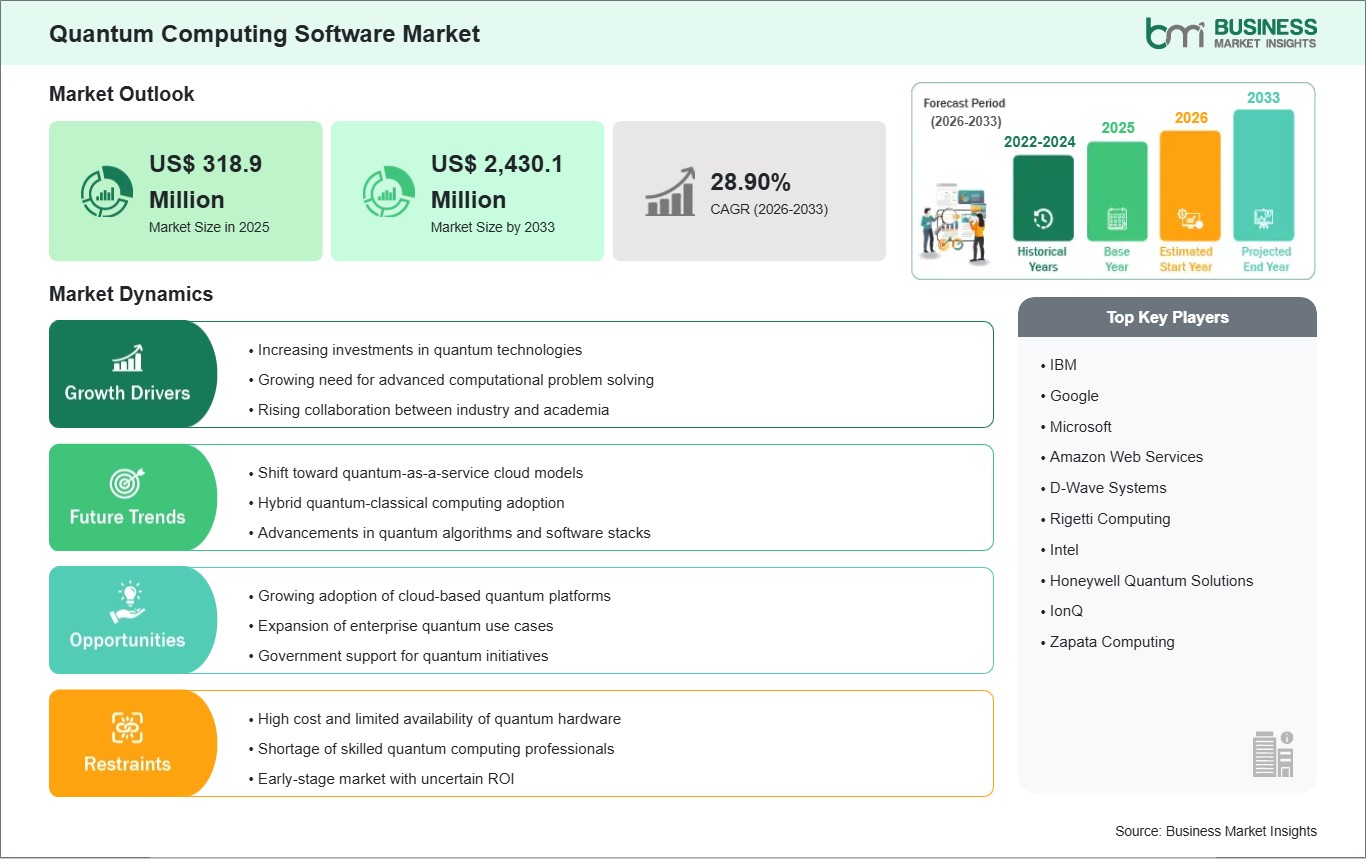
The Quantum Computing Software Market size is expected to reach US$ 2,430.1 million by 2033 from US$ 318.9 million in 2025. The market is estimated to record a CAGR of 28.90% from 2026 to 2033.
The global quantum computing software market is emerging as a critical enabler of next-generation computational capabilities, driven by the need to solve complex problems beyond classical computing limits. Quantum computing software includes platforms, development frameworks, compilers, and algorithms for quantum hardware and simulators, enabling applications across finance, healthcare, logistics, energy, and more.
The market is growing rapidly due to investments from technology companies, governments, and academic institutions. Companies like IBM, Google, and Microsoft are developing quantum software ecosystems providing cloud-based access to quantum processors, programming languages, development kits, and algorithms to accelerate innovation. The shift to quantum-as-a-service (QaaS) models lowers entry barriers, enabling broader experimentation and adoption.
Competitive dynamics focus on software stack optimization, hybrid quantum-classical computing, error mitigation, and user-friendly development environments. As quantum hardware evolves, the software layer becomes critical for practical applications, supported by national quantum initiatives worldwide.

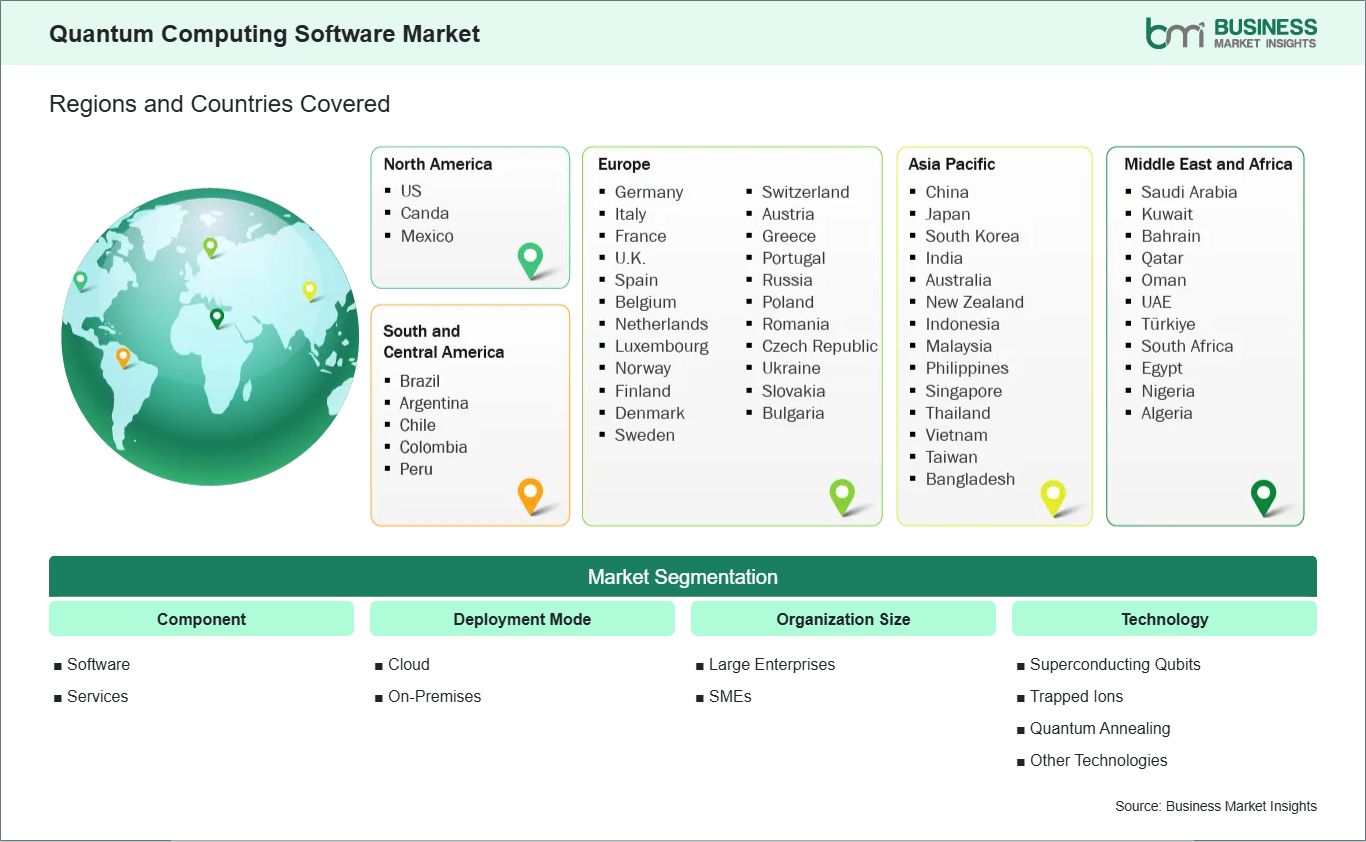
Key segments analyzed in the quantum computing software market include component, deployment mode, organization size, technology, application, and vertical.
Growth is driven by significant public and private investments. Governments are funding quantum initiatives to enhance computing capabilities and technological leadership. Private companies and venture capital also invest heavily. Quantum computing software enables practical applications through development frameworks, execution tools, and simulated environments that harness quantum hardware.
Collaborations between companies, universities, and research organizations accelerate development of quantum algorithms and applications, bridging theoretical research and real-world implementation.
Cloud-based Quantum Computing Platforms (QCPs) create opportunities for broader adoption. Cloud deployment allows access to quantum resources without large capital investment. Providers like AWS and Microsoft Azure offer QC services within classical cloud environments, enabling hybrid quantum-classical workflows. This supports complex applications in optimization, simulation, and machine learning, increasing demand for scalable, accessible, and cost-efficient QC services.
The Quantum Computing Software Market demonstrates steady growth, with size and share analysis highlighting evolving trends and competitive dynamics among key players. The report examines subsegments categorized within component, deployment mode, organization size, technology, application, and vertical, offering insights into their contribution to overall market performance.
By component, the software segment dominated the market in 2025, driven by increasing demand for quantum development platforms, programming frameworks, and simulation tools that enable users to design and execute quantum algorithms efficiently.
Based on deployment mode, the cloud segment dominated the market in 2025, primarily due to the widespread adoption of quantum-as-a-service platforms offered by providers such as IBM and Amazon Web Services. These platforms provide scalable access to quantum computing resources without requiring significant infrastructure investment.
In terms of organization size, the large enterprises segment dominated the market in 2025, supported by strong financial resources, dedicated research teams, and early adoption of quantum technologies for strategic advantage.
By technology, the superconducting qubits segment accounted for the largest share in 2025, driven by extensive research, commercialization efforts, and support from leading technology companies such as Google and IBM.
Based on application, the optimization segment dominated the market in 2025, as quantum algorithms are particularly well-suited for solving complex optimization problems in industries such as logistics, finance, and energy.
In terms of vertical, the BFSI segment dominated the market in 2025, driven by increasing use of quantum computing for portfolio optimization, risk modeling, and fraud detection, as financial institutions seek advanced computational tools to gain a competitive edge.

| Report Attribute | Details |
|---|---|
| Market size in 2025 | US$ 318.9 Million |
| Market Size by 2033 | US$ 2,430.1 Million |
| Global CAGR (2026 - 2033) | 28.90% |
| Historical Data | 2022-2024 |
| Forecast period | 2026-2033 |
| Segments Covered | By Component
|
|
Regions and Countries Covered
| |
| North America | US, Canada, Mexico |
| Europe | Belgium, Austria, Finland, Denmark, Greece, Poland, Romania, Russia, Ukraine, Czech Republic, Slovakia, Bulgaria, Italy, Luxembourg, Germany, Switzerland, France, Netherlands, Norway, Portugal, Spain, Sweden, United Kingdom |
| Asia-Pacific | Australia, China, India, Japan, South Korea, Indonesia, Malaysia, Philippines, Singapore, Thailand, Vietnam, Bangladesh, New Zealand, Taiwan |
| South and Central America | Brazil, Argentina, Peru, Chile, Colombia |
| Middle East and Africa | Bahrain, Kuwait, Oman, Qatar, Saudi Arabia, United Arab Emirates, Turkiye, South Africa, Egypt, Algeria, Nigeria |
| Market leaders and key company profiles |
|
The "Quantum Computing Software Market Size and Forecast (2022 - 2033)" report provides a detailed analysis of the market covering below areas:
The geographical scope of the Quantum Computing Software Market report is divided into North America, Asia Pacific, Europe, Middle East & Africa, and South & Central America. North America held the largest share in 2025.
North America’s leadership is driven by strong investments in quantum research, presence of leading technology companies such as IBM, Google, and Microsoft, and the availability of advanced cloud infrastructure. The region also benefits from government funding and collaborations between academia and industry.
Europe is witnessing steady growth supported by regional quantum initiatives and increasing focus on research and innovation. Asia Pacific is expected to experience the highest growth rate due to rising investments in quantum technologies by countries such as China, Japan, and India.
Meanwhile, Middle East & Africa and South & Central America are gradually entering the market, driven by growing awareness, academic research, and early-stage investments in advanced computing technologies.

The Quantum Computing Software Market is evaluated by gathering qualitative and quantitative data post primary and secondary research, which includes important corporate publications, association data, and databases. A few of the key developments in the quantum computing software market are:
The Quantum Computing Software Market is valued at US$ 318.9 Million in 2025, it is projected to reach US$ 2,430.1 Million by 2033.
As per our report Quantum Computing Software Market, the market size is valued at US$ 318.9 Million in 2025, projecting it to reach US$ 2,430.1 Million by 2033. This translates to a CAGR of approximately 28.90% during the forecast period.
The Quantum Computing Software Market report typically cover these key segments-
The historic period, base year, and forecast period can vary slightly depending on the specific market research report. However, for the Quantum Computing Software Market report:
The Quantum Computing Software Market is populated by several key players, each contributing to its growth and innovation. Some of the major players include:
The Quantum Computing Software Market report is valuable for diverse stakeholders, including:
Essentially, anyone involved in or considering involvement in the Quantum Computing Software Market value chain can benefit from the information contained in a comprehensive market report.
Please tell us your area of interest
(Market Segments/ Regions and Countries/ Companies)