Market Summary
Executive Summary and Global Market Analysis
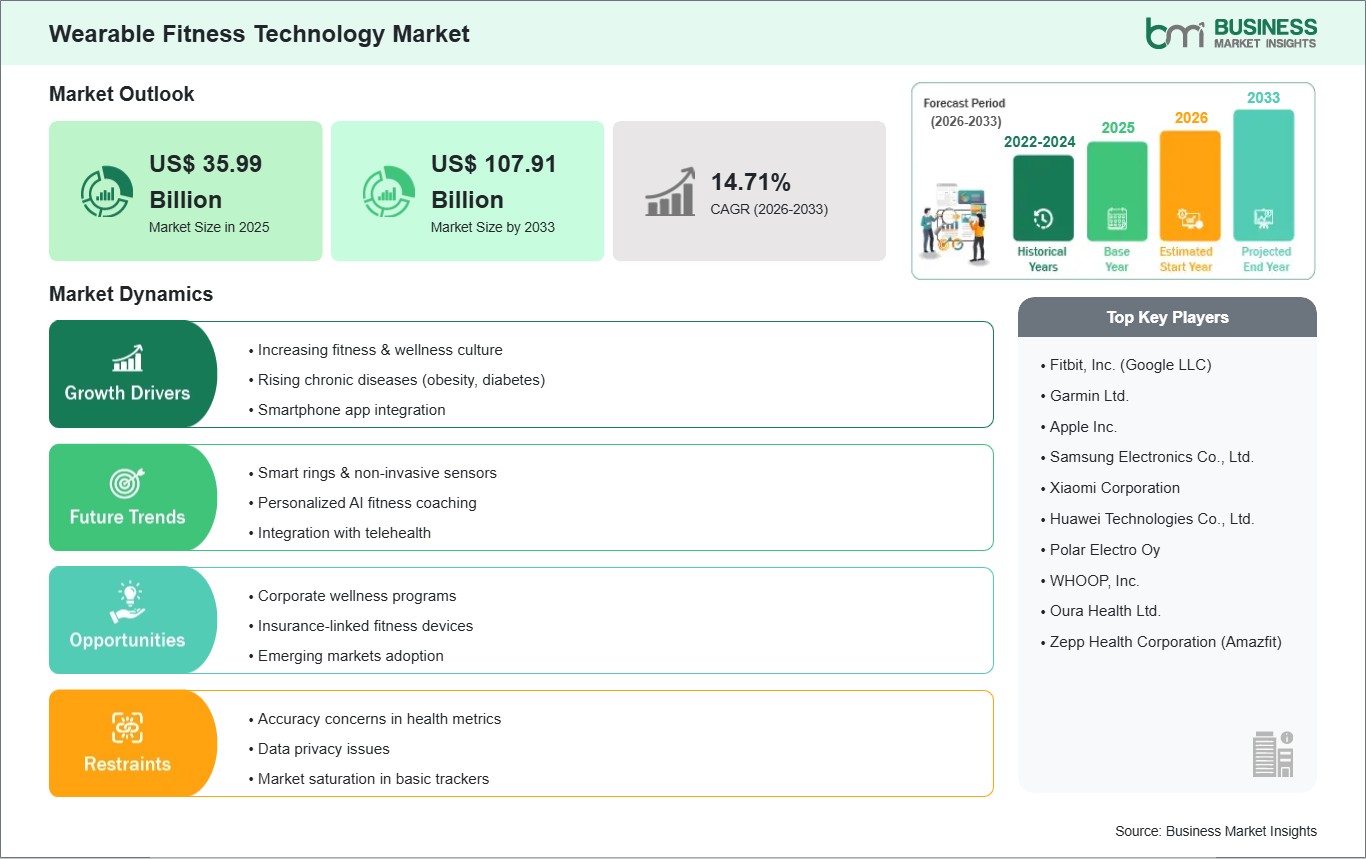
Wearable fitness technology refers to a diverse category of electronic devices designed to be worn on the body, such as smartwatches, fitness bands, smart rings, and e-textiles, to continuously monitor physiological and mechanical data. By utilizing advanced micro-electro-mechanical systems (MEMS) and biometric sensors, these devices quantify metrics including heart rate variability, sleep architecture, blood oxygen saturation, and physical activity levels. This technology is fundamental to the transition toward proactive wellness and personalized health management, serving as a critical interface for athletes, chronic disease patients, and health-conscious consumers. Market expansion is being propelled by the rising global focus on preventive healthcare, the integration of artificial intelligence (AI) for predictive health insights, and the increasing institutional adoption of wearables within corporate wellness programs and remote patient monitoring frameworks.
However, several factors may restrain market progression. The high capital intensity associated with premium flagship devices, often featuring medical-grade sensors and specialized display materials, remains a primary hurdle for price-sensitive segments, particularly in emerging economies. The industry also faces persistent technical challenges regarding battery density and power management, as users increasingly demand always-on monitoring without the inconvenience of frequent charging. Additionally, critical concerns regarding data privacy and biometric security act as a deterrent; the collection of sensitive personal health data necessitates rigorous adherence to evolving global mandates such as the GDPR. These hurdles, compounded by the risk of device abandonment once the initial novelty fades, require manufacturers to focus on long-term user engagement through actionable insights rather than raw data collection.
Despite these hurdles, the market outlook remains favorable. Opportunities are emerging through the expansion of invisible wearables, such as smart rings and sensor-embedded apparel, which offer a more discrete and ergonomic user experience compared to traditional wristwear. The integration of closed-loop fitness ecosystems is gaining traction; the market is seeing the rise of real-time adaptive training systems that automatically adjust workout intensity based on live biometric feedback and recovery scores. Furthermore, the growth of partnerships between wearable manufacturers and insurance providers, offering premium discounts for verified physical activity, aligns with global goals for reducing the burden of lifestyle-related chronic diseases. Collectively, these innovations position the wearable fitness technology industry for sustained long-term development as a cornerstone of the modern, data-driven, and hyper-personalized health landscape.
Segment Analysis
Wearable Fitness Technology Market Segmentation
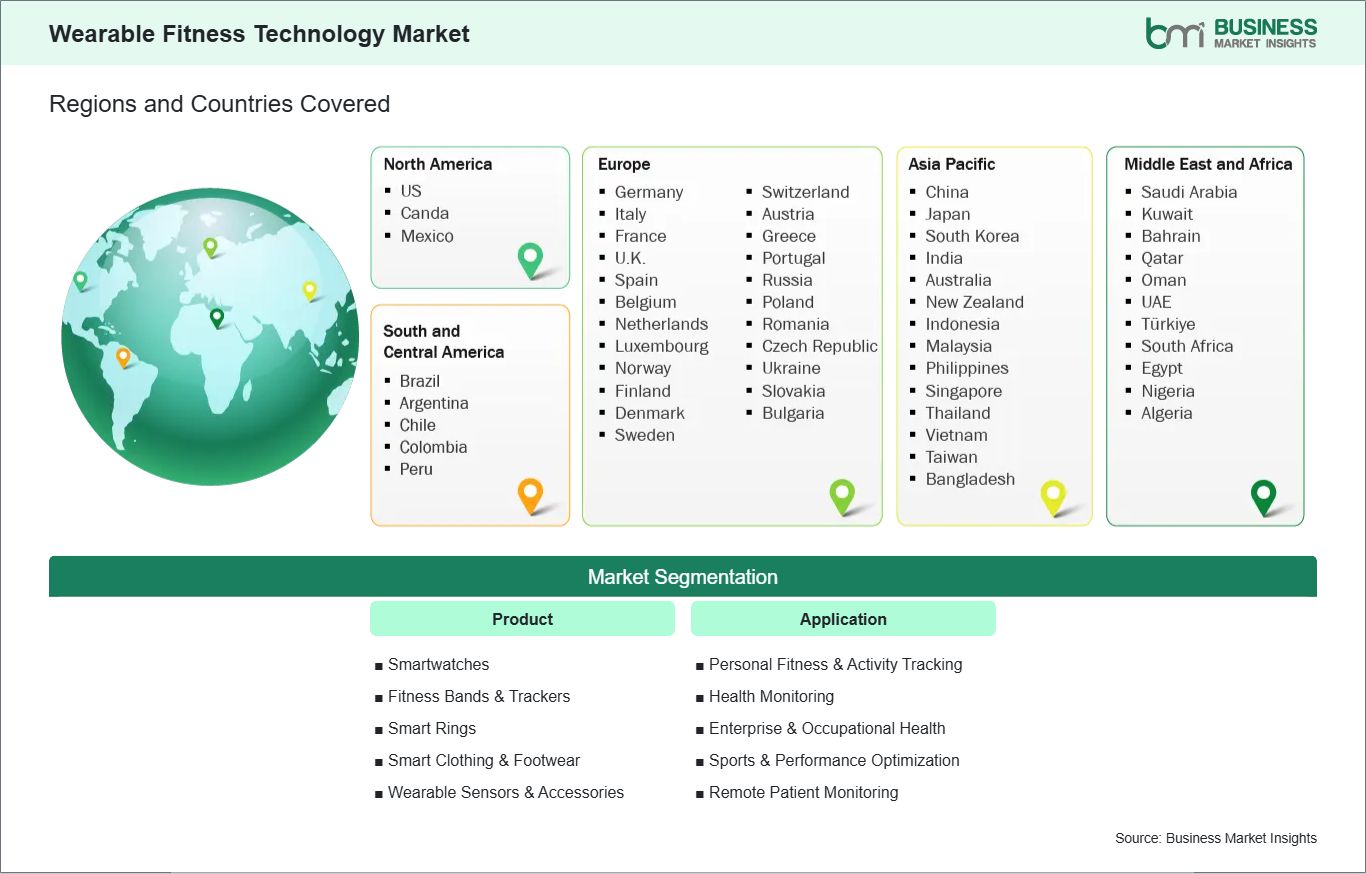
Key segments that contributed to the derivation of the Wearable Fitness Technology market analysis are product and application.
- By Product, the market is segmented into Smartwatches, Fitness Bands & Trackers, Smart Rings, Smart Clothing & Footwear, and Wearable Sensors & Accessories.
- By Application, the market is divided into Personal Fitness & Activity Tracking, Health Monitoring, Enterprise & Occupational Health, Sports & Performance Optimization, and Remote Patient Monitoring.
Market Forces
Wearable Fitness Technology Market Drivers and Opportunities
Rising Demand for Health Tracking and Lifestyle Management
The wearable fitness technology market is being driven by the growing consumer focus on health, wellness, and lifestyle management. Devices such as smartwatches, fitness bands, and connected clothing provide real‑time monitoring of vital signs, activity levels, and sleep patterns, empowering individuals to take proactive control of their health. Rising awareness of chronic diseases and preventive healthcare is amplifying adoption, as consumers increasingly rely on wearables to track fitness goals and detect early health anomalies. The expansion of digital healthcare ecosystems is reinforcing demand, with wearables integrating seamlessly into telemedicine platforms and electronic health records. Additionally, the popularity of personalized fitness programs and gamified health applications is fueling consumer engagement. The hybrid work culture and sedentary lifestyles are further driving adoption, as wearables encourage physical activity and wellness tracking. Collectively, preventive healthcare, lifestyle awareness, and digital integration are propelling sustained growth in the global wearable fitness technology market.
Rising Integration of AI, IoT, and Healthcare Applications
Opportunities in the wearable fitness technology market are expanding through the integration of artificial intelligence, IoT connectivity, and advanced healthcare applications. AI‑enabled wearables can deliver predictive insights, personalized coaching, and adaptive fitness programs, creating new pathways for user engagement and health optimization. IoT‑connected devices are gaining traction, enabling seamless data sharing across smartphones, healthcare providers, and fitness platforms. The growing emphasis on preventive healthcare is opening lucrative opportunities, as wearables evolve into diagnostic tools capable of monitoring heart health, glucose levels, and respiratory functions. Emerging applications in corporate wellness programs, insurance incentives, and sports performance analytics are also driving innovation. Additionally, the expansion of smart cities and digital healthcare infrastructure is fueling demand for interoperable wearables that support population health management. Sustainability trends are encouraging the development of eco‑friendly, energy‑efficient devices, aligning with global environmental goals. Vendors who focus on cost‑effective, AI‑driven, and healthcare‑integrated solutions are well‑positioned to capture growth. The convergence of smart functionality, predictive analytics, and healthcare innovation underscores a transformative trajectory for the global wearable fitness technology market.
Size and Share Analysis
Wearable Fitness Technology Market Size and Share Analysis
The Wearable Fitness Technology market demonstrates steady growth, with size and share analysis revealing evolving trends and competitive positioning among key players. The report examines subsegments categorized within product and application, offering insights into their contribution to overall market performance.
Based on Product, the Smartwatches subsegment holds the primary market presence. Smartwatches are indispensable for fitness tracking, health monitoring, and connectivity, offering features such as heart rate measurement, GPS tracking, and integration with mobile applications. Their multifunctionality and widespread consumer adoption make them the dominant product category. The Fitness Bands & Trackers subsegment is essential for cost-effective, lightweight solutions focused on activity tracking, step counting, and sleep monitoring, appealing to budget-conscious and fitness-focused users. The Smart Rings subsegment anchors demand in discreet, wearable health monitoring, offering convenience and continuous tracking without bulk. The Smart Clothing & Footwear subsegment is critical for advanced performance optimization, embedding sensors in apparel and footwear to monitor biomechanics, posture, and exertion levels. The Wearable Sensors & Accessories subsegment is indispensable for specialised applications, including medical monitoring and sports analytics, where precision and customization are essential.
Report Coverage
Wearable Fitness Technology Market Report Coverage and Deliverables
The "Wearable Fitness Technology Market Size and Forecast (2022 - 2033)" report provides a detailed analysis of the market covering below areas:
- Wearable Fitness Technology market size and forecast at global, regional, and country levels for all market segments covered under the scope
- Wearable Fitness Technology market trends, as well as drivers, restraints, and opportunities
- Wearable Fitness Technology market analysis covering key trends, global and regional framework, major players, regulations, and recent developments
- Industry landscape and competition analysis covering market concentration, heat map analysis, prominent players, and recent developments for the Wearable Fitness Technology market
- Detailed company profiles, including SWOT analysis
Geographic Insights
Wearable Fitness Technology Market Geographic Insights
The geographical scope of the Wearable Fitness Technology market report is divided into five regions: North America, Asia Pacific, Europe, Middle East & Africa, and South & Central America.
North America maintains a preeminent position within the global industry, a status reinforced by high consumer health consciousness and the early adoption of sophisticated digital ecosystems. The regional landscape is characterized by high-density investments in the United States and Canada, where the transition toward Clinical-Grade Biometric Sensors has become a strategic priority for both individual consumers and healthcare providers. This market leadership is further supported by the widespread integration of wearables into corporate wellness programs and insurance frameworks, which utilize real-time activity data to incentivize healthy lifestyles and manage chronic conditions proactively.
Technological progression in the United States and Canada is largely driven by a decisive shift toward AI-Powered Predictive Analytics and Remote Patient Monitoring. These advanced systems utilize machine learning to transform raw data, such as heart rate variability, blood oxygen levels, and sleep architecture, into actionable health insights. Furthermore, the region is witnessing an increasing utilization of Smart Clothing and Connected Footwear, as professional athletes and fitness enthusiasts seek more granular performance metrics without the requirement for traditional wrist-worn devices. This focus on Holistic Health Tracking allows North American operators to satisfy the growing demand for accurate, clinical-standard data in a consumer-friendly format.
Industry Activity
Recent Developments
The Wearable Fitness Technology market is evaluated by gathering qualitative and quantitative data post primary and secondary research, which includes important corporate publications, association data, and databases. A few of the key developments in the Wearable Fitness Technology market are:
- In October 2025, Samsung advances wearable fitness tech with AI-enabled smartwatches for early heart health detection. Collaboration with Medical AI and Hanyang University enhances LVSD monitoring and brain-computer interface wearables. These innovations strengthen the market with personalized, preventive health and wellness solutions.
- In August 2024, Huawei launches the HUAWEI TruSense System, advancing wearable fitness technology with accurate, comprehensive health monitoring. The system tracks over 60 health indicators and includes emotional wellbeing analysis, enhancing preventive care. Huawei’s TruSense integrates global partnerships to drive innovation in digital health and fitness wearables.
Trust & Transparency
Research Methodology
The market analysis combines proprietary research with secondary data from government agencies, company disclosures, regulatory filings, industry databases and expert interviews. Market estimates are validated through data triangulation, cross-market benchmarking and analyst
review.
View Full Research Methodology
Key Sources Referred:
World Bank - Global Trade Indicators World Trade Organization (WTO) International Monetary Fund (IMF) International Trade Administration (ITA) Company Websites Company Annual Reports Company Investor Presentations