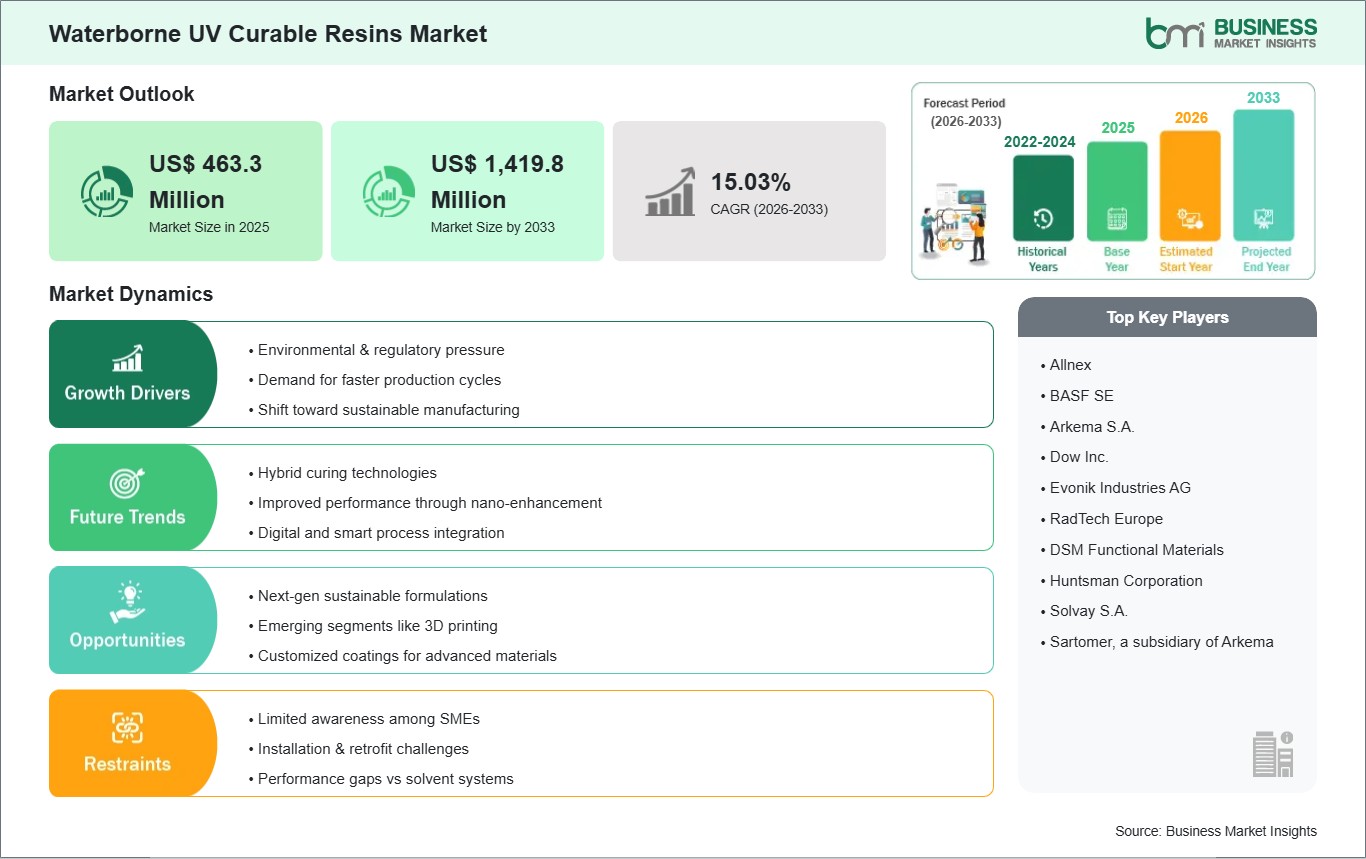
The Waterborne UV Curable Resins Market size is expected to reach US$ 1,419.8 million by 2033 from US$ 463.3 million in 2025. The market is estimated to record a CAGR of 15.03% from 2026 to 2033.
The global waterborne UV curable resins market is witnessing growing adoption as industries move toward environmentally friendly, high-performance coating and adhesive solutions. These resins combine the rapid curing benefits of ultraviolet technology with waterborne formulations, offering low VOC emissions, reduced hazardous solvent use, and enhanced sustainability. The demand is largely driven by stringent environmental regulations, particularly in developed regions, and the increasing need for coatings and inks that provide fast drying, chemical resistance, and durability in sectors such as automotive, electronics, wood coatings, and packaging. A key driver of the market is the rising focus on eco-friendly industrial processes and consumer preference for low-emission products. Manufacturers are increasingly investing in research to develop waterborne UV resins with improved adhesion, flexibility, and gloss, enabling broader applications across complex substrates.
However, challenges remain, including limitations in achieving certain performance characteristics—such as scratch resistance and curing depth compared to solvent-based UV resins. Additionally, the higher cost of advanced formulations and the need for specialized curing equipment can slow adoption in cost-sensitive markets. Overall, the global market for waterborne UV curable resins reflects a shift toward sustainable, high-efficiency coating technologies, balancing environmental compliance with industrial performance needs.

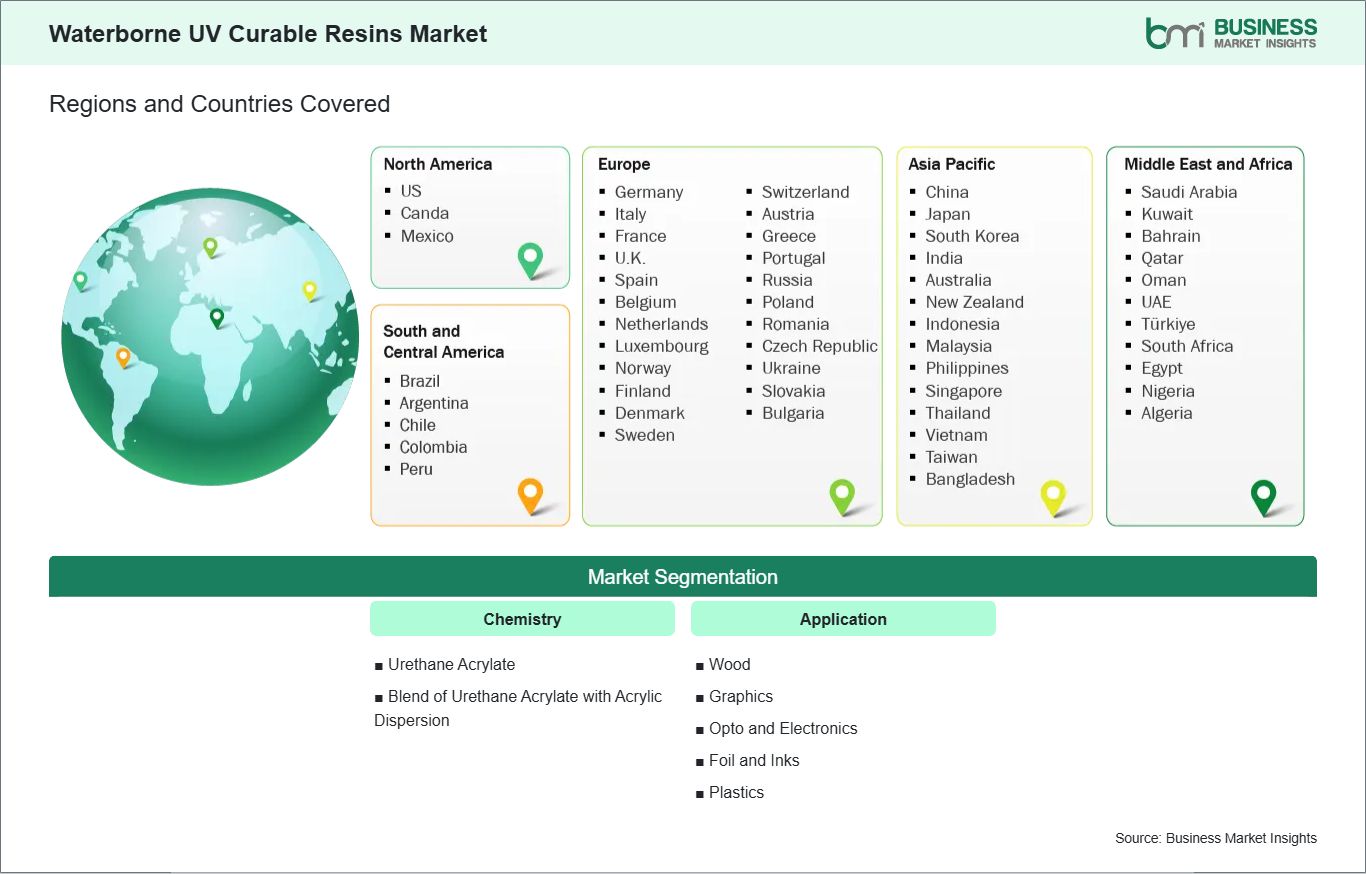
Key segments that contributed to the derivation of the waterborne uv curable resins market analysis are chemistry and application
The growth of the Asian Pacific region in the electronics industry is seen as the major growth driver for waterborne UV curable resins, as the industry looks for performance resins that can aid in the miniaturization of products and the speeding up of production cycles. In South Korea and Taiwan, global semiconductor and consumer electronics companies are using UV curable resins for coatings on printed circuit boards, displays, and surface protection due to the speed of cure and energy savings over conventional thermal cure resins. Local industry data show that the resin market in the Asian Pacific has seen growth in the electronics industry resins at a compound annual growth rate of nearly 12% over the last three years.
However, the rise in the production of smart devices, ranging from smartphones to wearable technology, has led to the widespread use of waterborne UV curable resins for both functional and decorative purposes. Resin manufacturers in China have noted that automotive parts suppliers in Shanghai and Shenzhen are using waterborne UV adhesives in the assembly of sensors and modules to deliver improved thermal performance and environmental compliance. Similarly, the use of UV curable resins in packaging has followed the same trend. This is due to the fact that the volume of e-commerce in China is still among the highest in the world.
The markets such as Malaysia and Vietnam are also contributing to this upward trend, as contract manufacturers build capacity to support global supply chains. In packaging, the move towards lightweight and faster production lines, especially for food and personal care products, is driving demand for UV curable varnishes and inks that dry instantly, enabling faster line speeds and less waste. Analysts estimate that combined demand from electronics and packaging could contribute to almost 60% of total waterborne UV resin demand in Asia Pacific by 2030, highlighting the importance of these end markets to this region.
The imperatives of sustainability are changing the dynamics of the waterborne UV curable resin market in Asia Pacific, with brands and governments calling for reduced volatile organic compound (VOC) emissions. In Japan and Singapore, the governments have set environmental standards that are in favor of waterborne UV resins over solvent-borne resins, encouraging companies to invest in the development of next-generation resins. In Japan, leading coating companies are reformulating existing products to have higher bio-based content and lower residual monomers, thus enabling customers to achieve higher indoor air quality and emission standards without compromising on performance.
The growing green building movement has fueled the growth of the market for low-VOC UV curable coatings in architectural markets like wood, metal, and glass coatings. In particular, architectural projects focused on green building ratings like Green Star are seeking resins with environmental benefits, thus commanding premium prices and differentiation for these resins. Local industry players are seizing the opportunity by working with European and North American licensors to develop innovative oligomer and photoinitiator technologies that balance environmental performance with long-term durability and weatherability.
Meanwhile, in many countries, sustainability trends are also affecting raw material sourcing, not just end users. In India, resin manufacturers and research institutions are working together to develop waterborne UV curable resins using renewable raw materials like plant-derived polyols and bio-based acrylates. This work supports the overall national agenda to reduce imports of petrochemical-based materials, as well as addressing the issue of waste management in many of these growing regions. Pilot projects have shown that the next generation of sustainable UV systems can provide performance equivalent to conventional products, ready for broader commercialization across the Asia Pacific region. This is one way for companies to make a big difference and help them excel in the global waterborne UV curable resins market.

The global waterborne uv curable resins market is experiencing steady growth, with market size and share analysis reflecting evolving treatment preferences and competitive dynamics among key players. The report evaluates important subsegments categorized within chemistry and application highlighting their respective contributions to overall market performance.
By chemistry, the urethane acrylate subsegment dominated the market in 2025 because it delivers superior mechanical properties, flexibility, and long‑term durability compared with blends. Its strong chemical resistance and excellent adhesion make it especially suitable for high‑performance coatings and industrial applications, leading manufacturers to favor urethane acrylate over mixed formulations for demanding end‑uses.
By application, the graphics subsegment dominated the market in 2025 s the demand for high‑quality, fast‑curing, environmentally compliant printing inks and coatings continues to grow. Waterborne UV resins in graphics support sophisticated printing technologies used in signage, packaging, and digital display media, where surface finish, color accuracy, and rapid production speeds are critical.
| Report Attribute | Details |
|---|---|
| Market size in 2025 | US$ 463.3 Million |
| Market Size by 2033 | US$ 1,419.8 Million |
| Global CAGR (2026 - 2033) | 15.03% |
| Historical Data | 2022-2024 |
| Forecast period | 2026-2033 |
| Segments Covered | By Chemistry
|
|
Regions and Countries Covered
| |
| North America | US, Canada, Mexico |
| Europe | Belgium, Austria, Finland, Denmark, Greece, Poland, Romania, Russia, Ukraine, Czech Republic, Slovakia, Bulgaria, Italy, Luxembourg, Germany, Switzerland, France, Netherlands, Norway, Portugal, Spain, Sweden, United Kingdom |
| Asia-Pacific | Australia, China, India, Japan, South Korea, Indonesia, Malaysia, Philippines, Singapore, Thailand, Vietnam, Bangladesh, New Zealand, Taiwan |
| South and Central America | Brazil, Argentina, Peru, Chile, Colombia |
| Middle East and Africa | Bahrain, Kuwait, Oman, Qatar, Saudi Arabia, United Arab Emirates, Turkiye, South Africa, Egypt, Algeria, Nigeria |
| Market leaders and key company profiles |
|
The "Waterborne uv curable resins market Size and Forecast (2022 - 2033)" report provides a detailed analysis of the market covering below areas:
The geographical scope of the waterborne uv curable resins market report is divided into: North America, Asia Pacific, Europe, Middle East & Africa, and South & Central America. North America held the largest share in 2025.
North America dominates the global waterborne UV curable resins market due to its advanced industrial infrastructure, high environmental standards, and early adoption of green technologies. The United States leads the region, driven by regulations that encourage low-VOC coatings and the growing trend of sustainable manufacturing across automotive, electronics, and wood products industries. Demand is particularly strong for applications requiring rapid curing, such as printing inks, furniture coatings, and electronics encapsulation, where performance and productivity are critical. Canada complements the market with growing adoption in specialty industrial coatings and packaging solutions.
Technological innovation in North America is a significant factor, with manufacturers developing hybrid formulations that improve adhesion, flexibility, and chemical resistance while maintaining low environmental impact. The integration of smart UV curing systems and process automation further enhances efficiency and quality control. North America’s dominance is reinforced by strong R&D capabilities, widespread environmental awareness, and a mature supply chain, positioning the region as a global benchmark for waterborne UV curable resin adoption and innovation.

The waterborne uv curable resins market is evaluated by gathering qualitative and quantitative data post primary and secondary research, which includes important corporate publications, association data, and databases. A few of the key developments in the Waterborne uv curable resins market are:
The Waterborne UV Curable Resins Market is valued at US$ 463.3 Million in 2025, it is projected to reach US$ 1,419.8 Million by 2033.
As per our report Waterborne UV Curable Resins Market, the market size is valued at US$ 463.3 Million in 2025, projecting it to reach US$ 1,419.8 Million by 2033. This translates to a CAGR of approximately 15.03% during the forecast period.
The Waterborne UV Curable Resins Market report typically cover these key segments-
The historic period, base year, and forecast period can vary slightly depending on the specific market research report. However, for the Waterborne UV Curable Resins Market report:
The Waterborne UV Curable Resins Market is populated by several key players, each contributing to its growth and innovation. Some of the major players include:
The Waterborne UV Curable Resins Market report is valuable for diverse stakeholders, including:
Essentially, anyone involved in or considering involvement in the Waterborne UV Curable Resins Market value chain can benefit from the information contained in a comprehensive market report.
Please tell us your area of interest
(Market Segments/ Regions and Countries/ Companies)