Market Summary
Executive Summary and Global Market Analysis
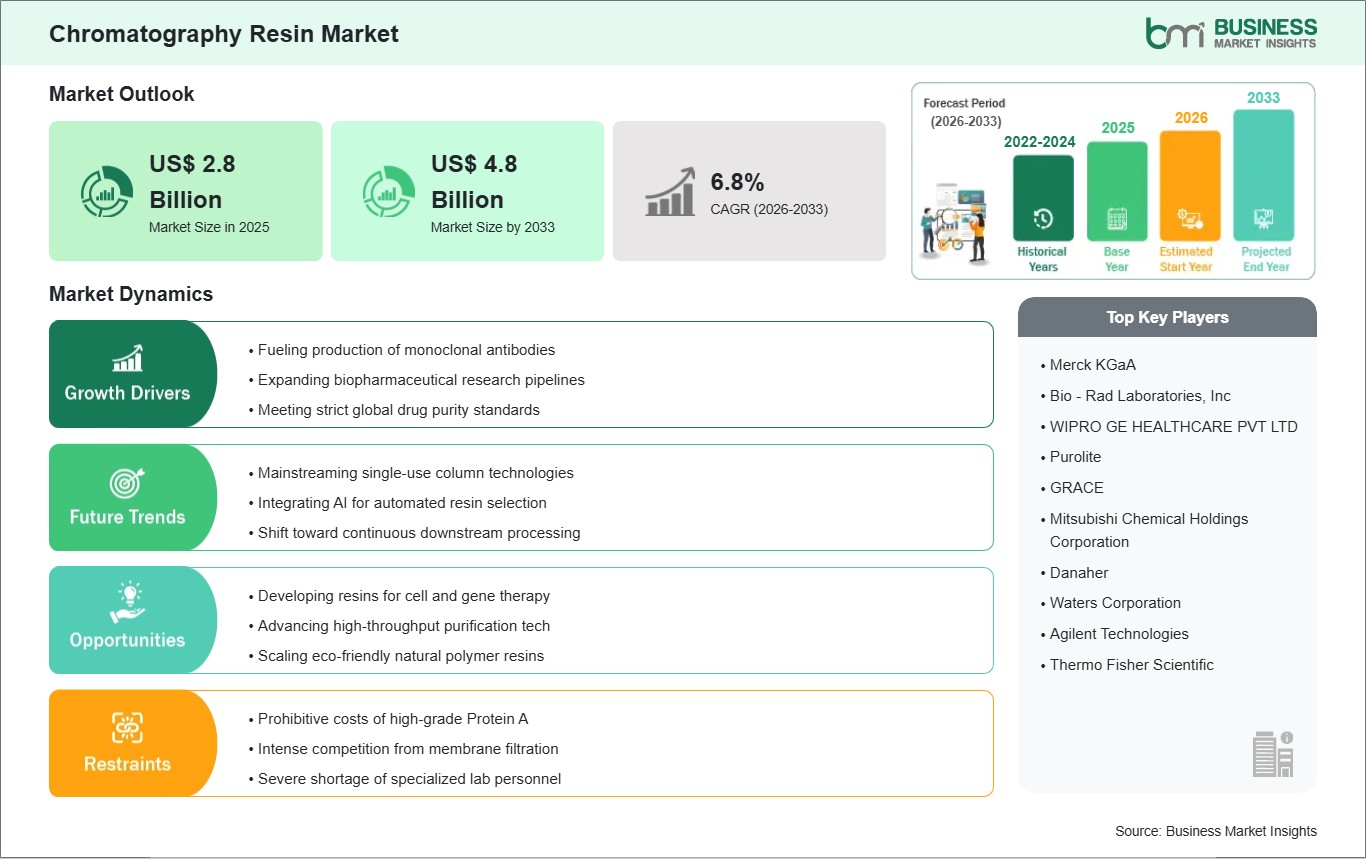
Chromatography resins play a key role in separating, purifying, and analyzing complex mixtures, making them essential for downstream bioprocessing. They are widely used in pharmaceuticals, biotechnology, food and beverages, and research. These resins stand out for their high selectivity, strong binding capacity, and scalability, which help meet strict purity standards for therapeutic products. The market is growing quickly due to the rise of biopharmaceuticals like monoclonal antibodies and gene therapies, more investment in life sciences research and development, and strict global regulations for drug purity.
However, a few challenges restrain market growth: the high cost of advanced affinity resins (e.g., Protein A), which contributes significantly to the total production expense of biologics, limits adoption. Competition from alternative separation technologies (e.g., single-use membrane chromatography) threatens traditional workflows. Furthermore, the industry faces constraints due to the complexity of optimizing purification processes for diverse new molecular modalities. Despite these hurdles, opportunities arise driven by the accelerating adoption of continuous bioprocessing and single-use columns, which enhance efficiency, the development of novel multimodal resins with improved stability, and substantial market growth in the Asia-Pacific region due to expanding biopharmaceutical manufacturing capabilities. Focus on high-throughput, customized resin solutions is expected to open powerful new avenues for market expansion.
Segment Analysis
Chromatography Resin Market Segmentation
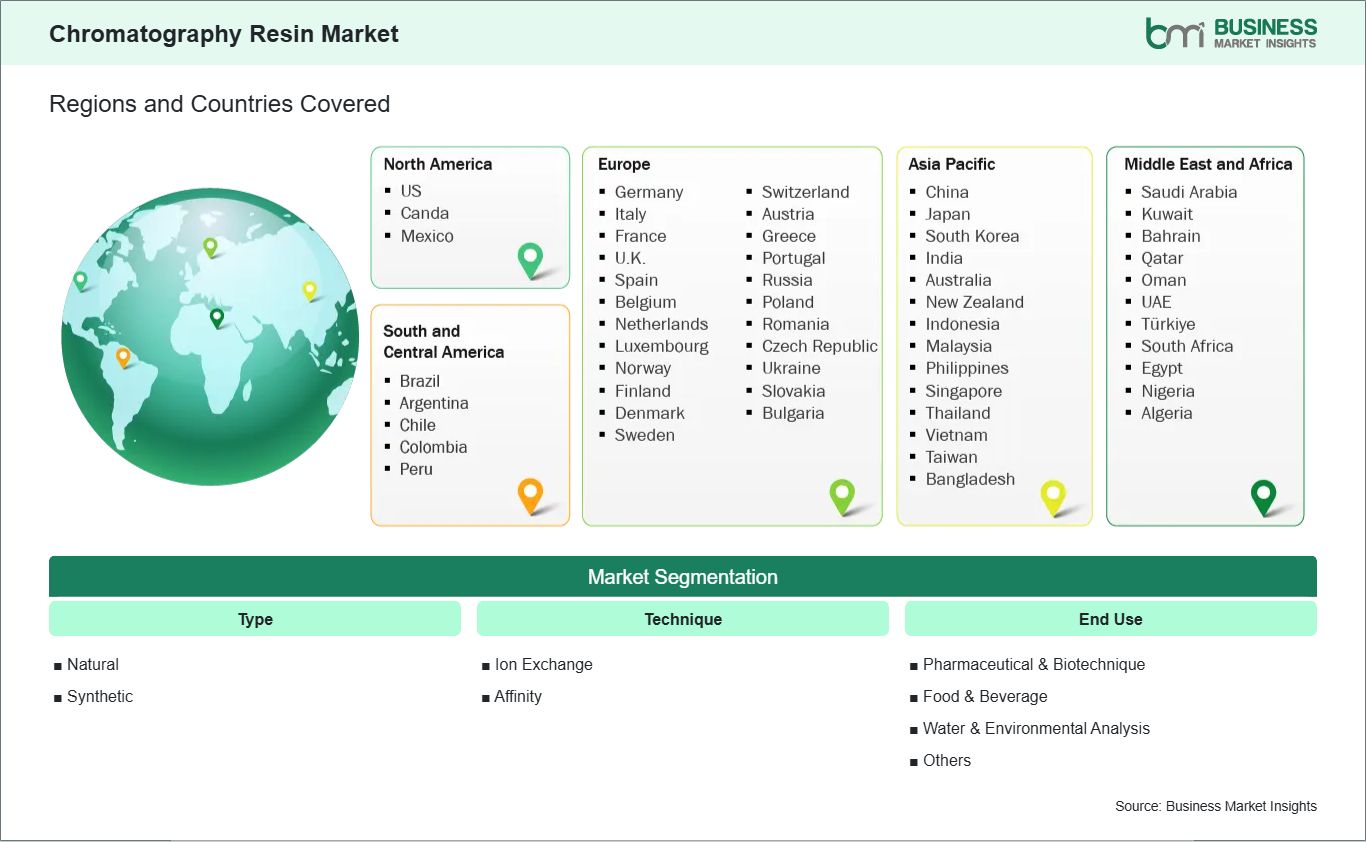
Key segments that contributed to the derivation of the Chromatography Resin Market analysis are type, technique, and end use.
- By Type, the market is segmented into Natural and Synthetic.
- By Technique, the market is segmented into Ion Exchange and Affinity.
- By End Use, the market is segmented into Pharmaceutical & Biotechnique, Food & Beverage, Water & Environmental Analysis, and Others.
Market Forces
Chromatography Resin Market Drivers and Opportunities
Exponential Growth in Biopharmaceuticals
The primary driver for the Chromatography Resin Market is the rapid growth in biopharmaceutical development and production, particularly for complex molecules like monoclonal antibodies and gene therapies. These products need very high purity, which is achieved using chromatography as the main separation method. Chromatography resins are crucial for isolating and purifying these valuable molecules with the needed accuracy and yield. Increased investment in life sciences R&D and strict global regulations for drug purity ensure ongoing, high demand for these resins.
Process Intensification and Advanced Material Architectures
A major opportunity exists in the industry-wide shift toward process intensification, specifically through continuous bioprocessing and the adoption of single-use chromatography systems. Traditional batch chromatography often faces productivity bottlenecks; however, emerging continuous chromatography platforms (such as multi-column systems) allow for significantly higher resin utilization and reduced buffer consumption. This shift opens a massive market for high-flow, high-capacity resins designed to withstand rapid cycling. Additionally, the development of "mixed-mode" or multimodal resins, which combine multiple types of chemical interactions, presents an opportunity to simplify purification steps for novel modalities such as cell and gene therapies. By integrating these advanced materials into automated, pre-packed, or single-use formats, manufacturers can significantly lower capital expenditure and reduce the risk of cross-contamination.
Size and Share Analysis
Chromatography Resin Market Size and Share Analysis
The Chromatography Resin Market demonstrates steady growth, with size and share analysis revealing evolving trends and competitive positioning among key players. The report further examines subsegments categorized within type, technique, and end use, offering insights into their contribution to overall market performance.
For instance, affinity resins are mainly used to purify monoclonal antibodies with high purity, using affinity chromatography. This subsegment holds a significant share of the market as a result of it is essential for biopharmaceutical production. The pharmaceutical and biotechnology sector often uses ion-exchange chromatography with synthetic resins to separate charged biomolecules, which is important for scaling up and meeting strict purity standards.
Report Coverage
Chromatography Resin Market Report Coverage and Deliverables
The "Chromatography Resin Market Size and Forecast (2022 - 2033)" report provides a detailed analysis of the market covering below areas:
- Chromatography Resin Market size and forecast at global, regional, and country levels for all the key market segments covered under the scope
- Chromatography Resin Market trends, as well as market dynamics such as drivers, restraints, and key opportunities
- Chromatography Resin Market analysis covering key market trends, global and regional framework, major players, regulations, and recent market developments
- Industry landscape and competition analysis covering market concentration, heat map analysis, prominent players, and recent developments for the Chromatography Resin Market
- Detailed company profiles, including SWOT analysis
Geographic Insights
Chromatography Resin Market Geographic Insights
The geographical scope of the Chromatography Resin Market report is divided into five regions: North America, Asia Pacific, Europe, the Middle East & Africa, and South & Central America.
For instance, the Asia-Pacific Chromatography Resin Market is segmented into China, Japan, South Korea, India, Australia, New Zealand, Indonesia, Malaysia, the Philippines, Singapore, Thailand, Vietnam, Taiwan, Bangladesh, and the Rest of Asia. The Asia-Pacific market is driven by the rapid expansion of the Biotechnology and Pharmaceutical sectors and massive investments in R&D infrastructure. China and India lead the growth, fueled by the rising demand for biologics, vaccines, and monoclonal antibodies.
Growth is further accelerated by the stringent need for high-purity separation in drug manufacturing and increasing concerns over food safety, which expands resin usage in food testing. Favorable government policies and the establishment of local biopharmaceutical manufacturing hubs across the region solidify Asia-Pacific as a critical global driver for chromatography resin demand and technological adoption.
Industry Activity
Recent Developments
The Chromatography Resin Market is evaluated by gathering qualitative and quantitative data post-primary and secondary research, which includes important corporate publications, association data, and databases. A few of the key developments in the Chromatography Resin Market are:
- In October 2025, Merck, a leading science and technology company, announced the signing of a definitive agreement to acquire the chromatography business of JSR Life Sciences, a leader in contract development and manufacturing, preclinical and translational clinical research, and bioprocessing solutions. The acquisition will expand Merck’s downstream processing portfolio with advanced Protein A chromatography capabilities, supporting more efficient and scalable production of biopharmaceutical therapies, including monoclonal antibodies. The transaction is expected to close by the end of the second quarter of 2026.
- In November 2025, Bio-Rad Laboratories, Inc., a global leader in life science research and clinical diagnostics products, announced that its Nuvia wPrime 2A Media has received a 2025 Innovation Award from The Analytical Scientist. Nuvia wPrime 2A Media, launched in January 2025, is a tunable weak anion exchange and hydrophobic interaction (AEX-HIC) mixed-mode chromatography resin designed for small- to large-scale biomolecule purification.
Trust & Transparency
Research Methodology
The market analysis combines proprietary research with secondary data from government agencies, company disclosures, regulatory filings, industry databases and expert interviews. Market estimates are validated through data triangulation, cross-market benchmarking and analyst
review.
View Full Research Methodology
Key Sources Referred:
World Bank - Global Trade Indicators
World Trade Organization (WTO)
International Monetary Fund (IMF)
International Trade Administration (ITA)
Company Websites
Company Annual Reports
Company Investor Presentations