Market Summary
Executive Summary and Global Market Analysis
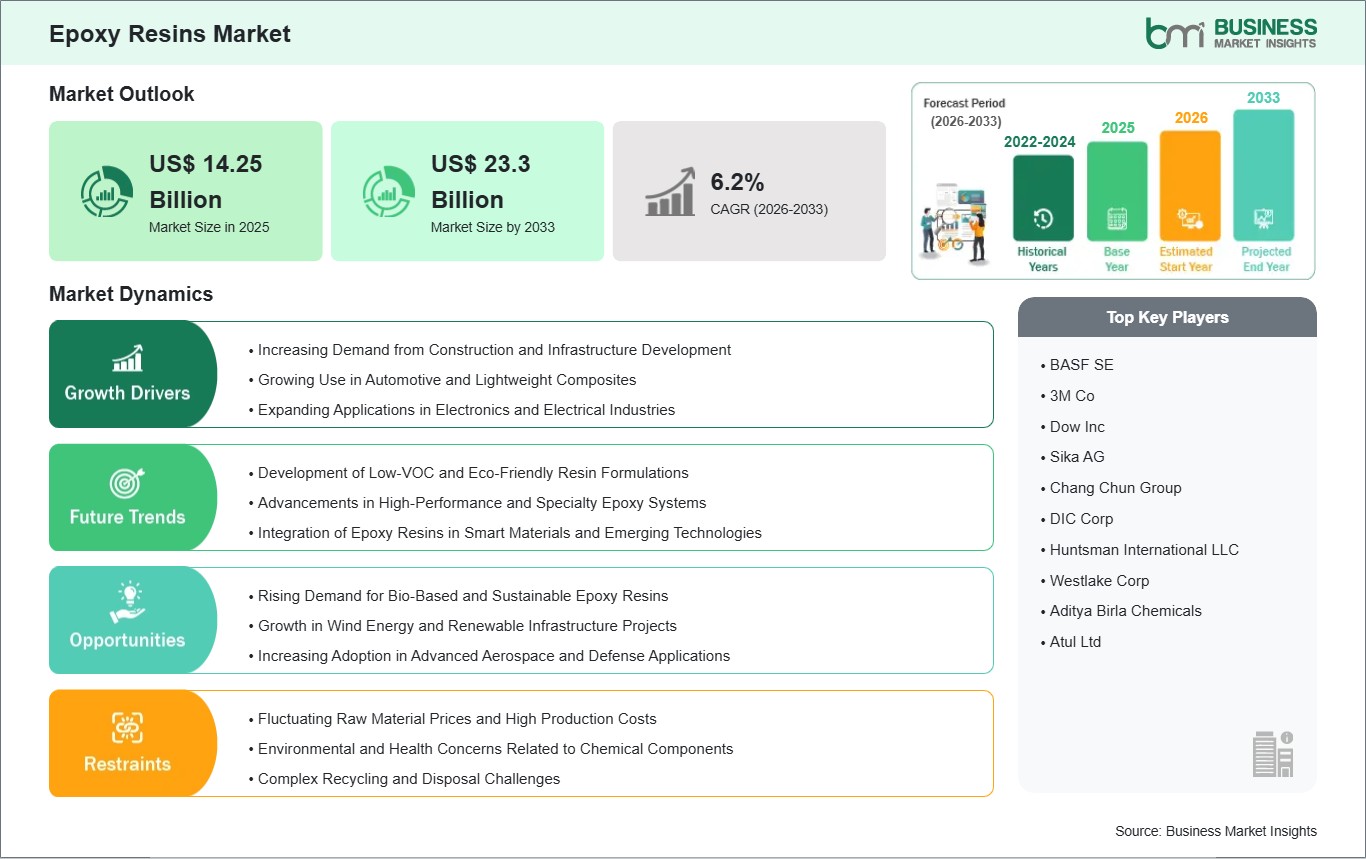
Epoxy resins are becoming an important part of the global chemical and materials industry because of their flexibility, strength, and growing use in many fields. These thermosetting polymers are common in coatings, adhesives, composites, electronics, construction, and automotive industries. Their features, such as strong bonding, resistance to chemicals, stability under heat, and electrical insulation, make them suitable for high-performance uses.
The market is growing mainly due to rising demand from the automotive and aerospace sectors, an increase in wind energy and renewable infrastructure, and higher construction activities worldwide. Moreover, technological progress in high-performance and bio-based epoxy resins is opening up new possibilities. The demand for lightweight, energy-saving vehicles and sustainable building materials is speeding up the use of epoxy resins, as they help reduce weight and improve durability. Global industrial growth, especially in emerging economies, is also driving up consumption in the electronics, electrical equipment, and infrastructure sectors. Despite its growth, the epoxy resins market faces several challenges. High production and material costs, along with changing petroleum prices, can affect profits. Concerns about volatile organic compounds (VOCs) and harmful chemical components require stricter adherence to health and safety rules.
Segment Analysis
Epoxy Resins Market Segmentation
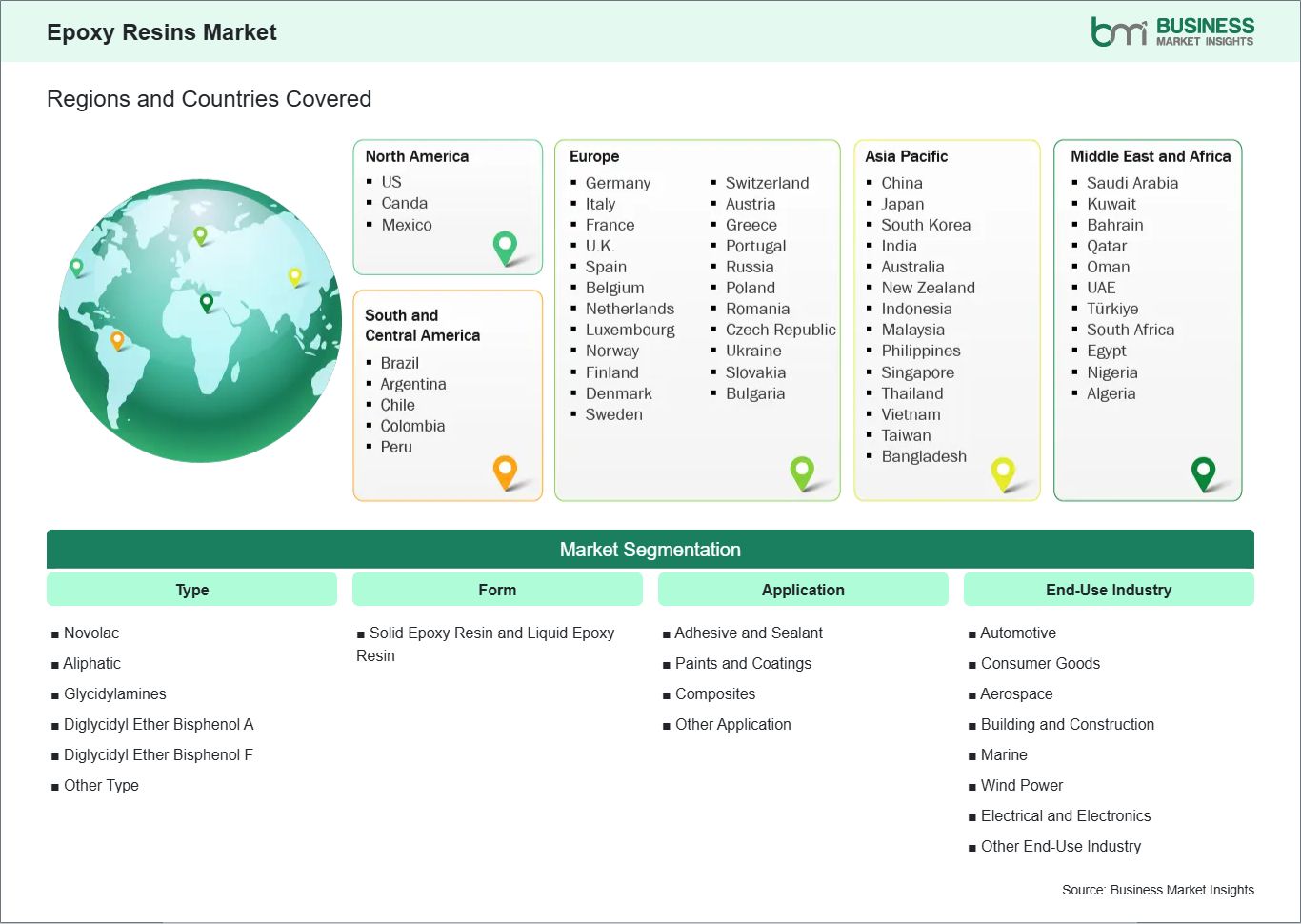
Key segments that contributed to the derivation of the Epoxy Resins market analysis are type, form, application, and end-use industry
- By type, the epoxy resins market is segmented into Novolac, Aliphatic, Glycidylamines, Diglycidyl Ether Bisphenol A, Diglycidyl Ether Bisphenol F, and other type. The Diglycidyl Ether Bisphenol A segment dominated the market in 2025.
- By form, the market is categorized into solid epoxy resin and liquid epoxy resin. The liquid epoxy resin segment dominated the market in 2025.
- By application, the market is categorized into adhesive and sealant, paints and coatings, composites, and other application. The adhesive and sealant segment held the largest share of the market in 2025.
- By end-use industry, the market is categorized into automotive, consumer goods, aerospace, building and construction, marine, wind power, electrical and electronics, and other end-use industry. The automotive segment held the largest share of the market in 2025.
Market Forces
Epoxy Resins Market Drivers and Opportunities
Rising Demand for High-Performance and Versatile Resin Solutions
Manufacturers in construction, automotive, aerospace, electronics, and wind energy are increasingly using epoxy resins to boost product durability, chemical resistance, and overall performance. These resins provide a practical and scalable method to improve adhesion, thermal stability, and mechanical strength without major changes to current manufacturing processes. Epoxy resins also help optimize resource use by reducing material waste, extending product life, and enhancing energy efficiency in applications like composite materials and protective coatings. Their compatibility with different substrates and industrial systems ensures consistent quality and reliability, making them a top choice for high-performance uses. Innovations in bio-based and low-VOC epoxy formulations are speeding up adoption, while rising industrial investments in lightweight, energy-efficient, and sustainable solutions are driving steady market growth..
Shift Toward Sustainable, Low-Impact, and Electrically/Energy Efficient Materials
The push for eco-friendly and energy-efficient materials is driving a strong demand for epoxy resins. Bio-based, low-VOC, and recyclable epoxy formulations help cut environmental impact while keeping high performance. In construction and infrastructure, epoxy resins provide longer-lasting coatings and adhesives. This reduces the need for frequent maintenance and replacements. In the automotive and aerospace industries, lightweight composite materials that use epoxy resins enhance fuel efficiency and lower carbon emissions. Stricter environmental laws, corporate sustainability goals, and increased awareness of material lifecycle impacts are speeding up the move toward sustainable epoxy solutions. The market is seeing new developments in green chemistries, recyclable composites, and bio-based raw materials. These innovations ensure that epoxy resins continue to meet global sustainability goals while also fulfilling technical performance needs.
Size and Share Analysis
Epoxy Resins Market Size and Share Analysis
The epoxy resins market demonstrates steady growth, with size and share analysis revealing evolving trends and competitive positioning among key players. The report further examines subsegments categorized within type, form, application, and end-use industry offering insights into their contribution to overall market performance.
Based on form, the liquid epoxy resin subsegment dominates the epoxy resins market. The liquid epoxy resin segment leads the epoxy resins market because of its flexibility and ease of use in coatings, adhesives, composites, and electronics. Its low viscosity improves substrate wetting, provides uniform coating, and enables efficient processing in industrial applications. Rising demand in the construction, automotive, aerospace, and wind energy sectors drives growth since liquid epoxy resins offer better adhesion, chemical resistance, and mechanical strength. New developments in bio-based and low-VOC formulas are improving environmental sustainability and meeting global regulations and green initiatives. The growing use of composite materials and protective coatings in infrastructure projects also supports market expansion. There are challenges, including high production costs and raw material price fluctuations, but ongoing technological improvements ensure continued growth and wider industrial application.
Report Coverage
Epoxy Resins Market Report Coverage and Deliverables
The " Epoxy Resins Market Size and Forecast (2022 - 2033)" report provides a detailed analysis of the market covering below areas:
- Epoxy Resins market size and forecast at global, regional, and country levels for all the key market segments covered under the scope
- Epoxy Resins market trends, as well as market dynamics such as drivers, restraints, and key opportunities
- Epoxy Resins market analysis covering key market trends, global and regional framework, major players, regulations, and recent market developments
- Industry landscape and competition analysis covering market concentration, heat map analysis, prominent players, and recent developments for the epoxy resins market
- Detailed company profiles, including SWOT analysis
Geographic Insights
Epoxy Resins Market Geographic Insights
The geographical scope of the Epoxy Resins market report is divided into five regions: North America, Asia Pacific, Europe, Middle East & Africa, and South & Central America. The Asia Pacific Epoxy Resins Market is segmented into China, Japan, South Korea, India, Australia, New Zealand, Indonesia, Malaysia, the Philippines, Singapore, Thailand, Vietnam, Taiwan, Bangladesh, and the Rest of Asia Pacific. Rising demand from the automotive, construction, electronics, and renewable energy sectors is boosting consumption, especially for liquid and high-performance epoxy formulations.
Government programs encouraging sustainable building materials and energy-efficient solutions are increasing the use of bio-based and low-VOC epoxy resins. The region`s large manufacturing base and higher exports of industrial goods also open up market opportunities. However, growth might be limited by fluctuations in raw material prices and environmental regulations in some countries. Overall, Asia-Pacific is still a strong market due to growing industrial activities, increased investment in advanced composites, and a rising awareness of durable, high-performance materials.
Industry Activity
Recent Developments
The Epoxy Resins market is evaluated by gathering qualitative and quantitative data post-primary and secondary research, which includes important corporate publications, association data, and databases. A few of the key developments in the epoxy resins market are:
- In March 2023, Westlake Corporation (NYSE: WLK) announced that Westlake Epoxy will launch its new AZURES product range at the European Coatings Show 2023, to be held in Nuremberg, Germany, March 28 to 30, 2023.
- In Sept 2025, Huntsman Advanced Materials, a division of Huntsman Corporation, announced the launch of a newly reformulated range of ARALDITE epoxy adhesives that are free from intentionally added BPA (Bisphenol A) and substances classified as CMR (Carcinogenic, Mutagenic, or Reprotoxic) under the EU`s CLP regulation.
Trust & Transparency
Research Methodology
The market analysis combines proprietary research with secondary data from government agencies, company disclosures, regulatory filings, industry databases and expert interviews. Market estimates are validated through data triangulation, cross-market benchmarking and analyst
review.
View Full Research Methodology
Key Sources Referred:
World Bank - Global Trade Indicators European Chemicals Agency International Monetary Fund (IMF) World Trade Organization (WTO) International Trade Administration (ITA) Company Websites Company Annual Reports Company Investor Presentations Polymer International