Market Summary
Executive Summary and Global Market Analysis
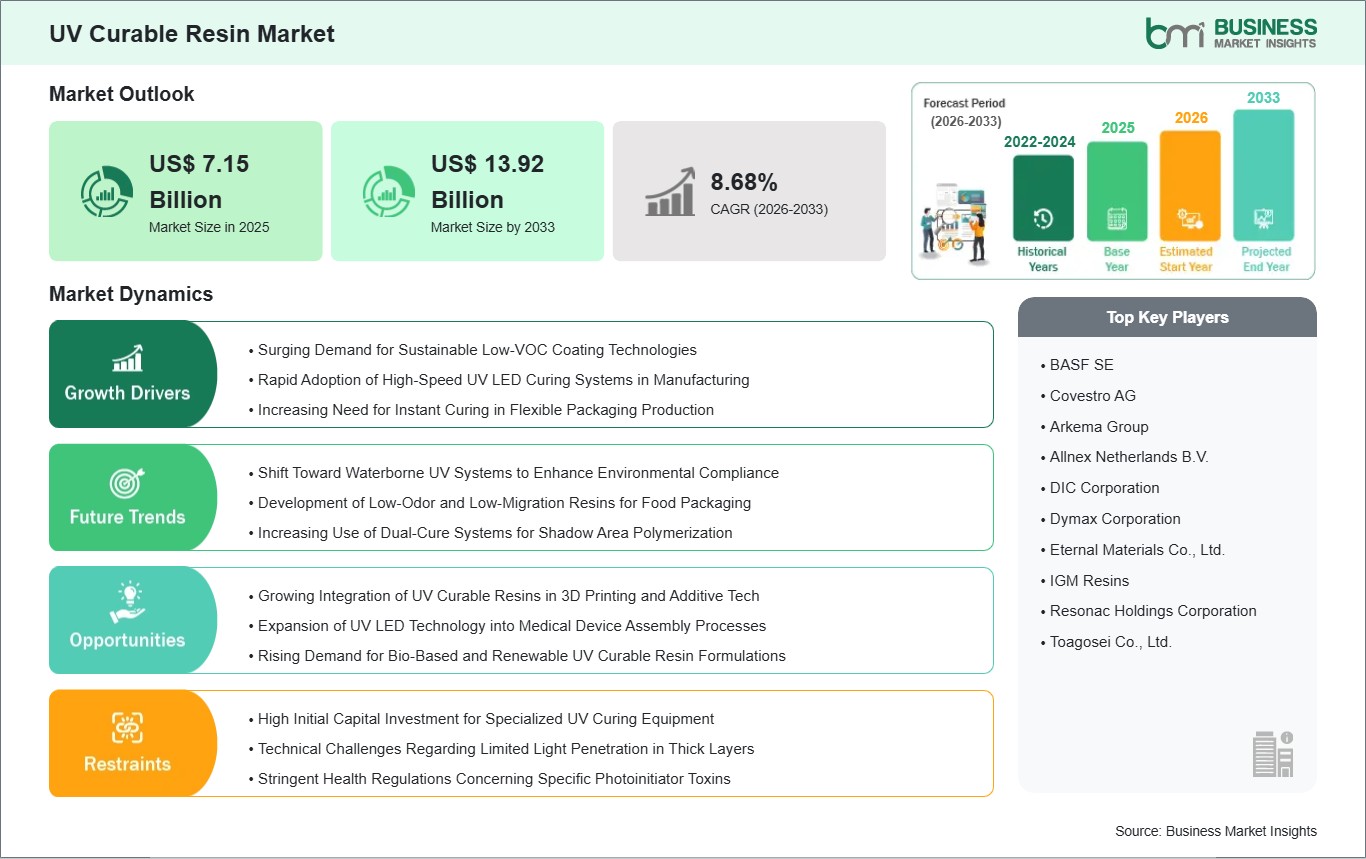
The definition of the global market for UV curable resins is characterized by their significant role in facilitating high-speed, efficient, and sustainable manufacturing processes. Resins that change their phase instantaneously from liquid to solid in response to ultraviolet light are now essential in various industries requiring high-performance finishes and bonds. Acrylated epoxies and urethanes are the dominant resins in the market in terms of product type, owing to their long lifespan and versatility. The coatings segment holds the largest share in the market, although printing inks and adhesives are also witnessing significant growth, especially in digital printing and medical devices. The market is in the midst of significant innovation, driven by the need to replace the conventional mercury vapor lamp with the more efficient LED lamp.
Strategic growth drivers for this market are mainly in the electronics and packaging industries, where miniaturization and food-safe, low-migration materials are in demand like never before. Despite challenges in this market, such as high equipment costs and raw material cost fluctuations, the overall outlook is very, very strong. As a result of the emergence of 3D printing and the global move toward low VOC industrial solutions, high-value opportunities are arising for resin formulators. As "green" technologies continue to gain ground, offering solutions that do not compromise on production speeds, UV curable resins are poised to dominate a vast array of industrial uses, replacing traditional thermal cure technologies, and solidifying their place in the world of modern material science.
Segment Analysis
UV Curable Resin Market Segmentation
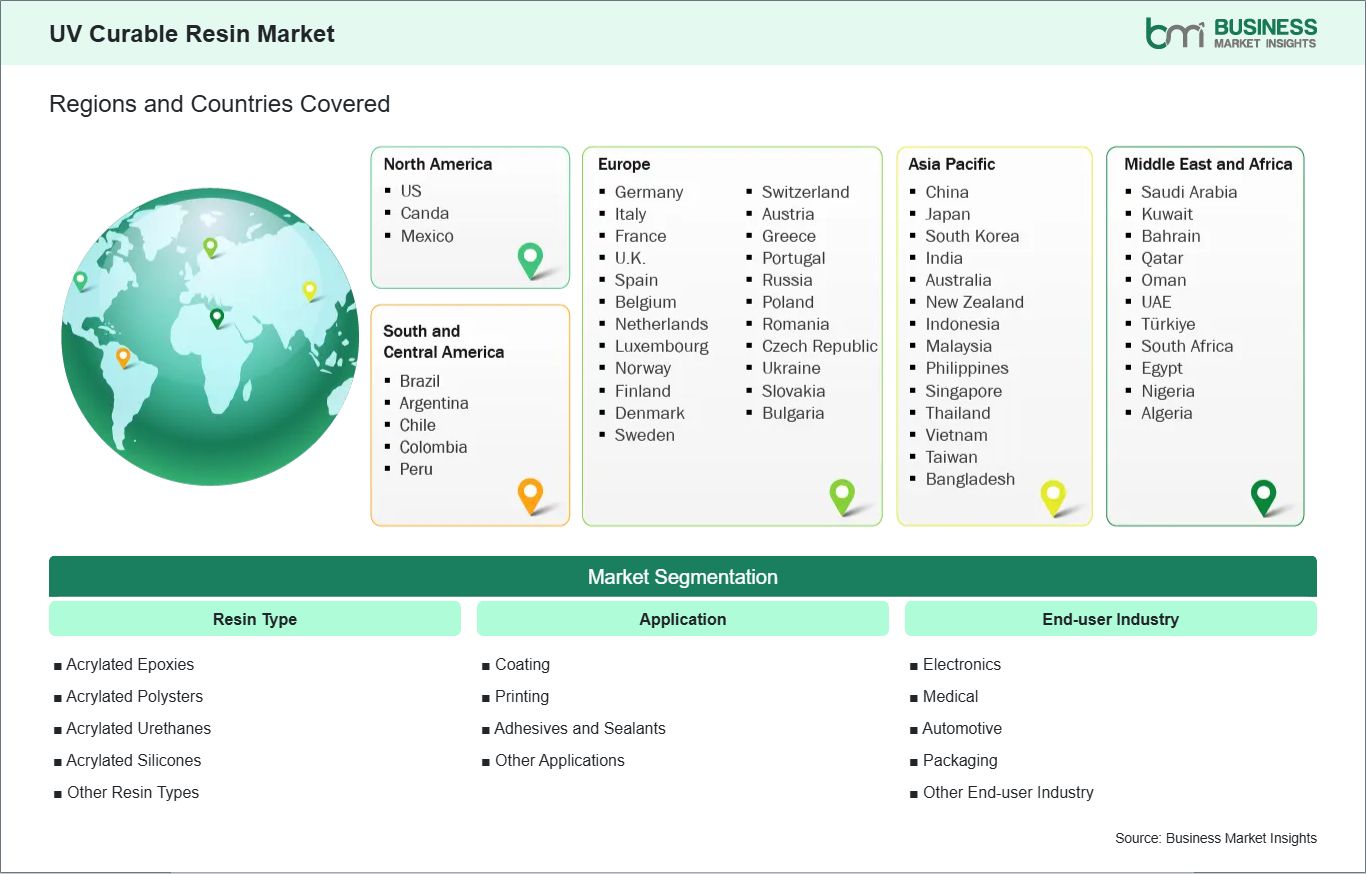
Key segments that contributed to the derivation of the UV Curable Resin market analysis are resin type, application, and end-user industry.
- By resin type, the UV Curable Resin market is segmented into Acrylated Epoxies, Acrylated Polyesters, Acrylated Urethanes, Acrylated Silicones, and Other resin types. The Acrylated Epoxies segment dominated the market in 2025.
- By application, the UV Curable Resin market is segmented into Coating, Printing, Adhesives and Sealants, and Other applications. The Coating segment dominated the market in 2025.
- By end-user industry, the UV Curable Resin market is segmented into Electronics, Medical, Automotive, Packaging, and Other end-user industry. The Electronics segment dominated the market in 2025.
Market Forces
UV Curable Resin Market Drivers and Opportunities
Surging Demand for Sustainable Low-VOC Coating Technologies
The global transition toward environmentally responsible manufacturing has placed significant pressure on industries to reduce their reliance on solvent-based systems. Conventional coatings often release substantial amounts of volatile organic compounds during the drying process, contributing to air pollution and posing health risks to workers. UV curable resins offer a compelling solution as they are typically formulated as 100 percent solid systems, meaning they contain little to no solvents. The polymerization process is triggered by ultraviolet light rather than evaporation, which effectively eliminates harmful emissions. This alignment with strict environmental mandates makes these resins the preferred choice for companies aiming to achieve carbon neutrality and regulatory compliance.
Beyond environmental benefits, the move toward low-VOC technologies is driven by operational efficiency. Because these resins cure through a photochemical reaction rather than thermal drying, they require significantly less energy and floor space. Traditional ovens are replaced by compact UV lamp stations, allowing for a more streamlined production layout. This shift is particularly evident in the wood finishing and automotive refinish sectors, where the ability to deliver a high-quality, durable surface without the environmental baggage of older technologies provides a clear competitive advantage. As sustainability becomes a core pillar of industrial strategy, the demand for these eco-friendly resin systems continues to expand across diverse manufacturing landscapes.
Growing Integration of UV Curable Resins in 3D Printing and Additive Tech
Additive manufacturing has evolved from a prototyping tool to a legitimate mass-production method, with UV curable resins at the heart of this transformation. Technologies such as Stereolithography and Digital Light Processing rely on the precise, layer-by-layer photopolymerization of liquid resins to create complex geometries that are impossible to achieve through traditional subtractive manufacturing. The ability of UV resins to cure rapidly while maintaining high dimensional accuracy allows for the production of intricate components with exceptional surface finishes. This is opening new avenues in sectors ranging from personalized healthcare, such as dental aligners and hearing aids, to high-performance aerospace components.
The opportunity lies in the development of specialty resins that mimic the mechanical properties of traditional engineering plastics. Innovations in resin chemistry are now producing materials with high heat deflection temperatures, flame retardancy, and impact resistance. This allows manufacturers to go beyond aesthetic models and produce functional end-use parts. As 3D printing speeds increase and the cost of UV LED hardware decreases, the consumption of UV curable resins in the additive sector is poised for exponential growth. Companies that can provide customized resin formulations tailored to specific 3D printing hardware and end-use requirements will find themselves at the forefront of a manufacturing revolution that prioritizes localized and on-demand production.
Size and Share Analysis
UV Curable Resin Market Size and Share Analysis
The global UV Curable Resin market is experiencing steady growth, with market size and share analysis reflecting evolving treatment preferences and competitive dynamics among key players. The report evaluates important subsegments categorized within resin type, application, and end-user industry, highlighting their respective contributions to overall market performance.
By resin type, the Acrylated Epoxies subsegment dominated the market in 2025 due to its exceptional chemical resistance, high surface hardness, and superior adhesion to various substrates. These properties make it the ideal choice for high-performance applications such as electronic encapsulants and durable industrial finishes.
By application, the Coating subsegment dominated the market in 2025 because of the widespread adoption of UV curing technology to achieve near-instantaneous drying and high-gloss finishes. Its ability to replace solvent-based systems in wood, metal, and plastic finishing drives its high-volume consumption globally.
By end-user industry, the Electronics subsegment dominated the market in 2025 due to the critical need for precision and rapid processing in semiconductor and circuit board assembly. UV resins provide the necessary electrical insulation and thermal stability required for the miniaturization of modern consumer devices.
Report Coverage
UV Curable Resin Market Report Coverage and Deliverables
The "UV Curable Resin Market Size and Forecast (2022 - 2033)" report provides a detailed analysis of the market covering below areas:
- UV Curable Resin market size and forecast at the regional and country levels for segments covered under the scope
- UV Curable Resin market trends, as well as drivers, restraints, and opportunities
- UV Curable Resin market analysis covering key trends, regional framework, major players, regulations, and recent developments
- Industry landscape and competition analysis covering market concentration, heat map analysis, prominent players, and recent developments for the UV Curable Resin market
- Detailed company profiles, including SWOT analysis
Geographic Insights
UV Curable Resin Market Geographic Insights
The geographical scope of the UV Curable Resin market report is divided into: North America, Asia Pacific, Europe, Middle East & Africa, and South & Central America. North America held the largest share in 2025.
North America stands as the dominant force in the UV curable resin market, a position established by its early adoption of advanced curing technologies and a highly concentrated landscape of end-user industries. The region’s leadership is particularly evident in the electronics and aerospace sectors, where the demand for high-reliability coatings and adhesives is constant. Major chemical manufacturers and technology providers in the United States and Canada are leading the shift toward UV LED systems, driven by a combination of corporate sustainability goals and federal environmental regulations. This mature market infrastructure allows for rapid commercialization of new resin chemistries, such as bio-based acrylates and low-migration formulations for the packaging industry.
The region's dominance is further bolstered by a strong focus on high-value applications in the medical and dental fields. The U.S. healthcare sector’s reliance on UV-cured biocompatible materials for device assembly and 3D-printed prosthetics ensures a steady stream of revenue for specialty resin producers. Additionally, the resurgence of domestic manufacturing and the modernization of automotive production lines have created a robust demand for high-performance clear coats and structural adhesives that utilize UV technology. While the Asia-Pacific region is a major volume consumer due to its electronics manufacturing hubs, North America remains the leader in market value and technological innovation, setting the standard for quality and regulatory compliance on a global scale.
Industry Activity
Recent Developments
The UV Curable Resin market is evaluated by gathering qualitative and quantitative data post primary and secondary research, which includes important corporate publications, association data, and databases. A few of the key developments in the UV Curable Resin market are:
- In March 2024, Arkema, announced the expansion of its UV-LED curing resin production capacity at its Nansha site in China, aimed at meeting growing demand in coatings, electronics, and 3D printing applications.
- In October 2023, Covestro, announced the launch of new sustainable UV-curable resins under its Decovery® portfolio, designed to reduce carbon footprint while maintaining high-performance coating properties.
- In May 2023, Allnex, announced the introduction of new UV-curable resin technologies for industrial coatings and inks, focusing on improved cure speed and lower energy consumption with LED systems.
Trust & Transparency
Research Methodology
The market analysis combines proprietary research with secondary data from government agencies, company disclosures, regulatory filings, industry databases and expert interviews. Market estimates are validated through data triangulation, cross-market benchmarking and analyst
review.
View Full Research Methodology
Key Sources Referred:
American Chemistry Council (ACC)International Council of Chemical Associations (ICCA)European Chemical Industry Council (Cefic)China Petroleum and Chemical Industry Federation (CPCIF)Indian Chemical Council (ICC)Japan Chemical Industry Association (JCIA)Brazilian Chemical Industry Association (ABIQUIM)Company WebsitesCompany Annual ReportsCompany Investor Presentations