Market Summary
Executive Summary and Global Market Analysis
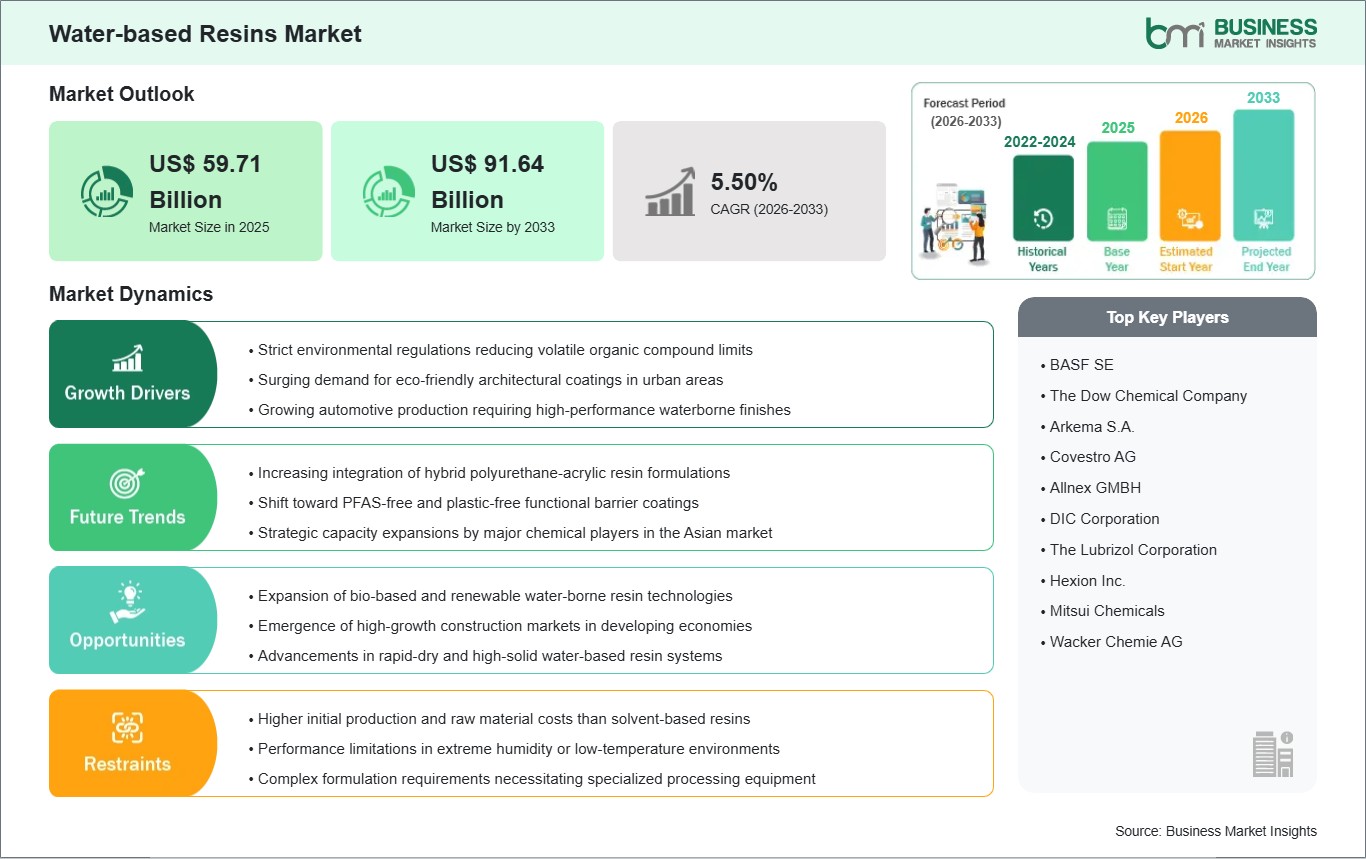
The water-based resins market is characterized by a robust transition away from traditional solvent-borne systems toward environmentally sustainable alternatives. Valued significantly in the global chemical landscape, this market is primarily fueled by the paints and coatings industry, which accounts for more than half of the total demand. The shift is not merely a preference but a necessity, as international air quality standards become increasingly unforgiving toward volatile organic compound emissions. Acrylic resins remain the cornerstone of the industry due to their adaptability and cost-effectiveness, though high-performance segments like polyurethane dispersions are seeing rapid growth in specialized automotive and textile applications.
Major technological improvements have mostly eliminated the significant difference in performance that used to separate water-based and solvent-based systems. Recently developed water-based resins can match the performance of solvent-based resins by virtue of their better weatherability, chemical resistance and fast drying capabilities, which put them on par with the most challenging industrial environments. Besides changes in raw material prices and the technical difficulties involved in formulation, the market is absolutely ready for further growth. Expansion of the market is particularly significant in the Asia-Pacific region, where the pace of urbanization and industrialization naturally coincide with the promulgation of new, stringent environmental policies. In the future, the industry will probably concentrate on bio-based chemistries and hybrid systems which will definitely help cement water-based resins as the standard bearer for sustainable and responsible manufacturing.
Segment Analysis
Water-based Resins Market Segmentation
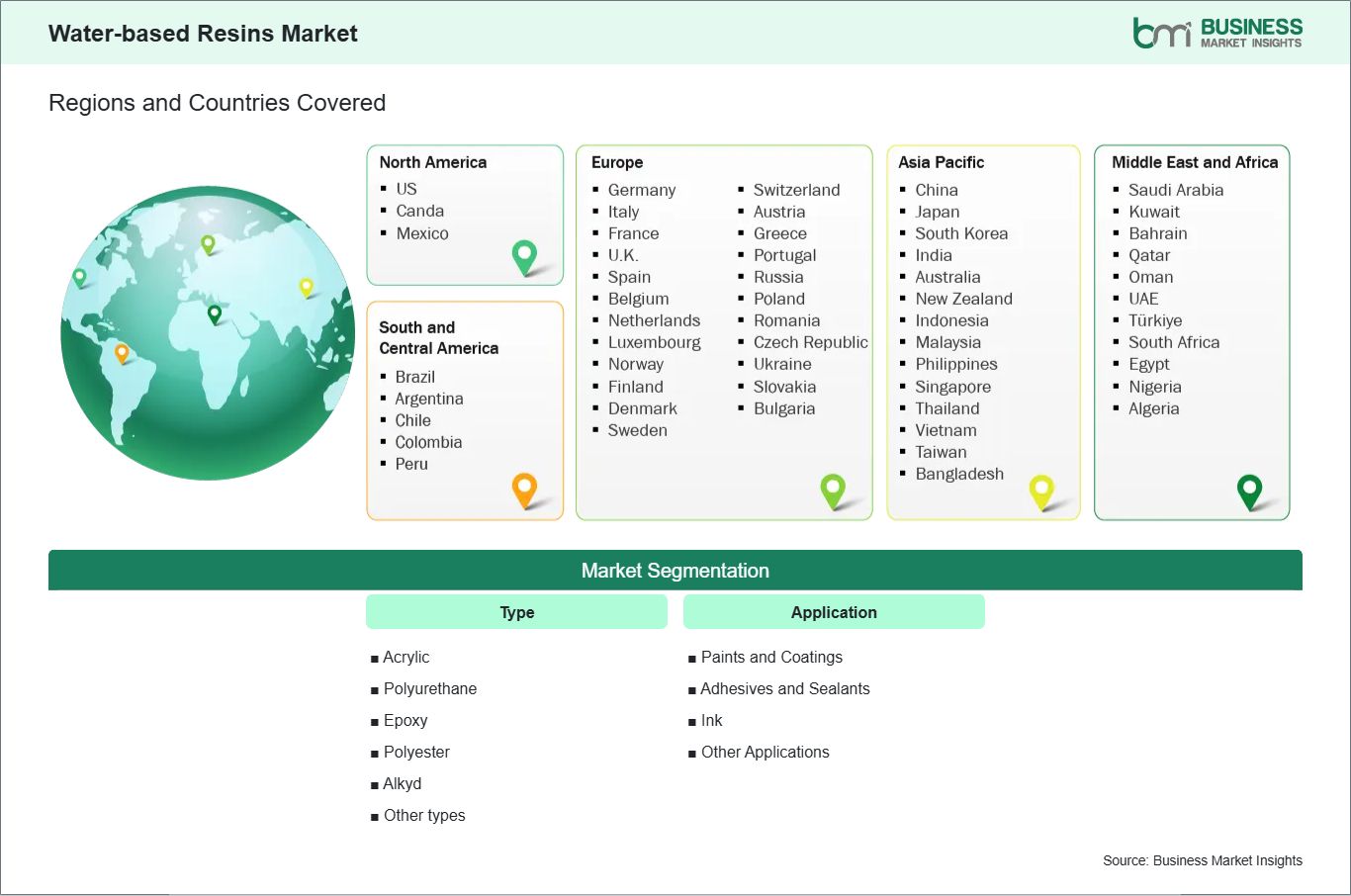
Key segments that contributed to the derivation of the Water-based Resins market analysis are type and application.
- By type, the water-based resins market is segmented into Acrylic, Polyurethane, Epoxy, Polyester, Alkyd, and other types. The Acrylic segment dominated the market in 2025.
- By application, the water-based resins market is segmented into Paints and Coatings, Adhesives and Sealants, Ink, and Other Applications. The Paints and Coatings segment dominated the market in 2025.
Market Forces
Water-based Resins Market Drivers and Opportunities
Strict environmental regulations reducing volatile organic compound limits
The major driving force behind the water-based resins market is the overall tightening of environmental and health safety standards globally. Organizations such as the EPA in the USA and the European Commission have put in place very stringent guidelines to restrict the discharge of volatile organic compounds (VOCs) into the environment. These are major culprits in the formation of ground-level ozone and smog, thereby causing major respiratory problems. Hence, the traditional solvent-based resin systems are being systematically removed from the market because of the large quantities of VOCs released during the curing process. This has put tremendous pressure on the coatings and adhesives industries to adopt the water-based systems, where water is the primary medium.
Beyond simple compliance, these regulations have sparked a wave of innovation in resin chemistry. Companies are investing heavily in research and development to ensure that water-based systems match or exceed the mechanical and chemical resistance of their solvent-based predecessors. In regions like China, the introduction of "Green Taxes" and monthly VOC audits has accelerated this transition even further. This top-down regulatory approach ensures a permanent structural shift in the chemical industry, making water-based resins the mandatory standard for any company wishing to operate in major global markets. The resulting demand for compliant materials provides a stable and long-term growth trajectory for resin suppliers across the board.
Expansion of bio-based and renewable water-borne resin technologies
The transition toward a circular economy has created a significant opportunity for the development of bio-based water-borne resins. As brand owners and consumers become increasingly focused on the carbon footprint of the products they purchase, there is a rising demand for materials derived from renewable feedstocks rather than traditional petrochemicals. Modern resin technology is now capable of utilizing plant-based oils, starches, and lignin to create high-performance water-based dispersions. These bio-based resins offer the dual benefit of being low-VOC while also reducing the overall life-cycle greenhouse gas emissions of the final product, such as food packaging or furniture coatings.
This opportunity is particularly lucrative in the packaging and consumer goods sectors, where sustainability certifications can serve as a key market differentiator. Advances in biotechnology are allowing for the synthesis of bio-derived monomers that provide the same level of adhesion and durability as synthetic versions. For manufacturers, this shift allows them to align with Corporate Social Responsibility (CSR) goals while tapping into a premium market segment willing to pay for sustainable solutions. By integrating these renewable materials into water-borne systems, the industry can address the entire sustainability spectrum—from non-toxic application to renewable sourcing—positioning these products as the ultimate solution for the next generation of eco-conscious industrial design.
Size and Share Analysis
Water-based Resins Market Size and Share Analysis
The global Water-based Resins market is experiencing steady growth, with market size and share analysis reflecting evolving treatment preferences and competitive dynamics among key players. The report evaluates important subsegments categorized within type and application highlighting their respective contributions to overall market performance.
By type, the Acrylic subsegment dominated the market in 2025 due to its excellent balance of cost-to-performance, UV resistance, and color retention. Its versatility makes it the primary choice for architectural coatings and industrial finishes where durability and weatherability are essential.
By application, the Paints and Coatings subsegment dominated the market in 2025 because of the massive volume required for global architectural and construction projects. Stringent VOC regulations have pushed decorative and industrial paint manufacturers to shift almost entirely toward water-based acrylic systems.
Report Coverage
Water-based Resins Market Report Coverage and Deliverables
The "Water-based Resins Market Size and Forecast (2022 - 2033)" report provides a detailed analysis of the market covering below areas:
- Water-based Resins market size and forecast at the regional and country levels for segments covered under the scope
- Water-based Resins market trends, as well as drivers, restraints, and opportunities
- Water-based Resins market analysis covering key trends, regional framework, major players, regulations, and recent developments
- Industry landscape and competition analysis covering market concentration, heat map analysis, prominent players, and recent developments for the Water-based Resins market
- Detailed company profiles, including SWOT analysis
Geographic Insights
Water-based Resins Market Geographic Insights
The geographical scope of the Water-based Resins market report is divided into: North America, Asia Pacific, Europe, Middle East & Africa, and South & Central America. North America held the largest share in 2025.
North America maintains a dominant position in the water-based resins market, underpinned by a mature industrial infrastructure and a long-standing commitment to environmental stewardship. The United States, in particular, has been a pioneer in the adoption of low-VOC technologies, driven by both federal regulations and state-level mandates such as those from the California Air Resources Board (CARB). These strict standards have compelled architectural and industrial coating manufacturers to lead the world in waterborne resin innovation. Additionally, the region benefits from a highly integrated supply chain and the presence of several global chemical giants who maintain their primary R&D centers within North American borders, ensuring a steady stream of cutting-edge resin technologies.
The dominance is further reinforced by a strong recovery in the residential construction sector and a robust automotive manufacturing base that increasingly utilizes water-based basecoats. North American consumers also exhibit a high awareness of indoor air quality, favoring "low-odor" and "non-toxic" DIY paints for home improvement, which sustains a massive retail market for water-based acrylics. While the Asia-Pacific region is growing faster in terms of volume, North America’s focus on high-value, specialty resins and its advanced regulatory framework provide it with a significant competitive edge in market value. The region's ongoing investment in Green Building initiatives ensures that water-based resins will remain a critical component of the domestic economy for the foreseeable future.
Industry Activity
Recent Developments
The Water-based Resins market is evaluated by gathering qualitative and quantitative data post primary and secondary research, which includes important corporate publications, association data, and databases. A few of the key developments in the Water-based Resins market are:
- In February 2024, Covestro AG, announced the launch of a new family of waterborne and waterborne UV resins for industrial coatings, targeting applications such as wood furniture, cabinetry, and building materials.
- In June 2025, Arkema, announced that it obtained ISCC PLUS certification for its waterborne acrylic resin manufacturing facility in St. Charles, USA, enabling production of resins with up to 90% bio-attributed content to support sustainable coatings and adhesives.
- In September 2025, BASF SE, Arkema, and AkzoNobel, announced a value chain collaboration to develop lower-carbon coating solutions, with Arkema converting bio-attributed raw materials into more sustainable resin systems for coatings applications.
Trust & Transparency
Research Methodology
The market analysis combines proprietary research with secondary data from government agencies, company disclosures, regulatory filings, industry databases and expert interviews. Market estimates are validated through data triangulation, cross-market benchmarking and analyst
review.
View Full Research Methodology
Key Sources Referred:
American Chemistry Council (ACC) International Council of Chemical Associations (ICCA) European Chemical Industry Council (Cefic) China Petroleum and Chemical Industry Federation (CPCIF) Indian Chemical Council (ICC) Japan Chemical Industry Association (JCIA) Brazilian Chemical Industry Association (ABIQUIM) Gulf Petrochemicals and Chemicals Association (GPCA) Company Annual Reports Company Investor Presentations