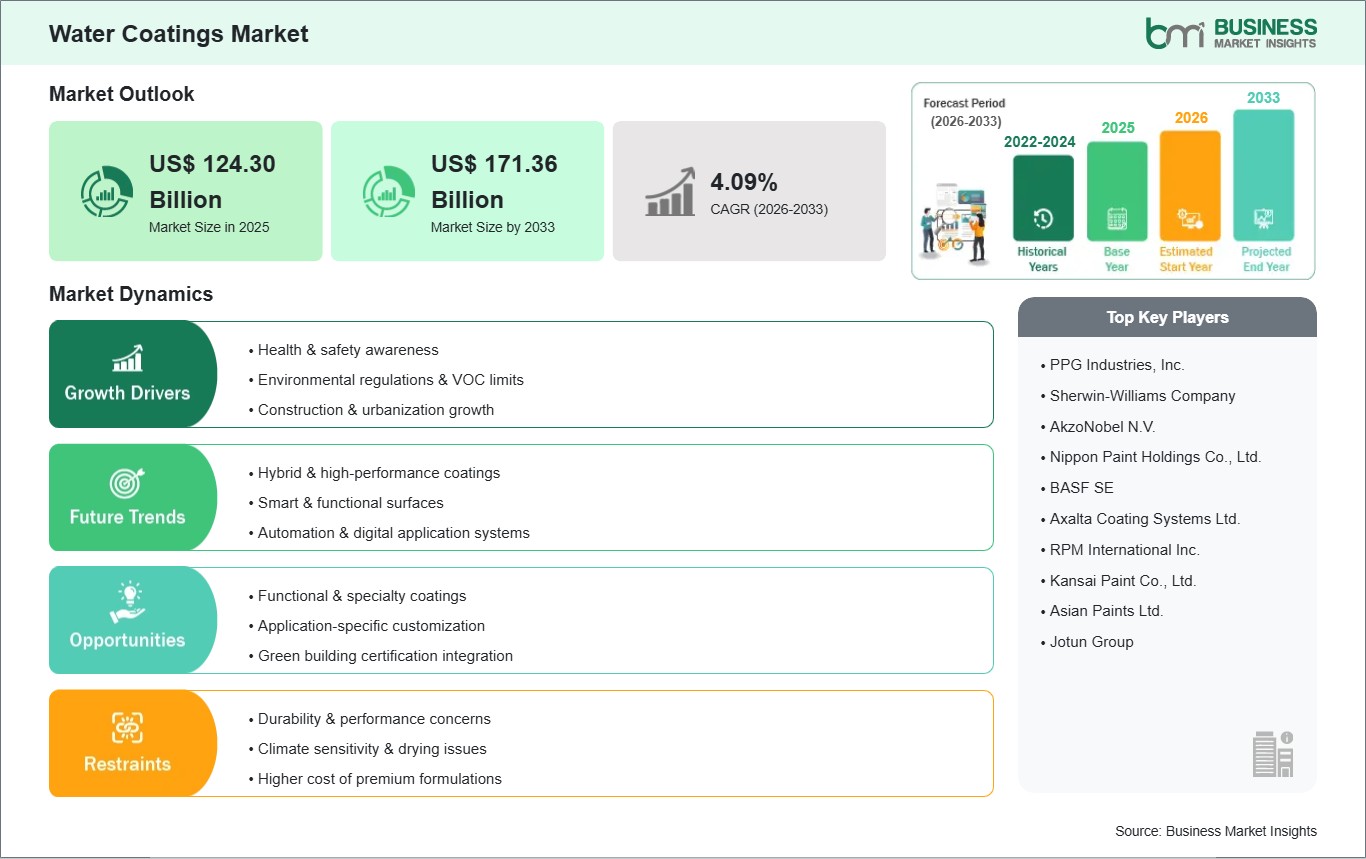
The Water Coatings Market size is expected to reach US$ 171.36 billion by 2033 from US$ 124.3 billion in 2025. The market is estimated to record a CAGR of 4.09% from 2026 to 2033.
The global water coatings market is expanding rapidly as industries and consumers shift toward environmentally friendly and low-VOC coating solutions. Water-based coatings offer significant advantages over traditional solvent-based alternatives, including reduced toxicity, lower flammability, and compliance with stringent environmental regulations. The market spans applications across residential and commercial construction, automotive, furniture, packaging, and industrial machinery, where water coatings provide protective, decorative, and functional finishes. One of the primary drivers of market growth is the increasing awareness of health and environmental concerns, coupled with regulatory mandates aimed at reducing volatile organic compounds and improving indoor air quality. Technological innovations are further fueling adoption, with advanced formulations improving durability, adhesion, gloss, and chemical resistance, making water coatings a viable alternative even in demanding industrial applications.
However, the market faces certain challenges, including performance limitations in extreme conditions, such as high humidity or exposure to aggressive chemicals, where solvent-based coatings may still outperform. Additionally, some water coatings require specialized application equipment and longer curing times, which can be a barrier for traditional manufacturing and construction processes. Despite these challenges, the global water coatings market continues to gain traction as industries increasingly prioritize sustainability, regulatory compliance, and safer working environments, driving investment and product innovation worldwide.

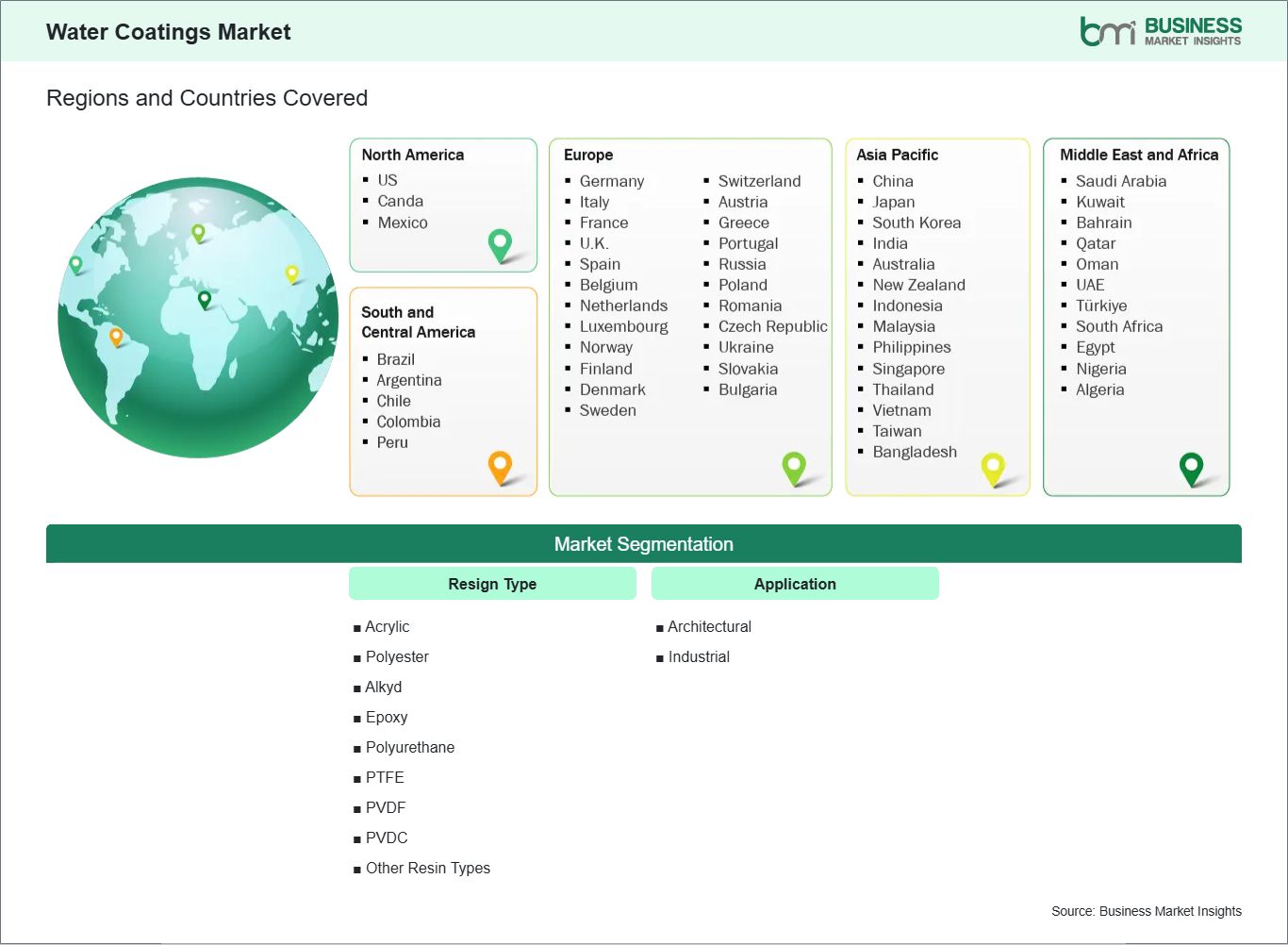
Key segments that contributed to the derivation of the waterborne coatings market analysis are reign type and application
The increasing awareness of health, safety, and environmental compliance is fueling the growth of water-based coatings in Western Europe. The European Union’s REACH and VOC directives have also forced manufacturers and end users to opt for low-emitting, water-based coating solutions. Water-based coatings are being used in commercial and residential buildings, with architects and builders choosing them for their interior applications, particularly for improving indoor air quality in areas with high occupant density, such as schools, hospitals, and offices. According to surveys, the growth rate of waterborne coatings used in interior applications in Western Europe has increased by 7-9% every year for the past three years.
Various industries are also responding to the increased health, safety, and environmental compliance challenges by moving towards waterborne coatings for their machinery and equipment. For instance, industries such as automotive, food processing, and packaging are using waterborne primers and protective coatings for their production plants, which are required to meet the most stringent hygiene demands. The use of waterborne coatings not only ensures compliance with the safety and health directives of the respective governments but also contributes to the sustainability of the businesses.
Consumer demand for safer and eco-friendly coatings is further driving this trend. In the Western European region, the Western European homeowners and home DIY markets are increasingly using waterborne paints and varnishes for both interior and exterior applications. They are preferring products that are labeled as low odor, low VOC, and non-toxic. Industry analysts predict that increased consumer awareness about indoor air quality issues will continue to propel the growth of waterborne coatings in both the commercial and residential markets.
The demand for functional and specialty water-based coatings is growing rapidly in Western Europe, as manufacturers look for additional performance characteristics in their water-based coatings. Coatings with anti-microbial properties for hospital, laboratory, and public transportation applications have also gained acceptance, particularly in densely populated cities in Western Europe. These water-based coatings are designed to resist bacterial and viral growth and are the preferred choice due to their environmental friendliness.
In addition to health-related characteristics, water-based coatings with chemical, abrasion, and heat resistance are also gaining acceptance in the industrial sector. In Western Europe, the automotive and electronics industry is using water-based coatings for the protective coatings of metallic parts, PCBs, and other consumer devices. Water-based coatings are ideal for creating high-performance surfaces that resist operating conditions and are suitable for the strict VOC regulations in the industrial sector.
The decorative and architectural segments are also contributing to the growth of specialty water-based coatings. The multi-functional properties offered by water-based coatings, such as self-cleaning, scratch resistance, and anti-fade properties, are being used in public infrastructure, commercial buildings, and even in high-end residential applications. The addition of specialty properties along with environmental and health advantages makes waterborne coatings a versatile product for various end-use industries in Western Europe, thereby contributing to market growth during the forecast period.

The global waterborne coatings market is experiencing steady growth, with market size and share analysis reflecting evolving treatment preferences and competitive dynamics among key players. The report evaluates important subsegments categorized within resign type, and application highlighting their respective contributions to overall market performance.
By resign type, the acrylic segment subsegment dominated the market in 2025 because they offer an excellent balance of cost‑effectiveness, performance, and environmental friendliness. Acrylic‑based coatings provide good adhesion, color retention, and weather resistance, which makes them highly suitable for a wide range of substrates and environments.
By application, the architectural subsegment dominated the market in 2025 because coatings are ubiquitously required across residential and commercial buildings for protection, aesthetics, and durability. Architectural coatings such as wall paints, facade finishes, primers, and protective sealants are essential in both new construction and renovation projects, where they protect structures from moisture, UV exposure, and wear while also enhancing appearance.
| Report Attribute | Details |
|---|---|
| Market size in 2025 | US$ 124.30 Billion |
| Market Size by 2033 | US$ 171.36 Billion |
| Global CAGR (2026 - 2033) | 4.09% |
| Historical Data | 2022-2024 |
| Forecast period | 2026-2033 |
| Segments Covered | By Resign Type
|
|
Regions and Countries Covered
| |
| North America | US, Canada, Mexico |
| Europe | Belgium, Austria, Finland, Denmark, Greece, Poland, Romania, Russia, Ukraine, Czech Republic, Slovakia, Bulgaria, Italy, Luxembourg, Germany, Switzerland, France, Netherlands, Norway, Portugal, Spain, Sweden, United Kingdom |
| Asia-Pacific | Australia, China, India, Japan, South Korea, Indonesia, Malaysia, Philippines, Singapore, Thailand, Vietnam, Bangladesh, New Zealand, Taiwan |
| South and Central America | Brazil, Argentina, Peru, Chile, Colombia |
| Middle East and Africa | Bahrain, Kuwait, Oman, Qatar, Saudi Arabia, United Arab Emirates, Turkiye, South Africa, Egypt, Algeria, Nigeria |
| Market leaders and key company profiles |
|
The "Waterborne coatings market Size and Forecast (2022 - 2033)" report provides a detailed analysis of the market covering below areas:
The geographical scope of the Waterborne coatings market report is divided into: North America, Asia Pacific, Europe, Middle East & Africa, and South & Central America. North America held the largest share in 2025.
North America dominates the global water coatings market, led by the United States, where stringent environmental regulations, mature industrial infrastructure, and high consumer awareness drive demand. The construction sector, both residential and commercial, is a major end-user, adopting water coatings for walls, flooring, and decorative finishes to reduce VOC emissions and comply with green building standards. The automotive industry also contributes significantly, using waterborne coatings for vehicle exteriors, interiors, and components to achieve high performance while meeting environmental compliance. Canada adds support through industrial applications and infrastructure projects requiring durable, low-emission coatings suitable for extreme weather conditions.
North America’s dominance is reinforced by continuous R&D investment, enabling the development of hybrid and high-performance water coatings that meet demanding industrial specifications while maintaining environmental benefits. The integration of automated coating technologies and efficient application methods further accelerates market growth. Combined with strong regulatory frameworks and sustainability-driven consumer preferences, North America serves as a global benchmark for the adoption and innovation of water coating solutions.

The waterborne coatings market is evaluated by gathering qualitative and quantitative data post primary and secondary research, which includes important corporate publications, association data, and databases. A few of the key developments in the Waterborne coatings market are:
The Water Coatings Market is valued at US$ 124.30 Billion in 2025, it is projected to reach US$ 171.36 Billion by 2033.
As per our report Water Coatings Market, the market size is valued at US$ 124.30 Billion in 2025, projecting it to reach US$ 171.36 Billion by 2033. This translates to a CAGR of approximately 4.09% during the forecast period.
The Water Coatings Market report typically cover these key segments-
The historic period, base year, and forecast period can vary slightly depending on the specific market research report. However, for the Water Coatings Market report:
The Water Coatings Market is populated by several key players, each contributing to its growth and innovation. Some of the major players include:
The Water Coatings Market report is valuable for diverse stakeholders, including:
Essentially, anyone involved in or considering involvement in the Water Coatings Market value chain can benefit from the information contained in a comprehensive market report.
Please tell us your area of interest
(Market Segments/ Regions and Countries/ Companies)