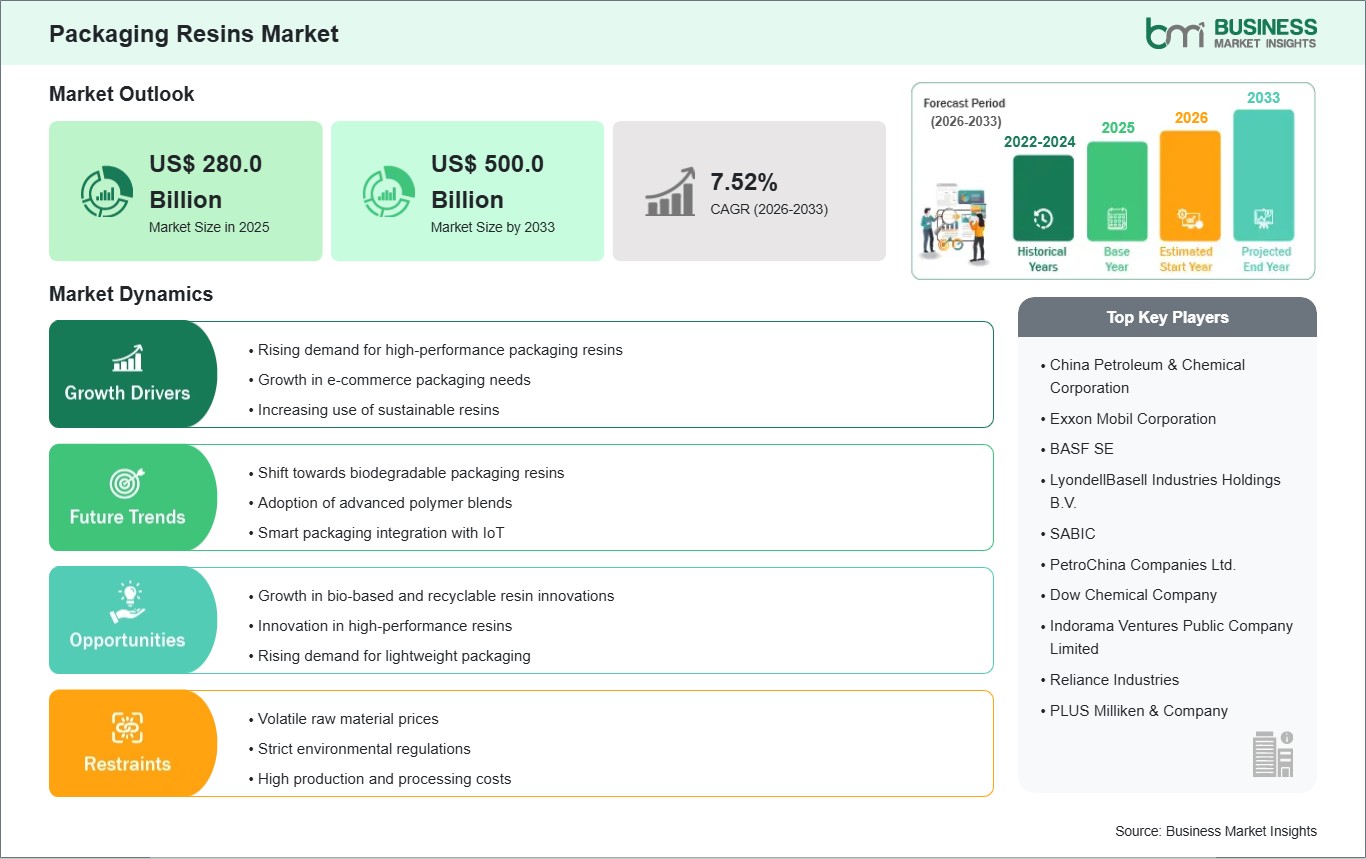
The Packaging Resins Market size is expected to reach US$ 500.0 Billion by 2033 from US$ 280.0 Billion in 2025. The market is estimated to record a CAGR of 7.52% from 2026 to 2033.
The packaging resins market is witnessing dynamic growth, driven primarily by the rising demand for versatile, lightweight, and durable packaging solutions in various industries such as food, beverages, pharmaceuticals, and consumer goods. Resins, including polyethylene, polypropylene, polyethylene terephthalate, and polystyrene, are at the heart of modern packaging due to their ability to be tailored to various mechanical, barrier, and thermal properties. The increasing demand for convenient and easy-to-use packaging formats, driven primarily by end-users and the growing e-commerce market, is further fueling the market for resins. One of the key trends currently being witnessed in this market is the increasing focus on sustainability and a circular economy. Biodegradable and bio-based resins are emerging as new and exciting opportunities for packaging applications, driven primarily by the increasing need to reduce environmental footprints and comply with stringent global regulations regarding single-use plastics and packaging waste. Simultaneously, advances in resin technology are allowing for more efficient and optimized packaging structures that can be designed to reduce material weights without compromising on barrier properties. Innovation is now focused on resins that can perform multiple functions at once.
In addition, digitalization and the use of automation in packaging machines are also affecting the selection of resins, as the resins are being designed for high-speed filling, thermoforming, and extrusion operations. The competitive scenario is influenced by a combination of international petrochemical companies and regional players. The major drivers of the industry include investment in research and development, partnerships with packaging companies, and acquisitions of niche resin companies to gain a competitive advantage over other players. The industry is also witnessing high variations in demand due to the price volatility of raw materials, changes in regulations, and the rate of growth of the end-use sectors. The overall picture of the packaging resins industry is a blend of innovation, sustainability, and optimization, which makes it a key enabler of innovative solutions for the next generation of packages that are efficient, sustainable, and attractive to consumers.

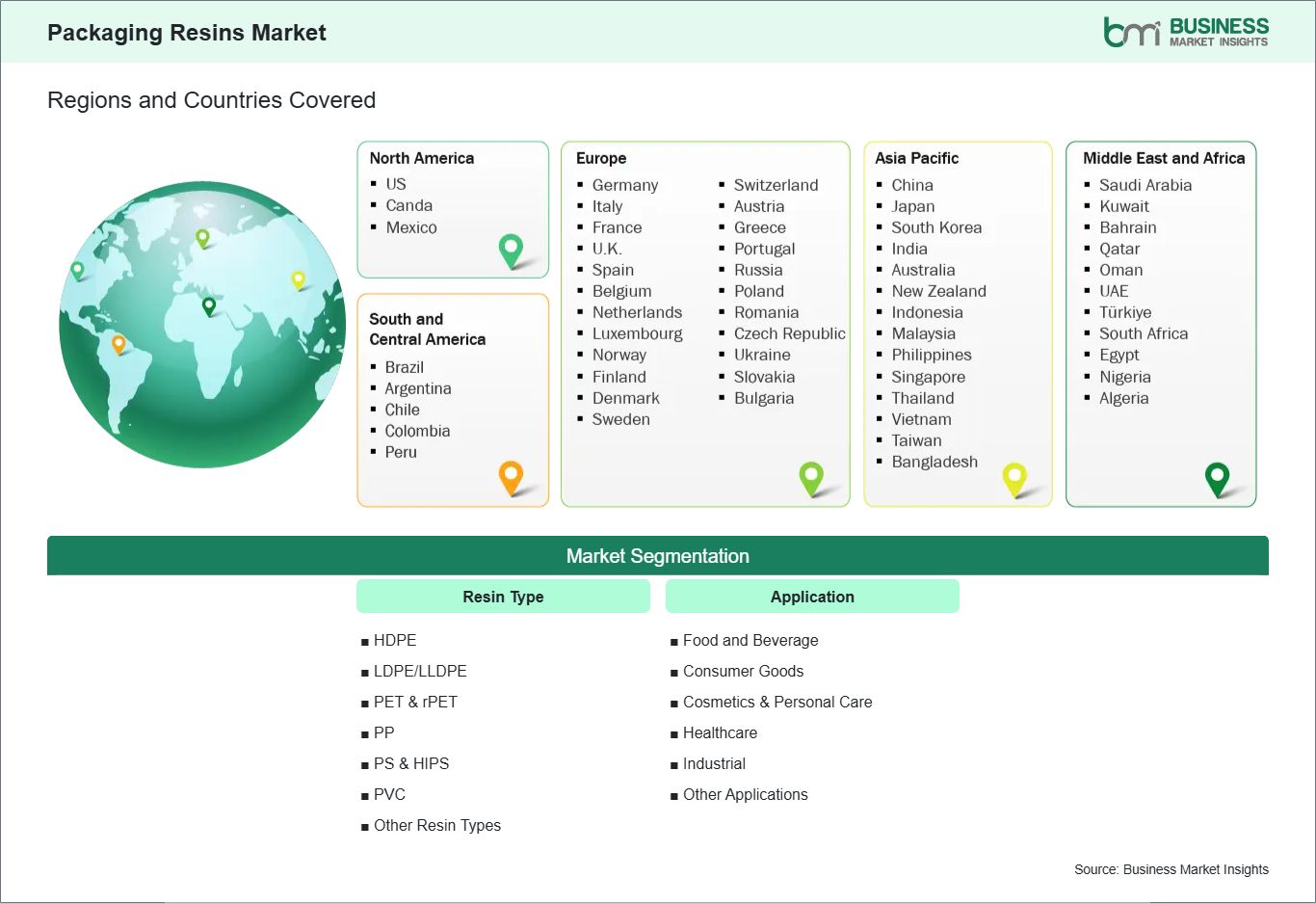
Key segments that contributed to the derivation of the packaging resins market analysis are resin type and application.
The demand for high-performance resins is increasing, especially for packaging applications that require resins to provide safety and versatility. Companies are looking for resins that can provide better barrier properties, moisture resistance, and structural integrity while maintaining lightweight properties. These resins play a vital role in ensuring product safety during transportation, storage, and display. With changes in consumer needs, resins for packaging applications will also be required to provide better finishes and printing compatibility to enhance brand products.
Environmental concerns are affecting resins for packaging applications, and this is leading to innovations in sustainable resins. Companies are looking for resins that can help reduce the carbon footprint and provide recyclability. With concerns about efficient use of resources, resins for packaging applications have been developed to perform better with less material being used. This is especially important for industries such as food, beverages, and personal care, where resins for packaging applications will play a vital role in purchasing decisions.
Ongoing research and development are shaping the evolution of packaging resins. Companies are investing in advanced technologies to create resins that combine mechanical strength, barrier efficiency, and sustainability. Innovations such as lightweighting, high-clarity resins, and multi-functional formulations are emerging to meet diverse market needs. These developments are enabling manufacturers to deliver solutions that meet both operational efficiency and sustainability objectives, driving the overall growth of the packaging resins market.
The packaging resins market is becoming increasingly driven by bio-based and recyclable innovations that help solve environmental challenges. Bio-based and recyclable resins are derived from renewable sources and are used as alternatives to traditional petroleum-based materials. Companies are using bio-based resins to help solve environmental challenges without sacrificing important properties like flexibility, barriers, and thermal properties. This shows the growing global commitment to developing more sustainable packaging solutions.
Innovation in technology is helping bio-based and recyclable resins become more diverse and affordable. Manufacturers are developing the performance characteristics of these resins to meet or beat conventional materials. The uses of these resins are becoming more diverse, especially in the packaging of food, pharmaceuticals, and consumer products, where sustainability and safety are top concerns. The ability to provide high-performance bio-based and recyclable resins is becoming a differentiator for companies in the packaging resins market.
Additionally, the emphasis on circular economy concepts is further driving the growth of recyclable and bio-based resins. Reusable, recyclable, and biodegradable packaging products are increasingly in demand by companies as well as end-users. This is because it reduces waste, creates a positive brand image, and is in line with global sustainability agendas. Ongoing innovations in material sciences and processing methods will further increase the usage of these resins, making them an exciting segment in the packaging resins industry.
The packaging resins market demonstrates steady growth, with size and share analysis highlighting evolving trends and competitive dynamics among key players. The report examines subsegments categorized within resin type and application, offering insights into their contribution to overall market performance.
By Resin Type, the HDPE subsegment dominated the market in 2025, driven by its versatility in rigid containers, bottles, and packaging films.
Based on Application, the food and beverage subsegment dominated the market in 2025, supported by increasing demand for hygienic, high-barrier, and durable packaging solutions.
| Report Attribute | Details |
|---|---|
| Market size in 2025 | US$ 280.0 Billion |
| Market Size by 2033 | US$ 500.0 Billion |
| Global CAGR (2026 - 2033) | 7.52% |
| Historical Data | 2022-2024 |
| Forecast period | 2026-2033 |
| Segments Covered | By Resin Type
|
|
Regions and Countries Covered
| |
| North America | US, Canada, Mexico |
| Europe | Belgium, Austria, Finland, Denmark, Greece, Poland, Romania, Russia, Ukraine, Czech Republic, Slovakia, Bulgaria, Italy, Luxembourg, Germany, Switzerland, France, Netherlands, Norway, Portugal, Spain, Sweden, United Kingdom |
| Asia-Pacific | Australia, China, India, Japan, South Korea, Indonesia, Malaysia, Philippines, Singapore, Thailand, Vietnam, Bangladesh, New Zealand, Taiwan |
| South and Central America | Brazil, Argentina, Peru, Chile, Colombia |
| Middle East and Africa | Bahrain, Kuwait, Oman, Qatar, Saudi Arabia, United Arab Emirates, Turkiye, South Africa, Egypt, Algeria, Nigeria |
| Market leaders and key company profiles |
|
The "Packaging Resins Market Size and Forecast (2022 - 2033)" report provides a detailed analysis of the market covering below areas:
The geographical scope of the Packaging Resins Market report is divided into North America, Asia Pacific, Europe, Middle East & Africa, and South & Central America. North America held the largest share in 2025.
North America dominates the packaging resins market, driven by high adoption of advanced packaging solutions, stringent regulatory compliance, and strong industrial infrastructure. The United States and Canada are leading the consumption of polyethylene, polypropylene, and PET in food, beverage, and pharmaceutical packaging. Sustainability initiatives, such as recycling mandates and bio-resin adoption, are increasingly shaping the market. Additionally, e-commerce growth demands resins that provide durability and protection during transportation while maintaining lightweight and flexible packaging formats.
Europe represents a mature and sustainability-driven market. Germany, France, and Italy are at the forefront of adopting recyclable, bio-based, and multilayer resin solutions to meet stringent EU regulations on packaging waste and single-use plastics. European manufacturers are also integrating lifecycle assessments into resin development, emphasizing eco-friendly alternatives without compromising performance. The market in Europe is characterized by high technical standards and innovation in barrier and thermal properties.
Asia Pacific is a rapidly expanding market, led by China, Japan, and India, driven by urbanization, rising disposable incomes, and growing packaged food and beverage demand. Investment in local production capacities and process modernization supports the adoption of high-performance resins. Environmental regulations are accelerating the shift to water-based, recyclable, and bio-derived resins, while consumer preference for visually appealing, durable packaging fuels growth.
Middle East & Africa is an emerging market where urbanization and industrialization are boosting demand for food and consumer goods packaging. Resins with barrier, clarity, and thermal stability properties are increasingly in demand, though cost-sensitive adoption remains a factor. Growth is tied to retail modernization and expanding cold-chain infrastructure.
South & Central America shows steady growth, with Brazil and Mexico driving demand. Market expansion is influenced by increasing packaged food and beverage consumption, along with gradual adoption of high-performance resins to improve shelf life and reduce packaging waste. Price sensitivity is a key consideration, encouraging manufacturers to balance performance and cost-efficiency in resin solutions.

The Packaging Resins Market is evaluated by gathering qualitative and quantitative data post primary and secondary research, which includes important corporate publications, association data, and databases. A few of the key developments in the packaging resins market are:
The Packaging Resins Market is valued at US$ 280.0 Billion in 2025, it is projected to reach US$ 500.0 Billion by 2033.
As per our report Packaging Resins Market, the market size is valued at US$ 280.0 Billion in 2025, projecting it to reach US$ 500.0 Billion by 2033. This translates to a CAGR of approximately 7.52% during the forecast period.
The Packaging Resins Market report typically cover these key segments-
The historic period, base year, and forecast period can vary slightly depending on the specific market research report. However, for the Packaging Resins Market report:
The Packaging Resins Market is populated by several key players, each contributing to its growth and innovation. Some of the major players include:
The Packaging Resins Market report is valuable for diverse stakeholders, including:
Essentially, anyone involved in or considering involvement in the Packaging Resins Market value chain can benefit from the information contained in a comprehensive market report.
Please tell us your area of interest
(Market Segments/ Regions and Countries/ Companies)