Market Summary
Executive Summary and Global Market Analysis
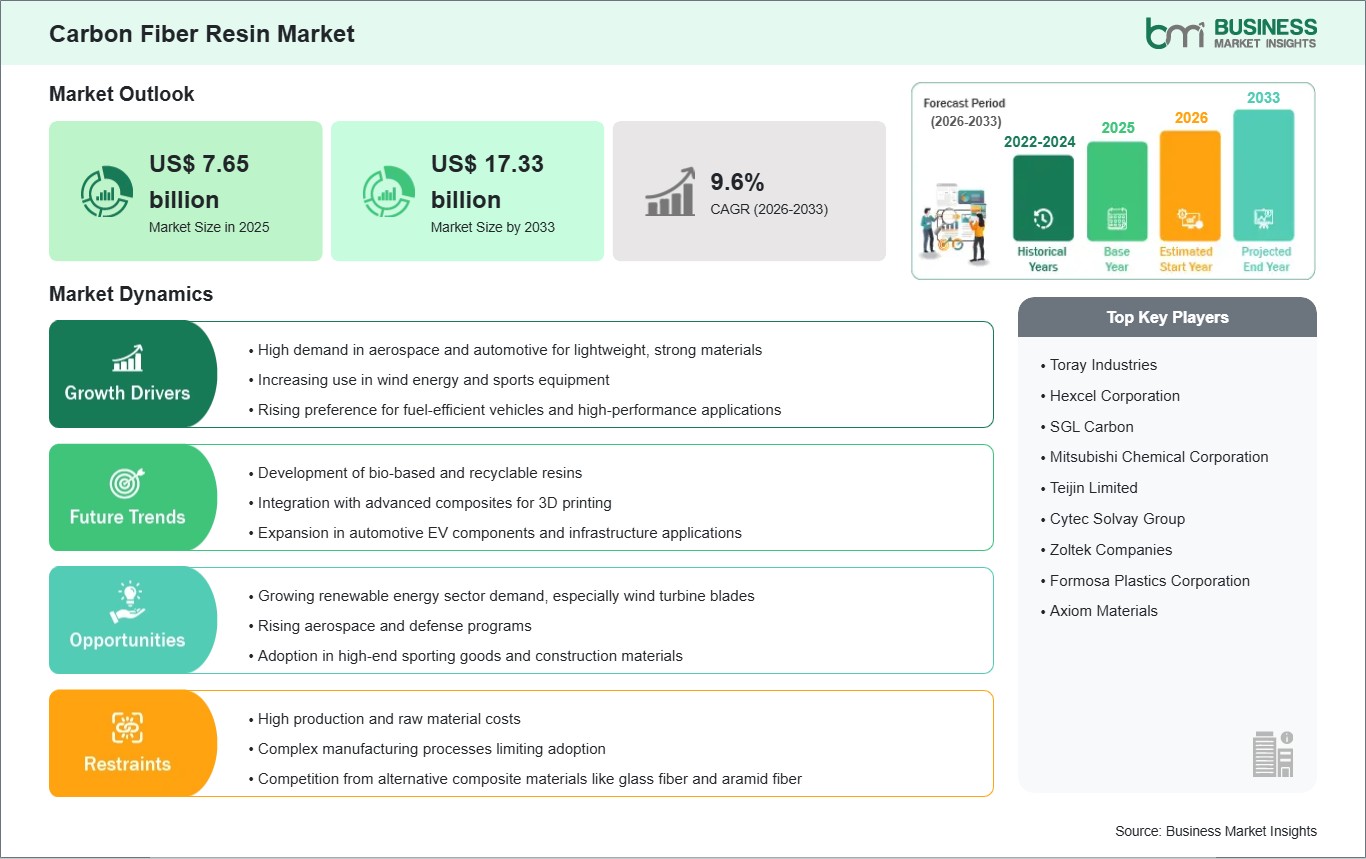
Carbon fiber resin is a high-performance polymer used to bond carbon fiber reinforcements in composite materials. It is crucial for determining the mechanical strength, durability, thermal stability, and chemical resistance of finished components. Common types include epoxy, polyester, vinyl ester, phenolic, and thermoplastic resins. Each type is chosen based on specific performance needs and use conditions. Carbon fiber resin systems are commonly used in aerospace, automotive, wind energy, marine, construction, and sporting goods industries. They create lightweight yet strong components that improve fuel efficiency and overall performance.
Market growth is fueled by the rising demand for lightweight materials that enhance energy efficiency and cut emissions, especially in the automotive and aerospace fields. The increase in renewable energy projects, particularly in wind turbine blade manufacturing, also boosts the need for composite materials. Advances in resin formulations, which include better curing times and recyclability, are helping the market grow. Furthermore, infrastructure upgrades and the growing use of high-performance materials in emerging economies are speeding up the adoption of carbon fiber resin across many industrial applications.
Segment Analysis
Carbon Fiber Resin Market Segmentation
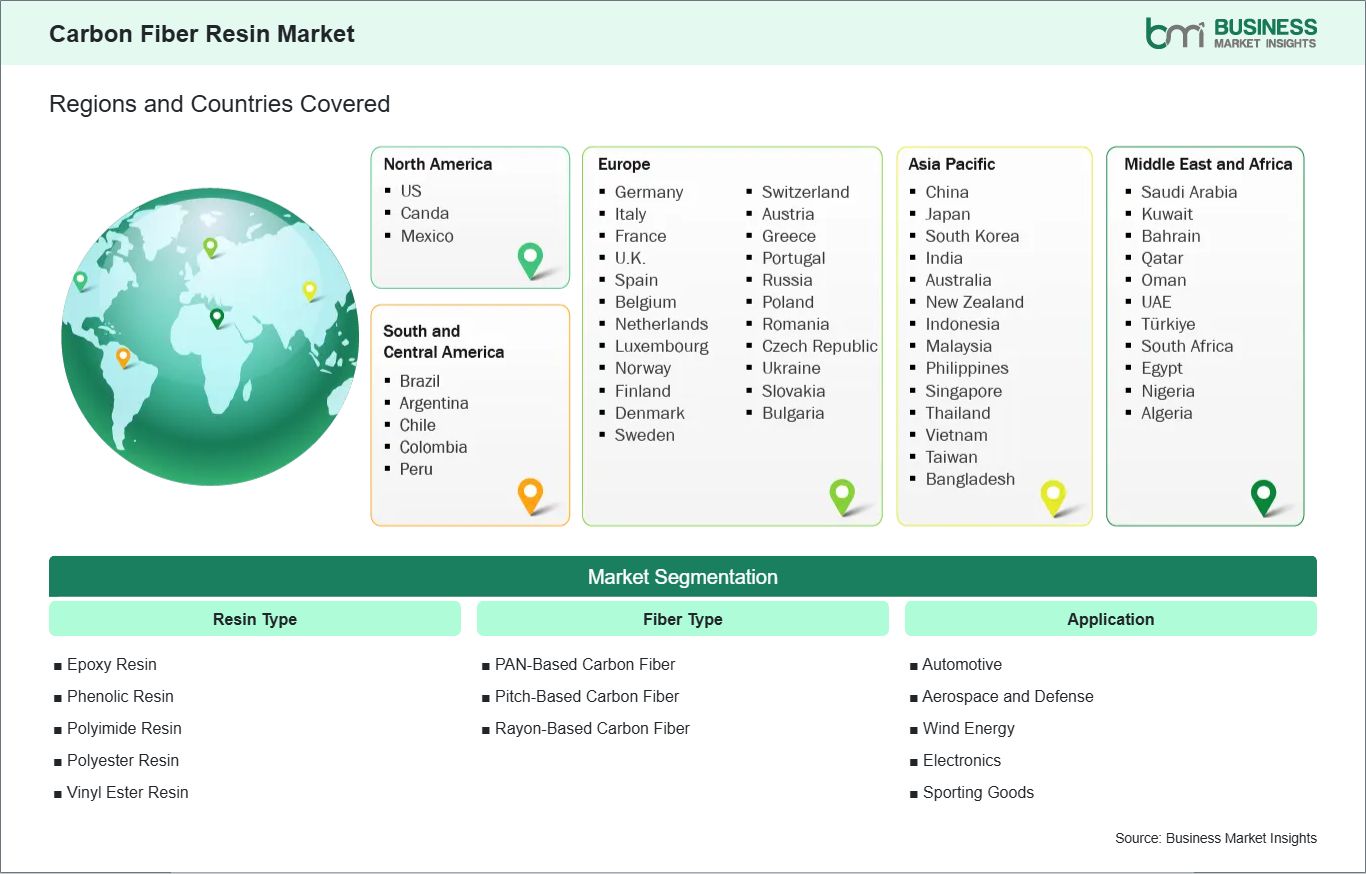
Key segments that contributed to the derivation of the carbon fiber resin market analysis are resin type, fiber type, and application.
- By resin type, the carbon fiber resin market is segmented into epoxy resin, phenolic resin, polyimide resin, polyester resin, and vinyl ester resin. The epoxy resin segment held the largest market share in 2025.
- By fiber type, the carbon fiber resin market is segmented into PAN-based carbon fiber, pitch-based carbon fiber, and rayon-based carbon fiber. The PAN-based carbon fiber segment accounted for the largest market share in 2025.
- By application, the carbon fiber resin market is segmented into automotive, aerospace and defense, wind energy, electronics, and sporting goods. The aerospace and defense segment dominated the market in 2025.
Market Forces
Carbon Fiber Resin Market Drivers and Opportunities
Rising Demand for Lightweight and High-Performance Materials
One of the primary growth factors of the carbon fiber resin market is the rising need for lightweight and high-performance materials in key industries like aerospace, automotive, and wind energy. Manufacturers witness constant pressure to improve fuel efficiency, lower greenhouse gas emissions, and comply with strict environmental rules. Carbon fiber composites, supported by modern resin systems, provide an excellent strength-to-weight ratio, resistance to corrosion, and long-lasting durability compared to traditional materials like steel and aluminum.
In the automotive industry, lightweight composite parts improve vehicle efficiency and help shift toward electric mobility. In aerospace, reducing aircraft weight directly leads to less fuel consumption and lower operating costs. The increasing installation of larger and more efficient wind turbines also depends heavily on strong resin systems for structural integrity. These performance benefits keep carbon fiber resin as an essential material for next-generation engineering applications.
Advancements in Sustainable and Recyclable Resin Technologies
A significant growth opportunity in the carbon fiber resin market lies in developing sustainable and recyclable resin technologies. As industries place more importance on environmental responsibility and circular economy principles, the demand for resin systems that lower environmental impact throughout their lifecycle is increasing. Traditional thermoset resins create recycling challenges because of their cross-linked molecular structure. However, innovations in bio-based resins, recyclable thermoplastics, and reversible curing chemistries are helping to overcome these issues.
Manufacturers that invest in research and development are working on improving resin reprocessability, cutting curing times, and reducing volatile organic compound emissions during production. These improvements not only meet changing environmental regulations but also improve cost efficiency in long-term composite applications. The adoption of sustainable resin solutions is especially important in the automotive, wind energy, and construction sectors, where large quantities of composites are used. As sustainability becomes a way to stand out in the market, companies that provide environmentally friendly carbon fiber resin solutions are likely to gain competitive advantages and more market opportunities.
Size and Share Analysis
Carbon Fiber Resin Market Size and Share Analysis
The carbon fiber resin market demonstrates steady growth, with size and share analysis revealing evolving trends and competitive positioning among key players. The report examines subsegments categorized within resin type, fiber type, and application, offering insights into their contribution to overall market performance. By resin type, the epoxy resin segment has the largest market share. This dominance comes from its common use in high-performance composite applications in the aerospace, automotive, and wind energy industries. Epoxy-based carbon fiber resin systems are highly valued for their strength, strong adhesion, resistance to chemicals, and durability in extreme environments. Epoxy resin is favored for its solid structural performance and its compatibility with different carbon fiber types. It also meets established regulatory and industry standards for critical applications. The growth of this segment is driven by rising demand for lightweight, fuel-efficient vehicles, increased aircraft production, and the rise in wind turbine installations worldwide. Ongoing improvements in resin formulations, like better curing cycles and thermal properties, encourage wider use.
Report Coverage
Carbon Fiber Resin Market Report Coverage and Deliverables
The " Carbon Fiber Resin Market Size and Forecast (2022 - 2033)" report provides a detailed analysis of the market covering below areas:
- Carbon fiber resin market size and forecast at global, regional, and country levels for all the key market segments covered under the scope
- Carbon fiber resin market trends, as well as market dynamics such as drivers, restraints, and key opportunities
- Carbon fiber resin market analysis covering key market trends, global and regional framework, major players, regulations, and recent market developments
- Industry landscape and competition analysis covering market concentration, heat map analysis, prominent players, and recent developments for the carbon fiber resin market
- Detailed company profiles, including SWOT analysis
Geographic Insights
Carbon Fiber Resin Market Geographic Insights
The geographical scope of the carbon fiber resin market report is divided into five regions: North America, Asia Pacific, Europe, the Middle East & Africa, and South & Central America. Asia Pacific holds a significant share of the carbon fiber resin market. This is due to its strong manufacturing base, growing industrial sector, and increasing investments in composite materials. Countries like China, Japan, South Korea, and India have become key production centers for automotive parts, wind energy equipment, consumer electronics, and industrial machinery that use carbon fiber composites. The region benefits from cost-effective manufacturing, supportive government policies for industrial growth, and rising domestic demand for lightweight, strong materials. The rapid growth of the renewable energy sector, especially with large-scale wind turbine installations, pushes up the demand for high-performance resin systems.
Additionally, Asia-Pacific's expanding aerospace and defense industries, along with infrastructure modernization projects, support ongoing consumption of composite materials. Major suppliers of raw materials and resin manufacturers improve the efficiency and competitiveness of the regional supply chain. Together, these elements position Asia-Pacific as the top market for carbon fiber resin. Continued growth is expected from ongoing industrialization, urbanization, and technological progress.
Industry Activity
Recent Developments
The carbon fiber resin market is evaluated by gathering qualitative and quantitative data post-primary and secondary research, which includes important corporate publications, association data, and databases. A few of the key developments in the carbon fiber resin market are:
- In August 2025, DIC Corporation announced an increase in its epoxy resin capacity by 59% at its Chiba Plant in Japan. The expansion received about a US$20 million government subsidy. It aimed to meet the growing demand for semiconductors and improve global competitiveness.
- In March 2025, BASF and Sika launched a new epoxy hardener called Baxxodur EC 151. This product is designed for sustainable flooring and construction coatings. It significantly lowers volatile organic compounds, cures at low temperatures, and improves durability in epoxy resin applications.
Trust & Transparency
Research Methodology
The market analysis combines proprietary research with secondary data from government agencies, company disclosures, regulatory filings, industry databases and expert interviews. Market estimates are validated through data triangulation, cross-market benchmarking and analyst
review.
View Full Research Methodology
Key Sources Referred:
World Bank - Global Trade IndicatorsWorld Trade Organization (WTO)International Monetary Fund (IMF)International Trade Administration (ITA)Company WebsitesCompany Annual ReportsCompany Investor PresentationsAmerican Composites Manufacturers Association (ACMA)European Composites Industry Association (EuCIA)Japan Carbon Fiber Manufacturers Association (JCMA)China Composites Industry Association (CCIA)