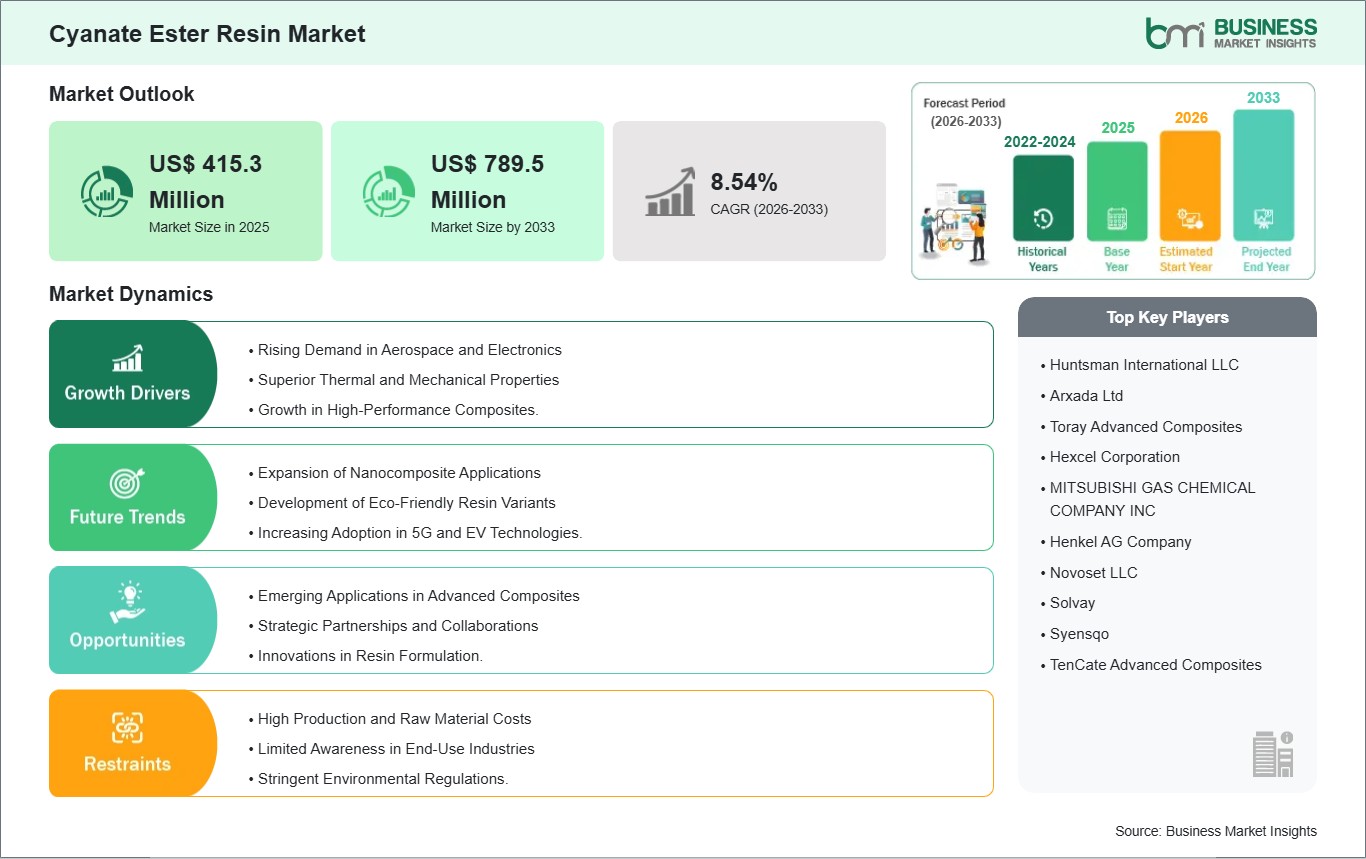
The Cyanate Ester Resin Market size is expected to reach US$ 789.5 Million by 2033 from US$ 415.3 Million in 2025 .The market is estimated to record a CAGR of 8.54% from 2026 to 2033.
The global cyanate ester resin market focuses on high-performance polymers known for their strong thermal stability, mechanical strength, and resistance to moisture and chemicals. These resins are mainly used when regular materials cannot handle tough environments or demanding conditions. Aerospace and defense segments are the largest end-users, utilizing cyanate ester resins for aircraft components, satellites, and radomes because of their lightweight and strength properties. The electronics industry uses these resins more frequently for high-frequency laminates, advanced circuit boards, and telecom applications, in which low dielectric loss and thermal properties are of prime importance. The market is growing as new technology drives more use of composite materials in aerospace, automotive, and electronics. As companies look for lighter and better-performing structures, cyanate esters have become essential for new systems. However, their use is limited by complex processing and high production costs, which keep them mostly in specialized fields. Strict environmental and safety rules around cyanate chemistry also make manufacturing more complicated. Ongoing research aims to make these resins easier to process, improve their performance, and lower production challenges. These efforts could open up more uses in the future, especially in industrial and automotive areas.

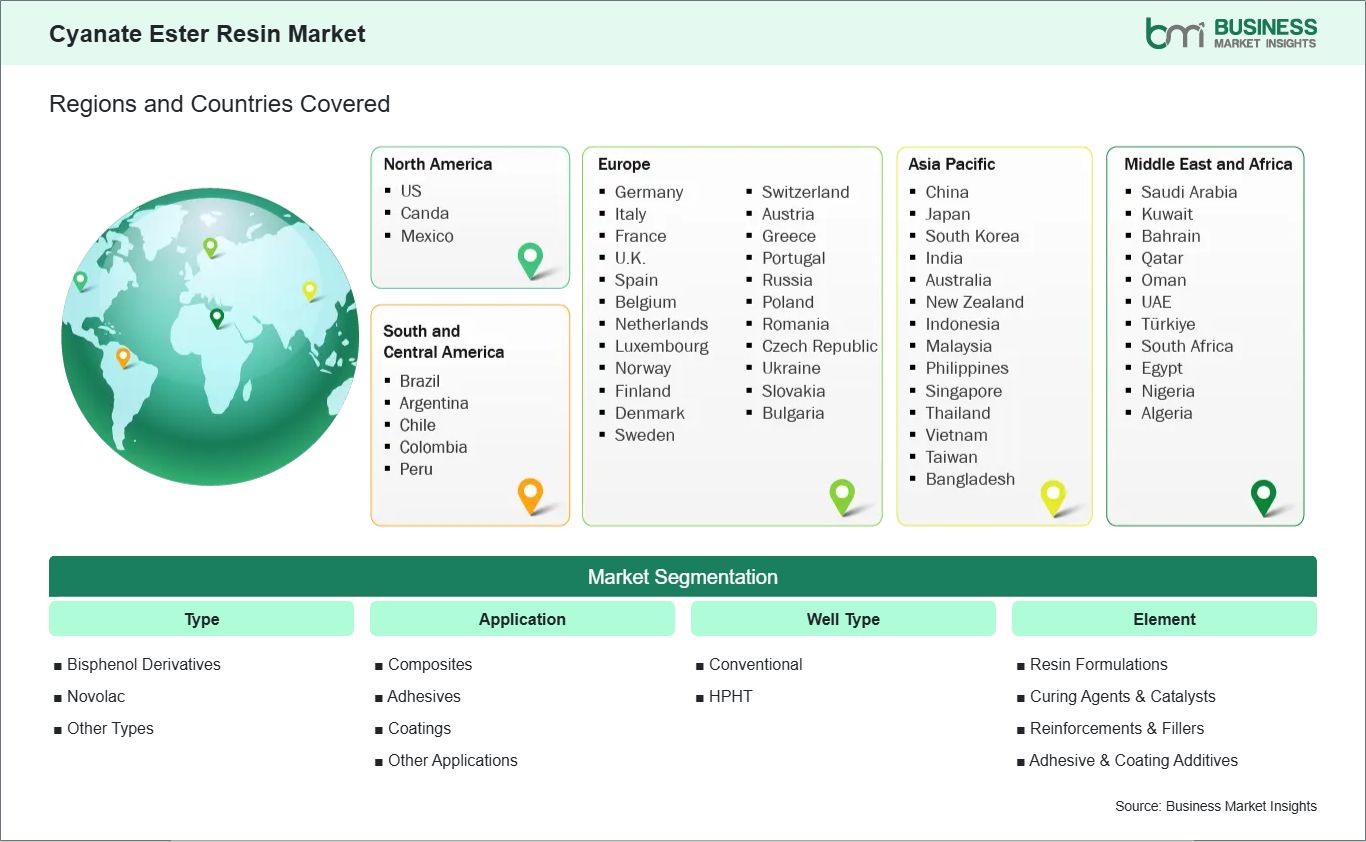
Key segments that contributed to the derivation of the cyanate ester resin market analysis are type, application, end-use industry, and element.
It has been observed that cyanate ester resin has become an essential component in various industries, especially in those sectors where the functionality of materials under extreme circumstances is non-negotiable. The thermal stability, low moisture absorption, and mechanical strength of these resins make them indispensable in the development of various components for the aerospace and electronics industries, as these materials are capable of maintaining their dimensional stability, thermal resistance, and functionality for a long period of time.
In the aerospace industry, these resins have been used for the development of various components, such as lightweight structures, which are capable of withstanding extreme temperatures and pressure fluctuations, thus ensuring greater efficiency in such applications. On the other hand, in the electronics industry, these resins are used for the development of various components, such as substrates, as they are capable of maintaining low dielectric constants, thus ensuring minimum signal loss in such applications.
As industries continue to demand higher performance, the preference for cyanate ester resins over conventional alternatives grows steadily. Their unique properties not only support the development of next-generation technologies but also provide manufacturers with the flexibility to innovate and enhance product reliability. This growing reliance positions cyanate ester resins as a central driver of progress in aerospace and electronics, ensuring their role in shaping future advancements.
Cyanate ester resins are increasingly recognized for their potential in advanced composite materials, unlocking opportunities for innovation across multiple sectors. Their combination of chemical resistance, high mechanical strength, and low moisture absorption allows designers to engineer lightweight yet robust structures capable of enduring demanding environments. This versatility supports applications in automotive components, industrial machinery, protective coatings, and other high-performance areas.
The flexibility of this material also allows for hybrid composites, where different materials combine, offering increased durability, flexibility, and thermal management. The ability of cyanate esters to allow for precise property management enables specialized products that meet increasingly sophisticated performance criteria. The compatibility of cyanate esters with modern manufacturing methods also aids in the mass production of sophisticated composite structures.
Cyanate ester resins continue to play an increasingly prominent role in advanced composite materials as the need for performance, efficiency, and light weight continues to increase. The properties of cyanate ester resins enable different industries to open new avenues for design, overcome material limitations, and achieve performance levels previously considered impossible. This versatility of cyanate ester resins ensures that it continues to be an essential material for innovation for future generations of composites.

The cyanate ester resin market is experiencing steady growth, with market size and share analysis reflecting evolving treatment preferences and competitive dynamics among key players. The report evaluates important subsegments categorized within type, application, end-use industry, and element, highlighting their respective contributions to overall market performance.
By type, the Bisphenol Derivatives subsegment dominated the Cyanate Ester Resins market in 2025. Bisphenol derivatives offer superior thermal stability, mechanical strength, and chemical resistance, making them highly suitable for advanced applications, which drives their widespread adoption.
Based on application, the Composites subsegment dominated the Cyanate Ester Resins market in 2025. Composites benefit from enhanced performance characteristics such as high strength-to-weight ratio and thermal stability, making them ideal for demanding industries, supporting strong demand for cyanate ester resin technologies.
In terms of end-use industry, the Aerospace & Defense subsegment dominated the Cyanate Ester Resins market in 2025. Aerospace & defense applications require high-performance materials for structural components, electronics, and coatings, reinforcing the dominance of this segment.
On the basis of element, the Resin Formulations subsegment dominated the Cyanate Ester Resins market in 2025. Advanced resin formulations are critical for improving processing, curing, and performance of final products, driving the widespread adoption of this segment.
| Report Attribute | Details |
|---|---|
| Market size in 2025 | US$ 415.3 Million |
| Market Size by 2033 | US$ 789.5 Million |
| Global CAGR (2026 - 2033) | 8.54% |
| Historical Data | 2022-2024 |
| Forecast period | 2026-2033 |
| Segments Covered | By Type
|
|
Regions and Countries Covered
| |
| North America | US, Canada, Mexico |
| Europe | Belgium, Austria, Finland, Denmark, Greece, Poland, Romania, Russia, Ukraine, Czech Republic, Slovakia, Bulgaria, Italy, Luxembourg, Germany, Switzerland, France, Netherlands, Norway, Portugal, Spain, Sweden, United Kingdom |
| Asia-Pacific | Australia, China, India, Japan, South Korea, Indonesia, Malaysia, Philippines, Singapore, Thailand, Vietnam, Bangladesh, New Zealand, Taiwan |
| South and Central America | Brazil, Argentina, Peru, Chile, Colombia |
| Middle East and Africa | Bahrain, Kuwait, Oman, Qatar, Saudi Arabia, United Arab Emirates, Turkiye, South Africa, Egypt, Algeria, Nigeria |
| Market leaders and key company profiles |
|
The "Cyanate Ester Resin Market Size and Forecast (2022 - 2033)" report provides a detailed analysis of the market covering below areas:
The geographical scope of the Cyanate Ester Resin market report is divided into five regions: North America, Asia Pacific, Europe, Middle East & Africa, and South & Central America. The Cyanate Ester Resin market in North America is expected to grow during the forecast period.
North America continues to hold the largest share of the cyanate ester resins market due to its highly developed aerospace, defense, and electronics industries. The aerospace industry in North America depends on cyanate ester resins to provide high-performance composite materials with lightweight, high-strength, and high-thermal-stability components necessary for the development of next-generation aerospace vehicles and spacecraft, as well as satellite technology. The defense industry also depends on cyanate ester resins to offer high-performance parts that are needed to ensure the durability, high-temperature resistance, and reliability of military operations. High-performance communications systems, high-frequency printed circuit boards, radar technologies, and 5G technologies all need resins with high-performance capabilities in harsh environments. The close working relationships between cyanate ester resin producers, aerospace companies, and electronic companies all promote innovation to offer resins with unique capabilities to fulfill the needs of the region`s industries. The unique processing characteristics of cyanate ester resins demand advanced infrastructure and skilled workforce capabilities. In addition, environmental issues and regulatory compliance make the process even more complex. The high cost of cyanate ester resins limits them to high-performance applications. However, the emphasis of the North American region on innovation, research, and high-performance applications will continue to make it a leader in the market, setting trends for the global cyanate ester resin market.

The cyanate ester resin market is evaluated by gathering qualitative and quantitative data post primary and secondary research, which includes important corporate publications, association data, and databases. A few of the key developments in the cyanate ester resin market are:
The Cyanate Ester Resin Market is valued at US$ 415.3 Million in 2025, it is projected to reach US$ 789.5 Million by 2033.
As per our report Cyanate Ester Resin Market, the market size is valued at US$ 415.3 Million in 2025, projecting it to reach US$ 789.5 Million by 2033. This translates to a CAGR of approximately 8.54% during the forecast period.
The Cyanate Ester Resin Market report typically cover these key segments-
The historic period, base year, and forecast period can vary slightly depending on the specific market research report. However, for the Cyanate Ester Resin Market report:
The Cyanate Ester Resin Market is populated by several key players, each contributing to its growth and innovation. Some of the major players include:
The Cyanate Ester Resin Market report is valuable for diverse stakeholders, including:
Essentially, anyone involved in or considering involvement in the Cyanate Ester Resin Market value chain can benefit from the information contained in a comprehensive market report.
Please tell us your area of interest
(Market Segments/ Regions and Countries/ Companies)