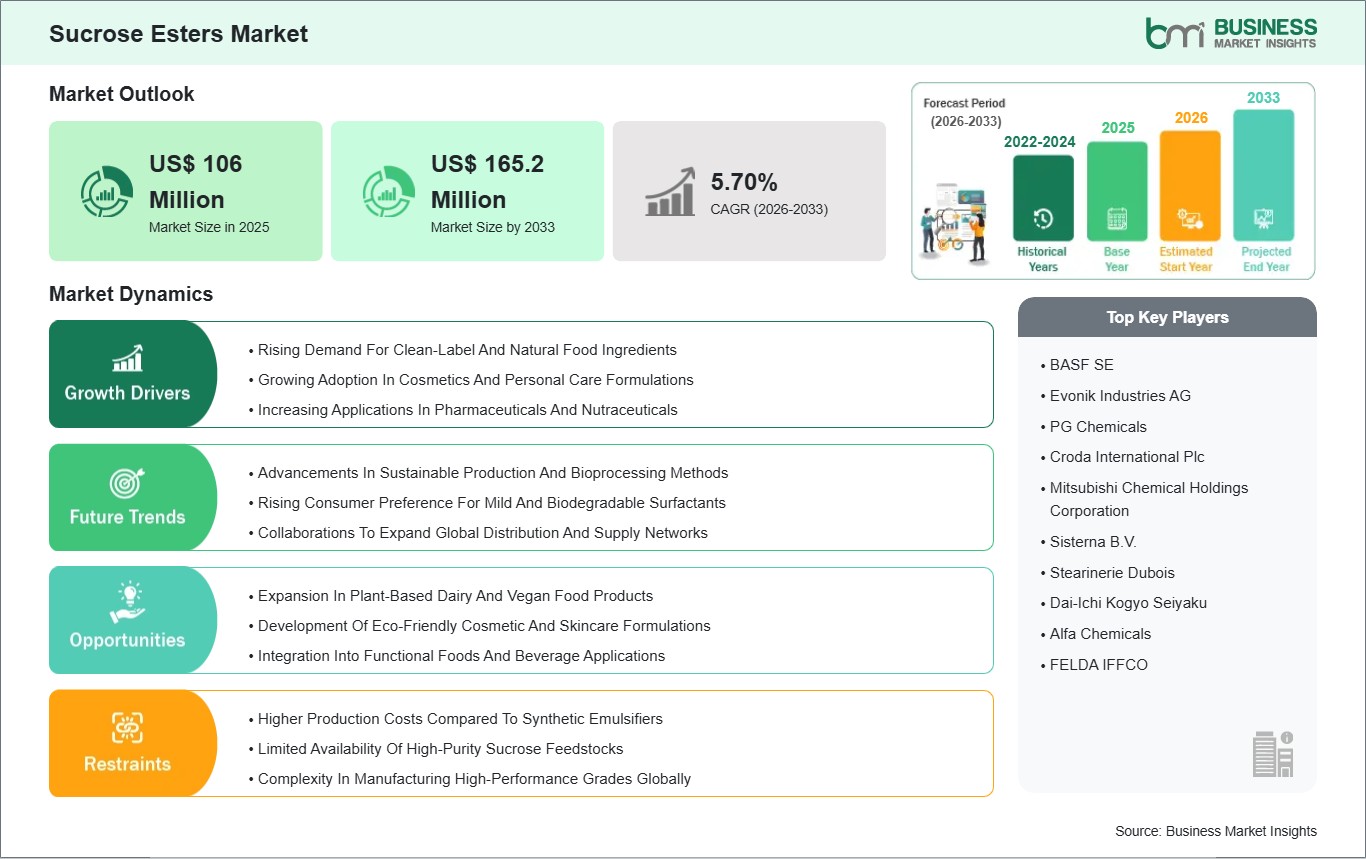
The Sucrose Esters Market size is expected to reach US$ 165.2 million by 2033 from US$ 106. million in 2025. The market is estimated to record a CAGR of 5.70% from 2026 to 2033.
The global sucrose esters market is expanding steadily as demand increases across diverse end-use industries including food and beverage, pharmaceuticals, cosmetics and personal care and industrial applications. Sucrose esters function as non-ionic surfactants, which commercial products derive from combining sucrose with fatty acids to create emulsifying, stabilizing and dispersing materials. Their versatility to adapt to multiple product formulations together with their safe usage and ability to degrade in the environment make them better options than synthetic surfactants and emulsifiers. Consumers increasingly choose natural plant-based ingredients for their food and cosmetic products, which drives manufacturers to reformulate their products with cleaner label components including sucrose esters. Sucrose esters function in food products to enhance texture and prolong shelf life, and maintain emulsion stability in baked goods, desserts, dairy substitutes and reduced fat products. The product enables markets to reach new customers because it functions as a stabilizer and solubilizer for beverages and confections. The cosmetics and personal care segment also contributes to global demand with sucrose esters used in creams and lotions, shampoos and other formulations that need to deliver gentle products that are safe for skin contact.
The surfactant meets sustainable product requirements because its mild performance enables use in natural and organic cosmetic products that formulators develop to meet consumer demand for environmentally safe solutions. Sucrose esters serve as emulsifiers and solubilizers in drug delivery systems for pharmaceuticals, which improve drug bioavailability and formulation stability in both topical and oral medication formats. The sucrose esters market experiences growth drivers that face several restrictions. High-purity sucrose ester grades cost more than commodity surfactants, which makes them unaffordable for industrial applications that value low pricing. The production process relies on feedstock supply chain restrictions, which affect production capacity because regions that depend on imports face challenges with essential feedstocks. Sucrose ester applications will experience continuous growth because production process innovations, bio-based manufacturing expansion and plant-derived ingredient acceptance in global markets will sustain their long-term development.

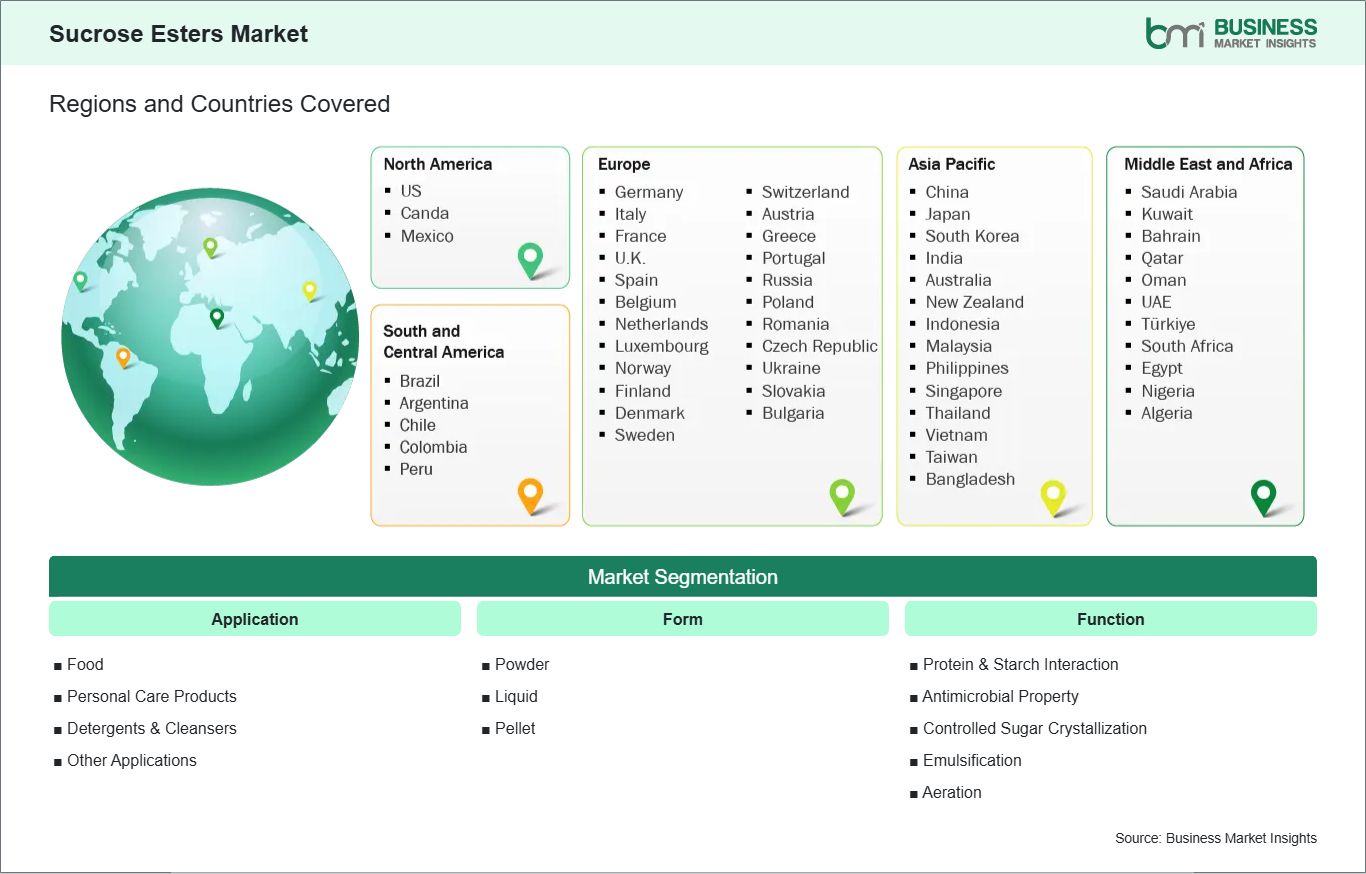
Key segments that contributed to the derivation of the sucrose esters market analysis are application, form, and function.
Global food and beverage manufacturers are increasingly reformulating products to meet consumer demand for clean‑label and natural ingredients, driving notable growth in the sucrose esters market. Sucrose esters, derived from sugar and fatty acids, appeal to consumers seeking recognizable, plant‑derived emulsifiers over synthetic alternatives. In bakery and confectionery applications, sucrose esters improve texture, extend freshness, and support stable emulsification without compromising on clean‑label claims. Brands competing in markets like North America and Europe often highlight sucrose ester usage as part of marketing strategies, reinforcing consumer trust in healthier, natural products.
In the beverage sector, sucrose esters are used to maintain homogeneity in flavored drinks and protein‑fortified beverages, supporting functional attributes without synthetic surfactants. Health‑conscious consumers in Asia Pacific and Latin America are extending these preferences to beverages, where emulsifier selection can influence perceptions of product transparency and ingredient simplicity. As regulatory scrutiny around artificial additives increases, sucrose esters offer a compliant pathway for formulators to balance product stability and ingredient authenticity.
Additionally, collaborative innovation between ingredient suppliers and food manufacturers is accelerating adoption of sucrose esters in clean‑label formulations. Technical support for reformulation helps brands integrate sucrose esters without sacrificing performance, enabling broader penetration across global food categories. As consumer demand for simple, natural ingredient decks continues, sucrose esters are well positioned to replace traditional emulsifiers in a wide range of food applications worldwide.
The global shift toward plant‑based diets and vegan lifestyle choices is creating new opportunities for sucrose esters as functional ingredients in dairy alternatives and vegan foods. Sucrose esters function as essential emulsifiers, which enhance mouthfeel, creaminess, and stability in plant-based dairy products that include almond, soy and oat and coconut beverages. The properties of these materials help dairy substitute producers solve their main formulation problems, which occur in products that contain water and plant oils because they need surface-active agents to stop separation and create better texture. North America and Europe lead the adoption of sucrose esters in premium vegan products because these regions show strong plant-based growth in their markets. Sucrose esters help plant-based yogurts, cheeses and desserts by preserving their structure and sensory qualities during processing. Asian Pacific manufacturers use sucrose esters to create new vegan food products, which plants-based diets provide environmental advantages and sustainability benefits. Retailers across the world are expanding their plant-based product lines, while ingredient developers create specific sucrose ester grades that match different formulation requirements found in various vegan food categories.
Moreover, sucrose esters are gaining traction in meat alternatives, where emulsification improves juiciness, texture, and flavor distribution. As the plant‑based sector evolves beyond niche to mainstream, sucrose esters are positioned as versatile, label‑friendly emulsifiers that support product innovation while aligning with global consumer expectations for ethical and sustainable sourcing.

The sucrose esters market demonstrates steady growth, with size and share analysis highlighting evolving trends and competitive dynamics among key players. The report examines subsegments categorized within application, form, and function, offering insights into their contribution to overall market performance.
By application, the food subsegment dominated the market in 2025, driven by its widespread use of sucrose esters as emulsifiers and stabilizers in bakery, dairy, sauces, and other processed foods.
Based on form, the powder subsegment dominated the market in 2025, driven by its ease of handling, stability during storage, and compatibility with a wide range of dry formulations.
On the basis of function, the emulsification subsegment dominated the market in 2025, driven by the high demand for agents that stabilize oil - water mixtures across food, personal care, and detergent applications.
| Report Attribute | Details |
|---|---|
| Market size in 2025 | US$ 106 Million |
| Market Size by 2033 | US$ 165.2 Million |
| Global CAGR (2026 - 2033) | 5.70% |
| Historical Data | 2022-2024 |
| Forecast period | 2026-2033 |
| Segments Covered | By Application
|
|
Regions and Countries Covered
| |
| North America | US, Canada, Mexico |
| Europe | Belgium, Austria, Finland, Denmark, Greece, Poland, Romania, Russia, Ukraine, Czech Republic, Slovakia, Bulgaria, Italy, Luxembourg, Germany, Switzerland, France, Netherlands, Norway, Portugal, Spain, Sweden, United Kingdom |
| Asia-Pacific | Australia, China, India, Japan, South Korea, Indonesia, Malaysia, Philippines, Singapore, Thailand, Vietnam, Bangladesh, New Zealand, Taiwan |
| South and Central America | Brazil, Argentina, Peru, Chile, Colombia |
| Middle East and Africa | Bahrain, Kuwait, Oman, Qatar, Saudi Arabia, United Arab Emirates, Turkiye, South Africa, Egypt, Algeria, Nigeria |
| Market leaders and key company profiles |
|
The "Sucrose Esters Market Size and Forecast (2022 - 2033)" report provides a detailed analysis of the market covering below areas:
The geographical scope of the Sucrose Esters Market report is divided into North America, Asia Pacific, Europe, Middle East & Africa, and South & Central America. North America held the largest share in 2025.
North America leads the global sucrose esters market because consumers there understand natural ingredients and clean-label products while the food processing and personal care sectors operate, and regulations protect ingredient safety and transparency. In North America, sucrose esters find common use across bakery products and confectionery items, dairy substitutes and beverages to enhance product texture and stability and shelf life while serving as essential components in premium skincare and haircare and cosmetic products that prioritize mildness and sustainability. The region`s pharmaceutical and nutraceutical sectors also leverage sucrose esters as excipients and solubilizers in drug delivery systems, reinforcing its dominant market position.
The Asia Pacific market experiences expansion because people have more money to spend, cities grow, and they want more functional foods and beverages and personal care products. The increasing awareness of plant-derived and eco-friendly ingredients has led to higher sucrose ester adoption in bakery products and dairy alternatives, emulsified sauces and cosmetic creams across China Japan India and South Korea.
The European market benefits from strict regulations and clean-label trends, while Germany, France and the UK lead natural food and cosmetic product development that uses sucrose esters to achieve sustainability and performance goals.
The Middle East and African region shows growth because food and cosmetic sector needs in the United Arab Emirates, South Africa and Saudi Arabia drive manufacturers to study natural emulsifiers for high-end products. Sucrose esters have become popular in Brazil and Argentina because these countries in South and Central America use locally sourced sugar feedstocks to produce baked goods and sweets and personal care products. The global market development results from three factors, which include consumer demand for natural products and industrial companies developing clean-label products and supply chains that prioritize sustainability.

The Sucrose Esters Market is evaluated by gathering qualitative and quantitative data post primary and secondary research, which includes important corporate publications, association data, and databases. A few of the key developments in the sucrose esters market are:
The Sucrose Esters Market is valued at US$ 106 Million in 2025, it is projected to reach US$ 165.2 Million by 2033.
As per our report Sucrose Esters Market, the market size is valued at US$ 106 Million in 2025, projecting it to reach US$ 165.2 Million by 2033. This translates to a CAGR of approximately 5.70% during the forecast period.
The Sucrose Esters Market report typically cover these key segments-
The historic period, base year, and forecast period can vary slightly depending on the specific market research report. However, for the Sucrose Esters Market report:
The Sucrose Esters Market is populated by several key players, each contributing to its growth and innovation. Some of the major players include:
The Sucrose Esters Market report is valuable for diverse stakeholders, including:
Essentially, anyone involved in or considering involvement in the Sucrose Esters Market value chain can benefit from the information contained in a comprehensive market report.
Please tell us your area of interest
(Market Segments/ Regions and Countries/ Companies)