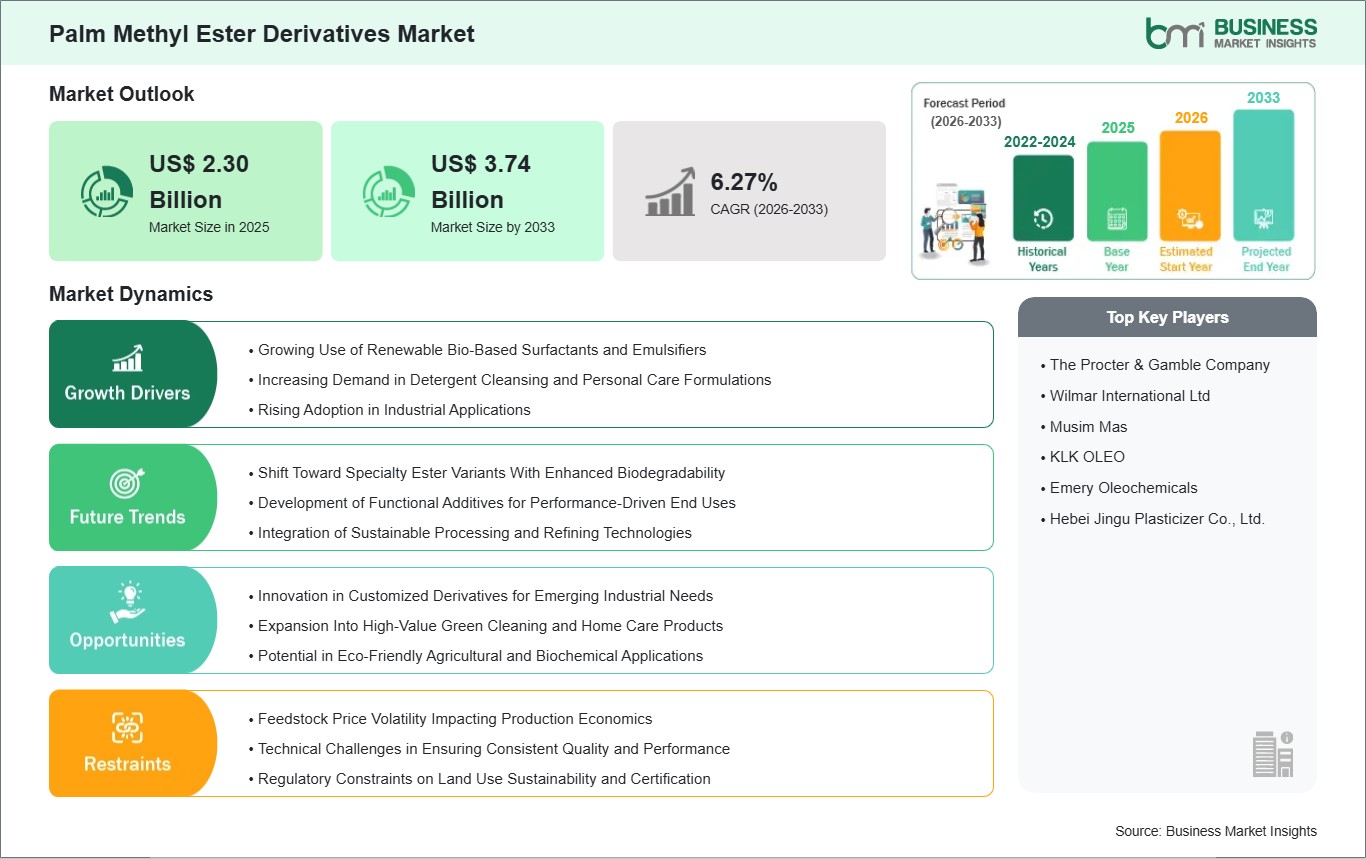
The Palm Methyl Ester Derivatives Market size is expected to reach US$ 3.74 Billion by 2033 from US$ 2.30 Billion in 2025. The market is estimated to record a CAGR of 6.27% from 2026 to 2033.
The palm methyl ester derivatives market, on a global level, is gaining traction as industries are shifting towards adopting renewable and eco-friendly alternatives for their operations. The use of these derivatives, which are derived from refined palm oil, is highly versatile, acting as intermediate materials in various industrial processes, such as surfactants, personal care, lubricants, and industrial chemicals. The main advantage of using palm methyl ester derivatives is their biodegradable, emulsifying, and functional versatility, which enables the production of materials that can meet the needs of sustainable development. These materials are also gaining popularity in household product formulations, such as cosmetics, which is an essential factor in their commercial success, considering their mildness, compatibility, and eco-friendly character. Various drivers affect the market, which include consumer awareness of sustainable materials, regulatory drivers that focus on reducing footprints, and the use of bio-based materials in both industrial and consumer markets.
However, there have been various concerns that have affected the market, which include those in relation to ethics in sourcing sustainability in palm oil. Moreover, there have been concerns in relation to price volatility in raw materials. Companies that have been able to integrate sustainable sourcing, production processes, and innovation in high-performance derivatives have been in a good position to tap into opportunities in the market. The focus on functionality in relation to environmental concerns is likely to influence market dynamics in the future.

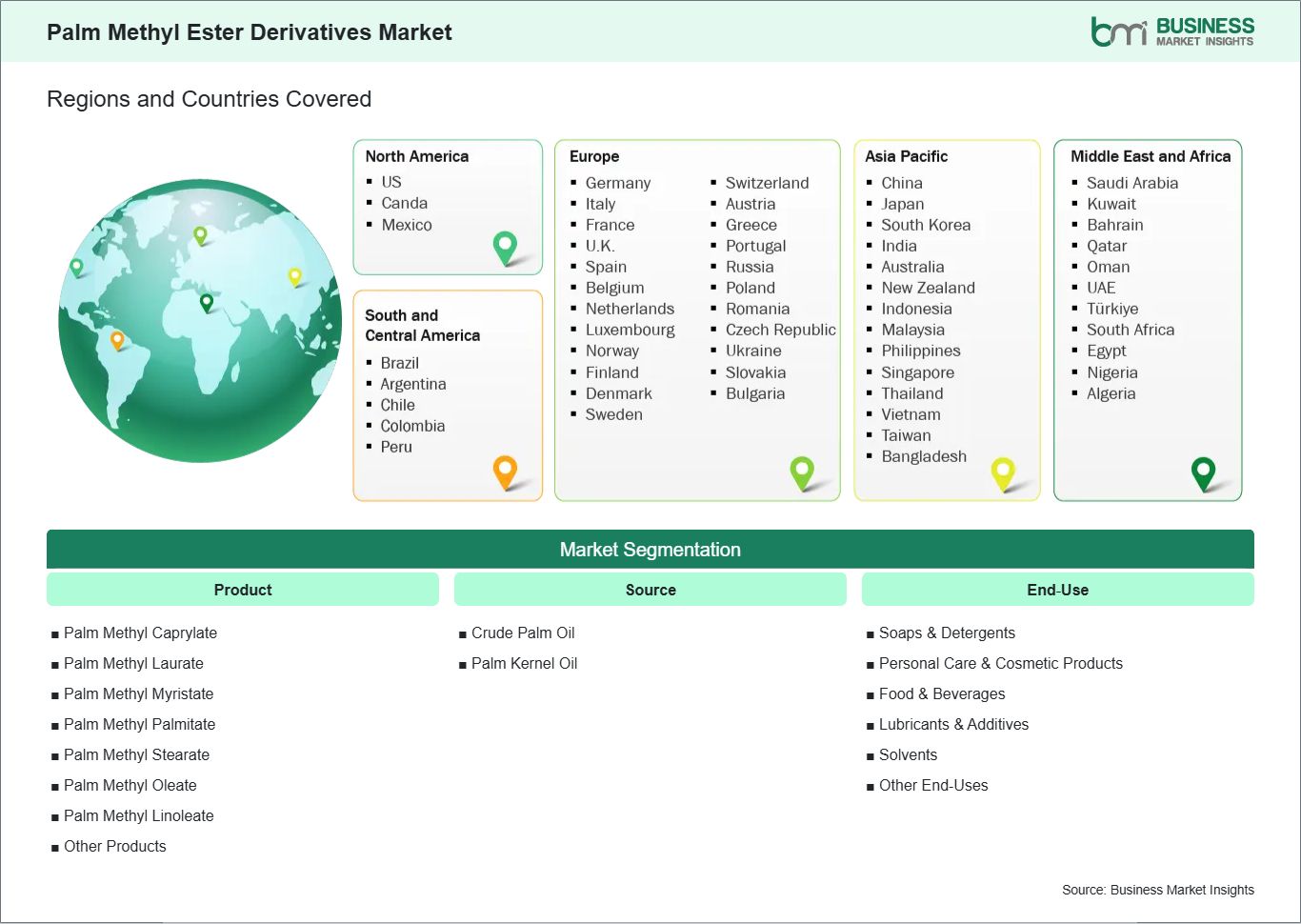
Key segments that contributed to the derivation of the palm methyl ester derivatives market analysis are product, source, and end‑use.
The global market for palm methyl ester derivatives is growing significantly due to rising demand for renewable bio-based surfactants and emulsifiers. These bio-based surfactants and emulsifiers, derived from renewable sources of sustainable palm oil, are commonly used in cleaning agents, personal care products, and household cleaning agents due to their biodegradability, low toxicity, and ability to function in water-based systems. These bio-based surfactants and emulsifiers are now an essential component in eco-friendly cleaning and personal care products as people increasingly look for alternatives that are environmentally friendly.
Industrial sectors are also embracing palm methyl ester derivatives for their surfactant and emulsifying properties. In applications such as metalworking fluids, textile processing, and agrochemical formulations, these derivatives improve dispersion, wetting, and stabilization of complex mixtures. Their versatility allows formulators to replace conventional petrochemical surfactants with renewable alternatives that meet both performance and regulatory requirements. In markets with a strong emphasis on environmental standards, renewable surfactants are increasingly specified to ensure compliance with biodegradability and low-VOC regulations, boosting demand for palm methyl ester derivatives globally.
Furthermore, the increasing emphasis on green and circular economies is also adding to the adoption of these compounds in both consumer and industrial markets. Palm methyl ester derivatives enable the creation of compounds that are not just effective but also support the green and circular economies, which include initiatives aimed at reducing carbon footprint and ecological impact. As the emphasis remains on the use of bio-based solutions, the market for palm methyl ester derivatives is expected to continue its steady growth in the future.
The global palm methyl ester derivatives market is also driven by the development of innovative customized formulations to meet emerging industrial needs. The development of customized derivatives with specific chain lengths, levels of unsaturation, and functional modifications to impart desired properties such as foaming, wetting, emulsification, and lubricity is driving the market. These customized formulations are used in specialty cleaning agents, industrial emulsifiers, lubricants, coatings, and other applications, enabling industry players to address specific challenges in their sectors of operation, all while maintaining the eco-friendly profile of palm methyl ester derivatives.
Besides the performance improvements, there are also possibilities for better compatibility, especially for complex formulations. For instance, the modified palm methyl ester derivatives may be used for the stabilization of multi-component emulsions for personal care and cosmetic products, or for dispersion in water treatment and agrochemical products. The molecular structure can be tailored to create a range of derivatives that offer better solubility, thermal, and oxidative resistance, and this allows for the expansion of palm methyl ester derivatives into a wider range of high-performance applications.
Research and development in this area are further supported by the global emphasis on sustainability and functional efficiency. Industries are seeking formulations that not only deliver high performance but also reduce environmental impact and comply with increasingly stringent regulations. Innovative derivatives derived from palm methyl esters enable manufacturers to meet these goals while expanding application scope across diverse industrial sectors. As customization and technological innovation continue to advance, the global market for palm methyl ester derivatives is expected to grow steadily, driven by emerging industrial needs, regulatory incentives, and the rising preference for renewable, bio-based chemical solutions.

The palm methyl ester derivatives market is experiencing steady growth, with market size and share analysis reflecting evolving treatment preferences and competitive dynamics among key players. The report evaluates important subsegments categorized within product, source, and end‑use, highlighting their respective contributions to overall market performance.
By product, the palm methyl laurate subsegment dominated the palm methyl ester derivatives market in 2025. Palm methyl laurate offers excellent surfactant properties, emulsification, and cleansing efficiency, driving its widespread use in personal care and cleaning products.
Based on source, the crude palm oil subsegment dominated the palm methyl ester derivatives market in 2025. Crude palm oil provides high availability, cost-effectiveness, and consistent quality, supporting strong demand in derivative production.
In terms of end-use, the soaps & detergents subsegment dominated the palm methyl ester derivatives market in 2025. Soaps and detergents benefit from the excellent foaming, cleansing, and emulsifying properties of palm methyl esters, reinforcing the dominance of this segment.
| Report Attribute | Details |
|---|---|
| Market size in 2025 | US$ 2.30 Billion |
| Market Size by 2033 | US$ 3.74 Billion |
| Global CAGR (2026 - 2033) | 6.27% |
| Historical Data | 2022-2024 |
| Forecast period | 2026-2033 |
| Segments Covered | By Product
|
|
Regions and Countries Covered
| |
| North America | US, Canada, Mexico |
| Europe | Belgium, Austria, Finland, Denmark, Greece, Poland, Romania, Russia, Ukraine, Czech Republic, Slovakia, Bulgaria, Italy, Luxembourg, Germany, Switzerland, France, Netherlands, Norway, Portugal, Spain, Sweden, United Kingdom |
| Asia-Pacific | Australia, China, India, Japan, South Korea, Indonesia, Malaysia, Philippines, Singapore, Thailand, Vietnam, Bangladesh, New Zealand, Taiwan |
| South and Central America | Brazil, Argentina, Peru, Chile, Colombia |
| Middle East and Africa | Bahrain, Kuwait, Oman, Qatar, Saudi Arabia, United Arab Emirates, Turkiye, South Africa, Egypt, Algeria, Nigeria |
| Market leaders and key company profiles |
|
The "Palm Methyl Ester Derivatives Market Size and Forecast (2022 - 2033)" report provides a detailed analysis of the market covering below areas:
The geographical scope of the Palm Methyl Ester Derivatives market report is divided into five regions: North America, Asia Pacific, Europe, Middle East & Africa, and South & Central America. The Palm Methyl Ester Derivatives market in North America is expected to grow during the forecast period.
North America is the leader in the palm methyl ester derivatives market worldwide, and this is mainly because of the wide acceptance of palm methyl ester derivatives in personal care products, cleaning agents, and other specialty industrial applications. The manufacturers in the North American market are now focusing more on renewable ingredients that not only perform but also have sustainability credentials. The palm methyl ester derivatives are used in personal care formulations, which provide moisturizing and emollient properties, and in cleaning agents, which are biodegradable and function as surfactants. The people in the North American market are now more aware of the safety and environmental concerns of the products and services used, and hence, the market is moving towards more renewable chemical products and derivatives.
The region’s leaders are also assisted by the presence of a developed industrial infrastructure, which is complemented by well-established research and development activities, along with supply chains supporting the use of sustainable palm oil derivatives. Additionally, the presence of supportive regulations promoting the use of low-toxicity and biodegradable chemicals encourages the adoption of the material in different applications. This enables the supply chain players, along with the chemical industry and end-users, to ensure the availability of high-quality material that meets the required criteria, thereby supporting the production of materials that meet the changing demands of end-users and the environment. This enables the North American region to act as a global trendsetter in the use of palm methyl ester derivatives.

The palm methyl ester derivatives market is evaluated by gathering qualitative and quantitative data post primary and secondary research, which includes important corporate publications, association data, and databases. A few of the key developments in the palm methyl ester derivatives market are:
The Palm Methyl Ester Derivatives Market is valued at US$ 2.30 Billion in 2025, it is projected to reach US$ 3.74 Billion by 2033.
As per our report Palm Methyl Ester Derivatives Market, the market size is valued at US$ 2.30 Billion in 2025, projecting it to reach US$ 3.74 Billion by 2033. This translates to a CAGR of approximately 6.27% during the forecast period.
The Palm Methyl Ester Derivatives Market report typically cover these key segments-
The historic period, base year, and forecast period can vary slightly depending on the specific market research report. However, for the Palm Methyl Ester Derivatives Market report:
The Palm Methyl Ester Derivatives Market is populated by several key players, each contributing to its growth and innovation. Some of the major players include:
The Palm Methyl Ester Derivatives Market report is valuable for diverse stakeholders, including:
Essentially, anyone involved in or considering involvement in the Palm Methyl Ester Derivatives Market value chain can benefit from the information contained in a comprehensive market report.
Please tell us your area of interest
(Market Segments/ Regions and Countries/ Companies)