Market Summary
Executive Summary and Global Market Analysis
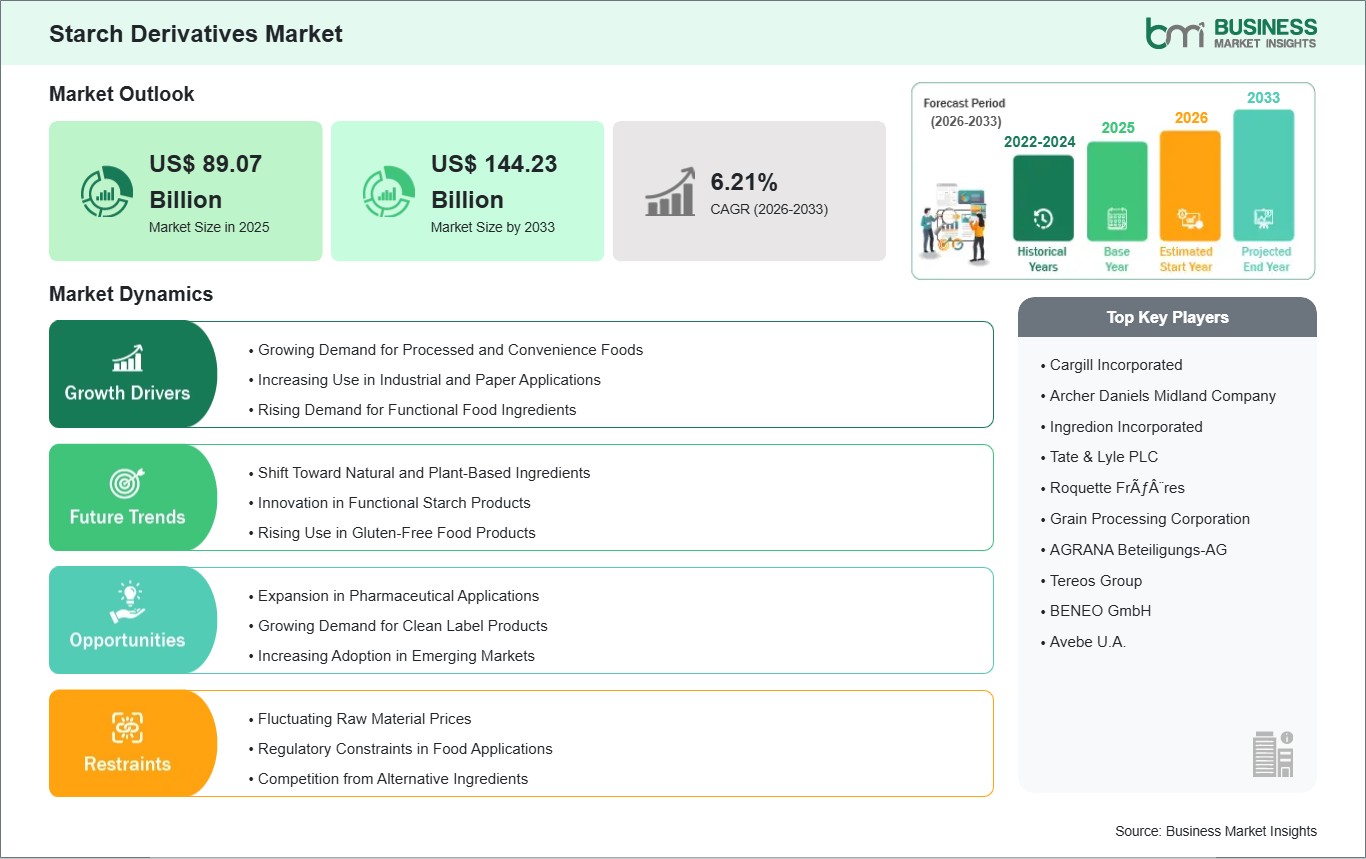
The market for starch derivatives is registering steady growth, and this is because of the rising demand for these derivatives in food and beverage, pharmaceutical, and other industries. Starch derivatives are used in different applications because they provide certain benefits, such as thickening, stabilizing, and binding properties. These are used in different industries as ingredients in food and beverages, pharmaceuticals, and other applications. Modified starch is the most popular derivative in this market because it possesses better properties and is used in different applications in various industries. The food and beverage segment is also registering strong growth in this market because of the rising demand for processed and convenience foods. The market for starch derivatives is also registering growth because of rising demand in pharmaceutical, paper, and cosmetics industries. Although this market is facing certain challenges, such as fluctuations in raw material prices and regulatory issues, it is registering steady growth because of rising demand in emerging markets and developments in product formulations.
Segment Analysis
Starch Derivatives Market Segmentation
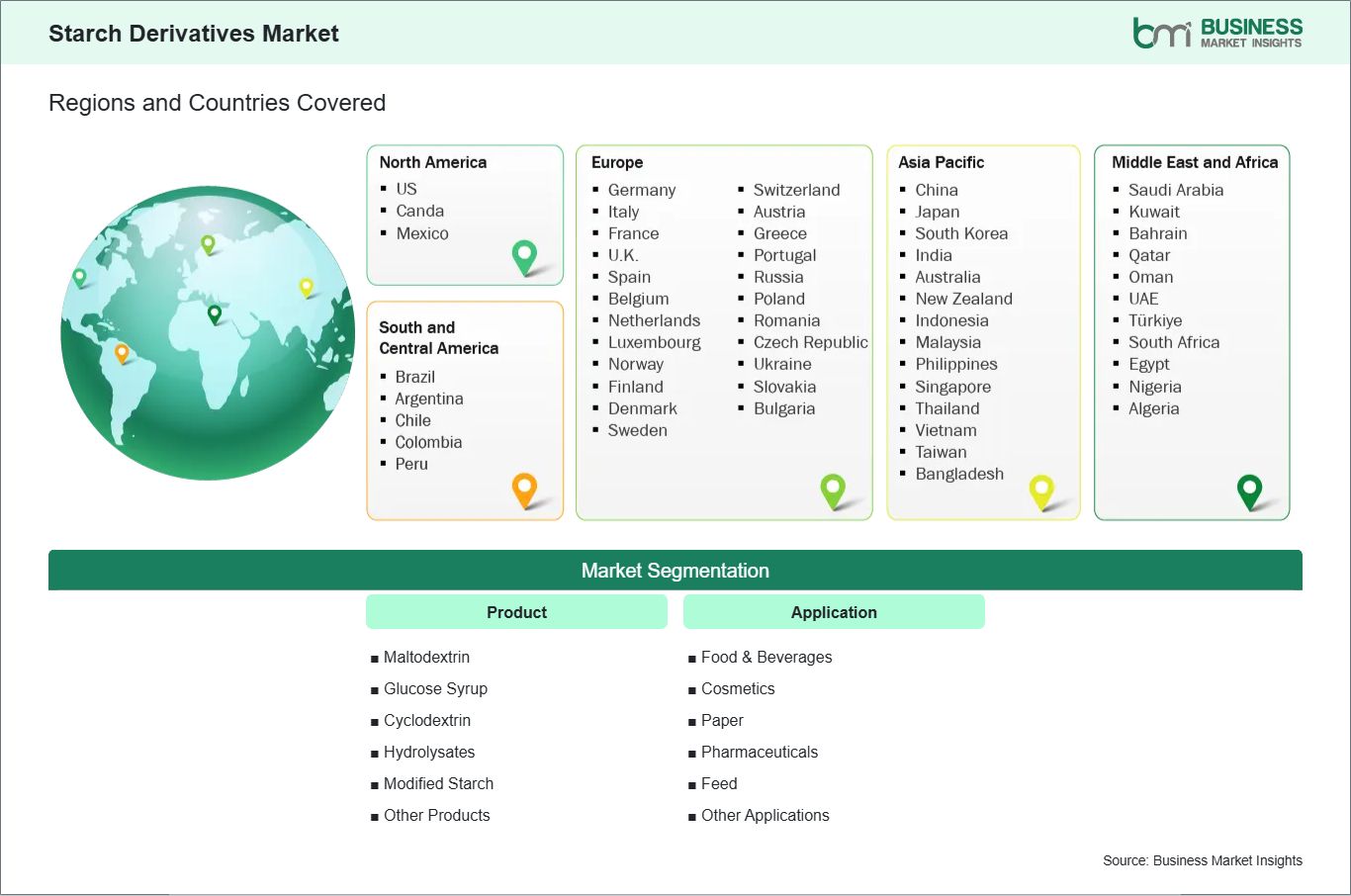
Key segments that contributed to the derivation of the Starch Derivatives market analysis are product and application.
- By product, the starch derivatives market is segmented into Maltodextrin, Glucose Syrup, Cyclodextrin, Hydrolysates, Modified Starch, and Others. The Modified Starch segment dominated the market in 2025.
- By application, the starch derivatives market is segmented into Food & Beverages, Cosmetics, Paper, Pharmaceuticals, Feed, and Others. The Food & Beverages segment dominated the market in 2025.
Market Forces
Starch Derivatives Market Drivers and Opportunities
Growing Demand for Processed and Convenience Foods
The growing demand for processed and convenience foods is a major driver for the starch derivatives market. Changing consumer lifestyles, urbanization, and increasing disposable incomes are driving the consumption of ready-to-eat and packaged food products. Starch derivatives such as modified starch, maltodextrin, and glucose syrup are widely used to enhance texture, stability, and shelf life in these products. Food manufacturers rely on starch derivatives for their functional properties, including thickening, binding, and moisture retention. These ingredients help improve product consistency and quality in applications such as sauces, bakery items, dairy products, and snacks. The demand for processed foods is particularly strong in urban areas, where convenience and time-saving solutions are highly valued by consumers. Additionally, the expansion of the global food processing industry is contributing to increased demand for starch derivatives. Manufacturers are continuously innovating to develop new food products with improved taste and texture. As consumer preferences shift toward convenient and high-quality food options, the demand for starch derivatives is expected to grow significantly in the coming years.
Expansion in Pharmaceutical Applications
The expansion in pharmaceutical applications presents significant opportunities for the starch derivatives market. Starch derivatives are widely used in the pharmaceutical industry as excipients in drug formulations. They serve functions such as binding, disintegration, and stabilization in tablets and capsules, ensuring effective drug delivery and performance. Modified starches and cyclodextrins are particularly important in pharmaceutical applications due to their ability to improve drug solubility and bioavailability. These materials help enhance the effectiveness of active pharmaceutical ingredients, making them more suitable for modern drug formulations. The growing demand for advanced drug delivery systems is driving the use of starch derivatives in the pharmaceutical sector. Furthermore, increasing investments in healthcare and pharmaceutical research are supporting the development of innovative drug formulations. The rising prevalence of chronic diseases and the need for effective medications are further driving demand. As pharmaceutical companies continue to focus on improving drug performance and patient outcomes, the use of starch derivatives is expected to expand, creating significant growth opportunities in the market.
Size and Share Analysis
Starch Derivatives Market Size and Share Analysis
The global Starch Derivatives market is experiencing steady growth, with market size and share analysis reflecting evolving treatment preferences and competitive dynamics among key players. The report evaluates important subsegments categorized within product and application highlighting their respective contributions to overall market performance.
By product, the Modified Starch subsegment dominated the market in 2025 due to its enhanced functional properties such as improved stability, thickening, and binding capabilities, making it widely used across food processing, paper manufacturing, and industrial applications requiring consistent performance.
By application, the Food & Beverages subsegment dominated the market in 2025 due to increasing demand for processed and convenience foods, where starch derivatives are widely used as stabilizers, thickeners, and texturizers to improve product quality, shelf life, and consumer appeal.
Report Coverage
Starch Derivatives Market Report Coverage and Deliverables
The "Starch Derivatives Market Size and Forecast (2022 - 2033)" report provides a detailed analysis of the market covering below areas:
- Starch Derivatives market size and forecast at the regional and country levels for segments covered under the scope
- Starch Derivatives market trends, as well as drivers, restraints, and opportunities
- Starch Derivatives market analysis covering key trends, regional framework, major players, regulations, and recent developments
- Industry landscape and competition analysis covering market concentration, heat map analysis, prominent players, and recent developments for the Starch Derivatives market
- Detailed company profiles, including SWOT analysis
Geographic Insights
Starch Derivatives Market Geographic Insights
The geographical scope of the Starch Derivatives market report is divided into: North America, Asia Pacific, Europe, Middle East & Africa, and South & Central America. North America held the largest share in 2025.
North America dominated the starch derivatives market in 2025 due to strong demand from the food and beverage industry, advanced food processing infrastructure, and high consumer preference for convenience foods. The United States is a key contributor, with extensive use of starch derivatives in processed food, beverages, and pharmaceutical applications. The region benefits from the presence of major manufacturers and continuous innovation in food ingredients and pharmaceutical excipients. Increasing demand for clean label and functional food products is driving the adoption of starch derivatives.
Additionally, regulatory support and high standards in food safety and quality contribute to market growth. Canada also plays a role with its food processing and agricultural sectors. With ongoing advancements in product development and strong demand across industries, North America is expected to maintain its dominant position in the starch derivatives market.
Industry Activity
Recent Developments
The Starch Derivatives market is evaluated by gathering qualitative and quantitative data post primary and secondary research, which includes important corporate publications, association data, and databases. A few of the key developments in the Starch Derivatives market are:
- In December 2022, Ingredion Incorporated expanded its clean-label starch derivatives portfolio with new functional native starches.
- In March 2023, Cargill launched a new line of soluble fibers and starch derivatives aimed at improving texture and nutritional value.
- In September 2023, Archer Daniels Midland (ADM) expanded its starch derivatives production capacity in North America.
Trust & Transparency
Research Methodology
The market analysis combines proprietary research with secondary data from government agencies, company disclosures, regulatory filings, industry databases and expert interviews. Market estimates are validated through data triangulation, cross-market benchmarking and analyst
review.
View Full Research Methodology
Key Sources Referred:
The American Chemical Society (ACS) European Starch Industry Association (Starch Europe) Corn Refiners Association (CRA, USA) Indian Starch Manufacturers Association (ISMA) China Starch Industry Association (CSIA) International Starch Institute (ISI) Company Annual Reports Company Investor Presentations