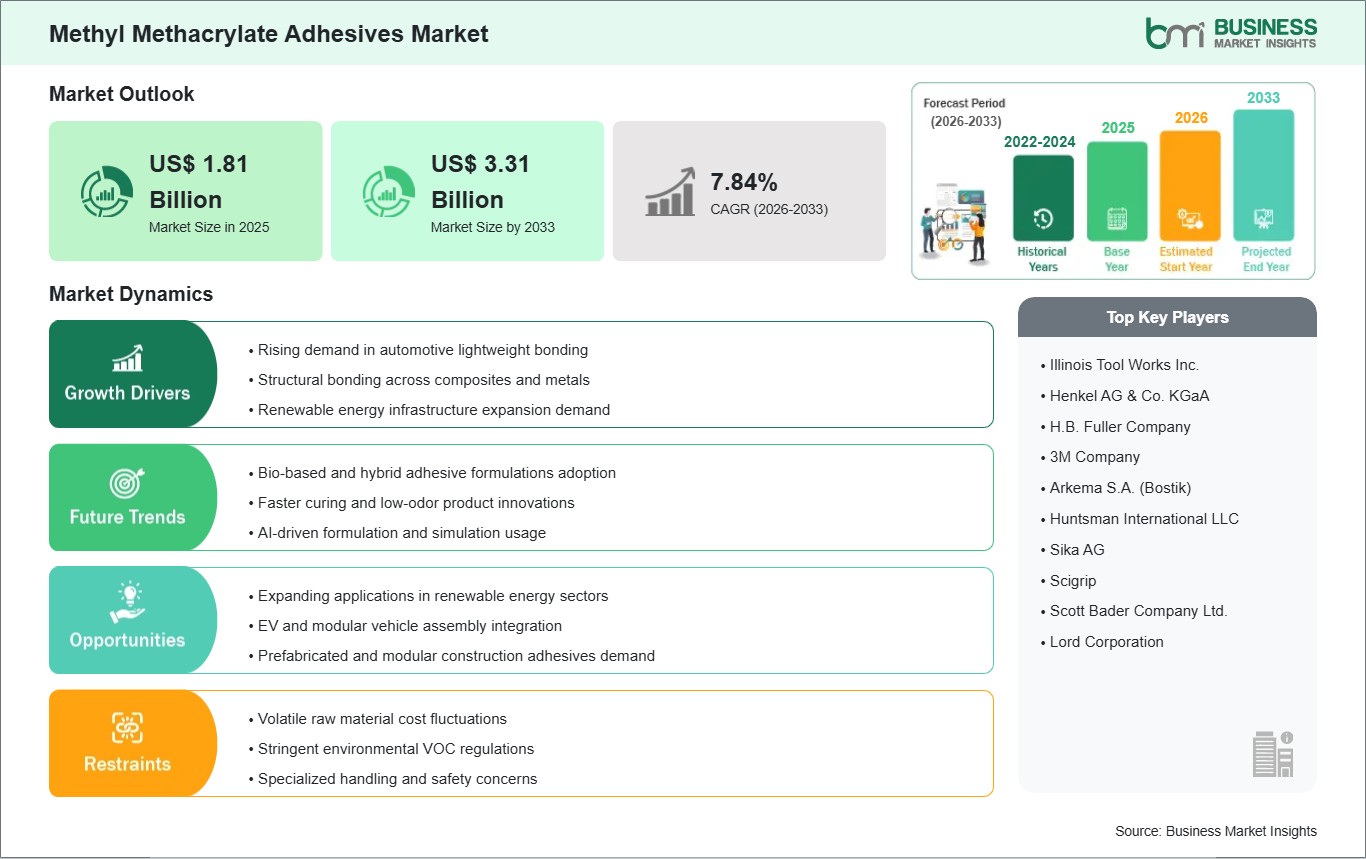
The Methyl Methacrylate Adhesives Market size is expected to reach US$ 3.31 Billion by 2033 from US$ 1.81 Billion in 2025. The market is estimated to record a CAGR of 7.84% from 2026 to 2033.
The methyl methacrylate (MMA) adhesives industry is experiencing a strong surge in growth due to its excellent capability of bonding between several substrates, such as metals, composites, and plastics. MMA adhesives are growing in use among many industries that work with high-strength, durable, and impact-resistant products requiring a bond that withstands significant dynamic stresses; automotive, marine, construction, and wind-energy sectors are transitioning away from traditional mechanical fastening methods and bonding and towards the use of MMA adhesives due to weight-reduction benefits, improved aesthetics, and greater structural integrity. Recent improvements in technology have resulted in low-odour, non-sagging, and rapidly curing formulations with accompanying enhancements in occupational safety and operational efficiencies.
Furthermore, manufacturers are actively working to develop products that comply with regulatory requirements for volatile organic compounds (VOCs) in response to growing technical and regulatory pressures, leading to the development of "green" product lines that meet the VOC standard. Manufacturers are creating custom-made solutions through cooperation with original equipment manufacturers (OEMs) to satisfy specific industrial needs so as to develop long-term supply agreements. The MMA adhesives market will benefit from continued increased use of composites for new products, particularly in the areas of electric vehicles and renewable-energy infrastructure, with MMA adhesives facilitating the assembly of these products without compromising the material characteristics. Nevertheless, raw material price fluctuations and handling sensitivity will continue to pose challenges to manufacturers' operations. Competitive dynamics are a combination of global chemical companies and smaller and mid-sized firms.

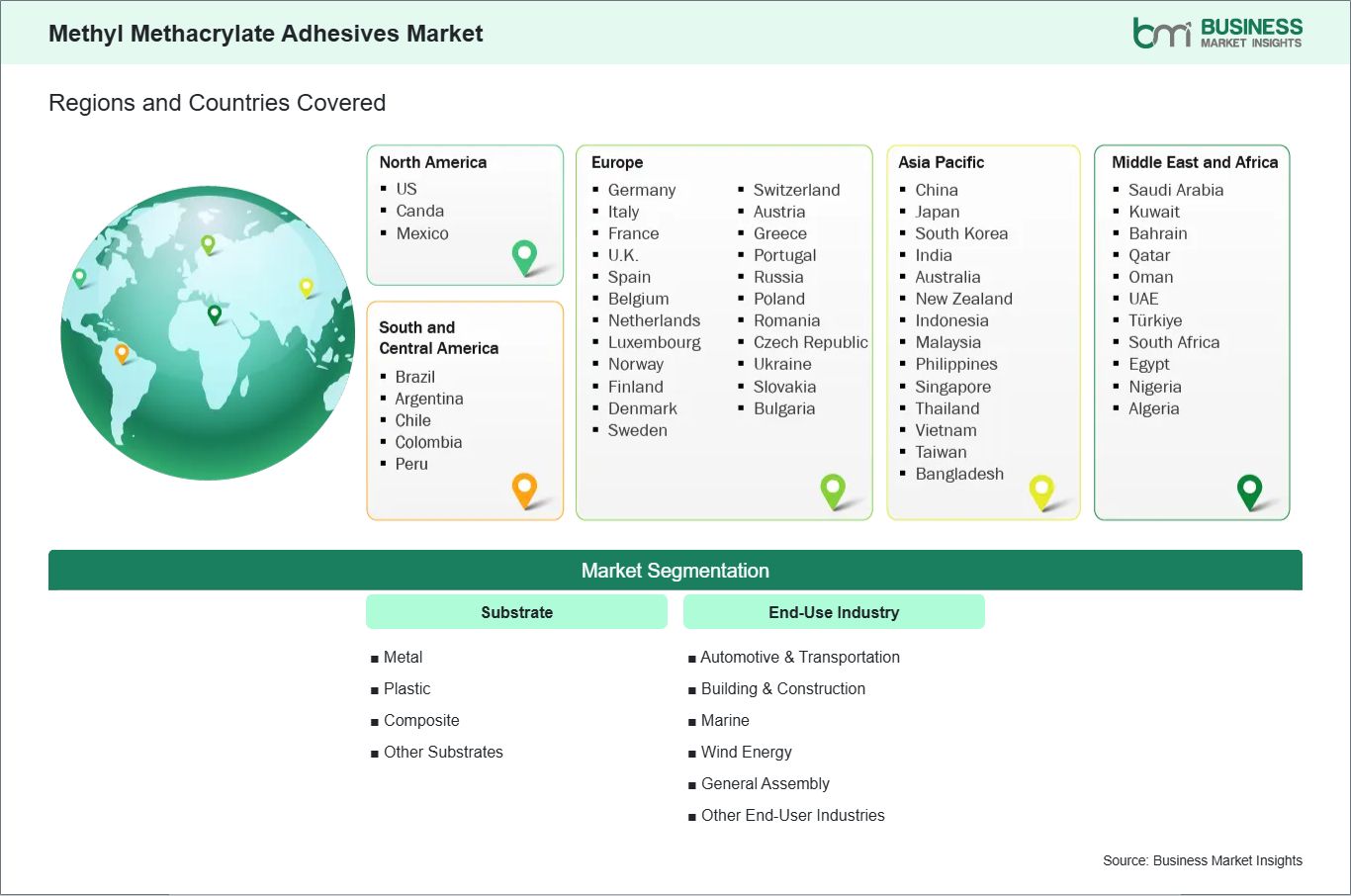
Key segments that contributed to the derivation of the methyl methacrylate adhesives market analysis are substrate, end-use industry.
The automotive industry is undergoing a transformation as manufacturers increasingly focus on lightweight designs to improve fuel efficiency, reduce emissions, and enhance overall vehicle performance. This trend has created growing demand for methyl methacrylate (MMA) adhesives, which provide high-strength bonding for metals, plastics, and composite structures. By replacing traditional mechanical fasteners, these adhesives help reduce vehicle weight while maintaining structural integrity and reliability.
MMA adhesives are particularly useful in assembling intricate parts that involve precision and flexibility. Their ability to bond different materials makes them useful in integrating light materials, thus promoting innovation in automotive design. Furthermore, they offer durability in response to stress, vibration, and environmental changes.
Furthermore, the trend towards electric and hybrid vehicle technologies will continue to heighten the importance of adhesives in the future. This is particularly the case with the increasing trend towards the use of advanced battery technologies and the need for lightweight body panels and composite materials. The ability of MMA adhesives to improve the speed and efficiency of production processes is also a key factor that is having a profound influence on the market for MMA adhesives and the importance of the product in the context of contemporary vehicle production technologies.
The global focus on renewable energy is experiencing steady growth driven by use of methyl methacrylate (MMA) adhesives in the construction of energy infrastructure. These adhesives provide strong, durable bonding for composite and multi-material components, ensuring reliability under extreme environmental conditions such as temperature fluctuations, moisture, and mechanical stress. Their performance makes them essential in wind, solar, and other renewable energy applications.
MMA adhesives enable the assembly of large, complex components with precision and structural stability. Their ability to bond dissimilar materials eliminates the need for additional mechanical fasteners, reducing the risk of failure and minimizing maintenance requirements. This flexibility supports innovation in design, allowing engineers to optimize efficiency and durability while meeting rigorous safety standards.
With the renewable energy sector in constant expansion, there is a constant need for high-performance adhesives. This is because MMA adhesives improve structural integrity, enhance efficiency in assembly, and are environmentally friendly by ensuring minimal wastage of materials in the manufacturing process. This ability to meet the demands of modern energy production makes them a vital component in renewable energy production, and therefore, an indispensable material in this transition to clean and sustainable energy production.
The methyl methacrylate adhesives market demonstrates steady growth, with size and share analysis highlighting evolving trends and competitive dynamics among key players. The report examines subsegments categorized within substrate, end-use industry, offering insights into their contribution to overall market performance.
By Substrate, the metal subsegment dominated the market in 2025, driven by its strong bonding capability and widespread application across industrial sectors.
Based on End-Use Industry, the automotive & transportation subsegment dominated the market in 2025, supported by increasing demand for lightweight and durable bonding solutions in vehicle manufacturing.
| Report Attribute | Details |
|---|---|
| Market size in 2025 | US$ 1.81 Billion |
| Market Size by 2033 | US$ 3.31 Billion |
| Global CAGR (2026 - 2033) | 7.84% |
| Historical Data | 2022-2024 |
| Forecast period | 2026-2033 |
| Segments Covered | By Substrate
|
|
Regions and Countries Covered
| |
| North America | US, Canada, Mexico |
| Europe | Belgium, Austria, Finland, Denmark, Greece, Poland, Romania, Russia, Ukraine, Czech Republic, Slovakia, Bulgaria, Italy, Luxembourg, Germany, Switzerland, France, Netherlands, Norway, Portugal, Spain, Sweden, United Kingdom |
| Asia-Pacific | Australia, China, India, Japan, South Korea, Indonesia, Malaysia, Philippines, Singapore, Thailand, Vietnam, Bangladesh, New Zealand, Taiwan |
| South and Central America | Brazil, Argentina, Peru, Chile, Colombia |
| Middle East and Africa | Bahrain, Kuwait, Oman, Qatar, Saudi Arabia, United Arab Emirates, Turkiye, South Africa, Egypt, Algeria, Nigeria |
| Market leaders and key company profiles |
|
The "Methyl Methacrylate Adhesives Market Size and Forecast (2022 - 2033)" report provides a detailed analysis of the market covering below areas:
The geographical scope of the Methyl Methacrylate Adhesives Market report is divided into North America, Asia Pacific, Europe, Middle East & Africa, and South & Central America. North America held the largest share in 2025.
Regional-level dynamics in the methyl methacrylate adhesives market reveal varied growth trajectories influenced by industrial maturity, regulatory frameworks, and end-use sector expansion. North America is the dominant market, benefiting from advanced manufacturing infrastructure, extensive automotive and aerospace sectors, and stringent regulatory standards that drive demand for high-performance, low-VOC adhesives.
Europe is experiencing steady growth, supported by sustainability initiatives, eco-friendly product mandates, and a strong focus on automotive, construction, and renewable energy applications, with Germany, France, and the UK leading adoption.
Asia Pacific is the fastest-growing region, led by China, Japan, and South Korea, driven by large-scale infrastructure projects, rapid industrialization, and the burgeoning electric vehicle sector, alongside increasing domestic production capacities to meet regional demand.
Middle East & Africa shows moderate growth, fueled by construction, oil & gas, and transportation sectors, with an emphasis on durable, high-strength adhesives suitable for harsh climates.
South & Central America represents an emerging market where infrastructure development, automotive production, and industrial modernization are gradually expanding MMA adhesive usage, though price sensitivity and supply chain challenges constrain faster growth.
Across all regions, demand is shaped by regulatory compliance, industrial applications, and the adoption of advanced bonding technologies, creating a diverse and dynamic global market landscape.

The Methyl Methacrylate Adhesives Market is evaluated by gathering qualitative and quantitative data post primary and secondary research, which includes important corporate publications, association data, and databases. A few of the key developments in the methyl methacrylate adhesives market are:
The Methyl Methacrylate Adhesives Market is valued at US$ 1.81 Billion in 2025, it is projected to reach US$ 3.31 Billion by 2033.
As per our report Methyl Methacrylate Adhesives Market, the market size is valued at US$ 1.81 Billion in 2025, projecting it to reach US$ 3.31 Billion by 2033. This translates to a CAGR of approximately 7.84% during the forecast period.
The Methyl Methacrylate Adhesives Market report typically cover these key segments-
The historic period, base year, and forecast period can vary slightly depending on the specific market research report. However, for the Methyl Methacrylate Adhesives Market report:
The Methyl Methacrylate Adhesives Market is populated by several key players, each contributing to its growth and innovation. Some of the major players include:
The Methyl Methacrylate Adhesives Market report is valuable for diverse stakeholders, including:
Essentially, anyone involved in or considering involvement in the Methyl Methacrylate Adhesives Market value chain can benefit from the information contained in a comprehensive market report.
Please tell us your area of interest
(Market Segments/ Regions and Countries/ Companies)