Market Summary
Executive Summary and Global Market Analysis
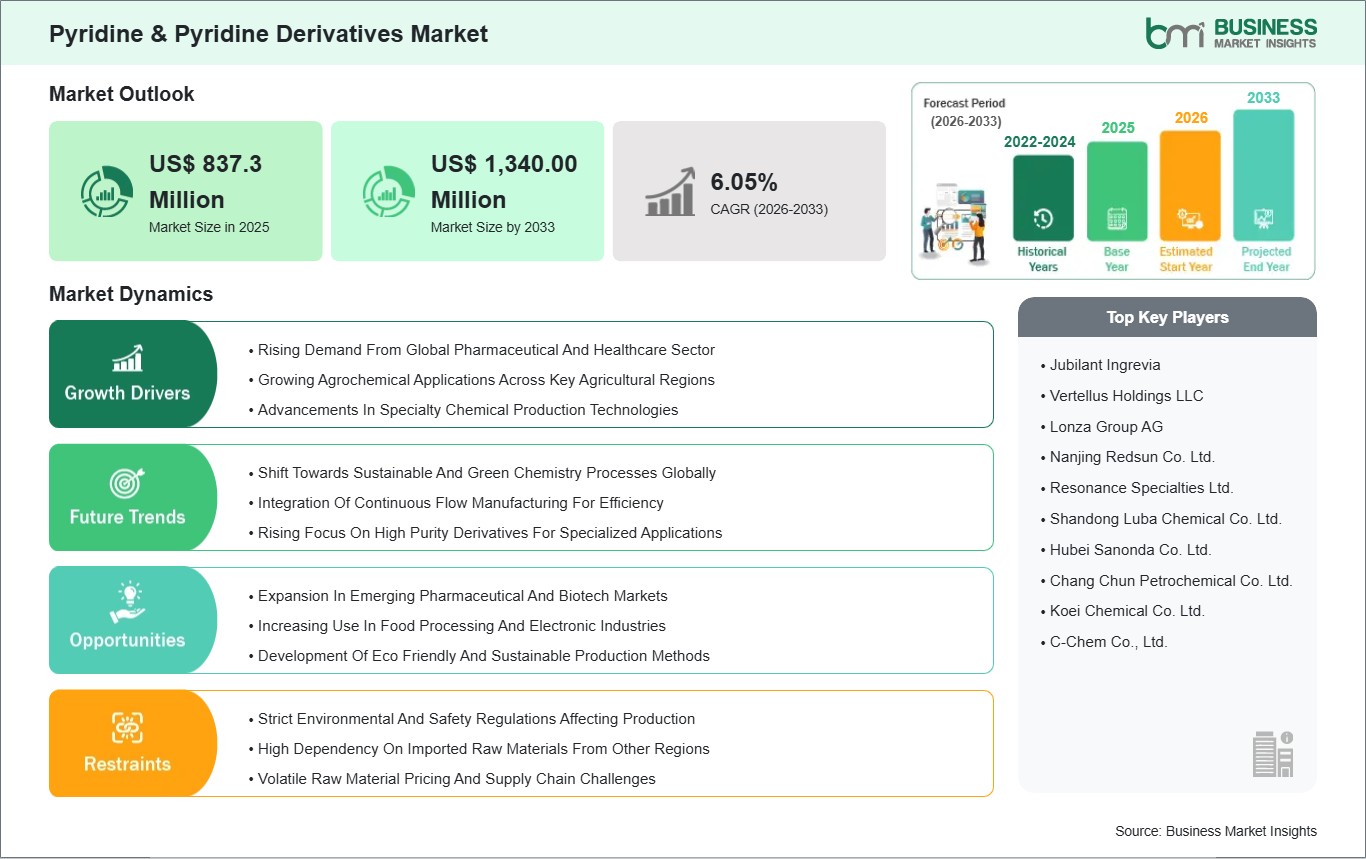
The global pyridine and its derivatives market is dominated by its position as an intermediate chemical industry that serves various end-use markets, especially the pharmaceutical, agrochemical, and specialty chemicals sectors. Pyridine compounds are highly appreciated for their chemical inertness and versatility. These compounds are essential for the manufacture of active pharmaceutical ingredients, vitamins, and agrochemicals. The pharmaceutical industry is the major driver of the pyridine and its derivatives market. This is because the derivatives of the said compound are used for the formulation of drugs for treating infections, inflammation, and other diseases. The growing need for healthcare services and the expansion of the generic drugs industry will further enhance the requirement for the said compound.
The agrochemical industry is also a major driver of the global industry. Pyridine derivatives play a crucial role as key ingredients for herbicides, fungicides, and insecticides. This supports the increase in agricultural output and the need for food security in developed and emerging markets. The increase in the pressure on crop yields and the adoption of modern agricultural practices further add to the consumption of the chemicals. Furthermore, the chemicals are benefiting the market due to the increase in the use of the derivatives for the food processing industry, electronics, and the use of solvents. From a supply chain point of view, the chemicals are manufactured in regions where the cost of manufacturing is efficient.
On the other hand, the technologically advanced markets are the key drivers of the consumption of the chemicals. This has created a highly interconnected chain where the prices of the chemicals are influenced by the trade and availability of the raw materials. However, the market is characterized by some significant restraints as well. The environmental and safety challenges related to the production and handling of pyridine have led to a series of stringent regulations, affecting the cost of compliance for the manufacturers. Additionally, the market is influenced by the changing prices of raw materials and the dependency on certain manufacturing hubs. The global pyridine and pyridine derivatives market is influenced by the varied industrial applications and end-user requirements of the products.
Segment Analysis
Pyridine & Pyridine Derivatives Market Segmentation
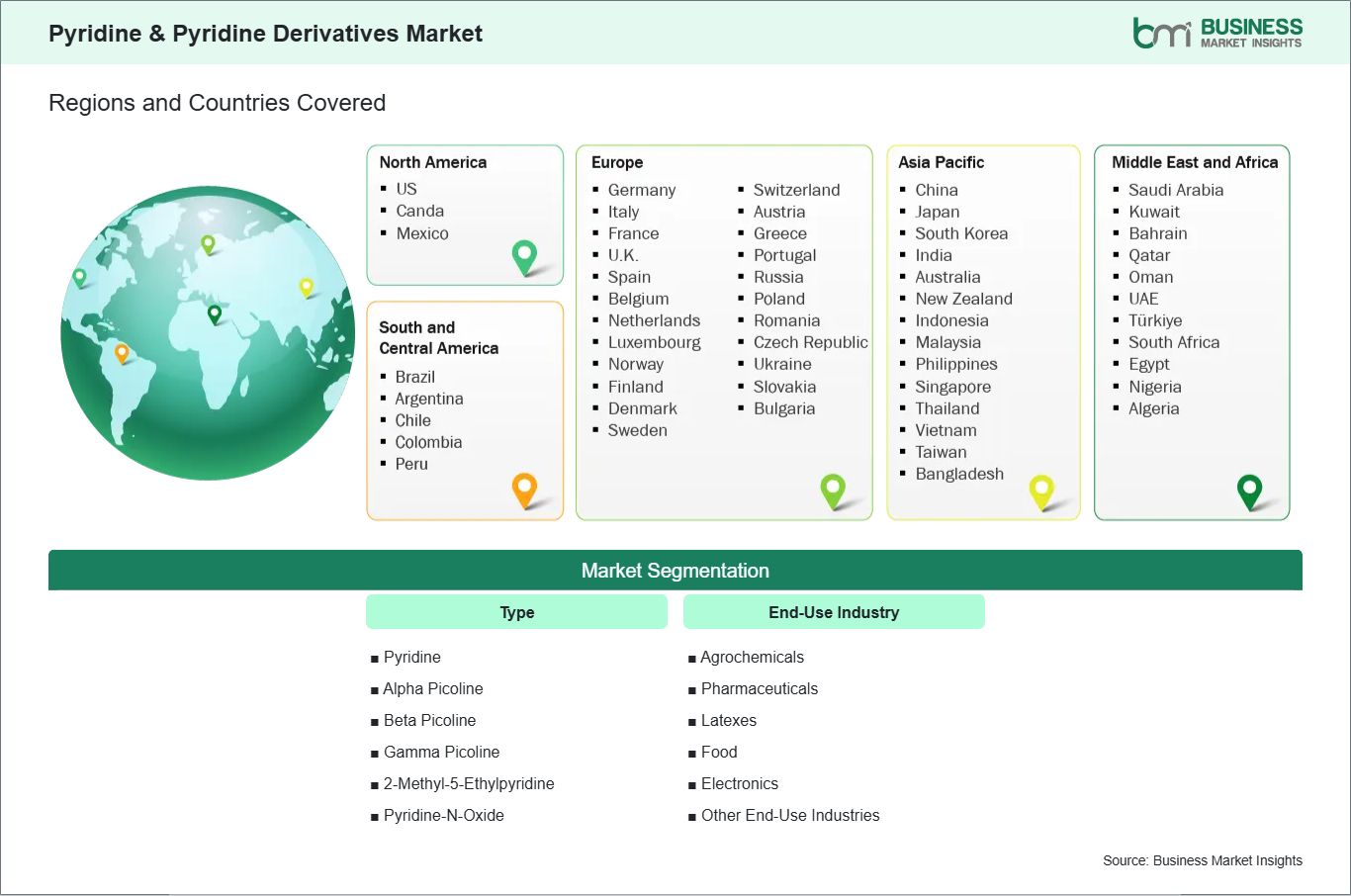
Key segments that contributed to the derivation of the pyridine & pyridine derivatives market analysis are type and end-use industry.
- By type, the pyridine & pyridine derivatives market is segmented into pyridine, alpha picoline, beta picoline, gamma picoline, 2-methyl-5-ethylpyridine (MEP), pyridine-N-oxide. The pyridine segment dominated the market in 2025.
- Based on end-use industry, the pyridine & pyridine derivatives market is categorized into agrochemicals, pharmaceuticals, latexes, food, electronics, other end-use industries. The pharmaceuticals segment dominated the market in 2025.
Market Forces
Pyridine & Pyridine Derivatives Market Drivers and Opportunities
Rising Demand From Global Pharmaceutical And Healthcare Sector
The pharmaceutical and healthcare sector remains the foremost driver of global pyridine and pyridine derivatives consumption. Pyridine is a critical intermediate in synthesizing active pharmaceutical ingredients (APIs), including vitamins, antibiotics, and cardiovascular drugs. Markets in North America and Europe are particularly strong, where advanced drug development pipelines demand high-purity derivatives. In emerging economies, expanding healthcare infrastructure and increasing access to essential medicines further bolster consumption. Global R&D investments in drug discovery continue to expand the market. Contract manufacturing organizations (CMOs) and pharmaceutical giants rely on pyridine-based intermediates for novel therapies, including anti-cancer and antiviral compounds.
For example, high-demand compounds for oncology treatments often incorporate pyridine derivatives, illustrating the chemical`s indispensable role in specialty pharmaceuticals worldwide. Additionally, the growing global prevalence of chronic diseases such as diabetes, cardiovascular disorders, and infections has elevated the need for synthetic intermediates. The increasing use of pyridine derivatives in both generic and specialty medications ensures steady global consumption. This demand is further reinforced by rising regulatory approvals for new drugs across multiple regions, driving a continuous supply requirement for pyridine-based raw materials.
Expansion In Emerging Pharmaceutical And Biotech Markets
Emerging markets in Asia Pacific, Latin America, and parts of the Middle East & Africa present significant growth opportunities for the pyridine and derivatives market. Countries like India, China, and Brazil are rapidly expanding their pharmaceutical manufacturing capabilities, including active pharmaceutical ingredient production. This expansion directly increases regional consumption of pyridine derivatives, both for domestic demand and export purposes. Biotech industries in these regions are also leveraging pyridine intermediates for the development of advanced therapies, such as biologics and gene-based treatments. Governments in countries like China and India are investing heavily in biotech R&D infrastructure, creating a steady pipeline for pyridine-based chemicals. This growth is complemented by the establishment of research parks and innovation hubs focused on pharmaceutical and chemical integration. Moreover, partnerships between multinational pharmaceutical companies and local manufacturers are driving technology transfer and increasing regional production capacity. This collaboration enhances access to high-quality pyridine derivatives and supports local innovation in drug development. The rising prevalence of global healthcare initiatives and increasing investment in clinical research across emerging economies further amplify the market potential for pyridine derivatives.
Size and Share Analysis
Pyridine & Pyridine Derivatives Market Size and Share Analysis
The pyridine & pyridine derivatives market demonstrates steady growth, with size and share analysis highlighting evolving trends and competitive dynamics among key players. The report examines subsegments categorized within type and end-use industry, offering insights into their contribution to overall market performance.
By type, the pyridine subsegment dominated the market in 2025, driven by its widespread use as a key intermediate in agrochemicals and pharmaceuticals, leading to consistently high demand.
In terms of end-use industry, the pharmaceuticals subsegment dominated the market in 2025, driven by the extensive use of pyridine derivatives in drug synthesis and active pharmaceutical ingredient (API) production.
Report Coverage
Pyridine & Pyridine Derivatives Market Report Coverage and Deliverables
The "Pyridine & Pyridine Derivatives Market Size and Forecast (2022 - 2033)" report provides a detailed analysis of the market covering below areas:
- Pyridine & Pyridine Derivatives Market size and forecast at global, regional, and country levels for all the key market segments covered under the scope
- Pyridine & Pyridine Derivatives Market trends, as well as drivers, restraints, and opportunities
- Pyridine & Pyridine Derivatives Market analysis covering key trends, global and regional framework, major players, regulations, and recent developments
- Industry landscape and competition analysis covering market concentration, heat map analysis, prominent players, and recent developments for the Pyridine & Pyridine Derivatives Market
- Detailed company profiles, including SWOT analysis
Geographic Insights
Pyridine & Pyridine Derivatives Market Geographic Insights
The geographical scope of the Pyridine & Pyridine Derivatives Market report is divided into North America, Asia Pacific, Europe, Middle East & Africa, and South & Central America. North America held the largest share in 2025.
The global market for pyridine and its derivatives shows a regionally diversified market structure. The region of North America shows the highest growth rate and is considered the dominant region in the global market for pyridine and its derivatives. The region is home to strong end-user industries such as pharmaceuticals and specialty chemicals. The region has access to advanced research and development capabilities and is home to a well-established chemical industry.
The Asia Pacific region shows the highest growth rate and is considered the largest producer of pyridine and its derivatives. The region is home to large-scale chemical industries in countries such as China and India. The region is considered to be the export hub for bulk quantities of pyridine and its derivatives. Europe is maintaining its position in the market due to its strong regulatory regime, focus on sustainable chemical production, and the need for premium-quality derivatives in the pharmaceutical and agrochemical industries; however, the growth is average due to stringent environmental regulations and higher production costs.
The Middle East & Africa is slowly growing in the market due to the increase in investments in the chemical sector and the need for agricultural products; however, the lack of production facilities in the country makes the country rely on imports. The South & Central America market is growing steadily due to the strong agricultural sector in the country, where pyridine derivatives are being increasingly used in crop protection chemicals to improve crop yields and efficiency. The interdependencies in the markets are visible in the global pyridine derivative market, as the production is in the most cost-effective regions and consumption is in the technologically advanced regions, thus making a global market.
Industry Activity
Recent Developments
The Pyridine & Pyridine Derivatives Market is evaluated by gathering qualitative and quantitative data post primary and secondary research, which includes important corporate publications, association data, and databases. A few of the key developments in the pyridine & pyridine derivatives market are:
- In March 2023, Aurorium (formerly Vertellus) announced that it acquired CENTAURI Technologies and officially rebranded from Vertellus to Aurorium, expanding its specialty materials and ingredient product portfolio, including advanced manufacturing capabilities that support global markets across healthcare, agriculture, and industrial sectors. This strategic acquisition enhances the company`s capacity to deliver differentiated chemical intermediates and specialty solutions worldwide
- In December 2023, Jubilant Ingrevia Limited announced the commissioning of its new multipurpose agro intermediate plant at its facility in Bharuch, Gujarat (India), designed to produce value‑added pyridine derivatives and advanced agro intermediates. This expansion strengthens the company`s capability to supply derivative products globally and supports higher global demand for pyridine‑based agrochemical intermediates.
Trust & Transparency
Research Methodology
The market analysis combines proprietary research with secondary data from government agencies, company disclosures, regulatory filings, industry databases and expert interviews. Market estimates are validated through data triangulation, cross-market benchmarking and analyst
review.
View Full Research Methodology
Key Sources Referred:
World Health Organization (WHO) Organisation for Economic Cooperation and Development (OECD) The World Bank Group Worldometer The Lancet International Bar Association International Trade Administration