Emollient Esters Market Outlook (2022-2033)

Historic Data: 2022-2024   |   Base Year: 2025   |   Forecast Period: 2026-2033
Report Content: Market Scope, Market Segmentation, Market Dynamics, and Competitive Analysis

Report Coverage:
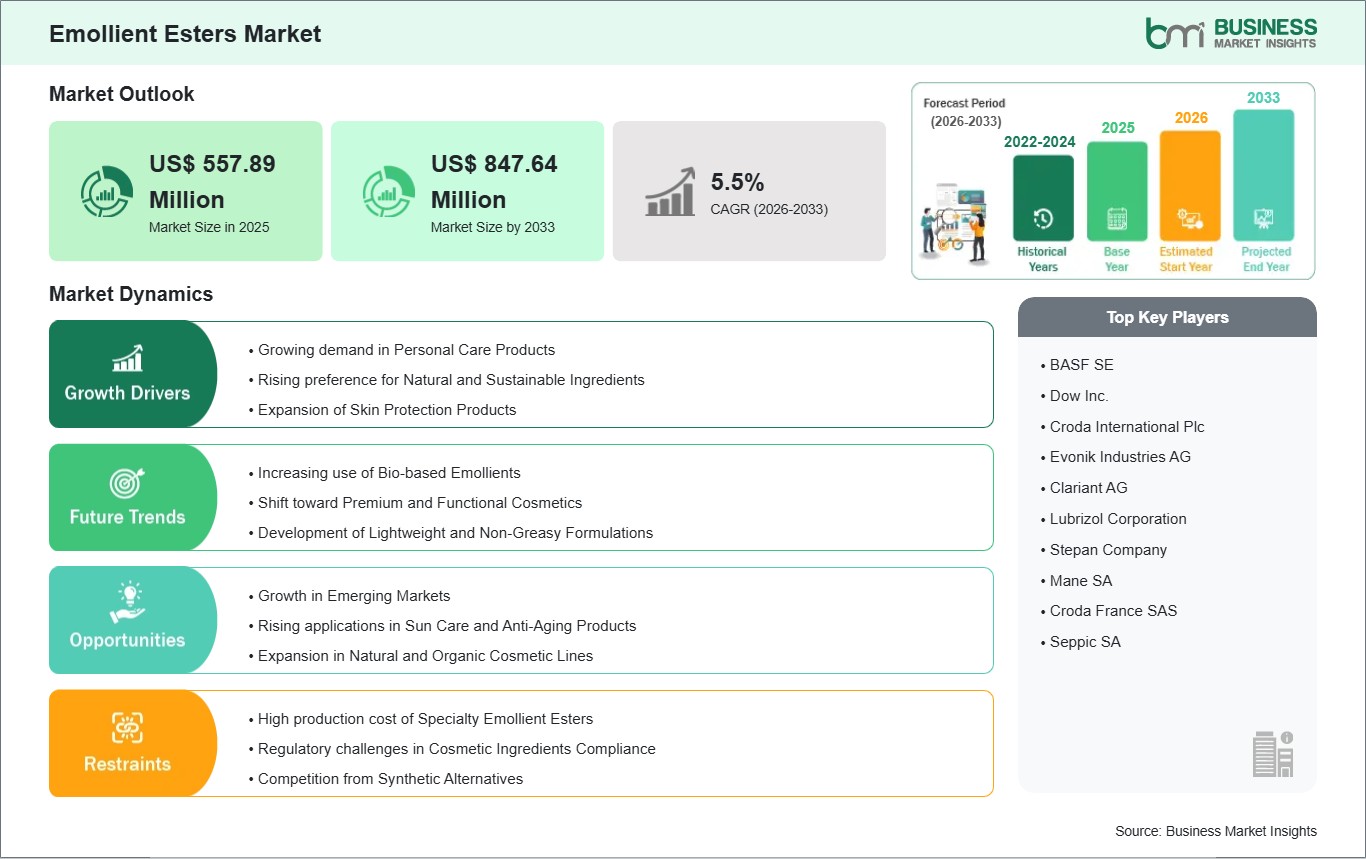
  • Product Type (Isopropyl Myristate, C-12-15 Alkyl Benzoate, Caprylic/Capric Triglyceride, Others)
  • End User (Skincare, Haircare, Cosmetics, Oral Care, and Others)

No. of Pages: 398
Report Code: BMIPUB00033917
Category: Chemicals and Materials
Emollient Esters Market

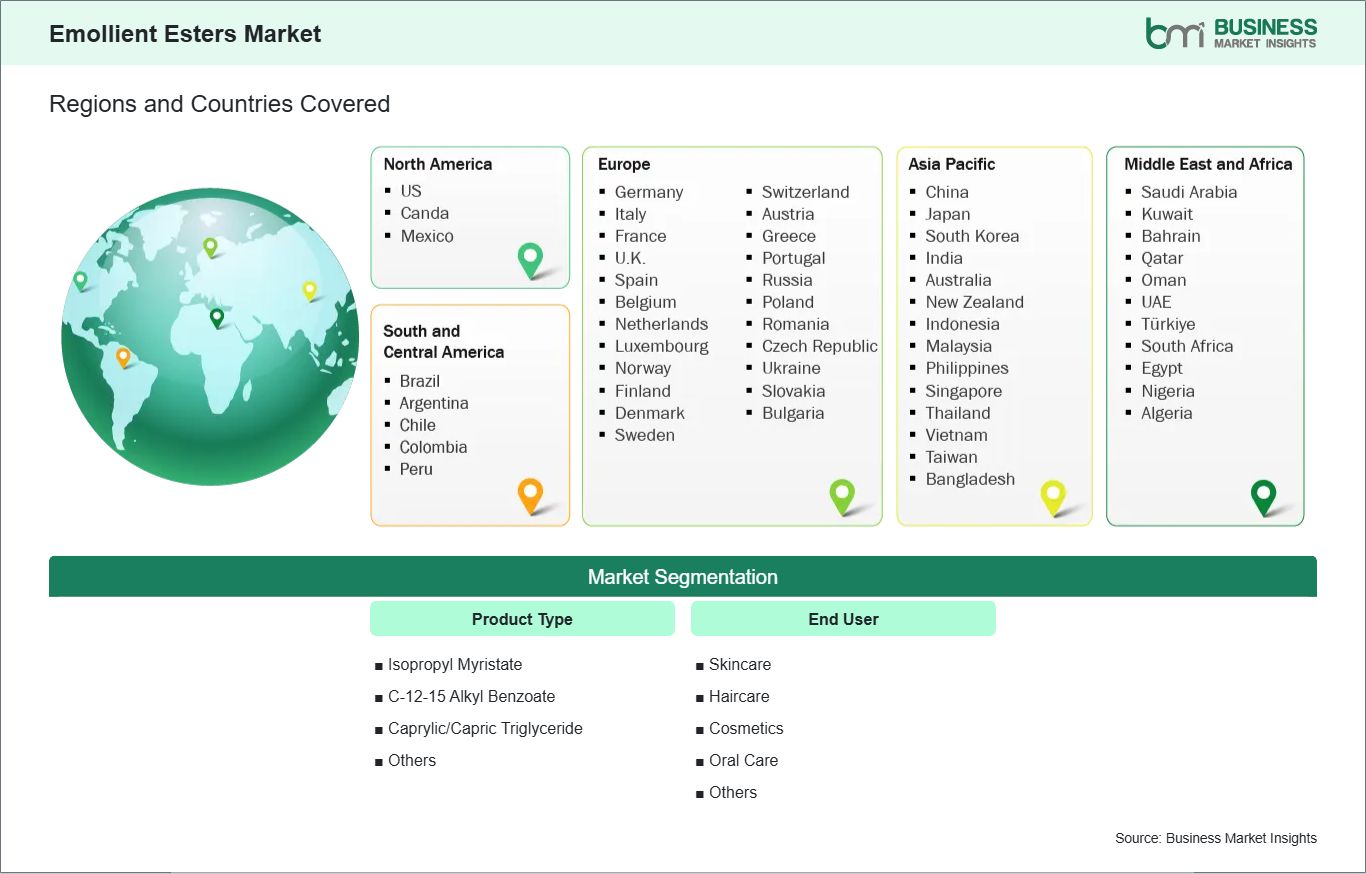
Emollient Esters market size is expected to reach US$ 847.64 Million by 2033 from US$ 557.89 Million in 2025. The market is estimated to record a CAGR of 5.5% from 2026 to 2033.

Executive Summary and Global Market Analysis:

The global market for emollient esters is an important part of the personal care, cosmetics, and specialty chemicals industry. These ingredients significantly improve the texture, spreadability, and sensory appeal of skincare, haircare, and cosmetic products. Emollient esters are widely used to soften and smooth the skin, increase moisture retention, and provide a lightweight, non-greasy feel in many products. You can commonly find them in creams, lotions, serums, sunscreens, and color cosmetics. As consumers seek high-performance and multifunctional beauty products, the demand for emollient esters has increased across personal care, pharmaceuticals, and wellness sectors. These esters come in various forms, including natural, synthetic, and semi-synthetic types, each made to deliver specific functional and sensory properties. Key categories of emollient esters include fatty esters, alkyl benzoates, isopropyl esters, and specialty blends, all designed for different formulation needs. They offer benefits like improved skin feel, better absorption, stability, and compatibility with active ingredients, which are key for maintaining product quality and effectiveness. Producing emollient esters involves chemical synthesis, esterification, and purification under controlled conditions to ensure consistent quality and performance. Manufacturers use advanced formulation techniques and innovative raw materials to customize traits like viscosity, volatility, and emolliency. Recent innovations focus on developing bio-based and sustainable esters to reduce environmental impact and meet clean-label and regulatory standards. Emollient esters play a vital role in fostering innovation in personal care and cosmetic products. In the skincare industry, they help develop moisturizing, anti-aging, and protective formulations. In haircare, they improve conditioning, shine, and manageability. The cosmetics sector relies on these ingredients to enhance texture, pigment dispersion, and product stability. Additionally, pharmaceutical and dermatological applications benefit from their soothing and carrier properties, further increasing their use. Market growth is driven by rising demand for premium personal care products, increased consumer awareness of skincare, and the global shift toward natural and sustainable ingredients. Trends like clean beauty, vegan formulations, and multifunctional products are boosting the adoption of emollient esters. At the same time, regulatory standards and sustainability concerns push manufacturers to create eco-friendly and biodegradable alternatives. Government regulations promoting safe cosmetic ingredients and environmentally responsible production practices also affect market development. However, the industry faces challenges such as fluctuations in raw material prices, strict regulatory requirements, and the need for constant product innovation. Supply chain complexities and balancing performance with sustainability can also impact market dynamics. Despite these challenges, ongoing advancements in chemical processing, more investment in research and development, and strong demand from personal care and related industries are expected to drive continued growth. Overall, the emollient esters market is set to meet the changing needs of modern consumers by supporting the development of high-performance, sustainable, and innovative products across global industries.

Emollient Esters Market - Strategic Insights:

global-market-strategic-framework
Get more information on this report

Emollient Esters Market Segmentation Analysis:

Key segments that contributed to the derivation of the Emollient Esters market analysis are product type and end user.

  • By product type, the Emollient Esters market is segmented into Isopropyl Myristate, C-12-15 Alkyl Benzoate, Caprylic/Capric Triglyceride, Others. The caprylic/capric triglyceride segment dominated the market in 2025.
  • By end user, the Emollient Esters market is segmented into skincare, haircare, cosmetics, oral care, and others. The skincare segment dominated the market in 2025.

Emollient Esters Market Drivers and Opportunities:

Rising Demand from Personal Care, Cosmetics, and Skincare Applications

The global market for emollient esters is growing quickly because of the rising demand from personal care, cosmetics, and skincare industries. The increased use of beauty and grooming products like moisturizers, lotions, sunscreens, and color cosmetics has significantly raised the need for effective emollient esters. These ingredients are crucial for improving texture, spreadability, and how products feel on the skin, while also increasing moisture retention and product stability. Growing consumer awareness about skincare, along with the demand for high-quality and multifunctional products, is driving market growth. The rising popularity of anti-aging, hydration, and sun protection formulations has also led to higher usage of emollient esters. The expansion of the men`s grooming segment and the growing interest in organic and natural cosmetics are further supporting market growth. In haircare applications, emollient esters enhance conditioning, shine, and manageability, making them vital in shampoos, conditioners, and styling products. The rapid growth of online shopping and beauty retail channels has made personal care products more accessible, which boosts demand even more. Emerging markets are seeing increased consumption due to higher disposable incomes, urbanization, and changing lifestyle preferences. As consumers look for high-quality, effective, and enjoyable products, the demand for emollient esters is expected to rise steadily worldwide.

Technological Advancements and Shift Toward Sustainable and Bio-Based Esters

Technological advancements are significantly influencing the global emollient esters market. Continuous innovation aims to improve formulation performance, enhance sensory qualities, and ensure compatibility with various cosmetic and personal care products. New ester chemistries allow for better absorption, non-greasy textures, and long-lasting moisture, meeting changing consumer needs. At the same time, there is a strong move toward sustainable, bio-based, and biodegradable esters due to growing environmental concerns and stricter regulations. Manufacturers are investing in green chemistry, renewable raw materials, and eco-friendly production methods to lessen environmental impact and meet clean-label standards. Advances in chemical engineering are enhancing the stability, versatility, and safety of emollient esters, making them suitable for sensitive skin and dermatological formulations. New formulation techniques also enable reduced ingredient use while keeping high product performance. Ongoing research and development efforts focus on creating multifunctional esters that combine emolliency with other advantages like emulsification and conditioning. As the industry keeps prioritizing sustainability, efficiency, and product innovation, technological advancements will be a key factor supporting long-term growth in the emollient esters market.

Emollient Esters Market Size and Share Analysis:

The caprylic/capric triglyceride segment leads the market due to its excellent emolliency, lightweight texture, and high skin compatibility. It is widely used in skincare and cosmetic products for moisturizing, improving spreadability, and enhancing the feel of creams, lotions, and serums. Its stability and versatility also make it suitable for both natural and synthetic formulations.

The skincare segment dominates the market because emollient esters are crucial for providing hydration, smoothness, and softness to the skin. A rising consumer focus on anti-aging, moisturizing, and sun protection products has significantly increased demand. Additionally, growing awareness of personal grooming, premium skincare trends, and formulations for sensitive skin further boost the use of emollient esters in this segment.

Emollient Esters Market Report Highlights:

Report Attribute Details
Market size in 2025 US$ 557.89 Million
Market Size by 2033 US$ 847.64 Million
Global CAGR (2026 - 2033)5.5%
Historical Data 2022-2024
Forecast period 2026-2033
Segments Covered By Product Type
  • Isopropyl Myristate
  • C-12-15 Alkyl Benzoate
  • Caprylic/Capric Triglyceride
  • Others
By End User
  • Skincare
  • Haircare
  • Cosmetics
  • Oral Care
  • Others
Regions and Countries Covered
North America US, Canada, Mexico
Europe Belgium, Austria, Finland, Denmark, Greece, Poland, Romania, Russia, Ukraine, Czech Republic, Slovakia, Bulgaria, Italy, Luxembourg, Germany, Switzerland, France, Netherlands, Norway, Portugal, Spain, Sweden, United Kingdom
Asia-Pacific Australia, China, India, Japan, South Korea, Indonesia, Malaysia, Philippines, Singapore, Thailand, Vietnam, Bangladesh, New Zealand, Taiwan
South and Central America Brazil, Argentina, Peru, Chile, Colombia
Middle East and Africa Bahrain, Kuwait, Oman, Qatar, Saudi Arabia, United Arab Emirates, Turkiye, South Africa, Egypt, Algeria, Nigeria
Market leaders and key company profiles
  • BASF SE
  • Dow Inc.
  • Croda International Plc
  • Evonik Industries AG
  • Clariant AG
  • Lubrizol Corporation
  • Stepan Company
  • Mane SA
  • Croda France SAS
  • Seppic SA
Get more information on this report

Emollient Esters Market Report Coverage and Deliverables:

The "Emollient Esters Market Size and Forecast (2022 - 2033)" report provides a detailed analysis of the market covering below areas:

  • Emollient Esters market size and forecast at global, regional, and country levels for all the key market segments covered under the scope
  • Emollient Esters market trends, as well as market dynamics such as drivers, restraints, and key opportunities
  • Emollient Esters market analysis covering key market trends, global and regional framework, major players, regulations, and recent market developments
  • Industry landscape and competition analysis covering market concentration, heat map analysis, prominent players, and recent developments for the Emollient Esters market
  • Detailed company profiles, including SWOT analysis

Emollient Esters Market Geographic Insights:

The geographical scope of the Emollient Esters market report is divided into five regions: North America, Asia Pacific, Europe, Middle East & Africa, and South & Central America. The Emollient Esters market in the Asia Pacific is expected to grow significantly during the forecast period.

The Asia-Pacific Emollient Esters market is segmented into China, Japan, South Korea, India, Australia, New Zealand, Indonesia, Malaysia, the Philippines, Singapore, Thailand, Vietnam, Taiwan, Bangladesh, and the Rest of Asia.

The Asia-Pacific region is the fastest-growing market for emollient esters. This growth comes from rapid industrialization, the expanding personal care and cosmetics industries, and a rising consumer demand for premium skincare and haircare products. Countries like China, Japan, India, South Korea, and Taiwan are seeing significant increases in the production and consumption of creams, lotions, sunscreens, and color cosmetics. These products rely heavily on emollient esters to improve texture, spreadability, and sensory appeal. The demand for multifunctional products with moisturizing, anti-aging, and protective benefits is driving the need for high-quality esters across the region. The popularity of men`s grooming products and natural or organic formulations is also helping the market grow. Investments in cosmetic manufacturing, research and development, and beauty product formulation technologies are further increasing the use of emollient esters. Rapid urbanization, rising disposable incomes, and more online shopping options are leading to higher consumption of skincare and haircare products, which raises the demand for high-quality emollient esters. The region benefits from cost-effective production capabilities, integrated supply chains, and a strong chemicals manufacturing ecosystem, allowing for large-scale production and export of emollient esters. Governments in Asia-Pacific are promoting industrial growth, encouraging innovation in personal care, and supporting sustainable manufacturing practices, which help the market expand further. Environmental regulations and consumer preference for eco-friendly products are pushing the adoption of bio-based, biodegradable, and low-toxicity esters. Technological improvements, including better synthesis methods, customized formulations, and enhanced delivery systems, increase performance, stability, and skin compatibility. The availability of a skilled workforce, access to raw materials, and growing investments in research and development enhance the region`s competitive edge. With ongoing growth in personal care consumption, supportive policies, and a focus on sustainability and innovation, Asia-Pacific is set to remain a central hub for production, consumption, and technological progress in the global emollient esters market.

global-market-geography
Get more information on this report

Emollient Esters Market Research Report Guidance:

  • The report includes qualitative and quantitative data in the Emollient Esters market across product type, end user, and geography.
  • The report starts with the key takeaways (chapter 2), highlighting the key trends and outlook of the Emollient Esters market.
  • Chapter 3 includes the research methodology of the study.
  • Chapter 4 further includes ecosystem analysis.
  • Chapter 5 highlights the major industry dynamics in the Emollient Esters market, including factors that are driving the market, prevailing deterrents, potential opportunities, as well as future trends. Impact analysis of these drivers and restraints is also covered in this section.
  • Chapter 6 discusses the Emollient Esters market scenario, in terms of historical market revenues, and forecast till the year 2031.
  • Chapters 7 to 10 cover Emollient Esters market segments by product type and end user across North America, Europe, Asia Pacific, Middle East and Africa, and South and Central America. They cover the market revenue and forecast and factors driving the market.
  • Chapter 11 describes the competitive analysis along with the heat map analysis for the key players operating in the market.
  • Chapter 12 describes the industry landscape analysis. It provides detailed descriptions of business activities such as market initiatives, new developments, mergers, and joint ventures globally, along with a competitive landscape.
  • Chapter 13 provides detailed profiles of the major companies operating in the Emollient Esters market. Companies have been profiled on the basis of their key facts, business descriptions, products and services, financial overview, SWOT analysis, and key developments.
  • Chapter 14, i.e., the appendix is inclusive of a brief overview of the company, a list of abbreviations, and a disclaimer.

Emollient Esters Market News and Key Development:

The Emollient Esters market is evaluated by gathering qualitative and quantitative data post primary and secondary research, which includes important corporate publications, association data, and databases. A few of the key developments in the Emollient Esters market are:

  • In March 2026, Emfinity Esters launched new ester-based emollients: Emfinity CGSA 600 B and Emfinity CGSA 200 B. Both are specialty emollients and industry-proven esters for every application - from light to rich sensory, including D5-mimic solutions.
  • In September 2024, Evonik officially inaugurated its new production plant for cosmetic emollients at its site in Steinau, Germany. These esters are manufactured using an enzymatic process. The double-digit million-euro plant will significantly increase Evonik`s production capacity which will cater to the growing customer demand for sustainable cosmetic emollients. This investment will help reduce the climate footprint of Evonik and the cosmetic formulations of its customers.

Key Sources Referred:

  • World Bank - Global Trade Indicators
  • World Trade Organization (WTO)
  • International Trade Administration (ITA)
  • Company website
  • Company annual reports
  • Company investor presentations
The List of Companies - Emollient Esters Market
  • BASF SE
  • Dow Inc.
  • Croda International Plc
  • Evonik Industries AG
  • Clariant AG
  • Lubrizol Corporation
  • Stepan Company
  • Mane SA
  • Croda France SAS
  • Seppic SA
Frequently Asked Questions
How big is the Emollient Esters Market?

The Emollient Esters Market is valued at US$ 557.89 Million in 2025, it is projected to reach US$ 847.64 Million by 2033.

What is the CAGR for Emollient Esters Market by (2026 - 2033)?

As per our report Emollient Esters Market, the market size is valued at US$ 557.89 Million in 2025, projecting it to reach US$ 847.64 Million by 2033. This translates to a CAGR of approximately 5.5% during the forecast period.

What segments are covered in this report?

The Emollient Esters Market report typically cover these key segments-

  • Product Type (Isopropyl Myristate, C-12-15 Alkyl Benzoate, Caprylic/Capric Triglyceride, Others)
  • End User (Skincare, Haircare, Cosmetics, Oral Care, and Others)

What is the historic period, base year, and forecast period taken for Emollient Esters Market?

The historic period, base year, and forecast period can vary slightly depending on the specific market research report. However, for the Emollient Esters Market report:

  • Historic Period : 2022-2024
  • Base Year : 2025
  • Forecast Period : 2026-2033
  • Who are the major players in Emollient Esters Market?

    The Emollient Esters Market is populated by several key players, each contributing to its growth and innovation. Some of the major players include:

  • BASF SE
  • Dow Inc.
  • Croda International Plc
  • Evonik Industries AG
  • Clariant AG
  • Lubrizol Corporation
  • Stepan Company
  • Mane SA
  • Croda France SAS
  • Seppic SA
  • Who should buy this report?

    The Emollient Esters Market report is valuable for diverse stakeholders, including:

    • Investors: Provides insights for investment decisions pertaining to market growth, companies, or industry insights. Helps assess market attractiveness and potential returns.
    • Industry Players: Offers competitive intelligence, market sizing, and trend analysis to inform strategic planning, product development, and sales strategies.
    • Suppliers and Manufacturers: Helps understand market demand for components, materials, and services related to concerned industry.
    • Researchers and Consultants: Provides data and analysis for academic research, consulting projects, and market studies.
    • Financial Institutions: Helps assess risks and opportunities associated with financing or investing in the concerned market.

    Essentially, anyone involved in or considering involvement in the Emollient Esters Market value chain can benefit from the information contained in a comprehensive market report.

    Available Report Formats

    pdf-format excel-format pptx-format
    Buy Now
    Sales Assistance
    +1 646 791 7070 (US & UK)
    Customization Form

    Please tell us your area of interest
    (Market Segments/ Regions and Countries/ Companies)