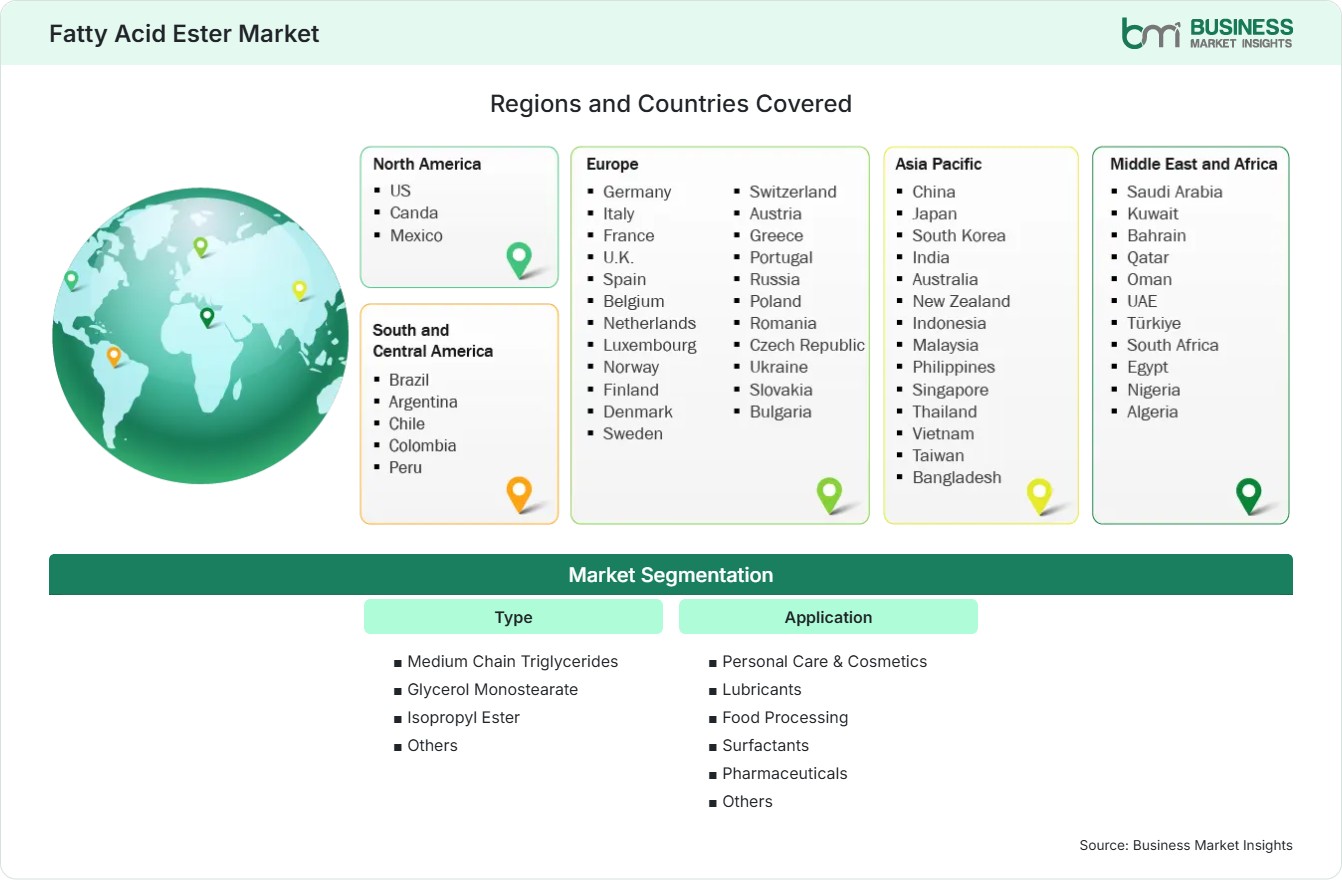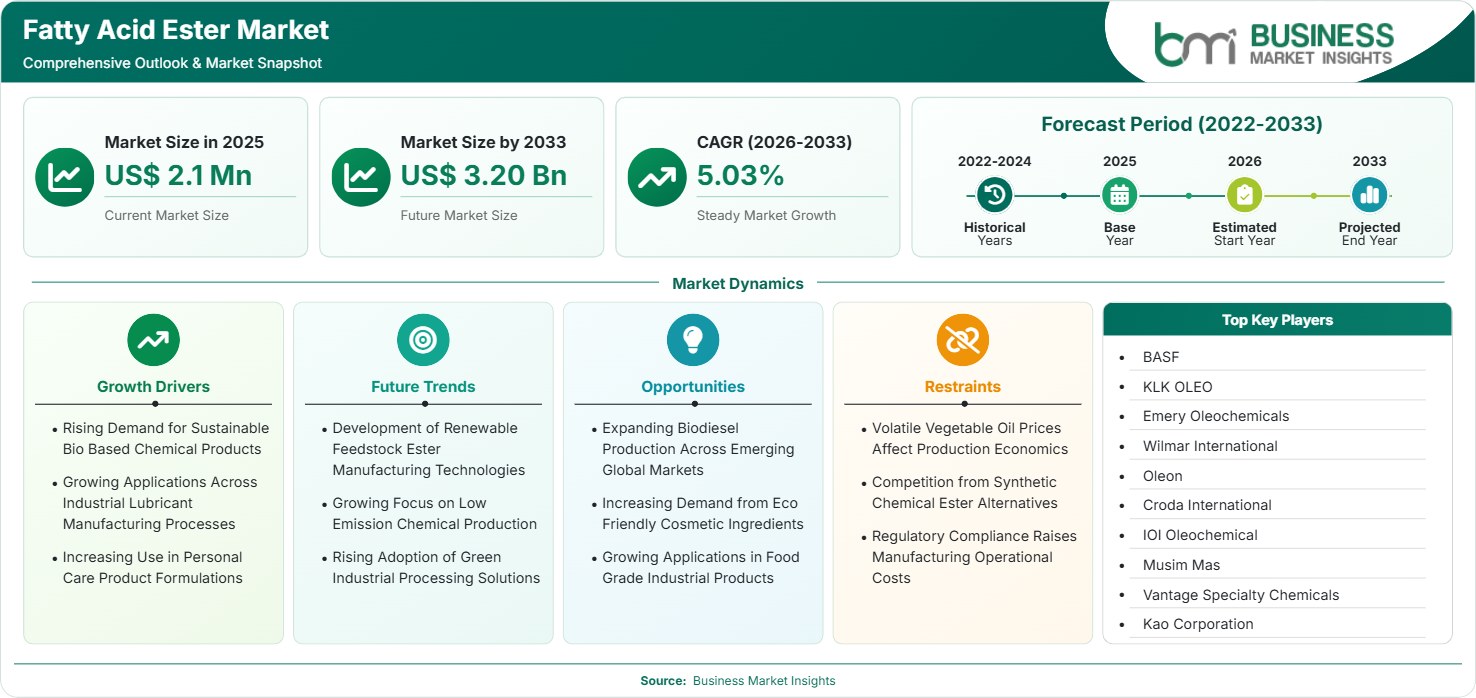
Fatty Acid Ester Market Regional Highlights
North America Fatty Acid Ester Market
North America represents 27%–30% of global demand in 2025 and is projected to grow at a CAGR of 4.7%–5.2% through 2033. The region benefits from strong specialty chemical manufacturing, advanced personal care industries, and increasing demand for sustainable ingredients. The United States remains the primary contributor, supported by established formulation capabilities and industrial applications.
- Cosmetic manufacturers are increasing adoption of ester-based ingredients to develop lightweight, skin-friendly, and sustainable personal care formulations.
- Industrial lubricant producers are incorporating fatty acid esters to improve biodegradability and performance characteristics in specialized applications.
- Chemical companies are investing in renewable feedstock utilization to align with sustainability objectives and consumer preferences.
- Research and development activities are supporting innovation in customized ester formulations for diverse applications.
US Fatty Acid Ester Market
The United States represents a significant North American market supported by strong personal care, pharmaceutical, food, and specialty chemical industries. Increasing preference for sustainable ingredients and environmentally responsible formulations is encouraging adoption across multiple applications. The country benefits from advanced manufacturing capabilities, established supply chains, and increasing demand for high-performance bio-based chemical solutions.
- Personal care companies are increasing usage of fatty acid esters in moisturizers, emollients, and specialty cosmetic formulations.
- Industrial users are adopting biodegradable lubricant solutions to improve environmental performance and operational efficiency.
- Pharmaceutical manufacturers are exploring ester-based ingredients for specialized formulations and functional applications.
Europe Fatty Acid Ester Market
Europe contributes 24%–27% of global demand in 2025 and is expected to expand at a CAGR of 4.8%–5.3% through 2033. Germany, France, and the United Kingdom remain important markets due to advanced cosmetic industries, sustainability regulations, and specialty chemical manufacturing capabilities. The region continues promoting renewable ingredient adoption across industrial and consumer applications.
- Regulatory focus on sustainable chemicals is encouraging manufacturers to adopt bio-based ester solutions across industries.
- Cosmetic brands are increasing demand for naturally derived ingredients supporting clean-label and environmentally conscious products.
- Industrial lubricant applications are expanding due to demand for biodegradable performance materials.
- Specialty chemical producers are investing in advanced ester formulation technologies.
Asia Pacific Fatty Acid Ester Market
Asia Pacific accounts for 36%–39% of global demand in 2025 and is projected to achieve a CAGR of 5.5%–6.0% through 2033. China, India, Indonesia, and Malaysia represent important markets due to expanding oleochemical production, cosmetic manufacturing, and industrial growth. The region benefits from strong raw material availability and increasing downstream application demand.
- Growing personal care manufacturing is increasing demand for ester-based ingredients in cosmetic and skincare formulations.
- Biodiesel production expansion is supporting demand for fatty acid ester derivatives across emerging economies.
- Food processing industries are adopting specialty esters for functional ingredient applications.
- Regional manufacturers are increasing production capacity to support domestic and international demand.
Rest of World Fatty Acid Ester Market
The Rest of World region represents 9%–12% of global demand in 2025 and is forecast to grow at a CAGR of 4.9%–5.4% through 2033. Latin America benefits from agricultural resources and biodiesel opportunities, while Middle Eastern and African markets are developing specialty chemical and personal care industries. Growing industrial diversification supports market expansion.
- Latin American producers are leveraging agricultural resources to support bio-based chemical manufacturing.
- Biodiesel development projects are increasing demand for ester-based raw materials in emerging economies.
- Personal care consumption growth is supporting adoption of specialty ingredients across developing markets.
- Industrial sectors are exploring sustainable alternatives to conventional chemical formulations.