
Fatty Acids Market Outlook: Size, Share, Trends, Growth Analysis, Competitive Landscape & Forecast, 2026–2033

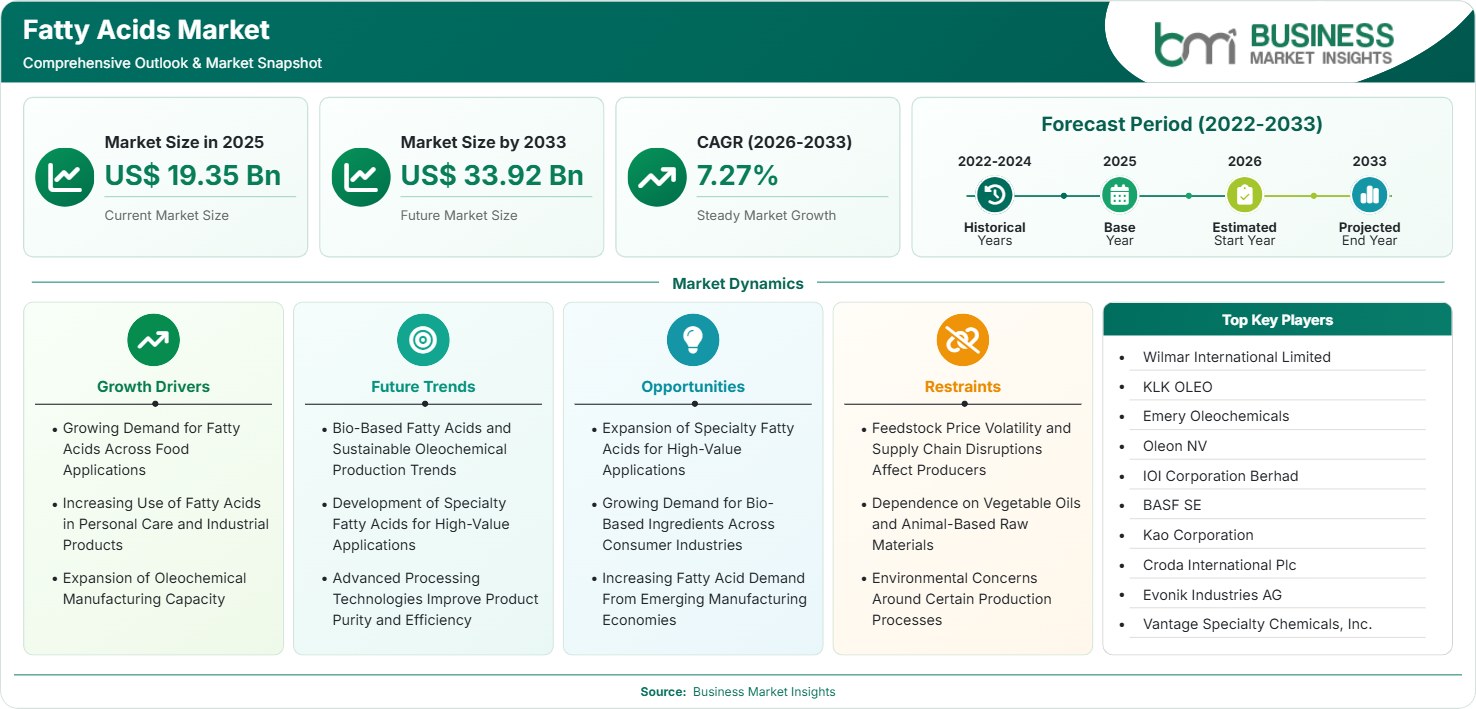
The Fatty Acids Market size was valued at US$ 19.35 Billion in 2025 and is projected to reach US$ 33.92 Billion by 2033, growing at a CAGR of 7.27% during 2026–2033, driven by oleochemical demand, personal care consumption, bio-based formulations, industrial applications, and expanding manufacturing capacity.

Report Coverage
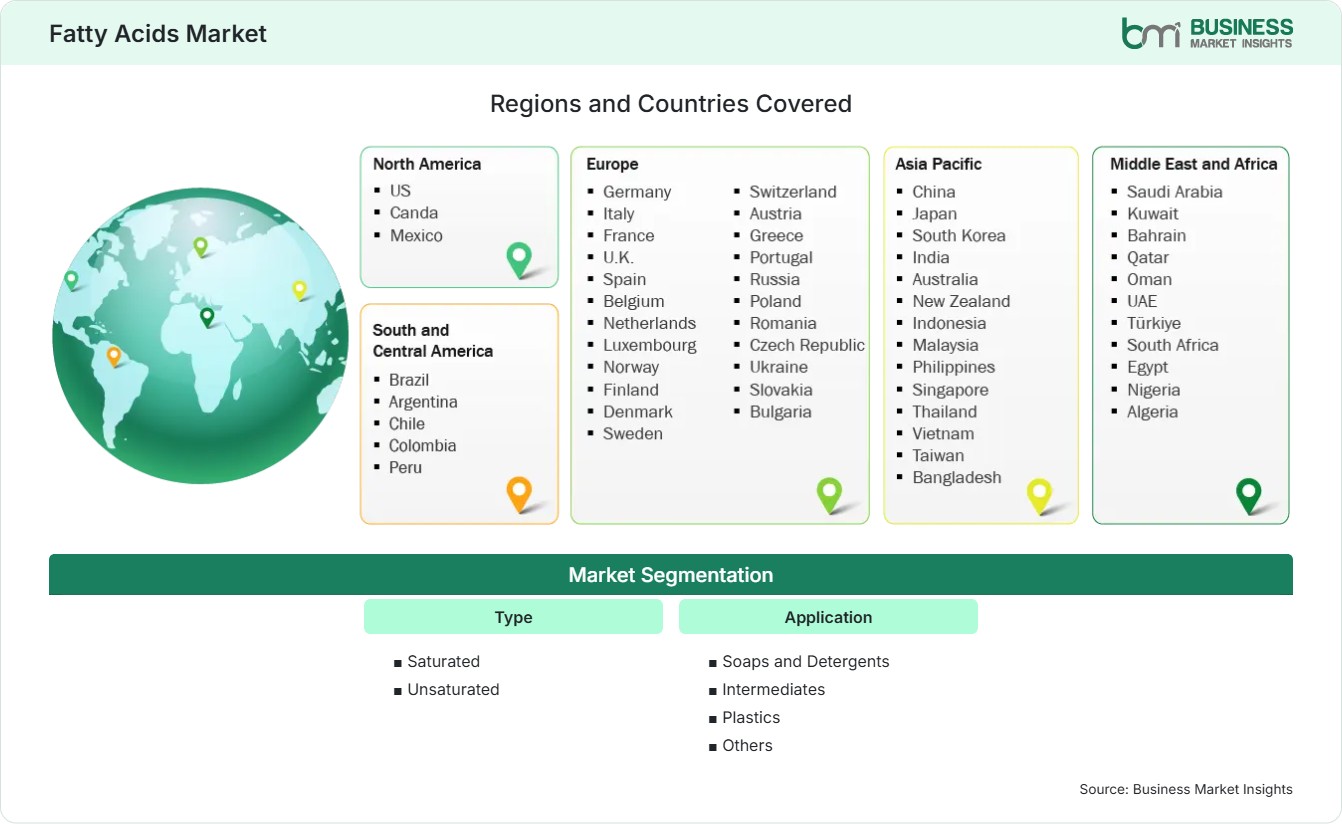
  • Type: Saturated, Unsaturated
  • Application: Soaps and Detergents, Intermediates, Plastics, Others
US$ 19.35 Bn Market size in 2025
US$ 33.92 Bn Market Size by 2033
7.27% CAGR, 2026 - 2033
2026-2033 Forecast Period

AI Overview

Fatty Acids Market Summary

  • North America Region: North America holds a 20%–23% fatty acids market share in 2025, growing at a 6.1%–6.6% CAGR during 2026–2033, supported by personal care, food processing, industrial chemicals, and demand for higher-purity specialty ingredients across established manufacturing networks. The US accounts for a 78%–82% share of regional demand and is projected to grow at a 6.0%–6.5% CAGR through 2033, supported by consumer products and industrial applications.
  • Fastest Growing Region: Asia Pacific holds a 43%–47% share in 2025, expanding at a 8.0%–8.6% CAGR during 2026–2033, supported by expanding oleochemical production, consumer goods manufacturing, detergent demand, personal care consumption, food processing, plastics production, and increasing availability of renewable feedstocks across major manufacturing economies.
  • Leading Segment: Saturated fatty acids account for a 58%–62% share in 2025 and are projected to grow at a 6.9%–7.4% CAGR during 2026–2033, supported by established demand in soaps, detergents, intermediates, personal care formulations, plastics, lubricants, and other industrial applications requiring consistent chemical properties.
  • High Growth Segment: Unsaturated fatty acids represent a 38%–42% share in 2025 and are forecast to expand at a 7.7%–8.2% CAGR during 2026–2033, driven by specialty formulations, nutrition-related applications, personal care ingredients, polymers, coatings, and increasing demand for functional bio-based intermediates.
  • Key Market Opportunity: Increasing substitution of petroleum-derived ingredients with renewable oleochemical feedstocks creates opportunities for specialty fatty acids, differentiated purity grades, traceable sourcing, functional derivatives, and higher-value formulations.
  • Major Market Players: Wilmar International Limited, KLK OLEO, Emery Oleochemicals, Oleon NV, IOI Corporation Berhad, BASF SE, Kao Corporation, Croda International Plc, Evonik Industries AG, Vantage Specialty Chemicals, Inc.
Strategic Insights

Fatty Acids Market: Strategic Insights

Fatty Acids Market Strategic Framework
FREE PDF
Request your free sample
Request free sample
Stakeholder View

Key Takeaways

  • The industry structure increasingly favors integrated producers controlling feedstock procurement, and downstream customer relationships, creating advantages in cost management, supply security, and product consistency.
  • Unsaturated fatty acids provide an attractive growth avenue because specialty applications increasingly require differentiated functional properties, including oxidation behavior, and performance in higher-value downstream products.
  • Product development is moving towards more high purity, specialized applications, traceability, and sustainably produced grades, raising the significance of analysis, process control, raw material certification, and formulations.
  • Asia Pacific offers the most compelling case for investment as the region sees growth in production, consumer goods production, and processing capacity.
  • Strategic investment is increasingly directed toward integrated production, downstream specialization, and regional distribution capabilities, strengthening competitive resilience against commodity price volatility.
  • Procurement strategies are becoming more diversified as buyers seek multiple feedstock options, and contractual flexibility to reduce exposure to agricultural commodity disruptions.
Geographic Outlook

Fatty Acids Market Regional Highlights

North America Fatty Acids Market

North America fatty acids market represents a 20%–23% share in 2025 and is projected to expand at a 6.1%–6.6% CAGR through 2033. Demand is supported by personal care, food processing, detergents, plastics, coatings, lubricants, and industrial intermediates. Established chemical infrastructure supports consistent production and distribution, while consumer preference for bio-based ingredients encourages renewable feedstock adoption.

  • Personal care and household formulations are increasing demand for consistent fatty acid grades with controlled purity, odor, color, oxidation characteristics, and compatibility with downstream formulation systems.
  • Food-related applications support demand for regulated grades where traceability, compositional consistency, and controlled processing conditions are increasingly important procurement requirements.
  • Plastics and industrial applications are expanding demand for fatty acids used as intermediates, processing aids, lubricants, modifiers, and performance-enhancing inputs across manufacturing processes.
  • Supply-chain diversification is encouraging regional inventory strategies, multiple sourcing arrangements, and greater emphasis on dependable delivery of renewable oleochemical feedstocks.

US Fatty Acids Market

The US fatty acids market accounts for a 78%–82% share of North American demand in 2025 and is expected to grow at a 6.0%–6.5% CAGR through 2033. Demand is diversified across detergents, personal care, food ingredients, plastics, coatings, lubricants, and industrial chemicals. Strong formulation capabilities support specialty-grade consumption, while sustainability requirements increase interest in renewable feedstocks.

  • Household and personal care production supports steady consumption of fatty acids as formulation ingredients, surfactant precursors, emulsifying components, and functional chemical intermediates.
  • Industrial manufacturing provides demand through plastics, coatings, lubricants, rubber-related processing, and chemical intermediates where specific chain lengths and purity characteristics influence performance.

Europe Fatty Acids Market

Europe fatty acids market holds a 22%–25% share in 2025 and is forecast to register a 6.0%–6.5% CAGR through 2033. Germany, France, Italy, and the Netherlands represent important downstream manufacturing centers, while Poland provides comparatively stronger growth potential at a 6.8%–7.3% CAGR. Sustainability regulation, circularity objectives, renewable feedstock adoption, and demand for responsibly sourced ingredients are shaping procurement.

  • Germany maintains strong demand through chemicals, personal care, industrial manufacturing, plastics, and formulation industries requiring consistent fatty acid specifications and dependable supply.
  • Poland provides higher growth potential as manufacturing capacity expands across consumer products, chemicals, plastics, food processing, and industrial applications.
  • France, Italy, and the Netherlands benefit from established formulation, food, personal care, chemical, and distribution ecosystems supporting diversified downstream demand.
  • Sustainability requirements are increasing the importance of traceability, renewable feedstocks, responsible sourcing, emissions management, and lifecycle considerations in supplier selection.

Asia Pacific Fatty Acids Market

Asia Pacific accounts for a 43%–47% share in 2025 and is projected to grow at an 8.0%–8.6% CAGR through 2033. China remains a major consumption and processing center, while India represents a high-growth market with a modeled 8.5%–9.1% CAGR. Southeast Asia benefits from integrated agricultural and oleochemical supply chains, while Japan and South Korea contribute demand for refined and specialty grades.

  • China provides broad demand across detergents, personal care, plastics, food processing, chemical intermediates, and industrial formulations supported by extensive downstream manufacturing infrastructure.
  • India offers high growth through consumer goods expansion, personal care consumption, detergents, food processing, plastics, and increasing domestic chemical manufacturing capacity.
  • Southeast Asia benefits from proximity to vegetable-oil feedstocks, integrated oleochemical processing, export-oriented manufacturing, and expanding downstream derivative production.
  • Japan and South Korea emphasize refined and specialty materials for high-performance applications, creating demand for consistent specifications, advanced purification, and technical formulation support.

Rest of World Fatty Acids Market

Rest of World represents a 9%–12% share in 2025 and is projected to grow at a 6.7%–7.2% CAGR through 2033. South and Central America benefit from agricultural processing, detergents, food manufacturing, personal care, and chemical production. Brazil remains the leading regional market, while Mexico provides diversified downstream demand. Middle Eastern and African markets are supported by consumer-product manufacturing, food processing, industrial chemicals, and infrastructure development. Latin American consumption is supported by food processing, home care, personal care, plastics, and industrial manufacturing. Brazil provides the broadest demand base. Saudi Arabia is modeled at a 7.1%–7.7% CAGR, supported by industrial diversification and downstream chemical investment.

  • Brazil benefits from diversified agricultural, food, personal care, home care, and industrial manufacturing activity, supporting broad fatty acid consumption across downstream formulations.
  • Mexico provides opportunities through manufacturing integration, consumer products, plastics, food processing, and industrial chemicals requiring dependable regional and cross-border supply.
  • Saudi Arabia's industrial diversification is expanding chemical and consumer-product manufacturing, increasing demand for renewable and conventional oleochemical inputs.
  • African markets offer longer-term growth potential as detergent, personal care, food, and industrial manufacturing capacity expands from relatively lower consumption bases.
Global Market Geography
FREE PDF
Request your free sample
Request free sample
Segment Analysis

Fatty Acids Market Segmentation

Type

Type segmentation determines functionality, stability, formulation compatibility, and downstream application suitability. Saturated fatty acids lead with a 58%–62% share in 2025 and grow at a 6.9%–7.4% CAGR through 2033, supported by established industrial consumption. Unsaturated fatty acids are gaining faster through specialty formulations and performance-oriented applications.

  • Saturated: Saturated fatty acids provide stability and consistent functional properties, supporting soaps, detergents, intermediates, personal care, plastics, lubricants, and industrial formulations requiring predictable performance.
  • Unsaturated: Unsaturated fatty acids provide functional flexibility for specialty formulations, nutrition-related uses, personal care, polymers, coatings, and advanced intermediates where unsaturation influences chemical reactivity and performance.

Application

Application demand is diversified across household products, chemical intermediates, polymers, and industrial formulations. Soaps and detergents remain a major consumption base because fatty acids provide essential inputs for surfactant and cleaning-product manufacturing. Intermediates represent a broad value-adding pathway, while plastics applications increasingly require functional additives and processing inputs.

  • Soaps and Detergents: Fatty acids support cleaning-product manufacturing through surfactant formation and formulation functionality, with demand influenced by household consumption, hygiene requirements, product diversification, and bio-based ingredient adoption.
  • Intermediates: Fatty acids serve as versatile chemical building blocks for downstream derivatives, with consumption supported by demand for fatty alcohols, esters, amines, surfactants, and specialty chemicals.
  • Plastics: Plastics applications use fatty acids and derivatives for processing, lubrication, modification, and performance enhancement, with demand linked to polymer production, additive development, and manufacturing efficiency.
Market Forces

Fatty Acids Market Dynamics

Key Market Drivers

Growing Demand for Fatty Acids Across Food Applications

Demand for fatty acids is bolstered by growing consumption of processed foods, functional ingredients, specialty formulations, and nutritional foods that require regulated levels of lipids and quality raw materials. Fatty acids provide functionalities in terms of formulation performance, nutrition, texture, stability, and processability in certain food applications. The increase in food production capability in emerging countries is expanding the addressable market size, while regulations are making purity, traceability, and consistent specifications increasingly important. Consequently, suppliers are focusing on quality management and differentiation rather than purely on volumes.

Increasing Use of Fatty Acids in Personal Care and Industrial Products

Personal care and industrial manufacturing are expanding the application base for fatty acids through detergents, cosmetics, lubricants, plastics, coatings, rubber processing, and chemical intermediates. Demand is increasingly differentiated according to purity, chain length, color, stability, and compatibility with formulation systems. Personal care formulators are also increasing the use of renewable and naturally derived ingredients as sustainability objectives influence product development. Fatty Acids Market trends are consequently shifting toward specialized grades, application support, and supply-chain transparency.

Expansion of Oleochemical Manufacturing Capacity

Oleochemical capacity growth will enhance regional product availability while also facilitating greater downstream integration. The growth in capacity will enhance the ability to transform vegetable oil and other renewable sources into fatty acids and other related chemicals. This is especially applicable in regions where there are existing agricultural networks and a growing manufacturing base for consumer goods. Producers have been working to increase efficiency, improve energy use, and minimize waste to ensure economic gains. Fatty Acids Market growth will be positively affected by the capacity expansion which support downstream consumption while reducing supply constraints.

Key Market Opportunities

Expansion of Specialty Fatty Acids for High-Value Applications

Specialty fatty acids offer an opportunity to increase margins on the basis of meeting applications that require better performance, higher purity, different chain lengths, oxidative stability, and functional properties above the pricing of commodity products. The demand could be broadened in areas such as personal care, nutrition, pharmaceuticals, advanced polymers, lubricants, coatings, and specialty intermediates chemicals. Consequently, building up on analytical, engineering, and customer collaboration could help to increase differentiation. The high value of applications will translate feedstock benefits into improved chemical performance in terms of differentiation.

Growing Demand for Bio-Based Ingredients Across Consumer Industries

The consumer industry is embracing the use of renewable components in light of the sustainability considerations, regulatory requirements, and consumer preferences affecting formulation approaches. The need for renewable materials is expected to grow in areas such as personal care, detergents, household products, plastic goods, coatings, and specialty formulations as consumers set renewable content goals. Companies can enhance their competitive positions by ensuring they have certified supply chain systems, better carbon accounting, and adequate documentation processes throughout the value chain.

Increasing Fatty Acid Demand from Emerging Manufacturing Economies

Manufacturing developing economies present many opportunities since industrialization will lead to an increase in usage of soaps, toiletries, foods, plastics, paints, and intermediate chemicals. The production of final products locally will lead to the sourcing of chemicals locally, whereas industrial park and processing facility investments may lead to an increased demand for stable supply of fatty acids. Developing countries like India, Southeast Asia, Latin America, and selected Middle East economies represent significant opportunities since their downstream manufacturing base is growing from a relatively lower level. Fatty Acids Market Forecasts show more preference to areas where the consumer base and industrialization are developing at the same time through multiple downstream channels.

Market Restraints and Challenges

Feedstock Price Volatility and Supply Chain Disruptions Affect Producers

Factor: Fluctuations in the price of vegetable oil and other sources of renewable raw materials can significantly affect the cost of fatty acid production. Impact: Increased or unstable input costs can compress profit margins for producers and cause increased price volatility for clients. The challenge is particularly relevant for commodity-oriented products where producers have limited ability to pass higher input costs through immediately.

Dependence on Vegetable Oils and Animal-Based Raw Materials

Factor: Heavy reliance on agricultural and animal-derived feedstocks exposes producers to availability constraints, sustainability requirements, seasonal production patterns, and changing sourcing conditions. Impact: Feedstock dependence can restrict production flexibility and create compliance, procurement, and cost pressures when preferred raw materials become constrained. Increasing demand for traceability and responsible sourcing further raises the importance of documented supply chains. Producers that cannot diversify sourcing may face greater exposure to agricultural disruptions and sustainability-related procurement constraints.

Company Analysis

Competitive Landscape

The Fatty Acids Market analysis indicates that competitiveness is becoming more dependent on factors such as feedstock integration, manufacturing capacity, quality of products, specialty grade offerings, geographic coverage, sustainability, and customer support downstream. The large manufacturers have an advantage because of their integration in the value chain, while the specialty manufacturers compete on basis of grades.

Company Name

Overview

Products and Services relevant to this market

Wilmar International Limited

Integrated agribusiness and oleochemical producer with extensive feedstock access, processing capabilities, and international distribution infrastructure.

Fatty acids, oleochemical derivatives, specialty grades, industrial chemistry products, personal care ingredients, home-care inputs, and supply-chain services.

KLK OLEO

Global oleochemical producer with integrated manufacturing operations across major Asian and European production regions.

Fatty acids, glycerine, fatty alcohols, fatty esters, specialty oleochemicals, renewable ingredients, polymers inputs, and technical solutions.

Emery Oleochemicals

Specialty chemicals producer focused on renewable-resource-based chemicals and performance-oriented oleochemical solutions.

Fatty acids, bio-based plasticizers, polyols, lubricants, coatings inputs, antioxidants, and specialty chemical intermediates.

Oleon NV

European oleochemical producer specializing in natural fats and oils conversion into renewable chemical ingredients.

Fatty acids, esters, glycerine, surfactants, lubricants, nutrition ingredients, personal care inputs, and industrial oleochemicals.

IOI Corporation Berhad

Integrated plantation and resource-based manufacturing group with substantial oleochemical production and downstream capabilities.

Fatty acids, fatty alcohols, glycerine, esters, specialty chemicals, surfactants, and renewable oleochemical derivatives.

BASF SE

Diversified chemical manufacturer serving consumer, industrial, nutrition, personal care, and specialty chemical value chains.

Fatty acids and related ingredients, care chemicals, specialty intermediates, formulation materials, and industrial chemical solutions.

Kao Corporation

Consumer and chemical products company with established oleochemical and specialty chemical capabilities.

Fatty acids, fatty alcohols, fatty amines, surfactants, oleochemical derivatives, personal care ingredients, and home-care materials.

Croda International Plc

Specialty chemicals producer focused on high-performance ingredients and application-specific solutions across consumer and industrial markets.

Oleochemical ingredients, specialty fatty derivatives, personal care materials, industrial additives, lubricants, coatings, and formulation technologies.

Evonik Industries AG

Specialty chemicals producer with advanced capabilities in functional ingredients and high-value chemical applications.

Specialty fatty derivatives, additives, formulation ingredients, industrial chemicals, nutrition materials, and performance-enhancing solutions.

Vantage Specialty Chemicals, Inc.

Specialty ingredients manufacturer serving personal care, food, pharmaceutical, and industrial formulation markets.

Fatty acids, esters, specialty ingredients, personal care materials, pharmaceutical excipients, food ingredients, and industrial additives.

Trust & Transparency

Research Methodology

The market analysis combines proprietary research with secondary data from government agencies, company disclosures, regulatory filings, industry databases and expert interviews. Market estimates are validated through data triangulation, cross-market benchmarking and analyst review.

View Full Research Methodology

Questions Answered

Frequently Asked Questions

Why is Asia Pacific expected to remain the primary regional growth center?

Increasing demand for detergents, personal care products, food, plastics, and industrial chemicals creates multiple consumption channels while regional feedstock availability supports competitive production economics.

Which downstream application provides the broadest demand base?

Soaps and detergents provide one of the broadest application bases because fatty acids are used directly and indirectly across cleaning-product value chains.

How important is renewable feedstock sourcing to future production?

Traceability, responsible sourcing, carbon accounting, and feedstock diversification are increasingly becoming procurement considerations alongside price, quality, and supply reliability.

What is driving demand for specialty fatty acids?

Specialty demand is being driven by applications requiring tighter purity, specific chain lengths, controlled oxidation characteristics, improved functionality, and traceable renewable sourcing.

Which fatty acid type is expected to maintain the largest market position in fatty acids market report?

Saturated fatty acids are expected to retain the leading position because of their broad use across soaps, detergents, intermediates, personal care, plastics, and industrial formulations.

Access the Full Fatty Acids Market Report

Get segment-level forecasts, regional estimates, competitive benchmarking, company profiles and downloadable Excel datasets.

Access the full Fatty Acids Market Report
350 pages PDF & Excel | 2026-08-20
Similar Research

Related Market Reports