
Formic Acid Market Outlook: Size, Share, Trends, Growth Analysis, Competitive Landscape & Forecast, 2026-2033

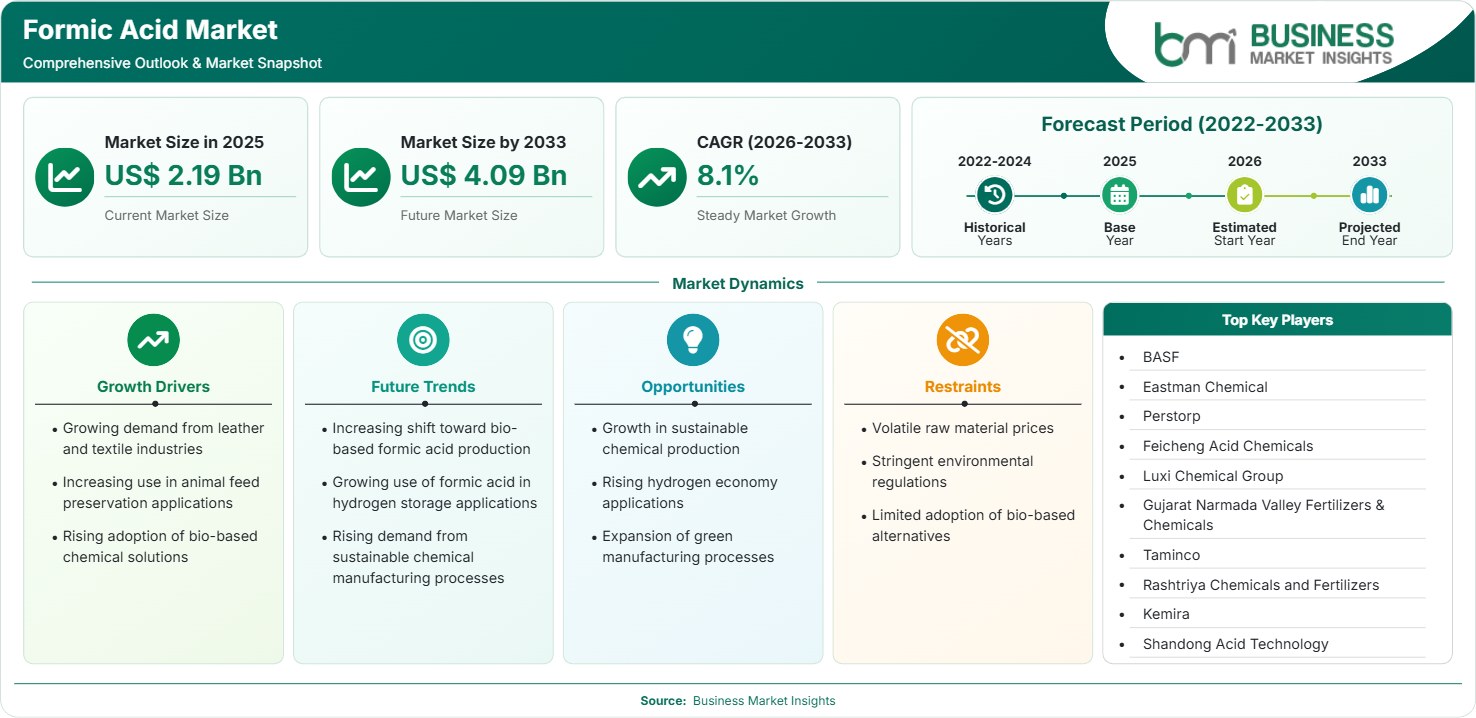
The Formic Acid Market size was valued at US$ 2.19 Billion in 2025 and is projected to reach US$ 4.09 Billion by 2033, growing at a CAGR of 8.1% during 2026–2033, driven by increasing applications in leather processing, textile manufacturing, animal feed preservation, and rising demand for sustainable chemical solutions across industrial sectors.

Report Coverage
  • Grade: 85%, 94%, 99%, Others
  • Application: Agriculture, Leather & Textile, Chemical, Rubber, Pharmaceuticals, Others
US$ 2.19 Bn Market size in 2025
US$ 4.09 Bn Market Size by 2033
8.1% CAGR, 2026 - 2033
2026-2033 Forecast Period

AI Overview

Formic Acid Market Summary

  • North America Region: North America holds a 24%–27% share in 2025 and is projected to grow at a CAGR of 7.2%–7.9% during 2026–2033. Formic Acid Market Growth is supported by expanding chemical manufacturing, sustainable production initiatives, agricultural applications, and demand for specialty chemicals. The US market is expected to grow at a 7.3%–8.0% CAGR, driven by industrial chemical demand, livestock production, and bio-based formulation adoption.
  • Fastest Growing Region: Asia Pacific represents a 42%–45% share in 2025 and is expected to register the fastest growth with a CAGR of 8.8%–9.5%, supported by expanding agriculture, textile manufacturing, chemical production, and increasing industrial investments in China and India.
  • Leading Segment: 85% Grade accounts for a 48%–52% share in 2025 and is forecast to grow at a CAGR of 7.8%–8.5%, supported by broad usage in animal feed preservation, agriculture, leather processing, and industrial applications.
  • High Growth Segment: 99% Grade is projected to expand at a CAGR of 9.0%–9.8%, supported by increasing demand for high-purity chemical applications, pharmaceutical intermediates, specialty synthesis, and advanced manufacturing processes.
  • Key Market Opportunity: Sustainable chemical production, green manufacturing processes, and hydrogen economy applications are creating opportunities for manufacturers to develop low-carbon formic acid production technologies and advanced industrial solutions.
  • Major Market Players: BASF, Eastman Chemical, Perstorp, Feicheng Acid Chemicals, Luxi Chemical Group, Gujarat Narmada Valley Fertilizers & Chemicals, Taminco, Rashtriya Chemicals and Fertilizers, Kemira, Shandong Acid Technology.
Strategic Insights

Formic Acid Market: Strategic Insights

Formic Acid Market Strategic Framework
FREE PDF
Request your free sample
Request free sample
Stakeholder View

Key Takeaways

  • The market value chain is expanding beyond conventional chemical production toward integrated systems incorporating sustainable feedstocks, specialty formulations, and application-focused solutions.
  • Agriculture and animal feed preservation remain important growth areas due to rising livestock production, increasing food demand, and the need for improved feed quality management.
  • Manufacturers are prioritizing bio-based production methods, process optimization, and lower-emission technologies to align with global sustainability objectives.
  • Asia Pacific offers strong investment potential due to expanding chemical manufacturing capacity, agricultural demand, textile production, and industrial infrastructure development.
  • Strategic partnerships among chemical manufacturers, technology providers, and end-user industries are supporting product innovation and geographic expansion.
  • Companies are exploring formic acid applications within the hydrogen economy, including hydrogen storage and transport solutions, creating future growth opportunities beyond traditional uses.
Geographic Outlook

Formic Acid Market Regional Highlights

North America Formic Acid Market

North America accounted for a 24%–27% share in 2025 and is projected to expand at a CAGR of 7.2%–7.9% from 2026–2033. The region benefits from established chemical manufacturing infrastructure, advanced agricultural systems, and demand for specialty chemicals. The United States remains the leading formic acid market due to industrial applications, livestock production, and increasing adoption of sustainable chemical solutions.

  • Chemical manufacturers are investing in cleaner production processes to meet sustainability targets and improve operational efficiency.
  • Agricultural producers increasingly use formic acid-based solutions for feed preservation and improved livestock management practices.
  • Textile and leather industries continue supporting demand through processing and finishing applications.
  • Specialty chemical applications are expanding through pharmaceutical and industrial manufacturing requirements.
  • Research initiatives around renewable chemical production are supporting long-term market innovation.

US Formic Acid Market

The US represented a 20%–23% share in 2025 and is forecast to grow at a CAGR of 7.3%–8.0% through 2033. Market expansion is supported by strong agricultural activity, chemical manufacturing capabilities, and increasing demand for sustainable solutions. Domestic producers are focusing on efficient manufacturing processes and application development across industrial sectors.

  • Livestock production continues driving demand for formic acid-based feed preservation solutions.
  • Chemical manufacturers are adopting improved processes to enhance efficiency and sustainability.
  • Pharmaceutical and specialty chemical applications are creating additional demand opportunities.
  • Environmental initiatives are encouraging investment in lower-carbon chemical production methods.

Europe Formic Acid Market

Europe held a 21%–24% share in 2025 and is expected to grow at a CAGR of 7.5%–8.2% during 2026–2033. Strong environmental regulations, sustainable chemical initiatives, and advanced industrial manufacturing support regional growth. Germany, the Netherlands, and Belgium remain significant contributors to the formic acid market share due to established chemical industries and increasing focus on renewable chemical production.

  • European chemical producers are investing in sustainable manufacturing technologies and carbon reduction strategies.
  • Germany continues to support specialty chemical demand through advanced industrial applications.
  • Agricultural sustainability initiatives are increasing adoption of environmentally preferable feed additives.
  • Textile and leather processing industries maintain steady demand for chemical processing solutions.
  • Regulatory focus on emissions reduction encourages development of greener production pathways.

Asia Pacific Formic Acid Market

Asia Pacific represented a 42%–45% share in 2025 and is projected to achieve the fastest CAGR of 8.8%–9.5% through 2033. Expanding chemical production, agricultural activities, textile manufacturing, and industrial development are strengthening regional demand. China, India, and Southeast Asian economies remain major contributors due to large manufacturing bases and growing domestic consumption.

  • China leads regional production through extensive chemical manufacturing capacity and industrial infrastructure.
  • India is witnessing increasing demand from agriculture, textiles, and chemical processing industries.
  • Southeast Asian textile manufacturing growth supports rising consumption of processing chemicals.
  • Regional livestock expansion encourages increased adoption of feed preservation solutions.
  • Manufacturers are exploring sustainable production technologies to meet environmental objectives.

Rest of World Formic Acid Market

Rest of World accounted for a 8%–11% share in 2025 and is expected to grow at a CAGR of 7.8%–8.6% between 2026–2033. Latin America, the Middle East, and Africa are experiencing increasing demand from agriculture, chemicals, and industrial processing sectors. Growing food production and industrial diversification are creating new application opportunities.

  • Latin America benefits from expanding agricultural activities and livestock production requiring feed preservation solutions.
  • Middle Eastern markets are increasing chemical investments through industrial diversification programs.
  • African agricultural development is supporting demand for improved livestock management solutions.
  • Regional manufacturers are exploring sustainable chemical technologies to improve production efficiency.
  • International partnerships are supporting industrial expansion and chemical supply chain development.
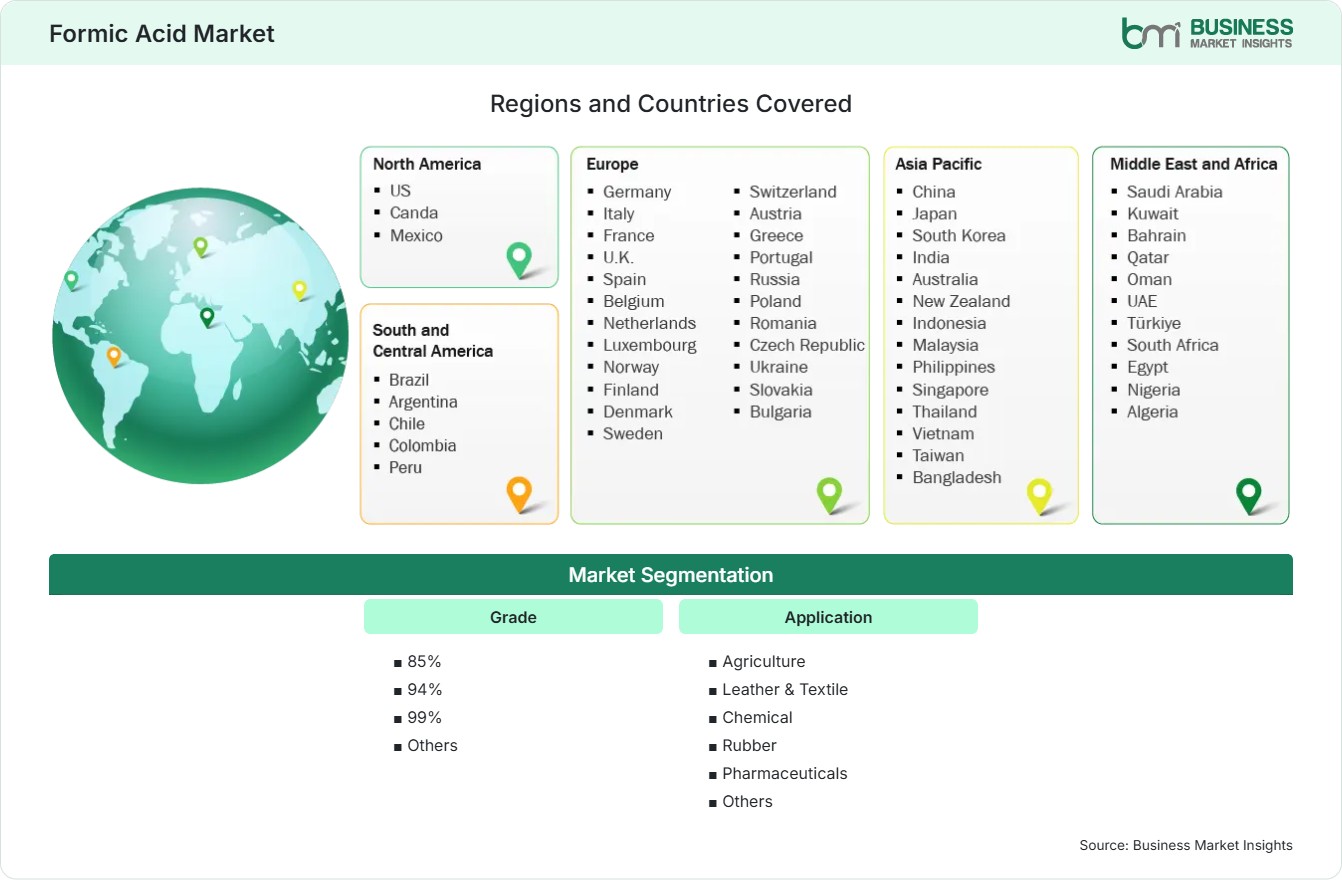
Global Market Geography
FREE PDF
Request your free sample
Request free sample
Segment Analysis

Formic Acid Market Segmentation

Grade

This segment indicates the purity of formic acid and its suitability for use in agriculture, chemicals, pharmaceuticals, and other applications. The Grade 85% segment emerged as the most dominant, with a market share of 48% to 52% in 2025, growing at a CAGR of 7.8% to 8.5% through 2033 due to its extensive use in animal feed preservation, the leather industry, and textiles. Higher-purity grades are gaining traction in advanced chemical synthesis and specialized industrial applications.

  • 85%: The 85% grade of formic acid continues to be the most popular formula because of its economic feasibility, versatility of industrial use, and the high demand for it from agricultural, leather production, and feed preservation industries.
  • 94%: The 94% grade of formic acid is used where there are higher concentration requirements of the acid, such as in chemical processes and industries.
  • 99%: 99% grade formic acid serves high-purity applications in pharmaceuticals, specialty chemicals, and advanced manufacturing processes requiring precise chemical properties and reduced impurities.

Application

The applications segment will be driven by diverse industrial applications, including agricultural preservation, leather processing, chemical synthesis, rubber processing, and pharmaceutical production. The agricultural sector has been a significant market for formic acid applications due to its growing use in preserving animal feed and silage. Formic acid has continued to be used extensively in the chemicals sector as a processing aid.

  • Agriculture: Agricultural applications are expanding through increasing livestock production, improved feed preservation practices, and demand for solutions that enhance feed quality and storage stability.
  • Leather & Textile: Leather and textile industries utilize formic acid for processing, dyeing, tanning, and finishing operations due to its effective chemical properties.
  • Chemical: Chemical applications include synthesis processes, pH adjustment, and manufacturing intermediates supporting diverse industrial production requirements.
  • Rubber: Rubber processing uses formic acid for coagulation and manufacturing applications, particularly in natural rubber production and specialty material processing.
  • Pharmaceuticals: Pharmaceutical applications are increasing through demand for high-purity chemical inputs and intermediates used in specialized manufacturing processes.
Market Forces

Formic Acid Market Dynamics

Key Market Drivers

Growing Demand from Leather and Textile Industries

The market is expanding due to rising use in the leather and textiles industries, where formic acid is significant in leather treatment, dyeing, and finishing, among other applications. The rising production of clothes and footwear, along with higher demand for processed leather, is driving up industrial use. Countries in the Asia-Pacific region, such as China, India, and Southeast Asian countries, have maintained their capacity to produce textiles. Formic Acid Market Trends indicate rising demand for chemical formulations that improve process efficiency and meet environmental requirements. Manufacturers are developing application-specific formulations to meet evolving requirements across leather and textile processing operations.

Increasing Use in Animal Feed Preservation Applications

There is a growing trend in livestock production worldwide, together with increasing interest in animal nutrition, which is driving the use of formic acid as a feed preservative. Formic acid enables effective control of microbial growth, improved feed quality, and improved storage. There is an increasing demand for animal protein of high quality from both producers and consumers, which is leading to the use of more efficient preservation techniques. The Food and Agriculture Organization continues to emphasize the importance of sustainable livestock production practices.

Rising Adoption of Bio-Based Chemical Solutions

Sustainability efforts have made it imperative for chemical manufacturers to develop bio-based substitutes and sustainable production methodologies. Formic acid is receiving significant consideration in light of the push for eco-friendly chemical manufacturing practices that emit lower levels of greenhouse gases throughout their lifecycles. Corporations are focusing on using sustainable raw materials and carbon capture systems to achieve their sustainability objectives. Sustainability trends affect the product development process in the chemicals industry. Corporations' efforts to reduce their carbon footprint will support the sustainable production of formic acid, creating opportunities for companies developing innovative manufacturing technologies.

Key Market Opportunities

Growth in Sustainable Chemical Production

The transition to sustainable chemical production offers immense possibilities for formic acid manufacturers seeking to implement renewable methods. Businesses are investigating methods that use biomass feedstock, carbon dioxide, and energy conservation to minimize environmental impacts. The rising regulatory concerns and sustainability objectives are driving companies to invest in greener chemical production. The implementation of sustainable systems by manufacturers would enable formic acid producers to capitalize on formic acid market trends and meet consumers' growing demand for environmentally preferred products.

Rising Hydrogen Economy Applications

Formic acid is gaining attention within hydrogen economy applications due to its potential role as a hydrogen carrier and storage medium. Research and development activities are exploring formic acid-based hydrogen release technologies that could support transportation, distributed energy, and chemical energy storage applications. While the commercial use of hydrogen is still evolving, rising investments in hydrogen infrastructure have opened the door to innovation. Companies developing hydrogen technologies can use formic acid technologies, which are much safer than compressed hydrogen technologies. Growth in clean energy initiatives is expected to encourage further research and commercialization efforts.

Expansion of Green Manufacturing Processes

Manufacturing green initiatives are presenting opportunities for chemical manufacturers to become more efficient, emit fewer greenhouse gases, and produce more sustainable products. Companies are beginning to consider how environmentally friendly their suppliers are, as well as the suppliers' carbon footprints and resource efficiency. Chemical manufacturers that are considering using renewable energy sources, improving processes, and reducing waste may become more competitive. There is a growing demand for sustainable manufacturing from environmentally conscious industries such as textiles, agriculture, and chemicals.

Market Restraints and Challenges

Volatile Raw Material Prices

Factor: Formic acid production depends on raw materials and energy inputs whose prices can fluctuate due to supply chain disruptions, market conditions, and geopolitical factors. Impact: Raw material volatility increases production costs, creates pricing uncertainty, and can reduce profit margins for manufacturers operating in competitive chemical markets. Fluctuating input costs may also affect downstream industries by increasing procurement expenses and influencing purchasing decisions. Producers must improve supply chain resilience, optimize production efficiency, and diversify sourcing strategies to manage cost pressures. Long-term contracts and technological improvements can help reduce exposure to raw material price fluctuations.

Stringent Environmental Regulations

Factor: Increasing environmental regulations related to chemical production, emissions control, waste management, and industrial safety standards create additional compliance requirements. Impact: Regulatory complexity can increase operational expenses, require investment in cleaner technologies, and slow expansion of manufacturing facilities. Chemical producers must continuously upgrade processes to meet evolving environmental standards across different regions. Compliance requirements may create challenges for smaller manufacturers with limited resources. However, companies investing in sustainable production technologies can improve regulatory alignment and gain competitive advantages in environmentally focused markets.

Company Analysis

Competitive Landscape

The Formic Acid market analysis highlights a competitive chemical industry environment consisting of global chemical manufacturers, specialty chemical producers, and regional suppliers. Companies are focusing on expanding production capacity, improving sustainable manufacturing processes, developing high-purity grades, and strengthening supply networks to serve agriculture, industrial, and specialty applications.

Company Name

Overview

Products and Services Relevant to this Market

BASF

Global chemical company producing specialty and industrial chemicals.

Formic acid production, chemical intermediates, industrial solutions.

Eastman Chemical

Specialty materials and chemical manufacturer.

Formic acid applications, chemical processing solutions.

Perstorp

Sustainable specialty chemicals producer.

Formic acid products, renewable chemical solutions.

Feicheng Acid Chemicals

Chinese chemical manufacturer specializing in acids.

Formic acid production and industrial chemical supplies.

Luxi Chemical Group

Integrated chemical producer in China.

Chemical products, industrial raw materials, formic acid solutions.

Gujarat Narmada Valley Fertilizers & Chemicals

Indian chemical and fertilizer producer.

Formic acid, fertilizers, industrial chemical products.

Taminco

Specialty chemical producer serving global markets.

Formic acid derivatives, agricultural and industrial chemicals.

Rashtriya Chemicals and Fertilizers

Indian fertilizer and chemical manufacturer.

Industrial chemicals and agricultural chemical products.

Kemira

Global sustainable chemical solutions provider.

Industrial chemicals, process solutions, specialty applications.

Shandong Acid Technology

Chemical manufacturer specializing in acid products.

Formic acid manufacturing and industrial chemical supply.

Industry Activity

Recent Developments

July 2026

Adani Enterprises Ltd. and French clean-technology company Dioxycle announced a partnership to develop low-carbon chemical manufacturing in India, beginning with a pilot facility to produce formic acid using captured CO₂ and renewable electricity. The project aims to establish a new pathway for sustainable formic acid production and future commercial-scale manufacturing.

March 2026

BASF announced a price increase for formic acid in Europe, effective immediately, due to market conditions. BASF highlighted formic acid’s continued use in animal nutrition (feed preservation, silage, drinking water treatment) and industrial applications as a process agent and chemical intermediate, reflecting ongoing commercial activity in the formic acid supply market.

March 2026

Eastman highlighted the role of formic acid in animal nutrition applications, including feed preservation and livestock health solutions, as part of its specialty chemical portfolio. The company continues supplying acid-based solutions for agricultural and industrial markets.

June 2025

BASF launched its low product carbon footprint (PCF) formic acid on its eAuction digital platform in China, allowing customers to purchase formic acid through a transparent digital procurement process. The initiative supports BASF’s sustainable chemicals strategy by offering formic acid with a lower cradle-to-gate carbon footprint compared with fossil-based equivalents.

Trust & Transparency

Research Methodology

The market analysis combines proprietary research with secondary data from government agencies, company disclosures, regulatory filings, industry databases and expert interviews. Market estimates are validated through data triangulation, cross-market benchmarking and analyst review.

View Full Research Methodology

Questions Answered

Frequently Asked Questions

What challenges affect formic acid industry expansion?

Major challenges include fluctuating raw material prices, regulatory compliance requirements, production cost pressures, and the need for continuous investment in cleaner manufacturing technologies.

Why is formic acid gaining attention in hydrogen applications?

Formic acid is being explored as a potential liquid hydrogen carrier because it can store and transport hydrogen chemically. Research activities are evaluating its role in cleaner energy systems and hydrogen infrastructure development.

How is sustainability influencing the Formic Acid Market report?

Sustainability is encouraging manufacturers to develop lower-carbon production methods, renewable feedstock pathways, and environmentally preferable chemical solutions. These developments are supporting adoption across industries seeking reduced environmental impact.

Which grade segment dominates the market?

The 85% grade segment holds the leading position due to broad adoption in animal feed preservation, agriculture, leather processing, and industrial applications where cost efficiency and performance balance are important.

What are the major applications driving the Formic Acid Market forecasts?

The market is primarily driven by agriculture, animal feed preservation, leather processing, textile manufacturing, chemical synthesis, rubber processing, and pharmaceutical applications. Increasing demand for sustainable chemical solutions is further expanding usage opportunities.

Access the Full Formic Acid Market Report

Get segment-level forecasts, regional estimates, competitive benchmarking, company profiles and downloadable Excel datasets.

Access the full Formic Acid Market Report
350 pages PDF & Excel | 2026-07-30
Similar Research

Related Market Reports