
Glycolic Acid Market Outlook: Size, Share, Trends, Growth Analysis, Competitive Landscape & Forecast, 2026-2033

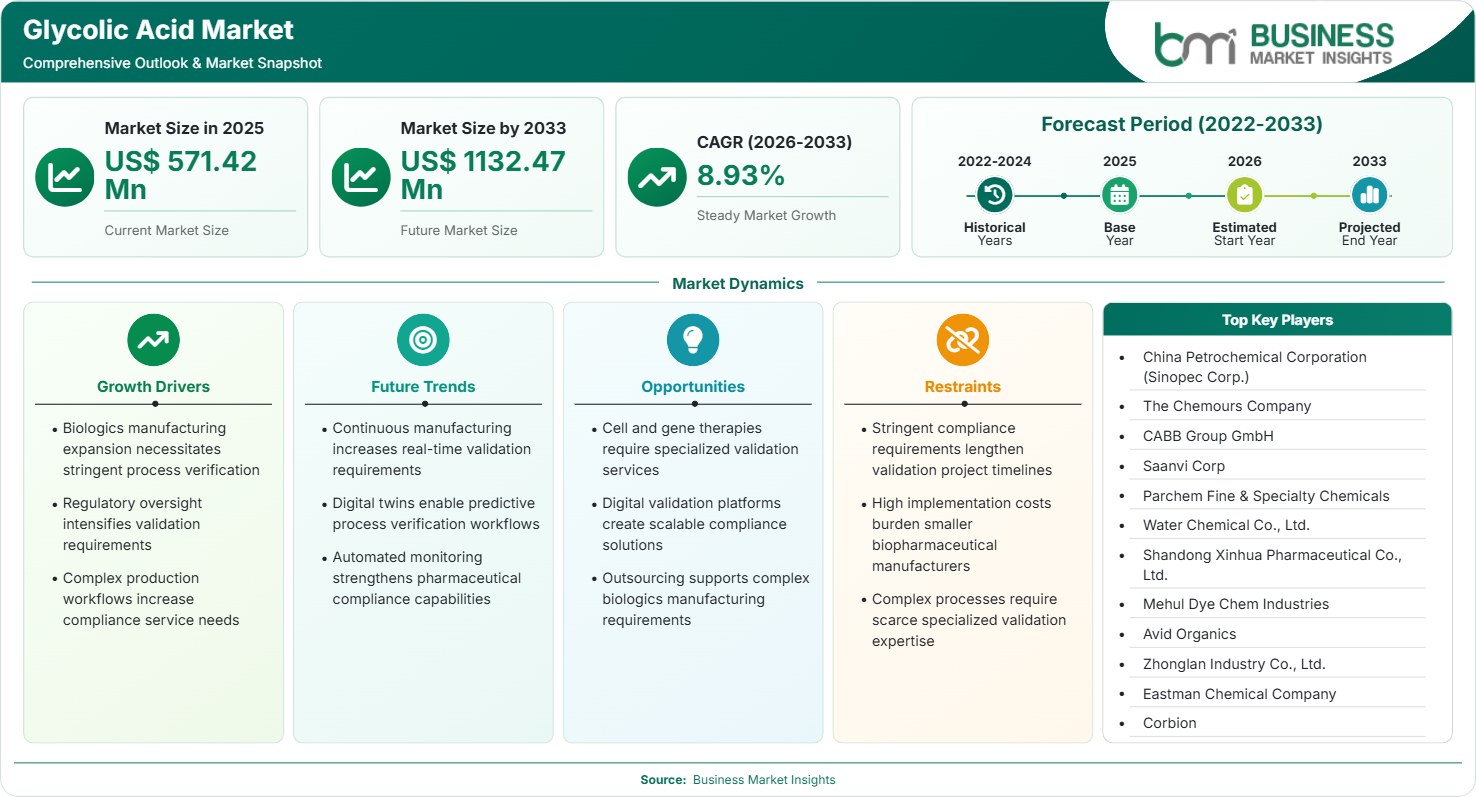
The Glycolic Acid Market size was valued at US$ 571.42 Million in 2025 and is projected to reach US$ 1132.47 Million by 2033, growing at a CAGR of 8.93% during 2026–2033, driven by skincare demand, high-purity formulations, pharmaceutical applications, industrial cleaning, and specialty chemical innovation.

Report Coverage
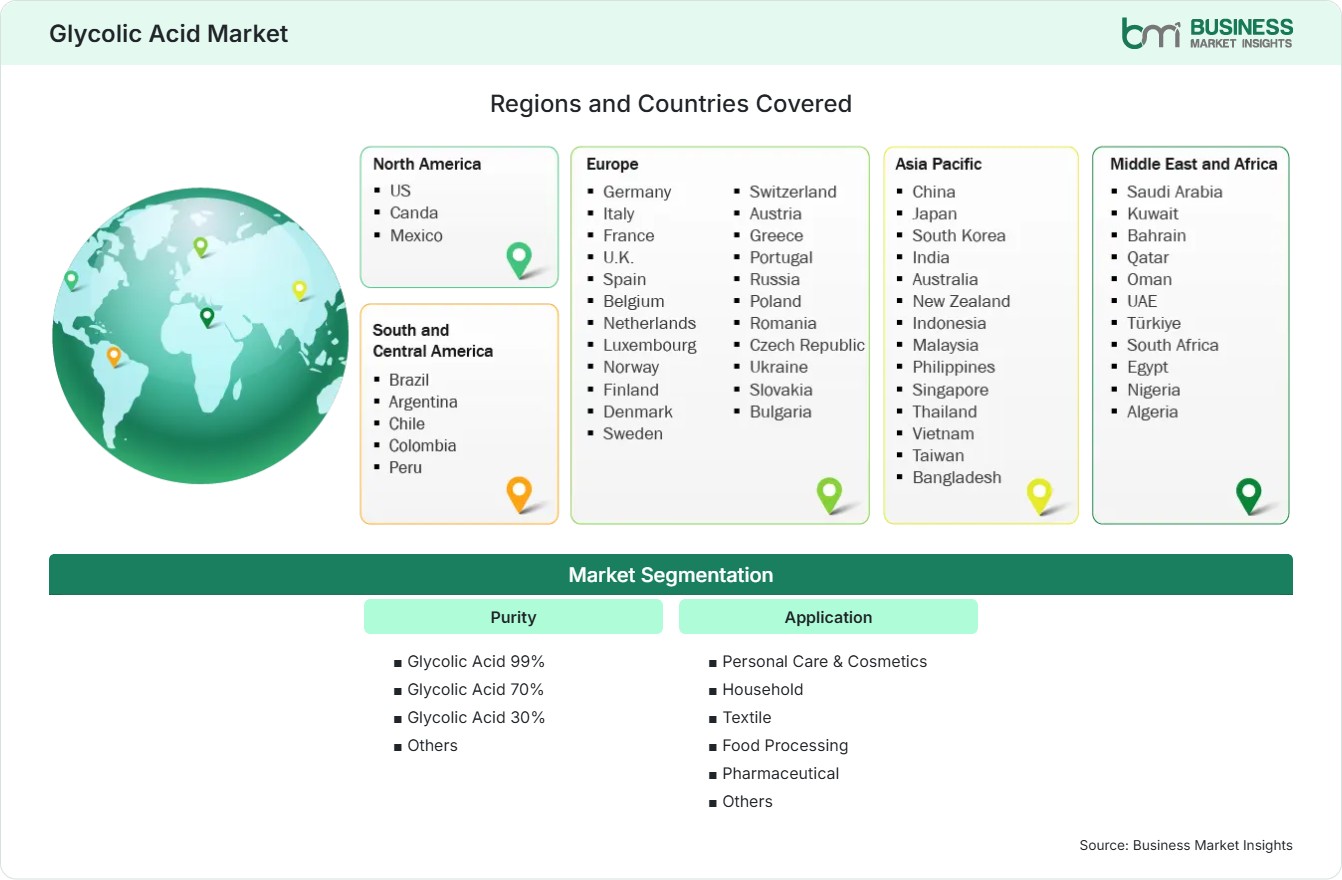
  • Purity: Glycolic Acid 99%, Glycolic Acid 70%, Glycolic Acid 30%, Others
  • Application: Personal Care & Cosmetics, Household, Textile, Food Processing, Pharmaceutical, Others
US$ 571.42 Mn Market size in 2025
US$ 1132.47 Mn Market Size by 2033
8.93% CAGR, 2026 - 2033
2026-2033 Forecast Period

AI Overview

Glycolic Acid Market Summary

  • North America Region: North America holds market share of 22%–25% in 2025, growing with a CAGR of 8.1%–8.8% during 2026–2033, influenced by premium skincare, dermatology, high-purity manufacturing, advanced cleaning applications, and specialized chemical demand. The U.S. represents the principal regional market, supported by established cosmetic formulators, specialty chemical distribution, and demand for high-purity grades, with estimated growth of 8.2%–8.9% through 2033. Independent market sources identify North America as a major consumption center for cosmetic and industrial glycolic acid applications.
  • Fastest Growing Region: Asia Pacific holds market share of 37%–40% in 2025, growing with a CAGR of 9.4%–10.2% during 2026–2033, supported by expanding skincare manufacturing, rising disposable income, chemical production capacity, pharmaceutical formulation, and regional export networks.
  • Leading Segment: Personal Care & Cosmetics holds market share of 44%–48% in 2025, growing with a CAGR of 9.0%–9.8% during 2026–2033, supported by exfoliation, anti-aging, pigmentation treatment, professional peels, haircare, and active-ingredient formulation demand. External research places personal care among the largest application categories, with estimates ranging from roughly 44% to 48% depending on methodology.
  • High Growth Segment: Pharmaceutical applications are positioned for a CAGR of 9.5%–10.5% during 2026–2033, supported by high-purity topical formulations, dermatological products, biodegradable polymer intermediates, medical devices, controlled delivery concepts, and increasingly stringent quality requirements.
  • Key Market Opportunity: Premium high-purity grades, ultra-low-impurity solutions, biodegradable formulations, pharmaceutical intermediates, electronics cleaning, and specialty personal-care delivery systems create attractive value pools for differentiated suppliers.
  • Major Market Players: China Petrochemical Corporation (Sinopec Corp.), The Chemours Company, CABB Group GmbH, Saanvi Corp, Parchem Fine & Specialty Chemicals, Water Chemical Co., Ltd., Shandong Xinhua Pharmaceutical Co., Ltd., Mehul Dye Chem Industries, Avid Organics, Zhonglan Industry Co., Ltd., Eastman Chemical Company, Corbion, and CrossChem LP.
Strategic Insights

Glycolic Acid Market: Strategic Insights

Glycolic Acid Market Strategic Framework
FREE PDF
Request your free sample
Request free sample
Stakeholder View

Key Takeaways

  • The supply chain is increasingly divided among large-scale chemical producers, specialty manufacturers, distributors, formulation firms, and suppliers of products for specific applications. Nowadays, the source of competitive advantage lies not just in the general availability of a product but in purity, consistency, regulatory documentation, reliable logistics, and technical support.
  • Personal Care & Cosmetics has the most substantial short-term demand due to the fact that glycolic acid provides exfoliation, refines texture, helps with pigmentation, and has anti-aging properties. There are further opportunities available in the areas of premium skincare, professional dermatology, hair care, and multifunctional formulations.
  • There is a trend towards the use of ultra-low-impurity solutions, crystalline forms, controlled-release chemistry, biodegradable polymer intermediates, and grades that are tailored to specific applications. The pure portfolio offered by PureTech Scientific is an example of the shift towards 70% solutions, 99% crystalline material, and the use of glycolide-based delivery systems.
  • The investment case for the Asia Pacific region is the most attractive since the depth of its chemical manufacturing combines with the growing demand for beauty products. China remains a major manufacturing center, and India matches its rapidly increasing beauty consumption with specialized chemical production capabilities. Market research carried out independently has identified the Asia Pacific region as the largest regional market.
  • The investment is focusing on specialized manufacturing and distribution abilities, as shown by the 2023 transaction in which Chemours transferred its glycolic acid business to PureTech Scientific for $137 million, an example of strategic consolidation concerning high-purity alpha hydroxy acids and special chemical applications.
  • Buyers are more likely to assess suppliers based on lifecycle, impurity, certification, packaging, and supply continuity criteria. This gives an advantage to producers who can provide global customers with documented specifications and distinct technical services.
Geographic Outlook

Glycolic Acid Market Regional Highlights

North America Glycolic Acid Market

North America held a 22%–25% Glycolic Acid Market share in 2025 and is estimated to expand at a 8.1%–8.8% CAGR through 2033. The region benefits from sophisticated personal-care formulation, professional dermatology, pharmaceutical manufacturing, specialty chemical distribution, and industrial cleaning demand. The United States accounts for the largest regional contribution, supported by established suppliers and advanced formulation ecosystems. High-purity products command greater strategic importance because customers increasingly require controlled impurity profiles, regulatory documentation, and consistent performance across repeated manufacturing batches.

  • Premium skincare brands are increasingly including glycolic acid in their exfoliating, brightening, resurfacing, and anti-aging products, since there is a demand for reliable cosmetic-grade solutions with controlled impurities.
  • The need for high-purity material is increased in the pharmaceutical and dermatological fields since formulation developers demand consistent chemical specifications, reliable performance, and established quality systems.
  • The use of glycolic acid in industrial cleaning is advantageous due to its chelating and cleaning properties, especially in cases where people want to use alternatives to stronger mineral acids on certain surfaces and equipment.
  • Partnerships in regional distribution help smaller formulators gain access by simplifying procurement, reducing the need for inventory, and lowering the qualification barriers in the United States, Canada, and Mexico.

US Glycolic Acid Market

The U.S. represents approximately 62%–66% of North American Glycolic Acid Market demand in 2025, with estimated growth of 8.2%–8.9% during 2026–2033. Demand is anchored by personal care, dermatology, pharmaceutical formulation, industrial cleaning, electronics processing, and specialty chemicals. Domestic manufacturing provides a strategic supply advantage, while specialty distributors extend availability to formulators. PureTech Scientific operates integrated manufacturing platforms in West Virginia and Tennessee and supplies high-purity grades across personal care, life sciences, electronics, industrial, and specialty chemical markets.

  • U.S. skincare formulators are increasingly inclined to use high-purity and ultra-low-impurity grades when their products are aimed at achieving clinical efficacy, offering clean formulations, being compatible with sensitive skin, and providing ingredient transparency.
  • Electronics and industrial applications go beyond mere cosmetic effects, since purified technical solutions are used in cleaning, for the removal of residues, in metal finishing, and in specialized processing situations.
  • Distribution agreements are increasing regional access, as the agreement between Brenntag Specialties and PureTech Scientific in 2025 covers beauty and care customers in the United States, Canada and Mexico.

Europe Glycolic Acid Market

Europe represented approximately 20%–23% Glycolic Acid Market share in 2025 and is estimated to register 7.7%–8.5% CAGR through 2033. Germany, France, Italy, the United Kingdom, and Switzerland remain important specialty chemical and personal-care markets. Germany benefits from established fine-chemical production, while France and Italy contribute strong cosmetic formulation ecosystems. European demand is shaped by ingredient traceability, chemical compliance, sustainability expectations, and quality documentation, favoring suppliers with robust certification and impurity-control systems.

  • Germany is still a major centre for production, since CABB manufactures glycolic acid of a premium grade by means of a special synthesis process which is designed to reduce impurities and ensure consistent quality.
  • France and Italy show a strong demand for skincare products, professional beauty products, and high-end cosmetic formulations, since active ingredients are increasingly being used to help distinguish the products.
  • When qualifying suppliers and carrying out procurement, European buyers place more importance on REACH registration, the environmental features, the packaging, the documentation, and the reproducible specifications.
  • Specialty chemical companies have the opportunity to create value by offering high-purity grades, technical support, formulation services, and application-specific solutions rather than merely competing on bulk prices.

Asia Pacific Glycolic Acid Market

Asia Pacific held approximately 37%–40% Glycolic Acid Market share in 2025, making it the leading regional market, and is estimated to grow at 9.4%–10.2% CAGR through 2033. China, Japan, South Korea, India, and Southeast Asia combine large consumer markets with chemical manufacturing capabilities. China remains a major regional production and consumption center, while India is gaining importance through beauty, pharmaceutical, specialty chemical, and export-oriented manufacturing. External research similarly identifies the Asia Pacific as the largest regional market.

  • China benefits from the advantages of integrated chemical manufacturing, has a large capacity for domestic formulation, and experiences strong demand coming from the cosmetics, pharmaceuticals, textiles, household products, and special chemical applications sectors.
  • India has attractive growth opportunities since its beauty and personal-care sector is expanding together with its pharmaceutical manufacturing and abilities in specialty chemicals. The segment of beauty products containing glycolic acid in India is expected to grow rapidly up to 2030.
  • Japan and South Korea meet premium demand by means of their sophisticated skincare markets, their advanced formulation technologies, and consumers' preference for products that focus on ingredients.
  • Southeast Asia offers gradual possibilities since the demand for cosmetic and industrial grades is increasing as a result of urbanization, higher disposable incomes, the expansion of beauty retail, and greater regional manufacturing investments.

Rest of World Glycolic Acid Market

South and Central America together represent approximately 7%–9% of the market in 2025, while the Middle East and Africa account for the remaining regional demand. Combined Rest of World demand is estimated at a 15%–18% share, with an 8.3%–9.2% CAGR, according to the Glycolic Acid Market Forecasts. Brazil and Mexico provide significant demand for personal care and industrial applications, while Gulf economies support specialty chemical distribution, water treatment, and industrial applications.

  • The fact that Brazil has a large beauty market provides opportunities for cosmetic-grade glycolic acid, especially for use in exfoliating, brightening, anti-aging, and haircare products which are sold via established retail channels.
  • Mexico benefits from its proximity to North America's supply network, with distribution, household cleaning, and the manufacture of personal care products.
  • The Gulf markets provide opportunities in the areas of industrial cleaning, water treatment, specialty chemicals, and high-end personal care since the chemical distribution infrastructure is becoming more sophisticated.
  • There are developing opportunities in South Africa and other parts of Africa, with consumption of ingredients in the fields of pharmaceutical manufacturing, cosmetics, household products and industrial processing increasing gradually.
Global Market Geography
FREE PDF
Request your free sample
Request free sample
Segment Analysis

Glycolic Acid Market Segmentation

Purity

The Purity segment is led by high-concentration and high-purity grades required in cosmetics, pharmaceuticals, specialty chemicals, and sensitive industrial applications. The segment represented an estimated 38%–42% Glycolic Acid Market share in 2025 for the leading 99% grade, with overall purity demand expanding at 8.4%–9.2% CAGR through 2033. The Glycolic Acid Market scope increasingly emphasizes specification control and application-specific purity.

  • Glycolic Acid 99%: High-purity crystalline material supports pharmaceutical, dermatological, anhydrous cosmetic, polymer, and specialized chemical applications requiring minimal water and tightly controlled impurities.
  • Glycolic Acid 70%: Concentrated aqueous solutions provide formulation flexibility across skincare, haircare, cleaning, industrial processing, and professional applications while simplifying handling and incorporation.
  • Glycolic Acid 30%: Lower-concentration solutions support selected formulation and processing requirements where controlled acid strength, easier handling, and cost-efficient application are priorities.

Application

Personal Care & Cosmetics is the leading application, representing approximately 44%–48% share in 2025 and growing at 9.0%–9.8% CAGR through 2033. The application benefits from skincare innovation, dermatology, haircare, professional treatments, and active-ingredient positioning. Pharmaceutical applications provide a faster-growth niche as purity requirements and specialized formulations expand globally.

  • Personal Care & Cosmetics: Demand is concentrated in exfoliants, serums, toners, peels, anti-aging products, pigmentation treatments, body care, and haircare formulations seeking measurable active-ingredient benefits.
  • Household: Glycolic acid supports cleaning and descaling formulations where chelation, surface interaction, and effective mineral-scale removal are valued across household and institutional applications.
  • Textile: Textile processors use glycolic acid in selected treatment and finishing processes, with demand linked to process efficiency, material compatibility, and specialty finishing requirements.
  • Food Processing: Applications include cleaning and sanitation processes where controlled acidity and chelating functionality can support equipment maintenance and selected processing environments.
  • Pharmaceutical: Pharmaceutical demand centers on high-purity material for dermatological formulations, specialized topical products, intermediates, and medical applications requiring stringent quality and documentation.
Market Forces

Glycolic Acid Market Dynamics

Key Market Drivers

Premium Skincare and Dermatological Formulation Expansion

Growing consumer interest in active-ingredient skincare is driving demand for glycolic acid across exfoliating cleansers, serums, toners, masks, chemical peels, and anti-aging formulations. External research places personal care among the dominant application categories, with reported 2025 shares around 44%–48% depending on market methodology. The ingredient's small molecular size supports penetration and exfoliation, making it attractive for formulation developers seeking visible texture and pigmentation benefits. Glycolic Acid Market growth is therefore increasingly tied to premiumization rather than basic volume expansion. The trend also supports higher-purity grades because cosmetic brands need reproducible performance, lower impurity levels, and documentation supporting increasingly sophisticated product claims.

Expansion of High-Purity and Specialty Chemical Applications

High-purity glycolic acid is moving beyond conventional cosmetics into pharmaceuticals, medical devices, electronics cleaning, specialty polymers, and industrial processing. PureTech Scientific identifies applications spanning medical sutures, semiconductors, industrial cleaning, electronics, and personal care, demonstrating how diversified end uses can reduce dependence on a single demand pool. Glycolic Acid Market trends increasingly favor continuous manufacturing, secondary purification, crystalline formats, and low-impurity solutions. Buyers in regulated industries prioritize consistency and qualification over the lowest nominal price. This shift allows producers with advanced purification, technical support, and application-specific documentation to secure stronger margins and longer customer relationships.

Rising Demand for Efficient and Lower-Impact Processing

Environmental performance is becoming a procurement consideration alongside price and purity. CABB describes GLYCOS Clear 70 as readily biodegradable, non-flammable, VOC-exempt, REACH-registered, and manufactured through a proprietary synthesis route designed to limit impurities. PureTech Scientific similarly emphasizes a continuous production process and the use of readily biodegradable glycolic acid. These developments support Glycolic Acid Market growth where customers seek effective chemistry with lower operational and environmental burdens. Suppliers that can combine process efficiency, consistent specifications, transparent documentation, and credible sustainability attributes will be better positioned to win formulation and industrial accounts.

Key Market Opportunities

Ultra-Pure Grades for Advanced Formulations

Since ultra-pure glycolic acid presents a premium chance, this is because customers in the pharmaceutical, dermatological, electronics, and high-end cosmetic sectors place a higher value on impurity control than do ordinary buyers. PureTech Scientific provides a 70% high-purity solution and 99% crystalline glycolic acid, and its ultra-purified 70% product is aimed at formulations that demand strict free-from characteristics. As a result, investment in purification, analytical testing, traceability, and dedicated production can lead to distinct revenue streams. Suppliers can increase their margins by offering documented performance, formulation reliability, and technical support rather than merely competing on concentration or bulk volume.

Asia Pacific Formulation and Manufacturing Expansion

The Asia Pacific region offers the best opportunity for incremental growth, as both manufacturing capacity and consumer demand are rising simultaneously. China has the advantage of large-scale chemical production and an established export infrastructure, whereas India combines specialty chemical manufacturing with rapidly expanding markets in the beauty and pharmaceutical sectors. Market research conducted by external firms ranks Asia Pacific as the top regional market, and the beauty products segment containing glycolic acid in India is expected to grow by 13.5% between 2025 and 2030. Producers can take advantage of this opportunity by using local technical teams, forming partnerships with distributors, offering smaller pack sizes, setting up application laboratories, and maintaining regional stock close to the formulators.

Controlled-Release and Biodegradable Specialty Applications

New delivery methods offer the possibility of extending the use of glycolic acid beyond its traditional free-acid forms. PureTech Scientific's Glypure GL employs glycolide chemistry to produce glycolic acid on-site and is intended for use in powder-free skincare formulations with a lower likelihood of irritation. Furthermore, high-purity glycolic acid can function as a monomer for polyglycolic acid, which is used in dissolvable sutures, tissue scaffolds, drug delivery systems, and biodegradable polymers. The existence of these applications provides suppliers with the opportunity to enter into more valuable technical partnerships that involve formulation development, polymer synthesis, meeting clinical requirements, and conducting application-specific qualification.

Market Restraints and Challenges

Raw Material, Energy, and Manufacturing Cost Volatility

Factor: Feedstock, energy, utilities, logistics, and specialty purification costs can fluctuate sharply across chemical manufacturing regions. Impact: Cost volatility can compress supplier margins and encourage buyers to switch toward alternative grades, regional suppliers, or lower-cost formulations when performance requirements permit. The challenge is more pronounced for high-purity products because additional purification, testing, controlled packaging, and dedicated equipment increase conversion costs. Producers, therefore, need disciplined procurement, efficient continuous processing, inventory planning, and long-term customer contracts. Competitive pressure from Asian producers can also affect pricing in mature markets, particularly when regional capacity exceeds local demand. This constraint favors suppliers with integrated manufacturing capabilities, differentiated specifications, and strong technical relationships, thereby reducing price-only competition.

Regulatory and Quality Qualification Complexity

Factor: Cosmetic, pharmaceutical, food-contact, electronics, and industrial applications can require different specifications, registrations, safety documentation, impurity thresholds, and customer qualification procedures. Impact: Suppliers may face longer commercialization cycles and higher compliance costs before gaining access to high-value accounts. Customers increasingly require certificates, traceability, analytical data, and consistent batch performance, especially for products positioned around sensitive-skin, pharmaceutical, or electronics applications. CABB, for example, highlights REACH registration and controlled quality attributes for its premium grade. Suppliers must therefore maintain robust quality systems and regulatory expertise while adapting product documentation to different geographic and end-use requirements.

Company Analysis

Competitive Landscape

The Glycolic Acid Market analysis indicates that competition is fragmented across integrated chemical producers, specialty manufacturers, distributors, and application-focused suppliers. Differentiation increasingly depends on purity, consistency, certifications, geographic availability, technical support, and sustainable production characteristics.

Company Name

Overview

Products and Services relevant to this market

China Petrochemical Corporation (Sinopec Corp.)

Major Chinese integrated energy and chemical enterprise with broad manufacturing, distribution, and specialty chemical capabilities.

Glycolic acid and chemical intermediates, manufacturing capabilities, industrial supply, and regional distribution serving specialty chemical applications.

The Chemours Company

U.S. chemistry company whose former glycolic acid business was transferred to PureTech Scientific in 2023.

Historical Glycolic Acid business, specialty chemistry expertise, technical development, and portfolio knowledge relevant to high-purity alpha hydroxy acids.

CABB Group GmbH

German fine-chemical producer supplying premium glycolic acid for demanding cosmetic and specialty applications.

GLYCOS Clear 70, glycolic acid solutions, fine-chemical manufacturing, quality documentation, and application support.

Saanvi Corp

Indian chemical supplier serving industrial and specialty chemical buyers across domestic and international markets.

Glycolic acid grades, chemical distribution, sourcing, packaging, and supply support for industrial and formulation customers.

Parchem Fine & Specialty Chemicals

U.S. specialty chemical distributor providing broad chemical sourcing and technical supply capabilities.

Glycolic Acid 70%, specialty chemical distribution, documentation, packaging, and customer sourcing support.

Water Chemical Co., Ltd.

China-based chemical supplier serving industrial and specialty chemical applications through regional supply networks.

Glycolic acid, industrial chemical solutions, bulk supply, packaging, and distribution support.

Shandong Xinhua Pharmaceutical Co., Ltd.

Chinese pharmaceutical and chemical manufacturer with established production capabilities and international market reach.

Pharmaceutical-grade chemicals, intermediates, specialty chemical manufacturing, and related high-purity material supply.

Mehul Dye Chem Industries

Indian specialty chemical company serving dye, chemical, pharmaceutical, and industrial customers.

Glycolic acid, specialty chemicals, industrial intermediates, customized supply, and formulation-oriented distribution.

Avid Organics

Indian specialty chemical producer focused on organic chemicals and application-specific products.

Glycolic acid and specialty organic chemicals, custom manufacturing, quality control, and customer-specific supply programs.

Zhonglan Industry Co., Ltd.

Chinese chemical supplier offering glycolic acid and related industrial chemicals to global buyers.

Glycolic acid products, bulk chemical supply, export distribution, packaging, and industrial customer support.

Eastman Chemical Company

U.S. specialty materials producer with broad chemical, personal-care, pharmaceutical, and formulation expertise.

Specialty ingredients, skin-care formulation support, acids, intermediates, technical services, and application development.

Corbion

Netherlands-based sustainable ingredients and specialty biochemicals company serving food, pharmaceutical, and industrial markets.

Sustainable ingredient technologies, specialty chemicals, formulation support, and bio-based application development relevant to glycolic acid ecosystems.

CrossChem LP

U.S. specialty chemical supplier supporting industrial and commercial customers with chemical products and distribution.

Glycolic acid supply, specialty chemical distribution, packaging, sourcing, and customer service for industrial applications.

Trust & Transparency

Research Methodology

The market analysis combines proprietary research with secondary data from government agencies, company disclosures, regulatory filings, industry databases and expert interviews. Market estimates are validated through data triangulation, cross-market benchmarking and analyst review.

View Full Research Methodology

Questions Answered

Frequently Asked Questions

What should buyers evaluate besides price?

The Glycolic Acid Market Report highlights that Buyers should compare impurity profiles, concentration consistency, analytical documentation, certifications, packaging, shelf life, production continuity, logistics capability, technical support, and supplier qualification history before selecting a long-term source.

Which business model can create the strongest supplier differentiation?

Application-specific supply combines high-purity material, regulatory documentation, technical formulation support, regional inventory, and reliable delivery. This model can create stronger customer retention than commodity-focused distribution alone.

How does glycolic acid support biodegradable polymers?

Glycolic acid can serve as a monomer for polyglycolic acid. PGA is used in applications including dissolvable sutures, medical scaffolding, drug delivery concepts, and biodegradable polymer systems.

Why is glycolic acid used in electronics processing?

Its chemical functionality supports cleaning and residue-removal applications. High-purity grades can be valuable where ionic contamination and surface defects must be tightly controlled during semiconductor-related processes.

What purity is most suitable for premium cosmetic formulations?

High-purity 70% solutions are widely suited to aqueous cosmetic formulations, while 99% crystalline material is useful for anhydrous or water-sensitive products. Selection depends on formulation architecture, impurity limits, processing requirements, and target concentration.

Access the Full Glycolic Acid Market Report

Get segment-level forecasts, regional estimates, competitive benchmarking, company profiles and downloadable Excel datasets.

Access the full Glycolic Acid Market Report
350 pages PDF & Excel | 2026-09-15
Similar Research

Related Market Reports