
Butyric Acid Market Outlook: Size, Share, Trends, Growth Analysis, Competitive Landscape & Forecast, 2026-2033

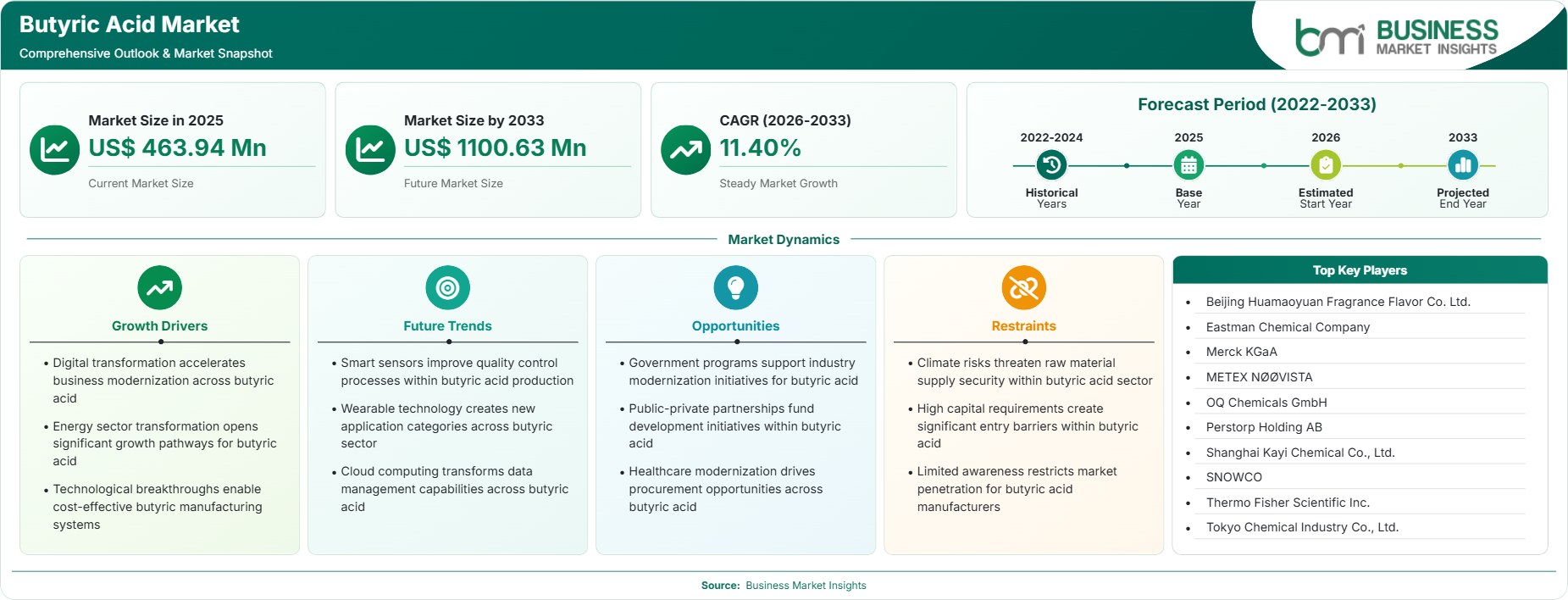
The Butyric Acid Market size was valued at US$ 463.94 Million in 2025 and is projected to reach US$ 1100.63 Million by 2033, growing at a CAGR of 11.40% during 2026–2033. Rising demand for animal nutrition solutions, expanding food flavor applications, renewable production technologies, and growing pharmaceutical utilization continue creating strong growth opportunities across global value chains.

Report Coverage
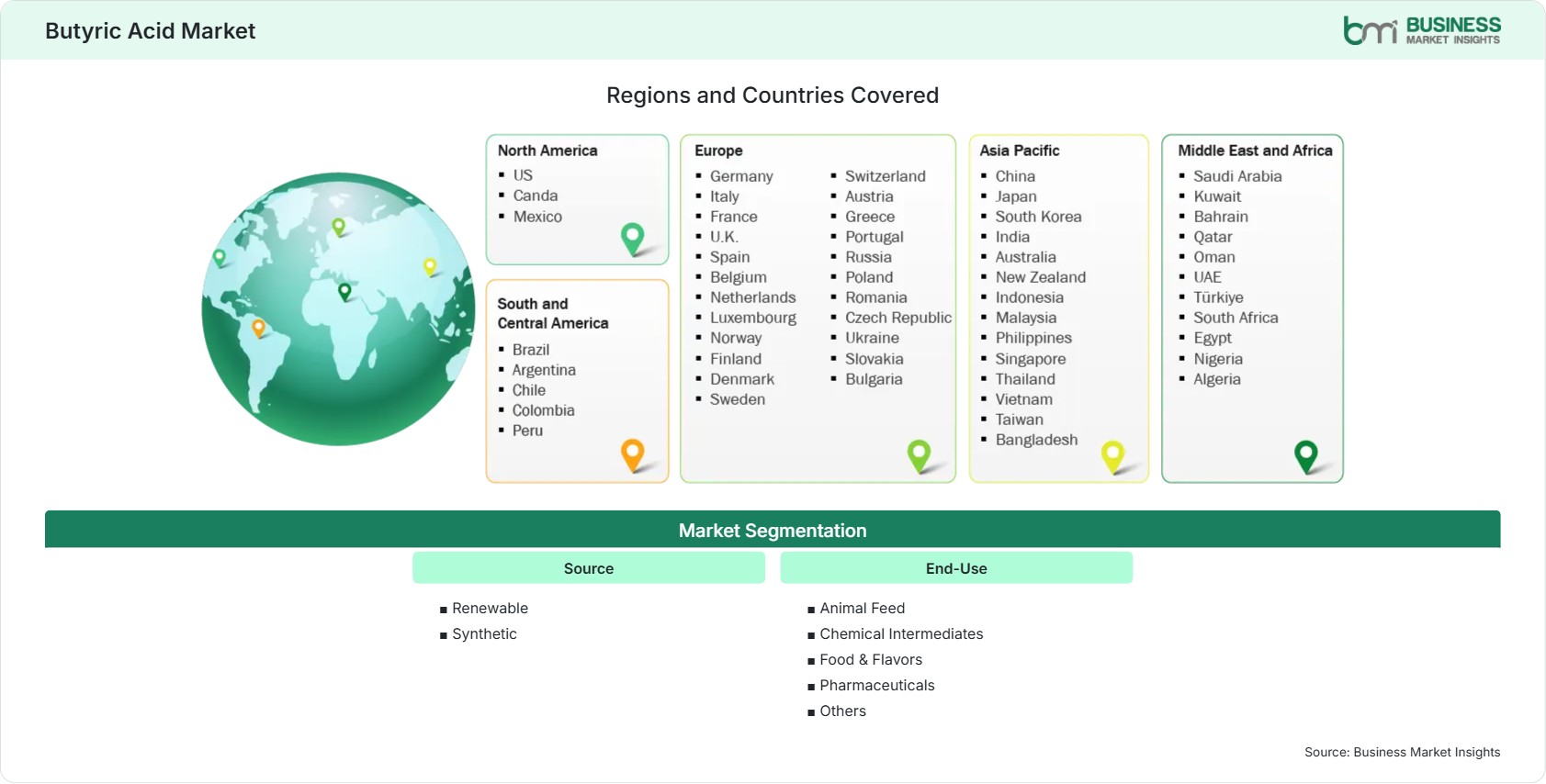
  • Source: Renewable, Synthetic
  • End-Use: Animal Feed, Chemical Intermediates, Food & Flavors, Pharmaceuticals, Others
US$ 463.94 Mn Market size in 2025
US$ 1100.63 Mn Market Size by 2033
11.40% CAGR, 2026 - 2033
2026-2033 Forecast Period

AI Overview

Butyric Acid Market Summary

  • North America Region: North America holds a market share of 34%–37% in 2025 and is projected to expand at a CAGR of 10.2%–10.8% during 2026–2033. Growth is supported by advanced feed additive adoption, established chemical manufacturing infrastructure, increasing pharmaceutical applications, sustainability initiatives, bio-based production investments, regulatory support, innovation partnerships, premium nutrition demand, supply-chain resilience programs, and expanding specialty chemical consumption. The U.S. market benefits from robust livestock nutrition demand and specialty chemical manufacturing, advancing at approximately 10.5%–11.0% CAGR.
  • Fastest Growing Region: Asia Pacific accounts for 27%–30% of global revenue in 2025 and is expected to record a CAGR of 12.8%–13.6% through 2033. Expansion is driven by livestock modernization, food processing investments, rising disposable incomes, increasing industrial chemical consumption, manufacturing relocation trends, favorable production economics, export-oriented capacity additions, biotechnology investments, expanding pharmaceutical production, and regional supply diversification initiatives.
  • Leading Segment: Animal Feed represents 40%–43% of market demand in 2025 and is forecast to grow at a CAGR of 11.0%–11.8% during 2026–2033. Strong adoption stems from gut health optimization, antibiotic reduction strategies, livestock productivity improvements, feed efficiency gains, poultry and swine nutrition demand, regulatory compliance requirements, commercial farming expansion, performance-enhancing formulations, sustainable production goals, and growing protein consumption worldwide.
  • High Growth Segment: Renewable source products hold 28%–31% of revenue in 2025 and are anticipated to advance at a CAGR of 13.2%–14.0% through 2033. Growth is encouraged by decarbonization priorities, bio-based chemical demand, circular economy objectives, fermentation technology improvements, feedstock innovation, regulatory incentives, sustainability commitments, green chemistry investments, carbon-footprint reduction programs, and premium product positioning strategies.
  • Key Market Opportunity: Expanding bio-based production platforms create opportunities for manufacturers to address sustainability mandates, reduce dependence on petrochemical feedstocks, improve environmental performance, strengthen supply security, and capture premium-value specialty applications globally.
  • Major Market Players: Beijing Huamaoyuan Fragrance Flavor Co. Ltd., Eastman Chemical Company, Merck KGaA, METEX NØØVISTA, OQ Chemicals GmbH, Perstorp Holding AB, Shanghai Kayi Chemical Co., Ltd., SNOWCO, Thermo Fisher Scientific Inc., and Tokyo Chemical Industry Co., Ltd.
Strategic Insights

Butyric Acid Market: Strategic Insights

Butyric Acid Market Strategic Framework
FREE PDF
Request your free sample
Request free sample
Stakeholder View

Key Takeaways

  • The value chain is becoming increasingly integrated, with feed additive manufacturers, specialty chemical producers, biotechnology firms, and downstream formulators collaborating to improve supply reliability and product differentiation.
  • Animal nutrition applications continue offering the strongest commercial upside, particularly in poultry and swine production systems where feed efficiency, gut health, and productivity enhancement remain critical priorities.
  • Innovation is shifting toward bio-based production technologies, advanced fermentation processes, and higher-purity formulations designed to meet sustainability targets and premium application requirements.
  • Asia Pacific presents one of the most compelling investment destinations due to rapid livestock industrialization, expanding food processing industries, favorable manufacturing economics, and increasing domestic chemical demand.
  • Strategic acquisitions and partnerships are increasingly focused on expanding specialty ingredient portfolios, strengthening biotechnology capabilities, and improving access to sustainable production technologies and regional distribution networks.
  • Manufacturers that successfully balance cost competitiveness with environmental performance are likely to secure stronger long-term positioning as customers increasingly prioritize sustainable sourcing and regulatory compliance.
Geographic Outlook

Butyric Acid Market Regional Highlights

North America Butyric Acid Market

North America accounted for approximately 34%–37% of global Butyric Acid Market revenue in 2025 and is projected to register a CAGR of 10.2%–10.8% during 2026–2033. The region benefits from advanced livestock production systems, strong specialty chemical manufacturing capabilities, and increasing adoption of functional feed additives. Growing investments in sustainable chemical production and expanding pharmaceutical ingredient demand continue supporting market expansion. The region also maintains a strong position in biotechnology innovation, enabling commercial development of renewable production pathways and high-purity formulations for specialized industrial applications.

  • Feed additive adoption remains strong across poultry and swine operations as producers focus on antibiotic reduction strategies, feed conversion efficiency improvements, and enhanced animal health outcomes supported by organic acid supplementation.
  • Specialty chemical manufacturers are increasing investments in process optimization technologies, improving production efficiency while responding to customer demand for sustainable and higher-value chemical intermediates.
  • Regulatory emphasis on food safety, animal welfare, and environmental compliance is encouraging wider use of advanced nutrition solutions and specialty ingredients across commercial production systems.
  • Renewable chemical initiatives are gaining traction as manufacturers pursue lower-carbon production pathways, creating opportunities for bio-based alternatives in industrial and specialty applications.
  • The regional Butyric Acid Market share remains the largest globally, supported by established supply chains, advanced research capabilities, and strong demand across multiple end-use industries.

US Butyric Acid Market

The United States represents approximately 74%–78% of North American Butyric Acid Market demand in 2025 and is expected to grow at a CAGR of 10.5%–11.0% through 2033. Strong commercial livestock operations, extensive food processing infrastructure, and significant specialty chemical production capacity support market development. Growing demand for performance-enhancing feed solutions and pharmaceutical intermediates continues driving consumption. Increasing investments in biotechnology innovation and sustainable manufacturing technologies further strengthen the country’s competitive position within the regional value chain and support future production expansion.

  • Large-scale poultry and swine industries continue increasing utilization of feed-performance ingredients to improve productivity, animal health outcomes, and operational efficiency amid evolving production requirements.
  • Investments in biotechnology and fermentation technologies are supporting development of renewable production routes, helping manufacturers address sustainability objectives and customer preferences.
  • Pharmaceutical and specialty ingredient producers are expanding sourcing requirements for high-purity organic acids, creating additional demand opportunities across industrial and healthcare applications.
  • Research collaborations between universities, ingredient developers, and commercial manufacturers continue accelerating product innovation and expanding application potential across diverse industries.

Europe Butyric Acid Market

Europe held approximately 25%–28% of global Butyric Acid Market revenue in 2025 and is projected to expand at a CAGR of 10.8%–11.4% during the forecast period. The region benefits from strict animal nutrition standards, advanced chemical manufacturing infrastructure, and growing sustainability commitments. Demand is supported by increasing adoption of specialty feed ingredients and bio-based chemical solutions. Germany remains the leading market with a CAGR of 10.5%–11.0%, while Eastern European countries are emerging as higher-growth destinations, recording CAGR levels of 11.5%–12.2% supported by industrial modernization initiatives.

  • European sustainability regulations continue encouraging investments in renewable feedstocks and environmentally responsible manufacturing processes across specialty chemical industries.
  • Livestock producers increasingly adopt advanced nutrition programs designed to improve feed efficiency and reduce dependence on conventional growth-promoting additives.
  • Germany maintains leadership through strong industrial capabilities, established research infrastructure, and significant specialty chemical production capacity.
  • Poland and several Eastern European markets are attracting investment due to competitive manufacturing costs and expanding agricultural production activities.
  • Strong emphasis on circular economy principles is supporting development of innovative bio-based production technologies and sustainable ingredient portfolios.

Asia Pacific Butyric Acid Market

Asia Pacific accounted for approximately 27%–30% of global Butyric Acid Market revenue in 2025 and is forecast to record the fastest CAGR of 12.8%–13.6% between 2026 and 2033. Rapid livestock industrialization, expanding food processing activities, and increasing chemical manufacturing investments are supporting regional growth. China remains the largest market with a CAGR of 12.5%–13.2%, while India represents the fastest-growing major country, expanding at a CAGR of 13.8%–14.5%. Rising protein consumption and industrial development continue strengthening regional demand fundamentals.

  • Large-scale poultry, aquaculture, and swine production industries are increasing consumption of feed-performance ingredients to improve productivity and meet growing protein demand.
  • China benefits from extensive manufacturing infrastructure and strong domestic consumption across food, feed, and industrial chemical applications.
  • India is experiencing accelerated expansion driven by livestock modernization, pharmaceutical manufacturing growth, and increasing investment in specialty chemical production.
  • Regional governments continue supporting industrial development through infrastructure investments, manufacturing incentives, and export-oriented growth initiatives.
  • The strongest Butyric Acid Market growth prospects remain concentrated in Asia Pacific due to favorable demographics, rising incomes, and expanding industrial demand.

Rest of World Butyric Acid Market

Rest of World represented approximately 8%–11% of global Butyric Acid Market revenue in 2025 and is anticipated to grow at a CAGR of 11.2%–11.9% through 2033. South & Central America benefit from expanding livestock production and increasing feed additive adoption, particularly in Brazil, which records a CAGR of 11.4%–12.0%.

The Middle East & Africa region is supported by growing food security initiatives, agricultural modernization programs, and investments in specialty chemical production. Saudi Arabia demonstrates strong growth potential with a CAGR of 11.8%–12.5%, supported by industrial diversification strategies and expanding manufacturing capabilities.

  • Brazil continues strengthening its position through expanding poultry and beef export industries, increasing demand for feed-efficiency solutions and advanced nutrition technologies.
  • Agricultural modernization programs across Latin America are creating opportunities for specialty feed ingredients that improve productivity and operational performance.
  • Gulf countries are investing in industrial diversification strategies that encourage development of higher-value chemical manufacturing capabilities and specialty products.
  • Food security initiatives across the Middle East and Africa are increasing focus on livestock productivity, creating long-term demand for performance-enhancing feed solutions.
  • Emerging economies throughout the region are attracting investments in manufacturing infrastructure, logistics capabilities, and agricultural value-chain development.
Global Market Geography
FREE PDF
Request your free sample
Request free sample
Segment Analysis

Butyric Acid Market Segmentation

Source

The Source segment plays a central role in determining production economics, sustainability performance, and end-use suitability across industries. This segment accounted for 100% of market demand in 2025, with synthetic products maintaining a larger installed base while renewable alternatives gain momentum. The Butyric Acid Market scope continues expanding as environmental regulations and corporate sustainability targets encourage adoption of bio-based production technologies. The segment is projected to grow at a CAGR of 11.4%–12.0% during the forecast period, supported by technological advancements and increasing investments in renewable feedstocks.

  • Renewable: Produced primarily through fermentation and bio-based feedstocks, renewable products are gaining adoption due to sustainability benefits, lower carbon footprints, regulatory support, and increasing demand from environmentally conscious manufacturers.
  • Synthetic: Synthetic variants remain widely utilized because of established production infrastructure, consistent product quality, cost efficiency, and broad availability across chemical, feed, pharmaceutical, and food-related industrial applications.

End-Use

The End-Use segment reflects the diverse application landscape supporting industry expansion. Animal Feed represented the largest share of approximately 40%–43% in 2025 and is forecast to expand at a CAGR of 11.0%–11.8% through 2033. The market share remains heavily influenced by feed applications, while evolving Butyric Acid Market trends across food ingredients, pharmaceuticals, and specialty chemicals continue creating new growth avenues. Increasing emphasis on productivity, formulation performance, and sustainable ingredient sourcing supports long-term demand across all major end-use categories.

  • Animal Feed: Strong demand originates from poultry, swine, aquaculture, and ruminant nutrition applications where gut health improvement, feed efficiency enhancement, and antibiotic-reduction strategies support increasing adoption.
  • Chemical Intermediates: Utilized in specialty chemical synthesis, solvents, esters, and industrial formulations, this segment benefits from expanding manufacturing activity and growing demand for value-added chemical products.
  • Food & Flavors: Food manufacturers use butyric acid derivatives to enhance flavor profiles and specialty ingredient formulations, supporting demand from processed foods, dairy products, and flavor development applications.
  • Pharmaceuticals: Pharmaceutical applications are expanding due to increasing research involving gastrointestinal health, drug formulation development, specialty compounds, and high-purity ingredient requirements across healthcare industries.
Market Forces

Butyric Acid Market Dynamics

Key Market Drivers

Rising Adoption of Gut Health Solutions in Animal Nutrition

Feed efficiency, disease prevention, and productivity enhancement have become increasingly important to global livestock producers, thereby generating steady demand for advanced nutritional components. The reduction of antibiotic growth promoters across several agricultural markets has accelerated interest in organic acid-based alternatives. According to the Food and Agriculture Organization (FAO), global meat production continues to expand alongside rising protein consumption, particularly in emerging economies. This trend directly supports Butyric Acid Market growth due to the inclusion of gut health additives in feed for poultry, swine, and aquatic animals. The effect that butyric acid has on maintaining intestinal function and nutrient absorption adds commercial significance to it. The rising concern for animal welfare standards and production efficiency goals keeps adding to its demand.

Expansion of Specialty Chemical Manufacturing Applications

The growing application of specialty chemicals within various industrial segments such as consumer and manufacturing industry is generating further demands for intermediates of organic acids. Butyric acid can act as one of the essential precursors in esters, solvents, and specialty formulations employed within different industries. As per the information provided by the International Council of Chemical Associations (ICCA), specialty chemicals have been performing better than several other chemical categories in terms of their value within specific applications. Butyric Acid Market trends indicate that there is increasing integration into industrial applications of high value where performance, purity, and formulation are very important. This will increase market resilience due to reduced reliance on a single end-use industry.

Growing Investment in Renewable and Bio-Based Production

Sustainability objectives across manufacturing industries are accelerating investment in bio-based chemicals and alternative production technologies. Renewable production pathways using fermentation technologies are attracting significant attention due to their potential to reduce greenhouse gas emissions and reliance on petrochemical feedstocks. According to the International Energy Agency (IEA), industrial decarbonization remains a key priority for global manufacturers pursuing net-zero commitments. Renewable butyric acid production will be well aligned with the above goals and provides a chance for premium product positioning. Advancements in microbial fermentation, feedstock selection, and process efficiencies have made the technology commercially viable. Growing support from regulatory bodies and business sustainability initiatives will help increase demand for eco-friendly production methods going forward.

Key Market Opportunities

Commercialization of Advanced Fermentation Technologies

Advances in fermentation technology have opened up possibilities for increasing yields, reducing costs of production, and making more renewable products available. Biotechnology firms are designing future generation microbes which can increase productivity by using different types of raw materials. Such innovations make scaling-up possible and enable them to compete with traditional methods. Industrial consumers’ preferences towards sustainability mean that such firms will enjoy premium market positioning. Strategic partnerships between biotechnology developers and specialty chemical producers are also accelerating commercialization efforts. Butyric Acid Market Forecasts indicate that successful implementation of cost-effective fermentation platforms can lead to the significant expansion of renewable products and also help in achieving various environmental targets within the next decade.

Expansion Across Pharmaceutical and Nutraceutical Applications

Increased research into gastrointestinal disorders, microbiome studies, and customized drug formulations have led to emerging prospects in the pharmaceuticals and nutraceutical industries. Studies have been conducted on butyric acid and its derivatives for their applications in digestive wellness and formulation development. In addition to this, increased costs in the healthcare industry along with growing demand for preventive wellness products have been responsible for the market expansion. Pharmaceutical companies have been looking for purity-based raw materials that can meet strict quality standards and facilitate product innovation. Future investments in clinical research and technology development may lead to many more commercial applications of this material.

Emerging Demand from High-Growth Developing Economies

Industrialization, increasing demand for protein, and growth in food processing industries in Asia, Latin America, and parts of Africa is providing a positive environment for market development. Many developing economies continue investing in livestock modernization and industrial manufacturing capabilities to support domestic demand growth. Advanced productivity programs for agriculture have been instrumental in promoting the use of high performance feeds. This is coupled with increased manufacturing activities of specialty chemicals and pharmaceuticals that have opened up new avenues of consumption. Foreign manufacturers are establishing themselves in the region by virtue of partnerships, setting up production facilities, and even acquisitions.

Market Restraints and Challenges

Volatility in Raw Material and Feedstock Costs

Factor: Production economics remain highly sensitive to fluctuations in feedstock prices, energy costs, and supply-chain conditions.

Impact: Sudden increases in raw material expenses can compress manufacturer margins, disrupt pricing strategies, and reduce competitiveness in cost-sensitive applications. The agricultural feedstock used for renewable production is particularly vulnerable to such factors as weather, availability of crops, and changes in the market. There could be more expenses incurred by energy-consuming industries at the periods of high prices for fuel and energy. The aforementioned problems represent certain challenges for planning and investments in the sector. There is a need for businesses to constantly look for means to reduce risks.

Regulatory Compliance and Product Standardization Requirements

Factor: Manufacturers must comply with evolving regulations governing feed additives, food ingredients, chemical handling, environmental performance, and product quality standards.

 Impact: Compliance costs can increase operational complexity and extend product approval timelines, particularly when entering new geographic markets. Due to differing regulations from region to region, customizing documentations, testings, and certification becomes necessary. Small enterprises will most probably find it harder to allocate resources in order to fulfill compliance requirements. Not only that, but customer expectations have grown and they expect traceability, sustainability, and quality assurance. All of these have administrative and operational implications which may influence profitability and access to markets.

Company Analysis

Competitive Landscape

The competitive environment is characterized by a mix of global specialty chemical manufacturers, laboratory reagent suppliers, feed additive specialists, and regional producers. Current Butyric Acid Market analysis indicates that companies are focusing on production efficiency, portfolio diversification, renewable chemistry investments, and expansion into high-growth application areas such as animal nutrition, pharmaceuticals, and specialty chemicals. Strategic partnerships, technology development initiatives, and regional capacity enhancements remain key competitive priorities as market participants seek to strengthen their positions across evolving end-use industries.

Company Name

Overview

Products and Services Relevant to This Market

Beijing Huamaoyuan Fragrance Flavor Co. Ltd.

Chinese specialty chemical and flavor ingredient manufacturer serving domestic and international customers with organic acid and aroma ingredient portfolios.

Produces butyric acid, flavor compounds, fragrance ingredients, specialty intermediates, and customized formulations supporting food, flavor, and industrial applications.

Eastman Chemical Company

Global specialty materials and chemical manufacturer with extensive expertise in performance chemicals, intermediates, and sustainable innovation initiatives.

Supplies specialty chemicals, performance intermediates, esters, and related chemical solutions serving industrial, consumer, and specialty manufacturing applications.

Merck KGaA

International science and technology company serving life science, healthcare, and electronics sectors through advanced research and manufacturing capabilities.

Provides research-grade chemicals, laboratory reagents, analytical materials, and high-purity organic compounds supporting pharmaceutical and scientific applications.

METEX NØØVISTA

Biotechnology-focused company emphasizing sustainable industrial solutions through fermentation technologies and renewable production capabilities.

Develops bio-based chemicals, fermentation-derived products, sustainable ingredients, and biotechnology solutions supporting renewable chemical production pathways.

OQ Chemicals GmbH

Global producer of oxo intermediates and performance chemicals with strong presence across industrial and specialty chemical markets.

Offers chemical intermediates, carboxylic acid derivatives, specialty esters, and industrial ingredients used in diverse manufacturing applications.

Perstorp Holding AB

Specialty chemicals company focused on innovation-driven solutions supporting sustainable production and advanced industrial formulations.

Supplies specialty intermediates, performance chemicals, feed-related ingredients, and sustainable solutions for industrial and agricultural markets.

Shanghai Kayi Chemical Co., Ltd.

China-based chemical supplier serving domestic and international customers through production and distribution of specialty chemical products.

Manufactures organic acids, chemical intermediates, industrial ingredients, and customized chemical products for multiple end-use sectors.

SNOWCO

Specialty ingredient and chemical supplier serving industrial customers with a range of chemical compounds and formulation solutions.

Provides organic acids, specialty chemicals, formulation ingredients, and application-focused products supporting industrial manufacturing requirements.

Thermo Fisher Scientific Inc.

Global leader in scientific services, laboratory solutions, and research materials supporting academic, industrial, and healthcare sectors.

Supplies analytical standards, laboratory-grade butyric acid, research chemicals, testing materials, and scientific support services.

Tokyo Chemical Industry Co., Ltd.

Leading manufacturer of research chemicals and specialty compounds serving laboratories, pharmaceutical companies, and industrial researchers worldwide.

Offers high-purity organic compounds, research reagents, pharmaceutical intermediates, and specialty chemicals for scientific and commercial applications.

Trust & Transparency

Research Methodology

The market analysis combines proprietary research with secondary data from government agencies, company disclosures, regulatory filings, industry databases and expert interviews. Market estimates are validated through data triangulation, cross-market benchmarking and analyst review.

View Full Research Methodology

Questions Answered

Frequently Asked Questions

What insights can stakeholders gain from a Butyric Acid Market Report?

A comprehensive Butyric Acid Market Report helps stakeholders evaluate demand trends, competitive positioning, regional opportunities, regulatory developments, investment priorities, and emerging application areas. It also supports strategic planning by identifying growth segments and evolving customer requirements across the value chain.

How is technological innovation influencing industry competition?

Manufacturers are investing in advanced fermentation processes, feedstock optimization technologies, and high-purity production methods. These innovations improve yield efficiency, enhance sustainability performance, and create opportunities to serve premium pharmaceutical, specialty chemical, and nutrition applications.

Which end-use industry generates the highest revenue contribution?

Animal feed remains the largest end-use category due to widespread use in poultry, swine, aquaculture, and livestock nutrition programs. Producers increasingly utilize butyric acid-based additives to improve feed conversion efficiency, digestive health, and overall production performance.

What makes renewable butyric acid an attractive investment area?

Renewable production technologies help reduce dependence on petrochemical feedstocks while supporting corporate sustainability objectives. Advances in fermentation efficiency, regulatory support for green chemicals, and customer preference for lower-carbon products are improving commercial prospects for renewable variants.

What are the primary factors driving demand for butyric acid worldwide?

Demand is primarily supported by expanding animal nutrition applications, increasing adoption of gut-health-enhancing feed additives, growing specialty chemical production, and rising interest in sustainable bio-based chemicals. Pharmaceutical and food ingredient applications also contribute to long-term consumption growth.

Access the Full Butyric Acid Market Report

Get segment-level forecasts, regional estimates, competitive benchmarking, company profiles and downloadable Excel datasets.

Access the full Butyric Acid Market Report
350 pages PDF & Excel | 2026-08-31