
Citric Acid Market Outlook: Size, Share, Trends, Growth Analysis, Competitive Landscape & Forecast, 2026-2033

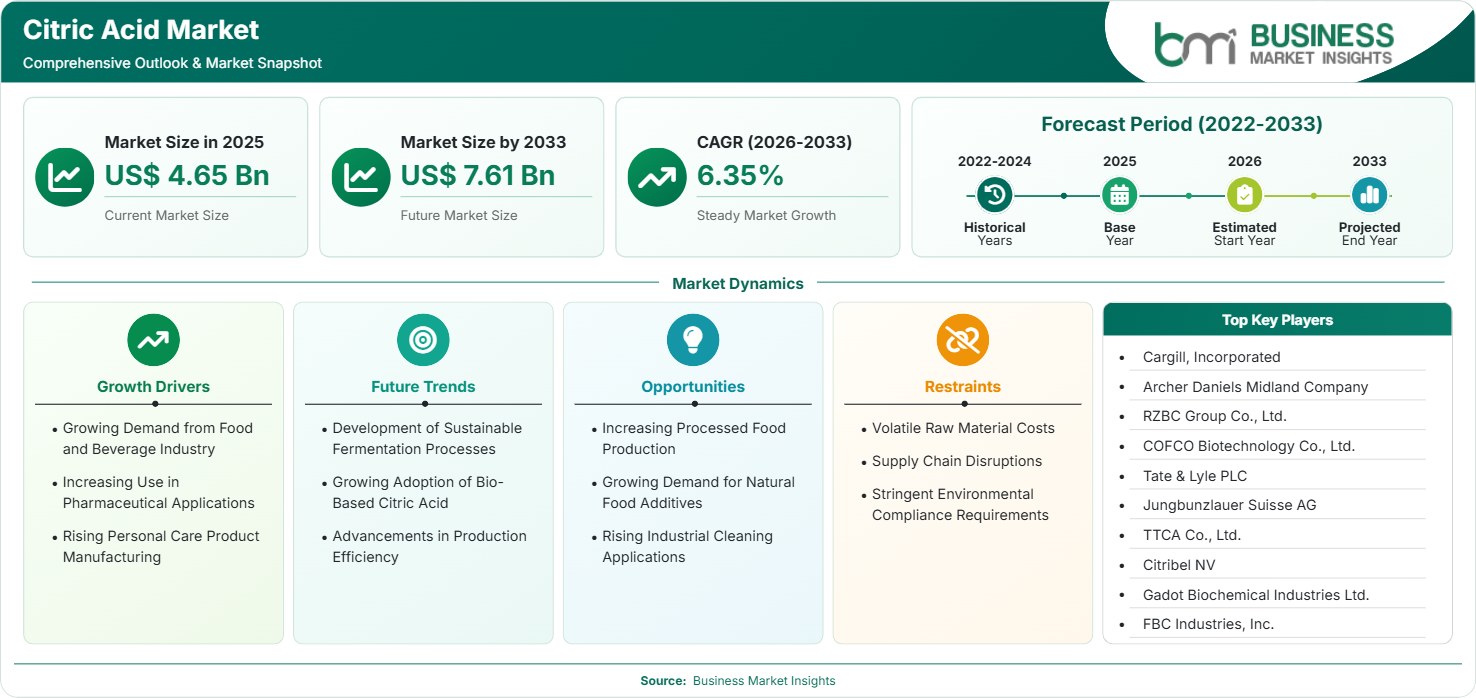
The Citric Acid Market size was valued at US$ 4.65 Billion in 2025 and is projected to reach US$ 7.61 Billion by 2033, growing at a CAGR of 6.35% during 2026–2033. Growth is supported by expanding processed food manufacturing, rising pharmaceutical formulations, increasing demand for natural acidulants, wider household cleaning applications, and sustained investment in bio-based production technologies across major manufacturing regions.

Report Coverage
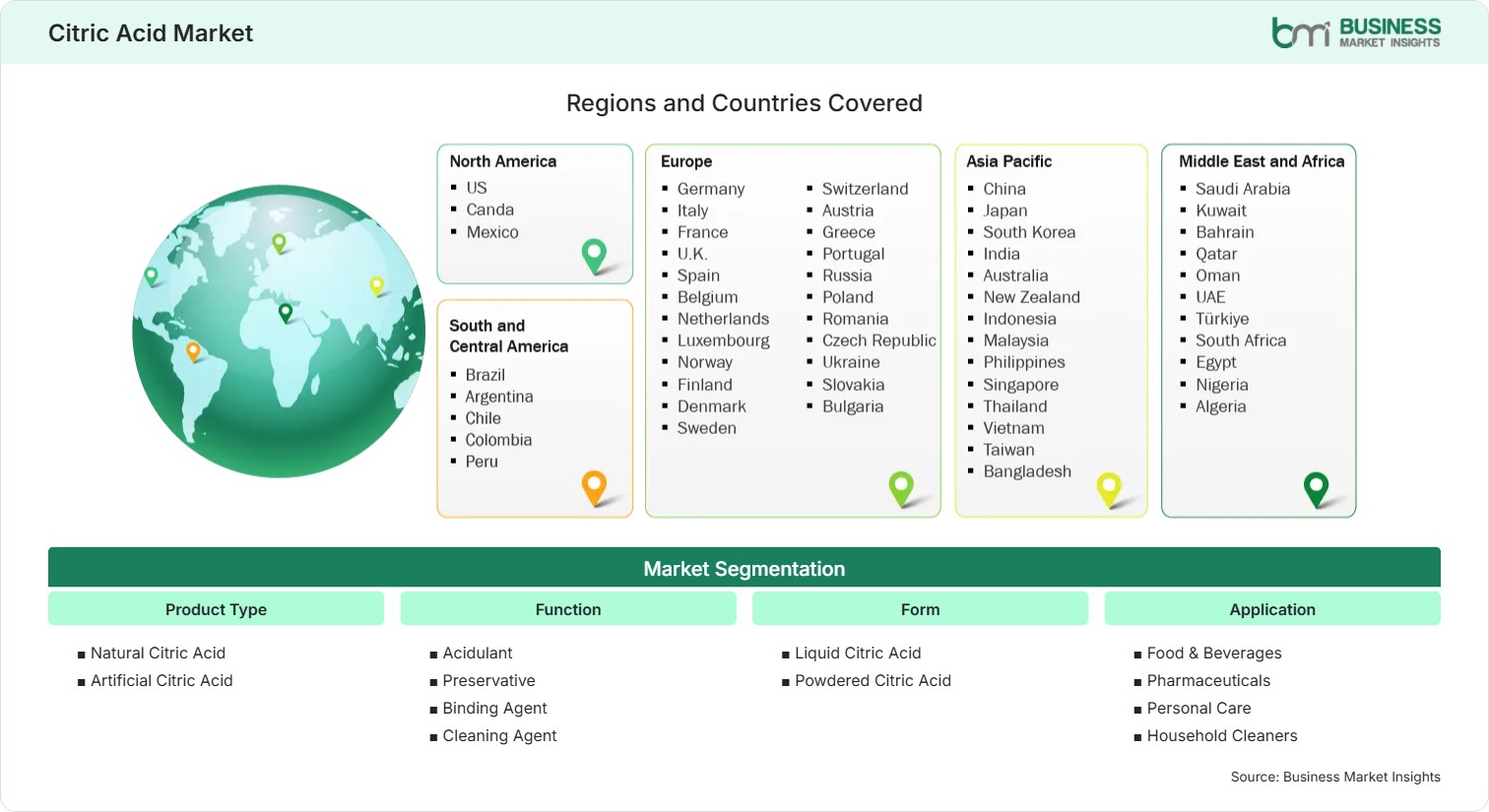
  • Product Type: Natural Citric Acid, Artificial Citric Acid
  • Function: Acidulant, Preservative, Binding Agent, Cleaning Agent
  • Form: Liquid Citric Acid, Powdered Citric Acid
  • Application: Food & Beverages, Pharmaceuticals, Personal Care, Household Cleaners
US$ 4.65 Bn Market size in 2025
US$ 7.61 Bn Market Size by 2033
6.35% CAGR, 2026 - 2033
2026-2033 Forecast Period

AI Overview

Citric Acid Market Summary

  • North America Region: North America holds 30%–33% share in 2025, growing at a 5.7%–6.2% CAGR during 2026–2033. Strong processed food production, pharmaceutical manufacturing, sustainable ingredient demand, and fermentation technology investments continue supporting regional expansion. The U.S. benefits from advanced ingredient manufacturing and expanding clean-label food production, recording an estimated 5.8%–6.3% CAGR.
  • Fastest Growing Region: Asia Pacific accounts for 29%–32% share in 2025 and is projected to expand at 7.0%–7.6% CAGR through 2033. Expanding food processing industries, pharmaceutical manufacturing capacity, export-oriented production, and favorable industrial investments continue accelerating regional demand.
  • Leading Segment: Food & Beverages represents 49%–53% share in 2025 while advancing at a 6.0%–6.5% CAGR. Growing demand for beverages, confectionery, dairy products, processed foods, and clean-label formulations continues strengthening long-term consumption across manufacturers.
  • High Growth Segment: Pharmaceuticals accounts for 19%–22% share during 2025 while expanding at 7.1%–7.8% CAGR through 2033. Increasing pharmaceutical production, effervescent formulations, excipient applications, nutraceutical expansion, and healthcare investments continue creating sustained commercial opportunities.
  • Key Market Opportunity: Rising investment in natural fermentation technologies, sustainable manufacturing, biodegradable industrial formulations, and clean-label ingredients is creating attractive long-term opportunities for manufacturers targeting premium applications and regulatory compliance.
  • Major Market Players: Cargill, Incorporated; Archer Daniels Midland Company; RZBC Group Co., Ltd.; COFCO Biotechnology Co., Ltd.; Tate & Lyle PLC; Jungbunzlauer Suisse AG; TTCA Co., Ltd.; Citribel NV; Gadot Biochemical Industries Ltd.; FBC Industries, Inc.
Strategic Insights

Citric Acid Market: Strategic Insights

Citric Acid Market Strategic Framework
FREE PDF
Request your free sample
Request free sample
Stakeholder View

Key Takeaways

  • Integration across fermentation, raw material sourcing, processing, and distribution is improving operational efficiency while reducing supply risks throughout the value chain.
  • Pharmaceutical formulations and premium food ingredients represent attractive investment opportunities due to increasing regulatory acceptance and expanding healthcare applications.
  • Continuous innovation in microbial fermentation technologies is improving production yields, lowering environmental impact, and enhancing manufacturing sustainability.
  • Asia Pacific continues presenting strong investment potential because of expanding manufacturing infrastructure, competitive production costs, and growing domestic consumption.
  • Strategic partnerships, production expansion, and technology modernization remain key competitive priorities as companies strengthen regional supply capabilities and product differentiation.
  • Sustainability initiatives focusing on renewable feedstocks and energy-efficient manufacturing are becoming major competitive advantages across global production networks.
Geographic Outlook

Citric Acid Market Regional Highlights

North America Citric Acid Market

North America accounts for 30%–33% of the Citric Acid Market share in 2025 and is projected to expand at a 5.7%–6.2% CAGR through 2033. The region benefits from mature food processing industries, advanced pharmaceutical manufacturing, and increasing adoption of environmentally friendly cleaning products. Strong regulatory oversight encourages manufacturers to use food-grade and bio-based ingredients. Continuous investments in fermentation technologies, supply chain modernization, and premium food formulations further strengthen regional competitiveness while supporting stable long-term demand across industrial and consumer applications.

  • Beverage manufacturers continue expanding low-sugar and functional drink portfolios, increasing demand for citric acid as an acidulant, flavor enhancer, and preservative while supporting production modernization across North American processing facilities.
  • Pharmaceutical manufacturers increasingly utilize citric acid in effervescent tablets, oral formulations, and mineral supplements, supported by expanding healthcare spending, product innovation, and regulatory compliance requirements.
  • Household cleaning product producers are introducing biodegradable formulations using naturally derived ingredients, encouraging wider adoption of citric acid in environmentally responsible cleaning solutions across residential and commercial applications.
  • Investments in fermentation efficiency, renewable feedstocks, and sustainable manufacturing technologies continue improving production productivity while reducing operational emissions and supporting long-term industrial competitiveness.

US Citric Acid Market

The United States represents 72%–75% of the North American market while advancing at a 5.8%–6.3% CAGR through 2033. Strong consumer demand for packaged foods, nutritional supplements, beverages, and household cleaners supports consistent industrial consumption. Investments in biotechnology, food innovation, and pharmaceutical production continue strengthening domestic manufacturing capabilities and improving supply resilience across multiple application sectors.

  • Food manufacturers continue expanding clean-label product portfolios, increasing utilization of fermentation-derived citric acid across beverages, confectionery, dairy, and processed foods.
  • Pharmaceutical companies strengthen domestic manufacturing capacity, supporting increasing consumption of citric acid for excipients, buffering agents, and formulation stabilization.
  • Sustainability initiatives encourage wider use of biodegradable ingredients in industrial and institutional cleaning products, supporting long-term demand growth.

Europe Citric Acid Market

Europe holds approximately 24%–27% market share in 2025 and is anticipated to grow at a 5.9%–6.4% CAGR through 2033. Strict food safety regulations, sustainability initiatives, and growing pharmaceutical production continue driving regional demand. Germany remains the leading national market, while Poland demonstrates comparatively faster expansion supported by food manufacturing investments and industrial production modernization.

  • Food manufacturers increasingly prioritize natural preservatives and clean-label ingredients to comply with evolving consumer preferences and stringent European food quality regulations.
  • Pharmaceutical production continues expanding across Germany, France, and Italy, strengthening long-term demand for pharmaceutical-grade citric acid applications.
  • Sustainability regulations encourage manufacturers to invest in environmentally responsible production technologies and renewable fermentation processes across regional manufacturing facilities.
  • Export-oriented specialty ingredient manufacturers continue improving production efficiency while strengthening Europe's position within international ingredient supply chains.

Asia Pacific Citric Acid Market

Asia Pacific Citric Acid Market represents 29%–32% share during 2025 while recording the fastest regional expansion at a 7.0%–7.6% CAGR through 2033. China leads regional production capacity, whereas India records the highest growth owing to rapid food processing expansion, pharmaceutical manufacturing, and rising household consumption.

  • Large-scale fermentation production facilities continue improving manufacturing efficiency while supporting exports to food, pharmaceutical, and industrial customers worldwide.
  • Rapid urbanization and changing dietary preferences increase consumption of processed foods, beverages, and nutritional supplements requiring citric acid formulations.
  • Pharmaceutical manufacturing expansion across India and Southeast Asia strengthens long-term industrial demand for high-purity citric acid applications.
  • Government support for biotechnology, industrial modernization, and sustainable manufacturing encourages additional production capacity investments across the region.

Rest of World Citric Acid Market

The Rest of World region contributes 15%–18% market share in 2025 while expanding at a 6.2%–6.8% CAGR through 2033. South & Central America continue benefiting from expanding food exports and beverage manufacturing, whereas the Middle East & Africa experience increasing demand from pharmaceutical production and industrial cleaning applications. Growing investment in food manufacturing infrastructure supports steady Citric Acid Market growth across developing economies.

  • Brazil leads regional food processing investments, while Mexico continues expanding beverage manufacturing and processed food exports supporting higher ingredient consumption.
  • Gulf countries continue increasing pharmaceutical manufacturing investments, strengthening demand for formulation ingredients and excipients across healthcare production facilities.
  • Industrial cleaning product demand continues expanding across commercial infrastructure, manufacturing facilities, and institutional applications requiring biodegradable formulations.
  • Increasing investment in regional distribution networks and food processing facilities enhances supply reliability while supporting broader industrial adoption.
Global Market Geography
FREE PDF
Request your free sample
Request free sample
Segment Analysis

Citric Acid Market Segmentation

Product Type

The Product Type segment accounts for a fundamental share of the Citric Acid Market scope, supported by increasing demand for naturally produced food ingredients and sustainable industrial chemicals. This segment holds approximately 58%–61% market share in 2025 and is expected to expand at a 6.4%–6.9% CAGR through 2033. Continuous investment in microbial fermentation, improved production efficiency, and clean-label ingredient adoption remains the primary growth catalyst.

  • Natural Citric Acid: Produced through microbial fermentation, this variant dominates food, beverage, pharmaceutical, and personal care applications because of regulatory acceptance, clean-label positioning, and increasing consumer preference for naturally sourced ingredients.
  • Artificial Citric Acid: Maintains demand across selected industrial applications where formulation consistency, cost optimization, and specific processing requirements remain important for manufacturers serving specialized commercial markets.

Function

The Function segment continues expanding as manufacturers increasingly incorporate multifunctional ingredients across diverse end-use industries. The segment contributes nearly 33%–36% market share during 2025 and is projected to register a 6.2%–6.7% CAGR through 2033. Rising demand for food preservation, formulation stability, acidity regulation, and environmentally friendly industrial formulations continues strengthening long-term commercial adoption.

  • Acidulant: Widely utilized to regulate acidity, improve flavor balance, extend shelf life, and maintain product consistency across beverages, confectionery, dairy products, processed foods, and nutritional formulations.
  • Preservative: Supports microbial stability and product safety while extending storage life in packaged foods, beverages, pharmaceutical preparations, and selected cosmetic formulations requiring reliable preservation performance.
  • Binding Agent: Improves formulation stability and ingredient compatibility across pharmaceutical tablets, nutritional supplements, industrial compounds, and specialty manufacturing applications requiring controlled product performance.
  • Cleaning Agent: Increasingly incorporated into biodegradable household and industrial cleaning formulations because of effective mineral removal, environmentally responsible chemistry, and compatibility with sustainable cleaning products.

Form

The Form segment remains essential because manufacturers select product formats according to processing efficiency, transportation requirements, and application-specific performance. The segment represents approximately 54%–57% Citric Acid Market share in 2025 while growing at a 6.1%–6.6% CAGR through 2033. Expanding industrial processing and wider commercial utilization continue supporting balanced demand across available product forms.

  • Liquid Citric Acid: Preferred in beverage manufacturing, industrial processing, pharmaceutical production, and institutional cleaning operations where rapid mixing, dosing precision, and continuous manufacturing efficiency are essential.
  • Powdered Citric Acid: Extensively used in dry food mixes, bakery products, dietary supplements, pharmaceuticals, and household cleaning formulations because of convenient storage, transportation, and extended product stability.

Application

Application remains the largest segment, benefiting from diversified end-use industries and increasing utilization across food manufacturing, healthcare, personal care, and industrial cleaning. This segment commands nearly 49%–53% market share during 2025 and is anticipated to grow at a 6.3%–6.8% CAGR through 2033. Expanding processed food production, healthcare investments, and Citric Acid Market trends related to sustainable formulations continue driving long-term demand.

  • Food & Beverages: Represents the largest application, supporting acidity regulation, flavor enhancement, preservation, beverage stabilization, confectionery production, dairy processing, and packaged food manufacturing across global consumer markets.
  • Pharmaceuticals: Increasingly utilized in effervescent tablets, buffering systems, oral medicines, dietary supplements, and formulation stabilization because of excellent compatibility with pharmaceutical manufacturing requirements.
  • Personal Care: Supports cosmetic and skincare formulations by regulating pH, improving product stability, enhancing preservation efficiency, and meeting growing consumer demand for naturally derived formulation ingredients.
  • Household Cleaners: Expanding use in biodegradable cleaning products, descaling formulations, kitchen cleaners, bathroom maintenance products, and environmentally responsible household chemical applications due to effective cleaning performance.
Market Forces

Citric Acid Market Dynamics

Key Market Drivers

Growing Demand from Food and Beverage Industry

The food and Beverage Sector still dominate the usage of citric acid and helps achieve sustainable growth through global manufacturing operations. The growing demand for processed foods, RTD drinks, dairy foods, candies, sauces, and functional drinks result in the rising ingredient demand. Citric acid helps to regulate pH levels, provides flavors, ensures preservation of products, and extends their shelf life, while maintaining the consistency of the products produced by the manufacturer. The consumer preference for clean-label products and fermentation leads to an increased usage of citric acid in premium food items. The growing production of beverages in developing countries along with innovation of products ensures the sustained growth of Citric Acid Market growth.

Increasing Use in Pharmaceutical Applications

Pharmaceutical producers have been constantly increasing the usage of citric acid due to its efficiency in acting as a buffer, excipient, stabilizer and formulation aid. The increase in the demand for effervescent tablets, oral drugs, vitamins, minerals and nutraceuticals has helped to develop more business prospects. Increased healthcare spending, ageing populations and increased pharmaceutical manufacturing in the emerging countries have helped to increase its usage. The regulation of high purity of pharmaceutical substances has driven pharmaceutical producers to develop advanced fermentation and purification techniques. An increase in OTC drugs and nutritional supplements has also aided industrial demand.

Rising Personal Care Product Manufacturing

Increased production of skin care products, cosmetics, hair care products, and hygiene products is still generating more demand for citric acid. The acid is being increasingly used in formulations owing to its capability of maintaining the right pH, acting as a preservative, and its compatibility with natural ingredients used in cosmetics. Increased consumer interest in sustainable beauty products has compelled manufacturers to use less harmful synthetic chemicals and instead opt for biodegradable chemicals where possible. Increased production of luxury skin care products, increased disposable incomes, and increased consumer interest in product ingredients are further driving the market forward.

Key Market Opportunities

Increasing Processed Food Production

The rapid growth in the manufacturing of processed food will continue to favorably impact Citric Acid Market Forecasts for the companies supplying ingredients in the global market. The urbanization trends along with lifestyle changes have led to an increase in the demand for packaged food, which is why the manufacturing companies are expanding their manufacturing capacity in the emerging countries. Citric acid is one of the most important ingredients used in beverages, confectionary, bakery products, dairy products, sauces, and ready-to-eat meals due to its diverse uses. There are several opportunities in the automation of food manufacturing and exporting of food in the premium category.

Growing Demand for Natural Food Additives

The consumer trend of favoring food products made from naturally derived food components is continuing to drive companies to switch to alternative synthetic food additives where possible. Fermented citric acid fits in well with the strategy of making natural label products used by food manufacturers in drinks, snacks, confectionery, and nutritional products. The regulatory push for ingredient visibility and sustainability continues to bolster the business potential for food manufacturers that have opted to develop bio-based technology solutions. Growth in the number of organic foods, premium beverages, and health-focused packaged foods is driving up demand for natural acidifiers.

Rising Industrial Cleaning Applications

The use of citric acid in industrial and institutional cleaning has been on the rise due to its environmentally friendly nature and efficient descaling properties. The demand for such products will keep on growing in manufacturing plants, food processing plants, hospitals, hotels, and other commercial structures where environmentally friendly cleaning solutions are required. Increasing efforts to limit the use of harmful chemicals have been one of the reasons why there has been a move towards environmentally friendly cleaning products. Firms that develop environmentally friendly citric acid products will be able to benefit from increased demand from commercial cleaners and industrial maintenance firms.

Market Restraints and Challenges

Volatile Raw Material Costs

Factor: Fluctuating prices of agricultural feedstocks, energy, transportation, and fermentation inputs continue affecting production economics across citric acid manufacturing facilities. Variability in raw material availability, climate conditions, and international commodity markets further increases operational uncertainty.

Impact: Manufacturers frequently experience pressure on operating margins and long-term pricing strategies. Cost volatility can reduce profitability, delay capacity expansion projects, and create pricing challenges for downstream food, pharmaceutical, and industrial customers seeking stable procurement agreements.

Supply Chain Disruptions

Factor: Global logistics constraints, shipping delays, port congestion, geopolitical uncertainties, and regional manufacturing interruptions continue affecting raw material procurement and finished product distribution across international markets.

Impact: Extended lead times, higher freight expenses, inventory imbalances, and inconsistent product availability can disrupt customer operations. Manufacturers increasingly diversify sourcing strategies, regionalize production, and strengthen inventory management to improve supply chain resilience while minimizing future operational risks.

Company Analysis

Competitive Landscape

The competitive environment is characterized by capacity expansion, product quality improvement, sustainable fermentation technologies, and regional manufacturing investments. Citric Acid Market analysis indicates that leading manufacturers are strengthening their positions through production efficiency, supply chain optimization, application-specific product development, and long-term partnerships with food, pharmaceutical, and industrial customers. Companies are also investing in environmentally responsible manufacturing processes and expanding their global distribution networks to address growing demand from multiple end-use industries.

Company Name

Overview

Products and Services Relevant to this Market

Cargill, Incorporated

Global food ingredient producer with extensive manufacturing capabilities and integrated agricultural supply chain supporting industrial ingredient production worldwide.

Food ingredients, acidulants, specialty ingredients, formulation solutions, technical support, and supply chain services for food and beverage manufacturers.

Archer Daniels Midland Company

International agricultural processing company with diversified ingredient manufacturing and strong global distribution capabilities across multiple industrial sectors.

Fermentation ingredients, food additives, specialty ingredients, nutrition solutions, ingredient sourcing, and industrial manufacturing support.

RZBC Group Co., Ltd.

Major citric acid manufacturer with large-scale fermentation facilities serving international food, pharmaceutical, and industrial markets.

Citric acid products, food-grade ingredients, pharmaceutical-grade materials, industrial chemicals, export solutions, and customized ingredient supply.

COFCO Biotechnology Co., Ltd.

Biotechnology manufacturer specializing in fermentation-derived ingredients supported by integrated agricultural processing operations.

Citric acid, fermentation products, food additives, industrial ingredients, biotechnology solutions, and customized manufacturing services.

Tate & Lyle PLC

Global specialty ingredient supplier focused on food innovation, ingredient functionality, and sustainable product development.

Ingredient solutions, food additives, formulation support, beverage ingredients, specialty food systems, and technical consulting services.

Jungbunzlauer Suisse AG

Leading producer of biodegradable ingredients and fermentation-derived specialty chemicals serving diverse global industries.

Citric acid, specialty ingredients, biodegradable chemicals, pharmaceutical excipients, personal care ingredients, and industrial formulation products.

TTCA Co., Ltd.

Asia-based producer specializing in fermentation technology and export-oriented citric acid manufacturing for international customers.

Food-grade citric acid, industrial-grade ingredients, pharmaceutical materials, customized product grades, and export distribution services.

Citribel NV

European manufacturer recognized for sustainable fermentation technologies and high-quality citric acid production capabilities.

Citric acid products, specialty ingredients, pharmaceutical materials, food additives, industrial chemicals, and technical application support.

Gadot Biochemical Industries Ltd.

International supplier of mineral-based and specialty ingredients serving food, nutrition, pharmaceutical, and industrial markets.

Citric acid products, mineral ingredients, nutritional compounds, food additives, pharmaceutical ingredients, and industrial formulation solutions.

FBC Industries, Inc.

Specialty ingredient manufacturer supplying customized food ingredients and industrial solutions across diverse commercial applications.

Food ingredients, citric acid products, beverage ingredients, customized formulations, industrial ingredient supply, and technical customer support.

Trust & Transparency

Research Methodology

The market analysis combines proprietary research with secondary data from government agencies, company disclosures, regulatory filings, industry databases and expert interviews. Market estimates are validated through data triangulation, cross-market benchmarking and analyst review.

View Full Research Methodology

Questions Answered

Frequently Asked Questions

What are the major factors supporting long-term market expansion?

Growing processed food consumption, increasing pharmaceutical manufacturing, rising demand for biodegradable cleaning products, wider adoption of natural food additives, and advances in fermentation technology continue supporting sustained market development.

Which companies are the major participants in the Citric Acid Market Report?

Major companies include Cargill, Incorporated, Archer Daniels Midland Company, RZBC Group Co., Ltd., COFCO Biotechnology Co., Ltd., Tate & Lyle PLC, Jungbunzlauer Suisse AG, TTCA Co., Ltd., Citribel NV, Gadot Biochemical Industries Ltd., and FBC Industries, Inc.

Which region is expected to record the fastest growth?

Asia Pacific is expected to remain the fastest-growing regional market owing to expanding food processing industries, pharmaceutical manufacturing investments, competitive production costs, and increasing domestic consumption.

Which application segment leads the market?

The Food & Beverages segment leads the market because citric acid is extensively used for acidity regulation, flavor enhancement, preservation, beverage stabilization, and shelf-life extension across numerous packaged food products.

Access the Full Citric Acid Market Report

Get segment-level forecasts, regional estimates, competitive benchmarking, company profiles and downloadable Excel datasets.

Access the full Citric Acid Market Report
350 pages PDF & Excel | 2026-08-06
Similar Research

Related Market Reports